智能体AI

Search documents
专家:2035年机器人数量或比人多
2 1 Shi Ji Jing Ji Bao Dao· 2025-10-04 05:41
Core Insights - The rapid development of the AI industry is accelerating iterations across various sectors, presenting significant industrial opportunities [1] Group 1: Trends in AI Industry - The first major trend is the transition from discriminative AI to generative AI, now evolving towards agent-based AI, with task length doubling and accuracy exceeding 50% in the past seven months [3] - The second trend indicates a slowdown in the scaling law during the pre-training phase, shifting focus to post-training stages like inference and agent applications, with inference costs decreasing by 10 times while computational complexity for agents has increased by 10 times [3] - The third trend highlights the rapid development of physical and biological intelligence, particularly in the smart driving sector, predicting that by 2030, 10% of vehicles will possess Level 4 autonomous driving capabilities [3] Group 2: Future Projections and Risks - The fourth trend points to a significant rise in AI risks, with the emergence of agents increasing risks at least twofold, necessitating greater attention from global enterprises and governments [4] - The fifth trend reveals a new industrial landscape for AI, characterized by a combination of foundational large models, vertical models, and edge models, with expectations that by 2026, there will be approximately 8-10 foundational large models globally, including 3-4 from China and 3-4 from the U.S. [4] - The future is expected to favor open-source models, with a projected ratio of 4:1 between open-source and closed-source models [4]

中国工程院外籍院士张亚勤:AI五大新趋势,物理智能快速演进
2 1 Shi Ji Jing Ji Bao Dao· 2025-10-01 05:32
Core Insights - The AI industry is rapidly evolving, leading to accelerated iterations across various sectors, with significant opportunities arising from the integration of information, physical, and biological intelligence [1]. Group 1: Trends in AI Development - The first trend is the transition from discriminative AI to generative AI, now moving towards agent-based AI, with task lengths doubling and accuracy exceeding 50% in the past seven months [3]. - The second trend indicates a slowdown in the scaling law during the pre-training phase, shifting focus to post-training stages like inference and agent applications, while the overall intellectual ceiling continues to advance [3]. - The third trend highlights the rapid development of physical and biological intelligence, particularly in the smart driving sector, predicting that by 2030, 10% of vehicles will possess Level 4 autonomous driving capabilities [3]. Group 2: AI Risks and Industry Structure - The fourth trend points to a significant increase in AI risks, with the emergence of agent-based AI doubling the associated risks, necessitating greater attention from global enterprises and governments [4]. - The fifth trend reveals a new industrial landscape characterized by foundational large models, vertical models, and edge models, with expectations that by 2026, there will be around 8-10 foundational large models globally, with China and the US each having 3-4 [4]. - The future is expected to favor open-source models, with a projected ratio of 4:1 between open-source and closed-source models [4].
从智能手机到智能体,芯片厂商竞逐端侧AI
Zheng Quan Shi Bao Wang· 2025-09-28 10:42
Core Insights - Qualcomm has emphasized the importance of edge AI in its recent flagship chip launch, highlighting its ability to process AI tasks locally on devices without relying on cloud servers [1][2] - Edge AI offers faster processing speeds and enhanced data security by keeping personal data on local devices, while cloud AI relies on server-based processing [1] - The shift towards edge AI is reshaping user experiences across various smart devices, moving from traditional smartphone extensions to direct interactions with intelligent agents [2] Group 1: Edge AI Advantages - Edge AI reduces latency by eliminating the need for data exchange between devices and cloud servers, resulting in quicker response times [1] - Local processing enhances data security by minimizing the risk of data breaches associated with cloud storage [1] - Despite its advantages, edge AI faces limitations in computational resources and storage capacity compared to cloud-based models [1] Group 2: Industry Trends - Qualcomm's CEO predicts a future dominated by intelligent agents, where various smart devices will collectively redefine mobile experiences [2] - Media reports indicate that edge AI applications are emerging, such as personalized travel planning that considers users' schedules [2] - MediaTek has also highlighted its advancements in edge AI capabilities, enabling high-resolution image generation and long-text processing directly on devices [3] Group 3: Future Developments - Qualcomm is working on a new computing architecture to support the evolving needs of edge AI, including redesigned operating systems, software, and chips [3] - The potential for edge AI extends beyond consumer devices to industrial applications, where sensors can analyze data streams and make decisions [3] - The narrative of edge AI is just beginning, with expectations for widespread adoption across various sectors, including manufacturing and retail [3] Group 4: Cloud and Edge AI Collaboration - The future will likely see a seamless collaboration between edge and cloud AI, optimizing task distribution for more efficient processing [4]

马蜂窝亮相骁龙峰会 展示智能体AI旅行合作成果
Jing Ji Guan Cha Wang· 2025-09-26 12:38
Core Insights - The 2025 Snapdragon Summit in China showcased the collaboration between Mafengwo and Xiaomi, highlighting advancements in AI applications for the travel sector [2] - The new Snapdragon platform offers breakthroughs in AI computing, energy efficiency, and multimodal interaction, supporting local large model operations and real-time applications [2] - The integration of Mafengwo's travel industry expertise with Xiaomi's technology creates a comprehensive service chain from data perception to personalized services [2] Group 1 - The Snapdragon platform enhances AI capabilities for mobile devices, shifting focus from parameters to scenario-based service improvements [2] - Mafengwo's travel research director demonstrated an AI itinerary planning feature that intelligently organizes travel schedules based on user availability and local data [2] - The collaboration leverages multiple technologies, including travel knowledge graphs and enhanced retrieval systems, to provide a one-stop service from pre-trip planning to in-trip recommendations [2]


高通发布多款骁龙芯片,支持智能体助手是最大卖点丨最前线
3 6 Ke· 2025-09-26 07:29
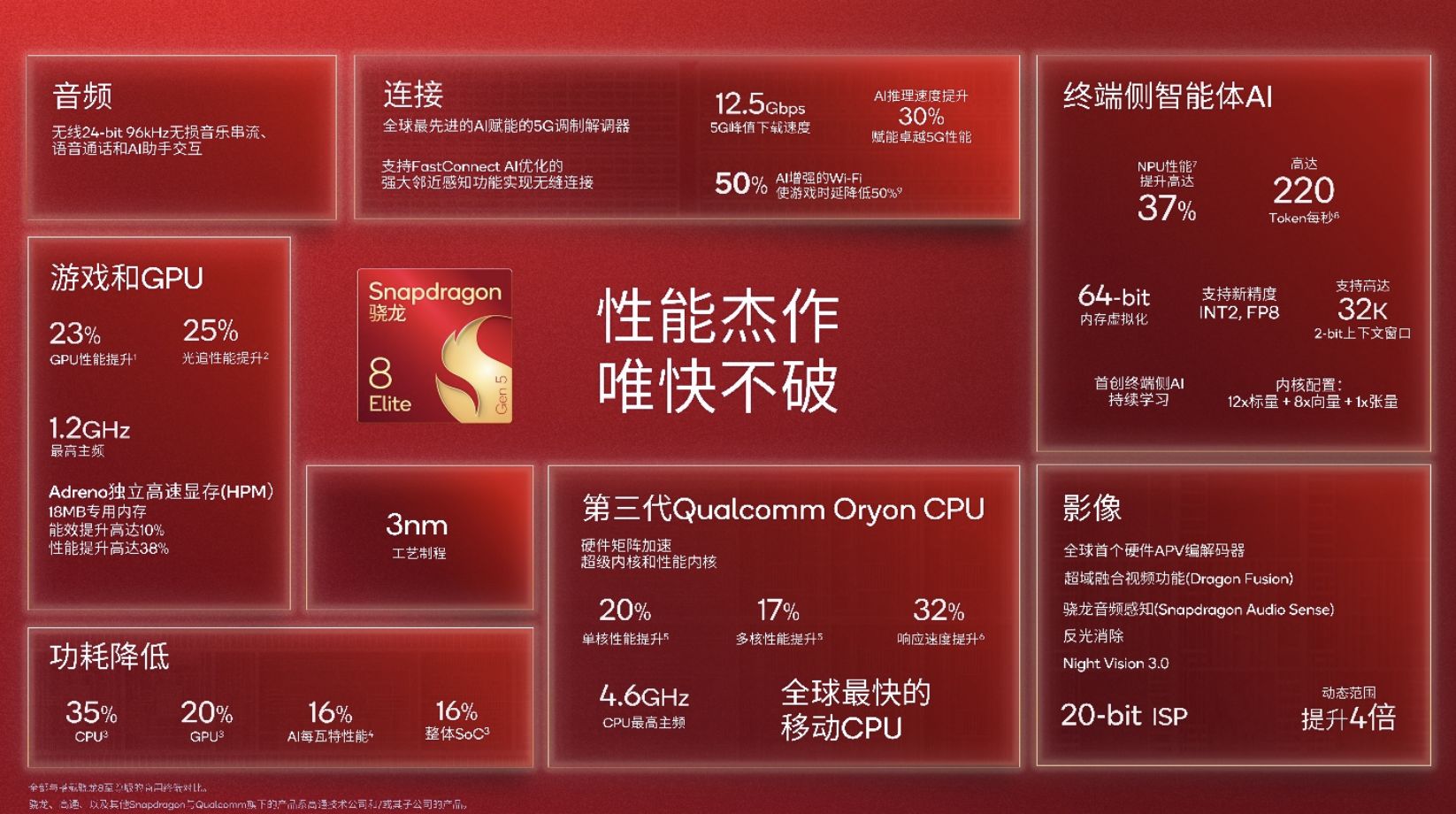
Core Insights - Qualcomm unveiled multiple chipsets at the Snapdragon Summit 2025, with AI capabilities being the main highlight of the new iterations [1][3] - The Snapdragon 8 series mobile platform features a 20% increase in CPU performance and a 23% enhancement in GPU graphics performance, making it the fastest in its category [1] - The Snapdragon X2 Elite Extreme processor integrates the third-generation CPU, offering up to 75% better performance than competitors at the same power consumption [3] AI Capabilities - The Snapdragon 8 series supports personalized AI assistants that provide customized operations across applications through continuous learning and real-time perception [1] - The NPU performance has improved by 37%, enabling advanced AI functionalities [1] Product Launches - Snapdragon X2 Elite is expected to launch in the first half of 2026, with a 31% performance increase at the same power consumption compared to previous models [3] - The GPU architecture of the Snapdragon X2 Elite Extreme shows a 2.3 times improvement in performance per watt compared to its predecessor [3] Industry Trends - Qualcomm's CEO highlighted six core trends in the AI industry, emphasizing a shift towards user-centric interfaces and the importance of AI agents in redefining user experiences across various smart devices [5][7] - A new computing architecture is necessary to support the transition to AI-driven experiences, requiring redesigns of operating systems, software, and chips [7] - The future of AI will involve seamless collaboration between edge and cloud processing, enhancing the capabilities of AI models through edge data training [7] Future Developments - The development of 6G technology is underway, expected to bridge the gap between cloud and edge computing, with pre-commercial terminals anticipated as early as 2028 [7]
你的最快安卓芯片发布了!全面为Agent铺路
量子位· 2025-09-25 02:21
Core Insights - Qualcomm has launched the world's fastest Windows PC processor and mobile SoC processor, focusing on AI capabilities for both PCs and smartphones [1][5][27] - The Snapdragon X2 Elite Extreme is designed for high-end PCs, enabling advanced AI experiences and complex data analysis [15][24] - The Snapdragon 8 series mobile platform aims to support personalized AI assistants through continuous learning and real-time perception [1][27] Group 1: AI and Computing Architecture - AI is being positioned as the new user interface, shifting from smartphone-centric to agent-centric computing [6] - A new computing architecture is required to support this transition, with enhanced edge data relevance and mixed model development [6] - 6G technology is expected to bridge the cloud, edge, and terminal connections [6] Group 2: Snapdragon X2 Elite Series - The Snapdragon X2 Elite series utilizes a 3nm process and third-generation Oryon architecture, featuring 12 Prime cores and 6 Performance cores [7] - Compared to the previous generation, CPU efficiency has improved by 31%, and power consumption has decreased by 43% [10] - Peak performance metrics show a 39% increase in single-core CPU performance, 50% in multi-core, 2.3 times in GPU, and 78% in NPU [13] Group 3: Performance Comparisons - The Snapdragon X2 Elite Extreme achieves a 75% performance increase at the same power consumption compared to competitors, which would require an additional 222% energy to match [16][17] - In single-core performance, it leads by 44%, with competitors needing 144% more energy to catch up [20] - In GPU performance, it is 52% faster at the same power consumption, with competitors needing 92% more energy to achieve similar performance [22] Group 4: Snapdragon 8 Gen 2 - The fifth-generation Snapdragon 8 Gen 2 also employs a 3nm process and features a third-generation Oryon architecture [25] - It shows a 20% increase in single-core performance and a 17% increase in multi-core performance, becoming the fastest mobile CPU [27] - The upgraded Adreno GPU offers a 23% improvement in gaming performance and a 25% increase in ray tracing performance [28] Group 5: Power Efficiency and Features - Overall power consumption has decreased by 16%, with CPU power down by 35% and GPU by 20% [33] - The upgraded ISP supports advanced video encoding and AI enhancements for video processing [33] - The integrated X85 5G Modem-RF system enhances AI-driven WiFi capabilities, reducing gaming latency by 50% [34]

复旦大学窦德景解读中国AI发展:加强场景应用引导 在数据可信领域强化竞争力
Shang Hai Zheng Quan Bao· 2025-09-24 19:46
Core Insights - The discussion emphasizes the necessity for AI technology to be rooted in specific application scenarios to achieve breakthroughs in China [4][8] - The importance of high-quality data and its role in enhancing AI model value is highlighted, along with the challenges of data quality and cost [6][7] Group 1: AI Development and Application - The speaker, a prominent figure in AI, has a rich background in both academia and industry, having published over 250 papers and contributed significantly to AI advancements [3] - The evolution of AI technology is marked by key milestones, such as AlexNet in 2012 and ChatGPT in 2022, which demonstrate the deep integration of technology and application scenarios [4][8] - The speaker advocates for a focus on practical problem-solving in AI, emphasizing that the technology's value must address real-world issues [4][5] Group 2: Key Elements for AI Success - The three essential elements for AI are computing power, algorithms, and data, and their collaborative development is crucial for technological breakthroughs [5] - The concept of "leveraging strengths to compensate for weaknesses" is introduced, suggesting that in resource-limited conditions, optimizing algorithms and improving data quality are vital [5] - A case study illustrates the importance of data quality, where a team improved an AI model's performance through careful data selection and training, highlighting the high cost of achieving data quality [6][7] Group 3: Future Trends and Opportunities - The speaker identifies the need for China to cultivate talent that understands both technology and application scenarios to enhance AI competitiveness [8] - The potential for AI in China is vast, given its diverse application scenarios and significant market demand across various sectors [8][9] - Future trends in AI are expected to evolve from generative AI to intelligent agents and ultimately to physical AI, which will enable deeper collaboration between robots and humans [9]

训推一体机火了,多家上市公司布局!
Zheng Quan Shi Bao Wang· 2025-09-11 03:50
Core Insights - The demand for AI training and inference integrated machines is increasing as AI applications become more prevalent in various industries [1][4][5] - Companies like ZTE and Digital China are experiencing significant sales growth in their AI integrated machine products, indicating a strong market trend [2][7] Market Demand - Nearly 100 manufacturers have launched AI integrated machine products in the domestic market this year, including several listed companies [1][7] - The demand for training and inference integrated machines is driven by the need for private deployment in sectors with sensitive data, such as government and finance [3][8] Industry Applications - The integrated machines are being utilized across 15 industries, including government, education, healthcare, and telecommunications, with notable sales reported [2][7] - Specific applications include AI education tools, medical diagnostic systems, and automotive design solutions, showcasing the versatility of these machines [7] Future Outlook - The market for training and inference integrated machines is expected to grow significantly, with IDC predicting a 260% increase in the intelligent agent market by 2025 [4][5] - The integration of AI capabilities into various business processes is seen as essential for future development, with a focus on personalized solutions for different industries [5][6] Challenges - Companies face challenges in deploying integrated machines due to the complexity of AI ecosystems and the need for deep integration of hardware and software [9][10] - There is a need for improved scalability and cloud management to support the development of AI models and applications [9][10]


AI训推一体机销售火热,上市公司积极抢滩
Zheng Quan Shi Bao· 2025-09-11 01:12
Core Insights - The demand for AI training and inference integrated machines is increasing as AI applications become more prevalent in various industries [1][4][5] - Companies like ZTE and Digital China are experiencing significant sales growth in their integrated training and inference machines [2][7] Market Trends - Nearly 100 manufacturers have launched integrated training and inference machine products in the domestic market this year, including several listed companies [1][7] - The integrated training and inference machine market is expected to grow significantly, driven by the need for AI applications across various sectors such as finance, government, and energy [8][9] Technology Development - The integrated training and inference machines support the entire process of large model training, inference, and application development, catering to the needs of enterprises for ready-to-use solutions [2][3] - The transition from training-focused machines to those that emphasize inference capabilities reflects the evolving landscape of AI technology [2][4] Industry Applications - Key sectors such as finance, government, and energy are showing strong demand for integrated training and inference machines, which are essential for building AI model training and real-time inference capabilities [8][9] - Companies are collaborating with educational institutions and healthcare providers to enhance AI applications in their respective fields [7] Challenges and Considerations - The deployment of integrated training and inference machines faces challenges related to the complexity of the AI ecosystem and the need for deep integration of hardware and software [9][10] - Companies are advised to enhance the scalability of integrated training and inference machines and incorporate cloud management systems to support the full lifecycle of AI model development [9][10]
AI重构保险业:从技术试点到战略重构的破局之道
麦肯锡· 2025-08-29 11:18
Core Viewpoint - The insurance industry is undergoing a significant transformation driven by artificial intelligence (AI), particularly generative AI, which is reshaping workflows and enhancing customer interactions, leading to increased efficiency and personalized services [2][3][4]. Group 1: AI's Impact on the Insurance Industry - AI is fundamentally changing the insurance sector by improving risk identification and providing personalized support during customer crises [3]. - Generative AI's ability to process unstructured data allows for more personalized and human-like interactions, enhancing customer service [3][4]. - The integration of AI into core business functions, such as underwriting, claims processing, and customer service, is accelerating within insurance companies [3][4]. Group 2: Strategic AI Transformation - Successful AI transformation requires a comprehensive strategy that redefines key operational paradigms rather than piecemeal implementations [4]. - Companies must establish a future-oriented AI strategy that integrates technology capabilities into their operational mechanisms [4][5]. - The focus should be on end-to-end process reengineering rather than merely adding AI tools to existing workflows [4][5]. Group 3: AI Deployment and Management - The deployment of AI in insurance is not without challenges, including security risks, high costs, and cultural resistance [6]. - Effective change management is crucial for realizing both financial and non-financial returns from AI investments [6][7]. - Leading insurance companies are already leveraging AI to enhance their market position, with significant shareholder returns compared to their peers [7]. Group 4: Key Initiatives for AI Success - Companies should focus on six key initiatives to maximize AI potential: high-level collaboration, building a digital talent pool, creating scalable operational models, enhancing technology architecture, embedding data capabilities, and increasing resource investment [8][9][10][11][12][13]. - A clear AI transformation roadmap should prioritize business areas with significant optimization potential [14][15]. - The establishment of a robust data platform is essential for supporting AI systems and ensuring data quality and governance [45]. Group 5: Case Studies and Practical Applications - Leading insurance firms have successfully implemented AI in various areas, such as claims processing and sales automation, resulting in significant efficiency gains and cost savings [31][32]. - For instance, Aviva reduced claims assessment time by 23 days and improved accuracy in case assignment by 30% through AI deployment [31]. - Another company saw an increase in online transaction rates to 80% after introducing intelligent tools for customer quotes and policy issuance [31]. Group 6: Future Directions and Challenges - The insurance industry is poised for further transformation as generative AI continues to evolve, enhancing operational efficiency and customer engagement [16][19][22]. - Companies must address existing barriers, such as outdated systems and the need for modern infrastructure, to fully leverage AI capabilities [43][44]. - A culture of innovation and adaptability is necessary for employees to embrace new AI-driven workflows and maximize productivity [46][47].