直播电商

Search documents
抖音电商发布年度报告:超8万新商家直播成交额破百万
Huan Qiu Wang· 2026-01-15 08:56
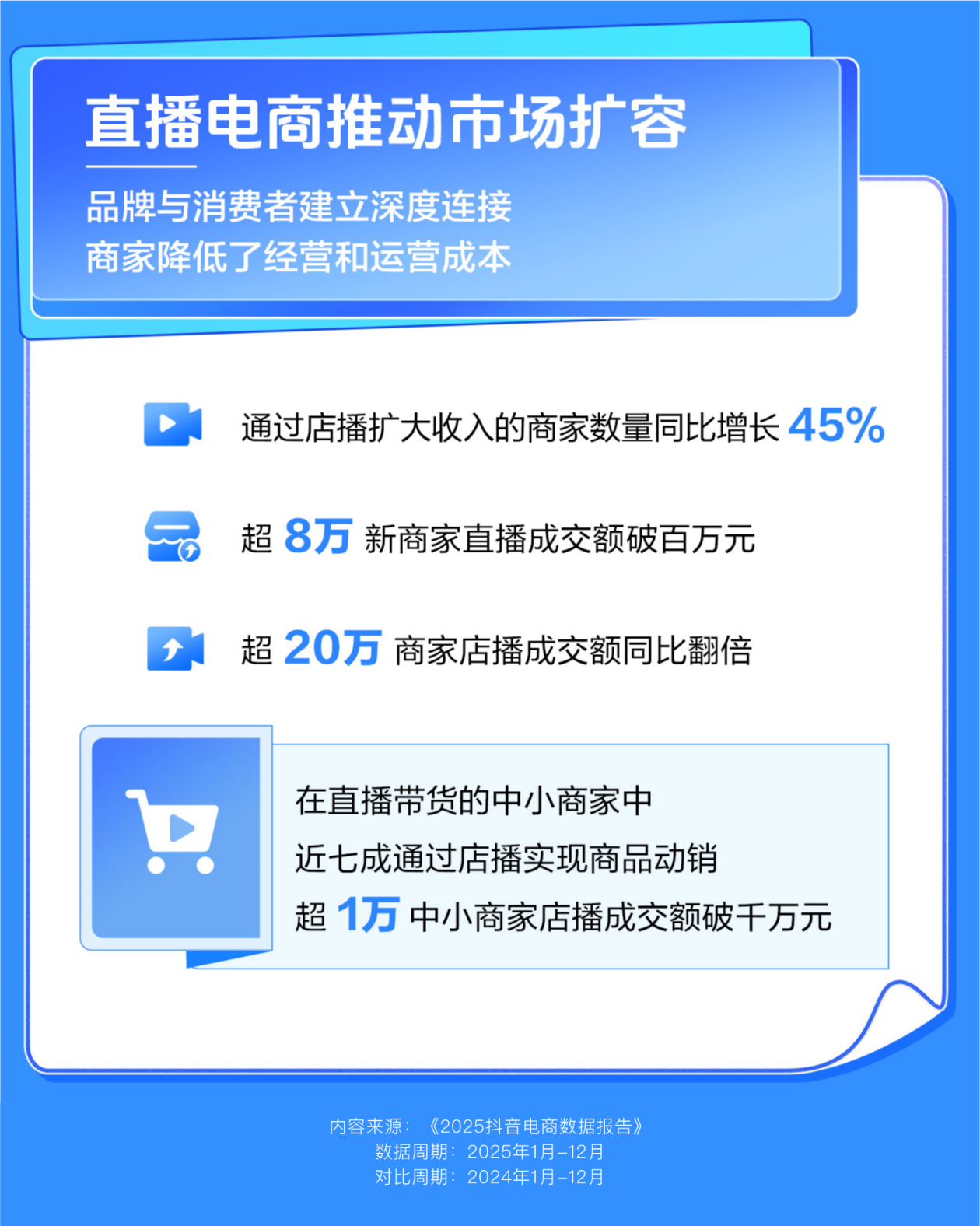
Core Insights - Douyin e-commerce is experiencing steady growth, with a significant increase in transaction volume and the number of new merchants and influencers participating in the platform [1][2][4] Group 1: E-commerce Growth and Merchant Participation - From August 2024 to August 2025, the transaction volume in Douyin's shelf scene increased by 49%, with over 5.36 million new merchants and 5.11 million new influencers earning stable incomes through the platform [1] - The number of merchants achieving revenue growth through live streaming increased by 45% in 2025, with over 80,000 new merchants surpassing 1 million yuan in live streaming sales [2] - Nearly 70% of small and medium-sized merchants participating in live streaming achieved product sales through store broadcasts, with over 10,000 small merchants exceeding 10 million yuan in sales [2] Group 2: Employment and Economic Impact - Live streaming e-commerce is becoming a major source of employment, with over 85% of sales from influencers with fewer than 1 million followers, highlighting their crucial role in the sector's growth [4] - The integration of live streaming e-commerce is expected to enhance the operational conditions for merchants, reduce transaction costs, and allow more small businesses to benefit from technological advancements [4][11] Group 3: Industry and Regional Development - In 2025, Douyin e-commerce facilitated the sale of 18.8 billion units of source goods, with the number of industry merchants engaging in live streaming increasing by 83% [6] - The number of small merchants in industrial belts achieving over 1 million yuan in sales grew by 49%, with nearly 400 industrial belts processing over 10 million orders [6] - In the past year, 491 interest industrial belts achieved over 100 million yuan in sales, with 108 located in county towns contributing approximately one-quarter of the total sales [7] Group 4: Cultural and Agricultural Growth - The number of merchants selling intangible cultural heritage products through live streaming increased by 43%, while sales from time-honored brands rose by 70% [10] - Douyin e-commerce sold over 10.2 billion units of agricultural specialty products from September 2024 to September 2025, with the number of agricultural merchants engaging in live streaming increasing by 51% [10]

网红带货构成商业广告丨南财合规周报(第221期)
2 1 Shi Ji Jing Ji Bao Dao· 2026-01-11 00:11
AI Dynamics - Manus, an AI startup, is under scrutiny from domestic regulators despite relocating its headquarters to Singapore, indicating potential compliance issues related to technology export controls [2][3] - The core technology of Manus may fall under China's export restrictions, raising questions about whether proper declarations were made during its relocation [3] - The acquisition of Manus by Meta for several billion dollars is significant as it represents one of the few instances of a Chinese AI application being fully acquired by a major tech company [2] User Growth in AI - AMD's CEO predicts that the number of active AI users globally will exceed 5 billion within the next five years, highlighting the rapid expansion of AI technology [4] - Since the launch of ChatGPT, the user base has grown from millions to over 1 billion active users, outpacing early internet growth [4] Platform Regulation - The State Administration for Market Regulation and the National Internet Information Office have issued the "Live E-commerce Supervision Management Measures," mandating platforms to establish a blacklist system for non-compliant operators [9][10] - The measures require live e-commerce platforms to implement tiered management based on compliance, user engagement, and transaction volume [9] Food Delivery Market Investigation - The State Council's Anti-Monopoly and Anti-Unfair Competition Committee is conducting an investigation into the competitive landscape of the food delivery service industry due to concerns over aggressive subsidy practices and market pressure [13][14] - The investigation aims to assess the competitive behavior of food delivery platforms and gather feedback from various stakeholders, including operators and consumers [13]
2025快手电商生鲜食品行业“有食力·敢当鲜”年度荣誉盛典举行
Sou Hu Wang· 2026-01-09 01:58
Core Insights - The annual honor ceremony "You Shili·Gan Dang Xian" for Kuaishou e-commerce in the fresh food industry was held, recognizing merchants and streamers for their achievements and growth strategies over the past year, while also outlining growth directions for the upcoming year in live-streaming e-commerce [1][3] Group 1: Industry Overview - Fresh food is a critical sector in live-streaming e-commerce, closely related to daily life and testing supply and service capabilities [3] - For merchants, stable supply and fulfillment experience are key to long-term reputation, while for streamers, continuous content output and trust management are essential for customer retention [3] Group 2: Marketing and Growth Strategies - Kuaishou's fresh food industry head emphasized that short videos serve as a pre-traffic tool for live-streaming e-commerce, creating a closed loop of "content traffic—live conversion—fan retention—repeat purchase" [4] - Recommendations for streamers and merchants include increasing the quantity and quality of short video content, utilizing platform tools like "Lucky Red Packet" and "Good Fortune" to enhance interaction and conversion efficiency [6][7] Group 3: Seasonal Promotions - The upcoming New Year Festival is a significant sales peak for the fresh food industry, with Kuaishou focusing on local specialty products and high-demand items to meet consumer needs [8] - The festival will feature a pre-sale period from January 5 to January 14, followed by the official sales period from January 15 to February 3, with concentrated subsidies and resource support for popular products [8] Group 4: Exemplary Practices - The ceremony awarded several brands and streamers, including Yili and Three Squirrels, for their outstanding performance in the fresh food sector [9][12] - Case studies highlighted successful operators like Li Dairui in the seafood sector and Xiaoyu in the fruit sector, showcasing their effective content creation and stable supply capabilities, leading to significant sales growth [14][15]


扩大免佣范围、缩短账期,抖音电商发布2026年扶持方案
Guan Cha Zhe Wang· 2026-01-08 10:34
Group 1 - The core viewpoint of the article is that Douyin E-commerce has launched an upgraded plan for its "Nine Merchant Support Policies" aimed at reducing operational costs and enhancing efficiency for merchants, thereby supporting their long-term development [1][2] - The new policies address key concerns of merchants, including comprehensive cost pressure, traffic acquisition and conversion efficiency, transaction uncertainty, and operational efficiency [1][2] - Over the past year, Douyin E-commerce has saved merchants over 32 billion yuan through various initiatives such as commission waivers and support funds for small businesses [1] Group 2 - The platform will expand its commission-free policy to all categories, reducing technical service fees for orders generated by the "Qianchuan·Chengfang" product to 0.6% [1] - Douyin E-commerce will enhance its AI capabilities to help merchants reduce labor costs and improve response efficiency, including free AI customer service and dynamic AIGC creative capabilities [1][2] - A cash incentive program will be launched to promote high-value content production, with 3.67 million creators participating by the end of 2025 [2] Group 3 - The platform will implement a 10 billion yuan coupon subsidy plan and introduce a "dual commission" feature to lower overall costs for merchants [2] - Douyin E-commerce will prioritize support for merchants with high settlement rates, fast shipping, and good service experiences, while also optimizing advertising and recommendation logic [2] - The platform will provide differentiated support for various merchants, including financial and service support for small and medium-sized businesses and optimizing payment terms [2][3]

抖音电商升级九大商家扶持政策 2025年累计为商家节省成本超320亿元
Sou Hu Cai Jing· 2026-01-08 08:27
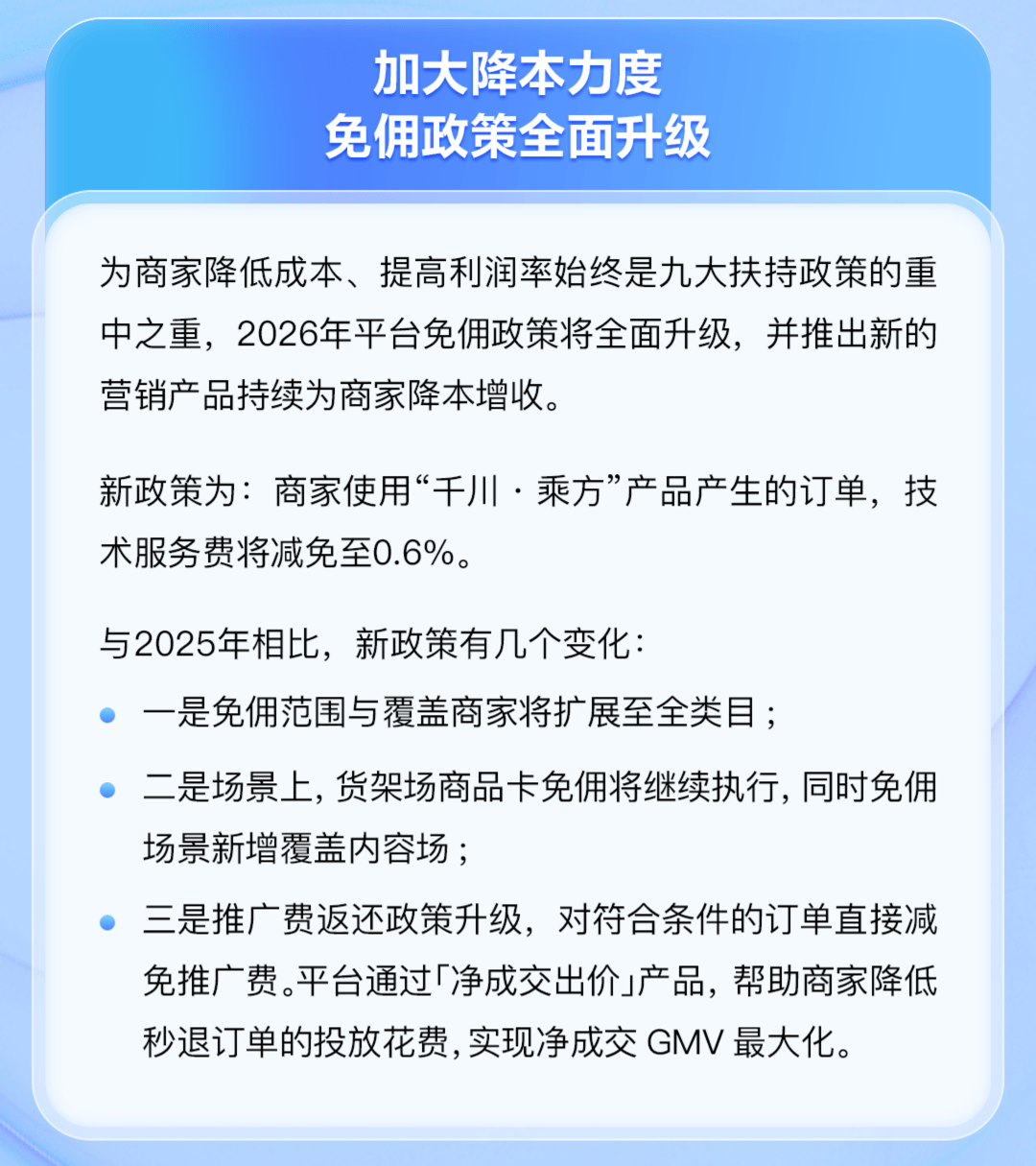
Core Insights - Douyin E-commerce announced an upgrade to its "Nine Merchant Support Policies" for 2026, focusing on enhancing long-term certainty for merchants by increasing investment across various operational aspects [1] - The platform aims to address common merchant concerns such as cost pressure, traffic acquisition, conversion efficiency, and operational efficiency through systematic upgrades [1] Group 1: Cost Reduction and Efficiency Improvement - The upgraded support plan emphasizes reducing merchant operating costs, with a new commission exemption policy that lowers technical service fees to 0.6% for orders generated using the "Qianchuan·Chengfang" product [2] - The exemption range has been expanded to cover all categories, and promotional fee refund policies have been optimized to enhance return on investment [2] - The platform will also provide a large number of materials to help merchants save on production costs [5] Group 2: Traffic Distribution and Transaction Mechanism - The platform will optimize algorithms and distribution mechanisms to direct traffic towards high-quality content and efficient supply [6] - A cash incentive and growth support program will be upgraded to encourage the continuous production of high-value content, with 3.67 million creators participating in the "Grass Planting Incentive Program" by the end of 2025 [6] - A 10 billion yuan coupon subsidy plan will be launched to lower overall operating costs for merchants and stabilize revenue expectations [6] Group 3: Transaction Certainty and Risk Management - The platform will enhance transaction certainty by supporting merchants with high settlement rates and fast shipping, while also improving the identification and removal of abnormal and high-risk orders [8] - Advertising and recommendation logic will be optimized to improve product and user demand matching, and a return diagnosis tool will be developed to help merchants analyze return reasons [8] Group 4: Fair Business Environment and Support for Different Merchant Stages - Douyin E-commerce will strengthen intellectual property protection and market order governance, including measures to combat false advertising and counterfeit goods [10] - Differentiated support arrangements will be provided for merchants at various development stages, including financial, traffic, and service support for small and medium-sized merchants [10] - The platform will also reduce the minimum payment period to three days after order confirmation to alleviate cash flow pressure for merchants [10] Group 5: Industry Context and Future Outlook - The platform will continue to listen to merchant feedback to improve communication and service mechanisms, promoting stable growth for good products, content, and services [12] - The integration of live-streaming e-commerce is highlighted as a significant growth area, with the potential to improve merchant operations and lower transaction costs [12]
扩大免佣范围、缩短账期、开放AI技术 抖音电商2026年再出扶持新方案
Huan Qiu Wang· 2026-01-08 07:15
Core Viewpoint - Douyin E-commerce has announced an upgraded plan for its "Nine Merchant Support Policies" for 2026, focusing on enhancing long-term certainty for merchants by systematically upgrading various aspects of their operations, including costs, traffic, conversion, fulfillment, technology, and governance [1] Group 1: Cost Reduction and Efficiency Improvement - The platform aims to lower merchant operating costs by upgrading its commission-free policies, reducing technical service fees to 0.6% for orders generated using the "Qianchuan·Chengfang" product [1] - The commission-free scope has been expanded to all categories, and promotional fee refund policies have been optimized to directly reduce promotional fees for eligible orders [1] - The platform will also implement measures to lower costs associated with ineffective advertising, enhancing the return on investment for merchants [1] Group 2: AI Technology Integration - Douyin E-commerce will continue to provide merchants with AI capabilities to enhance customer service, content production, and business decision-making [3] - Free AI smart customer service will help reduce labor costs and improve response efficiency, while dynamic AIGC creative capabilities can generate 1 to 2 million pieces of content daily, significantly saving production costs for merchants [3] Group 3: Traffic Acquisition and Conversion Efficiency - The platform will optimize algorithms and distribution mechanisms to direct traffic towards high-quality content and efficient supply [5] - The "Grass Planting Incentive Program" will be upgraded to encourage the production of high-value content, with cash incentives and support for creators [5] - A 10 billion yuan coupon subsidy plan will be launched to further enhance conversion rates and stabilize merchant revenue expectations [5] Group 4: Transaction Certainty Enhancement - The platform will focus on improving transaction certainty by supporting merchants with high settlement rates and fast shipping, while identifying and eliminating high-risk orders [7] - Advertising and recommendation logic will be optimized to better match products with user needs, and a return diagnosis tool will be developed to help merchants analyze return reasons [7] Group 5: Fair Business Environment and Differentiated Support - Douyin E-commerce will strengthen intellectual property protection and market order governance, implementing measures to combat false advertising and counterfeit goods [9] - The platform will provide differentiated support for merchants at various development stages, including financial, traffic, and service support for small and medium-sized businesses [9] - The platform will also reduce the minimum payment period to three days post-order confirmation to alleviate cash flow pressures for merchants [9] Group 6: Industry Insights - Industry experts note that the measures introduced by Douyin E-commerce, if effectively implemented, could improve merchant operating conditions and lower transaction costs, allowing more small and medium-sized businesses to benefit from the growth of live commerce [11]
“网红第一大楼”为何冷清了? 杭州直播电商产业在重构中新生
Zheng Quan Shi Bao· 2026-01-07 22:28
Core Viewpoint - The decline in rental prices and the reduction of tenants in the Regin International Center in Hangzhou, a symbol of the live-streaming economy, does not indicate the retreat of the live-streaming e-commerce industry but rather a transition from rapid growth to refined operations [1][3]. Industry Transition - The live-streaming e-commerce industry is moving from a phase of "barbaric growth" to a stage of "mature differentiation," driven by increased competition, stricter regulations, and the need for professionalization [3][4]. - The industry is experiencing a shift from a focus on traffic acquisition to refined operations, emphasizing efficiency and sustainability [5][6]. Market Dynamics - The rental prices in the Regin International Center have decreased by 500 to 1000 yuan per month, reflecting normal market adjustments rather than a decline in the industry [2][3]. - The number of businesses related to live-streaming in the Regin International Center has decreased, with only 25% of the tenants being involved in live-streaming-related activities [2]. Growth Projections - The live-streaming e-commerce market in China is projected to reach a transaction scale of 5.33 trillion yuan in 2024, with a year-on-year growth of 8.31%, and is expected to increase to 5.6 trillion yuan in 2025 [4]. Technological Advancements - The integration of AI and new technologies is becoming crucial in various aspects of the live-streaming e-commerce industry, including product selection, efficiency optimization, and content creation [5][6]. - Companies are investing heavily in technology to enhance operational efficiency, with some institutions developing comprehensive live-streaming service platforms [6]. Competitive Landscape - Hangzhou remains a vital hub for live-streaming e-commerce, housing the largest number of MCN institutions and live-streaming practitioners in China, which contributes to its unmatched industry concentration [7][8]. - The city has a complete ecosystem for live-streaming e-commerce, including upstream supply chains, midstream live-streaming institutions, and downstream e-commerce platforms [9]. Talent and Resource Availability - The availability of abundant resources and skilled personnel in Hangzhou continues to attract live-streaming e-commerce professionals, reinforcing the city's position as a leading center for the industry [7][8].
杭州互联网推广公司排名2025年全网评测及行业分析
Sou Hu Cai Jing· 2026-01-07 20:19
Core Insights - The internet promotion has become a core engine for business growth in the digital age, with Hangzhou, known as the "e-commerce capital," rapidly reconstructing its internet service ecosystem by 2025 [1][3] - The internet promotion service market in Hangzhou is expected to exceed 10 billion by 2025, with a compound annual growth rate of over 18%, driven by emerging sectors like live e-commerce and metaverse marketing [3][4] Industry Trends - The industry is witnessing a vibrant competition among tech companies, with notable innovations such as a content generation system that produces thousands of creative materials in real-time based on user profiles and a customer churn prediction model with an accuracy rate of 92% [3][4] - The rise of small and medium enterprises in niche markets is notable, with companies developing smart product selection tools that triple customer ROI and utilizing VR technology to enhance online experiences in the hospitality sector [4] - The commercialization of AI-generated content technology is a key trend, with systems capable of live streaming in 12 dialects and emotional computing algorithms improving advertising empathy by 60% [4] Compliance and Regulation - Compliance has become a central theme in 2025, with the implementation of personal information protection laws prompting thorough industry self-assessments [5] - Companies that have turned compliance into a competitive advantage, such as those with ISO27701 certified data governance solutions, are better positioned to attract financial clients [5] Talent Acquisition - The competition for talent is intensifying, with composite talents skilled in data analysis and creative thinking commanding annual salaries exceeding 800,000 [6] - Companies are restructuring their training systems to cultivate talent, exemplified by initiatives like the "digital craftsman" program that has led to several projects generating tens of millions in revenue [6] Market Evolution - The internet promotion industry in Hangzhou has transformed from being mere "tool providers" to becoming "business partners," emphasizing the integration of technological innovation with humanistic care [6]

直播电商带动乡村共富
Jing Ji Ri Bao· 2026-01-03 22:09
Core Insights - The "Golden Shoulder" cooperative live-streaming project in Qingdao's Xihai'an New District is successfully promoting rural e-commerce and helping farmers sell their products through live broadcasts [1][2][3] - The initiative has led to the establishment of a rural live-streaming e-commerce association, aiming to standardize and professionalize the industry while enhancing logistics and distribution [2][3] Group 1: Project Overview - The "Golden Shoulder" live-streaming project has conducted over 1,200 live broadcasts and trained more than 3,600 participants, successfully marketing over 50 types of local agricultural products nationwide [1] - The project has revitalized idle rural properties and attracted 12 professionals in the live-streaming e-commerce field to support its development [1] Group 2: Future Plans and Developments - The newly formed rural live-streaming e-commerce association will focus on resource integration, platform development, and standardization to guide the industry towards a more organized and professional direction [2] - Future initiatives include exploring a "cloud warehouse" logistics model and establishing a regional agricultural product distribution center to improve rural logistics [2][3] - The project aims to implement diverse models such as "live-streaming + cultural tourism" and "live-streaming + educational experiences" to enhance local employment and increase collective and individual incomes by over 3 million yuan annually [2]
张勇:服装电商20年大浪淘沙,我还在|我们的四分之一世纪
经济观察报· 2026-01-01 07:08
Core Viewpoint - The article highlights the journey of Zhang Yong and his company, Xiaohan Pavilion, from humble beginnings in e-commerce to becoming a significant player in the fashion industry, emphasizing the importance of perseverance, adaptability, and customer focus in achieving success [2][3][20]. Company Development - Zhang Yong started Xiaohan Pavilion in a small room in Baoshan, Shanghai, using basic resources to sell clothes online, which has now grown to achieve annual sales of several billion yuan and employs over 800 people [2][3]. - The company is preparing for its anniversary celebration and moving to a new headquarters, reflecting its growth and commitment to providing a good working environment for employees [4]. Early Challenges - In the early days, Zhang faced significant challenges, including limited resources and the need to learn various skills, such as photography and customer service, to run the business effectively [6][7]. - The first order came from a customer in Hubei, marking the beginning of a journey filled with learning and adaptation [8]. Key Milestones - A major turning point occurred during the 2013 Double Eleven shopping festival, where Xiaohan Pavilion achieved over ten million yuan in sales in a single day, leading to a doubling of sales the following year [9]. - The company faced cash flow challenges due to rapid growth, prompting Zhang to negotiate with suppliers for better terms [9]. Supply Chain and Logistics - Zhang recognized the importance of a robust supply chain after experiencing a stock shortage, leading to the establishment of an office in Shenzhen to access better resources [9]. - The decision to use high-quality logistics services, such as SF Express, despite higher costs, resulted in improved customer satisfaction and reduced return rates [12]. Management Philosophy - Zhang's management style is characterized by a cautious yet determined approach, focusing on product quality and customer experience rather than aggressive expansion [10][20]. - The company has adopted a specialized approach to product development, allowing for faster innovation and a higher volume of new product launches [14][15]. Market Adaptation - Despite the rise of live-streaming e-commerce, Xiaohan Pavilion did not fully embrace this trend initially, focusing instead on maintaining product quality and customer relationships [19]. - The company is now expanding its presence on platforms like Douyin while continuing to strengthen its core business on Taobao [19][20]. Future Plans - Looking ahead, Xiaohan Pavilion plans to diversify its product lines by introducing men's and children's clothing, building on its established supply chain [20].