资本市场制度型开放

Search documents
合格境外投资者昨起可参与ETF期权交易 可投资品种范围持续拓宽 目前可参与境内期货期权品种已达104个
Zheng Quan Ri Bao· 2025-10-09 16:23
Core Viewpoint - The announcement by the China Securities Regulatory Commission (CSRC) allows qualified foreign institutional investors (QFII) and renminbi qualified foreign institutional investors (RQFII) to participate in on-exchange ETF options trading starting from October 9, enhancing their risk management capabilities and potentially increasing long-term investments in A-shares [1][3]. Group 1: Expansion of Investment Opportunities - The range of investment products available to qualified foreign investors has been continuously expanded throughout the year, with a total of 104 futures and options products now accessible [2][4]. - As of September 30, qualified foreign investors can trade 95 futures and options products, including 88 commodity futures options and 7 stock index futures options [2]. Group 2: Impact on Market Confidence - The inclusion of ETF options is expected to provide foreign investors with suitable risk management tools, thereby enhancing investment stability and promoting long-term allocation [3]. - The ongoing optimization of the qualified foreign investor system is seen as a significant step towards increasing foreign confidence in the A-share market [3]. Group 3: Institutional Growth and Market Participation - The number of qualified foreign investors has rapidly increased, with 907 institutions qualifying by the end of August, covering various types such as sovereign funds, pension funds, and asset management firms [4]. - Qualified foreign investors have become a crucial participant in the A-share market, holding a total of 949.3 billion yuan in A-shares as of August [4]. Group 4: Future Developments - The CSRC plans to introduce more reforms to further optimize the qualified foreign investor system, enhancing access and operational arrangements [5]. - Future improvements may include expanding investment categories, optimizing trading mechanisms, and enhancing cross-border regulatory cooperation to create a more attractive investment environment [6].
合格境外投资者昨起可参与ETF期权交易
Zheng Quan Ri Bao· 2025-10-09 16:05
Core Viewpoint - The scope of investment for Qualified Foreign Institutional Investors (QFII) and Renminbi Qualified Foreign Institutional Investors (RQFII) continues to expand, with the number of tradable futures and options in the domestic market reaching 104 as of October 9, 2023 [1][2][3] Group 1: Expansion of Investment Products - As of October 9, 2023, QFII and RQFII can participate in trading of 9 new ETF options, bringing the total to 104 tradable futures and options [1][2] - In 2023, the Shanghai Futures Exchange and other exchanges have opened a total of 49 new commodity futures and options products to QFII, enhancing the variety of investment options available [2][4] Group 2: Impact on Foreign Investment Confidence - The introduction of ETF options is expected to provide foreign investors with effective risk management tools, thereby enhancing investment stability and promoting long-term allocation in the A-share market [3][4] - The ongoing optimization of the QFII system is seen as a significant step towards increasing foreign confidence in the A-share market [3][4] Group 3: Growth of Qualified Foreign Institutional Investors - By the end of August 2023, there were 907 foreign institutions qualified as QFII, covering a wide range of types including sovereign funds, international organizations, and asset management firms [4][5] - The total investment by QFII in A-shares reached 949.3 billion yuan by the end of August 2023, indicating their growing importance in the market [4][5] Group 4: Future Developments - The China Securities Regulatory Commission (CSRC) plans to introduce more reforms to further optimize the QFII system, aiming to enhance market accessibility and align with international standards [5][6] - Future improvements may include expanding the range of investment products, enhancing transaction mechanisms, and providing clearer tax incentives for foreign investors [5][6]
管涛:低利率时代更加呼唤资本市场高质量发展
Di Yi Cai Jing· 2025-10-01 02:38
Group 1: Monetary Policy and Economic Transformation - Current monetary policy in China is supportive with major interest rates at historical lows, expected to persist for some time [1] - Monetary tightening can curb inflation, but monetary easing is less effective in addressing price stagnation, which often requires structural policies [2] - The imbalance in China's financing structure, characterized by high debt and low equity, necessitates an increase in direct financing, particularly equity financing [2][3] Group 2: Capital Market Development - The capital market plays a crucial role in promoting a virtuous cycle among industry, technology, and capital, essential for both emerging and traditional industries [3] - Recent policies, such as the "New National Nine Articles" and the "1+N" policy framework, aim to enhance the quality of listed companies and encourage long-term investments [4] - The low proportion of stocks in household wealth limits the wealth effect from monetary easing, highlighting the need for a more balanced financial market structure [5] Group 3: Financial System Resilience - The current issues of "reluctance to lend" from enterprises and "caution in lending" from banks are not unique to China and require a diversified financing structure [6] - Developing direct financing options, including stocks and bonds, is essential for enhancing the resilience of the financial system and improving monetary policy transmission [6] Group 4: Financial Power and Internationalization - The construction of a financial powerhouse is crucial for economic strength, with a strong currency being a key element [6] - The internationalization of the Renminbi is a significant goal, requiring high-level financial openness and capital market reforms [7] - Institutional openness should align domestic regulations with international standards to better support cross-border investments [7]
又一家外资券商,获证监会核准设立
Zhong Guo Zheng Quan Bao· 2025-09-30 16:18
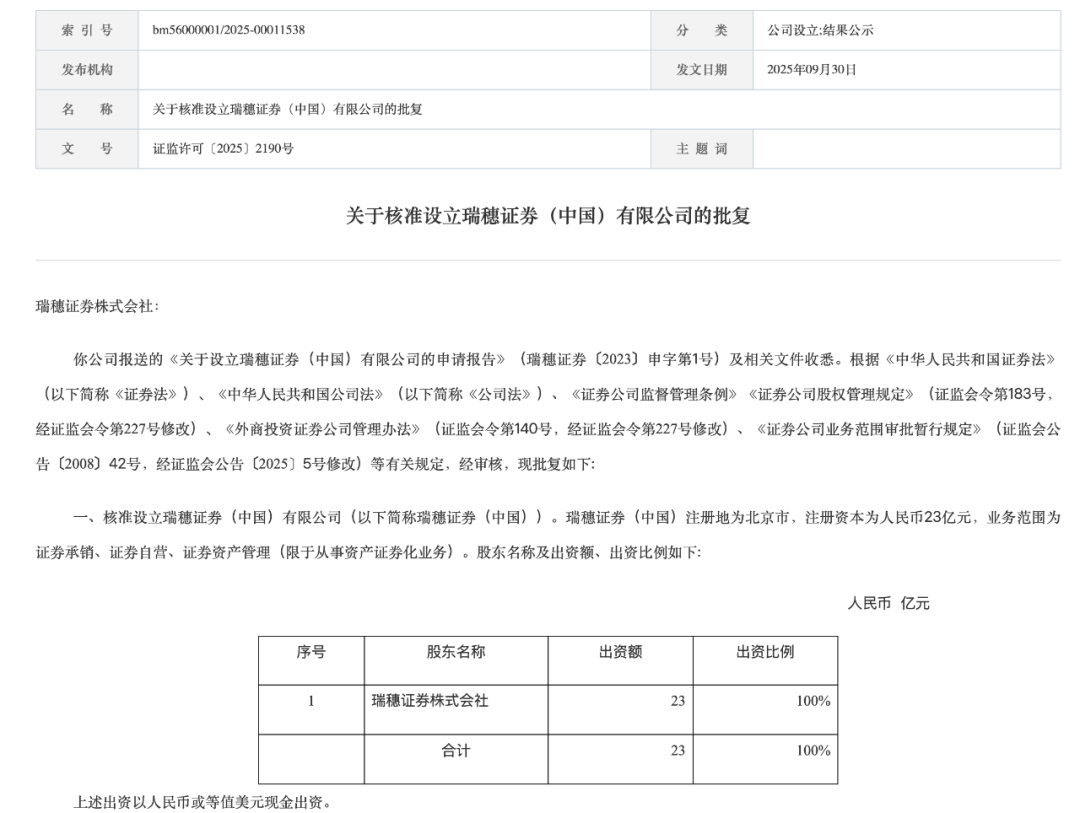
Group 1 - The core viewpoint of the article is that foreign securities firms are accelerating their entry into the Chinese market, with Mizuho Securities being a recent example of this trend [10][13]. - Mizuho Securities (China) Co., Ltd. has been approved by the China Securities Regulatory Commission (CSRC) with a registered capital of RMB 2.3 billion, fully funded by Mizuho Securities Co., Ltd. [7][5]. - The business scope of Mizuho Securities (China) includes securities underwriting, proprietary trading, and asset management, specifically in asset securitization [7][8]. Group 2 - The establishment of Mizuho Securities (China) must be completed within six months of the approval, and it must apply for a business license within 15 days of obtaining its operating license [8]. - The rapid expansion of foreign securities firms in China is supported by ongoing policy reforms aimed at enhancing the attractiveness and competitiveness of the capital market [13][14]. - Market participants expect that the next steps in capital market reforms will focus on deeper and broader institutional openings, enhancing connectivity, and strengthening risk prevention measures [14].

又一家外资券商 获证监会核准设立
Zhong Guo Zheng Quan Bao· 2025-09-30 15:45
Core Viewpoint - Foreign securities firms are accelerating their entry into the Chinese market, with Mizuho Securities (China) Co., Ltd. recently approved for establishment by the China Securities Regulatory Commission (CSRC) [2][11]. Company Establishment - The CSRC approved the establishment of Mizuho Securities (China) Co., Ltd. on September 30, 2025, with a registered capital of RMB 2.3 billion [3][7]. - Mizuho Securities Co., Ltd. holds a 100% stake in the new entity [6][7]. - Mizuho Securities (China) must complete its business registration within six months of the approval and apply for a securities and futures business license within 15 days of obtaining its business license [7]. Market Trends - There has been a notable increase in foreign securities firms establishing or expanding their operations in China this year, including firms like UBS and others [8][9]. - The trend reflects a broader policy push from the Chinese government to enhance the attractiveness and competitiveness of its capital markets [11]. Regulatory Environment - The CSRC emphasizes compliance with laws such as the Cybersecurity Law and the Securities Law, focusing on the protection of investor rights and the security of important information systems [7]. - The CSRC is expected to implement further measures to enhance cross-border investment and financing convenience, which may attract more global capital to China [11].
四大证券报精华摘要:9月26日
Zhong Guo Jin Rong Xin Xi Wang· 2025-09-26 00:20
Group 1 - The Chinese capital market is expanding its "circle of friends," with the approval of 13 foreign-controlled securities and fund institutions to operate in China, and foreign ownership of A-shares reaching 3.4 trillion yuan [5] - The People's Bank of China has launched the Digital Renminbi International Operation Center, which will facilitate cross-border digital payments and blockchain services, marking a significant step in the internationalization of the digital yuan [3] - The A-share market is experiencing a recovery, with institutional investors showing a clear trend of increasing their holdings in both active and passive equity funds, resulting in a 541 billion yuan increase in assets by mid-year [1] Group 2 - The A-share market is expected to continue its upward trend in the fourth quarter, with brokerages maintaining a positive outlook and identifying various thematic investment opportunities [2] - The balance of margin trading has reached a historical high of 2.43 trillion yuan, indicating confidence in the market's future and intensifying competition among brokerages [4] - Xiaomi has launched its flagship Xiaomi 17 series, aiming to compete directly with the iPhone, reflecting the trend of high-end product development in the smartphone market [3] Group 3 - The Hong Kong stock market has seen a significant increase in new listings, with 65 new stocks raising approximately 1560.32 million HKD this year, and expectations for continued growth in IPOs [9] - The public fund management industry in China has reached a record high of 36.25 trillion yuan in assets under management, reflecting a robust growth trend in the sector [9] - JD.com is heavily investing in artificial intelligence, aiming to create a trillion-yuan AI ecosystem and enhance its supply chain capabilities through technological advancements [10]
制度型开放稳步扩大 中国资本市场吸引力增强
Zhong Guo Zheng Quan Bao· 2025-09-25 22:11
Core Insights - The Chinese capital market is entering a new phase of high-level dual openness during the "14th Five-Year Plan" period, with significant growth in foreign investment and an increase in the number of foreign-controlled securities and futures companies [1][2][3] Group 1: "Bringing In" Initiatives - The China Securities Regulatory Commission (CSRC) has approved 13 new foreign-controlled securities and futures companies, reflecting a steady increase in foreign investment [1][3] - The number of Qualified Foreign Institutional Investors (QFII) has rapidly increased, with 907 foreign institutions obtaining QFII status and holding a total of 949.3 billion yuan [1][2] - Northbound capital has shown a continuous net inflow, with total holdings reaching 2.29 trillion yuan by the end of Q2, an increase of over 2% from the previous quarter [1] Group 2: "Going Out" Developments - A total of 269 Chinese enterprises have listed overseas during the "14th Five-Year Plan" period, with A-share companies generating 4.90 trillion yuan in overseas revenue in the first half of the year, a year-on-year increase of 4.5% [2][4] - The regulatory framework for overseas listings has been improved, facilitating the process for companies to raise funds abroad [4] - The introduction of the depositary receipt mechanism has expanded financing channels for Chinese companies in international markets [4] Group 3: Policy Measures - A series of targeted policy measures have been implemented to enhance the convenience of foreign investment and provide institutional guarantees for dual openness [2][5] - The CSRC has introduced key measures to eliminate foreign ownership limits in various sectors and improve the QFII system, aiming to allow global investors to better share in China's development opportunities [3][5] - The recent opening of ETF options trading for qualified foreign investors is expected to enhance risk management for long-term foreign capital [5] Group 4: Future Outlook - Market participants anticipate that the next steps in capital market institutional openness will focus on enhancing connectivity and strengthening risk prevention measures [5][6] - The Hong Kong Stock Exchange plans to optimize connectivity mechanisms and expand the range of investment products to further facilitate cross-border capital flows [5]
资本市场高水平制度型开放稳步扩大
Zheng Quan Ri Bao· 2025-09-23 16:43
Group 1 - The core viewpoint is that China's capital market is steadily expanding its high-level institutional openness, supported by concrete measures and data [1] - During the 14th Five-Year Plan, the foreign ownership limit for industry institutions has been fully lifted, and the Qualified Foreign Institutional Investor (QFII) system has been improved [1][5] - As of now, foreign capital holds a market value of 3.4 trillion yuan in A-shares, with 269 companies listed overseas [1][5] Group 2 - Foreign institutional investment in China's capital market is showing resilience, with QFII holding shares in 1,145 A-share companies, totaling a market value of 143.464 billion yuan, an increase of 21.290 billion yuan from the previous quarter [2] - The potential for growth in foreign institutional holdings is significant, with estimates suggesting a possible inflow of $20 billion if holdings return to 2021 peak levels [2] - Foreign investment is diversifying, covering over 1,100 listed companies, with the top five sectors being finance, information technology, industrials, materials, and consumer discretionary [2] Group 3 - The Chinese stock market has performed well this year, driven by improved corporate fundamentals, with MSCI China Index showing stable earnings and upward revisions in sectors like internet, technology, pharmaceuticals, and automotive [3] - The bond market in China, exceeding one trillion yuan, is becoming increasingly attractive to foreign investors, with a custody balance of 4.0 trillion yuan held by foreign institutions [3] - As of August 2023, 907 foreign institutions have obtained QFII qualifications, with 47 institutions approved in the first eight months of the year [3] Group 4 - The plan includes enhancing the role of long-term funds as stabilizers, improving cross-border investment and financing convenience, and attracting more global capital to invest in China [4] - China's capital market is actively participating in international rule-making, aligning domestic markets with international standards [5] Group 5 - Since the implementation of the new regulations in March 2023, 269 companies have successfully listed overseas, enhancing the visibility and influence of Chinese enterprises globally [6] - Chinese securities firms and fund companies are accelerating their international expansion, supported by mechanisms like fund recognition and cross-border financial services [6] - A-share companies achieved overseas revenue of 4.90 trillion yuan in the first half of the year, a year-on-year increase of 4.50%, marking a continuous rise in the proportion of overseas income [6] Group 6 - Future reforms are expected to deepen the openness of China's capital market, with suggestions to expand stock connect programs and enhance cross-border financial products [7] - Recommendations include increasing the transparency and predictability of domestic policies to encourage more foreign investment in China [7]
上交所:持续打造便利友好的跨境投融资环境
Zheng Quan Shi Bao Wang· 2025-09-05 11:52
Core Viewpoint - The Shanghai Stock Exchange (SSE) and the Singapore Exchange (SGX) are enhancing their collaboration to create new opportunities in the capital markets, focusing on the development of cross-border investment products and facilitating the international expansion of Chinese companies [1] Group 1: Collaboration and Achievements - The SSE and SGX have strengthened their cooperation, resulting in the successful launch of five ETF mutual products that are now trading on both exchanges [1] - The joint development of the China Securities Index SGX Asian Emerging Markets Technology Index was officially released in January 2024, marking a significant milestone in the index collaboration project between the two exchanges [1] Group 2: Future Directions - The SSE emphasized that the internationalization of Chinese companies aligns with the country's institutional opening-up, promoting Chinese standards and narratives globally [1] - The SSE plans to continue developing the ETF mutual mechanism and create a favorable cross-border investment environment under the guidance of the China Securities Regulatory Commission, aiming to support high-quality economic development [1]
加快推进中国资本市场高水平制度型开放|资本市场
清华金融评论· 2025-09-03 10:18
Core Viewpoint - Accelerating the high-level institutional opening of China's capital market is essential for achieving high-quality development, emphasizing that "post-border rules are more important than border opening" [3][4][5]. Group 1: Significance of Institutional Opening - Institutional opening represents a new phase of China's opening-up, differing significantly from traditional commodity and factor flow openings [8][9]. - High-level institutional opening is necessary for building a socialist market economy, enhancing resource allocation efficiency, and supporting high-quality economic development [11]. - It is crucial for advancing the internationalization of the RMB and mitigating external shocks, thereby enhancing the attractiveness of RMB assets to foreign investors [12]. Group 2: Principles for Advancing Institutional Opening - The opening should follow the principles of "taking the initiative, facing international standards, being rooted in local conditions, focusing on market needs, promoting overall progress, and prioritizing safety" [14][13]. - Emphasizing the importance of understanding local conditions to avoid the pitfalls of blindly adopting foreign systems [17][18]. - The process should be market-driven, ensuring that there is demand, institutional capability, and regulatory oversight [19]. Group 3: Pathways for Stock Market Opening - The stock market is a key area for institutional opening, requiring improvements in issuance, trading, investment, and securities firms [22][23]. - Support for Chinese companies to list abroad and for foreign companies to list in China is essential for internationalization [24][25]. - Enhancements in the registration system and merger and acquisition processes are necessary to facilitate market activity [26][27]. Group 4: Pathways for Bond Market Opening - The bond market requires improvements in issuance, investment, and investor protection mechanisms [37][38]. - Enhancing the information disclosure mechanism and rating system is vital for increasing foreign investor confidence [39][40]. - Expanding the channels for foreign investment in RMB bonds and improving the legal framework for bondholder meetings and trustee management is necessary [43][44]. Group 5: Risk Prevention in Institutional Opening - The process of institutional opening must address risks such as institutional mismatch, information leakage, external shocks, malicious attacks, and financial sanctions [47][48]. - Emphasizing the importance of national security and the need for robust monitoring and regulatory frameworks to mitigate these risks [50][51][52]. - Developing a comprehensive response plan to potential financial attacks and enhancing the resilience of the financial system against sanctions is crucial [53][54]. Group 6: Conclusion - The high-level institutional opening of the capital market is vital for supporting economic development and enhancing market stability and competitiveness [56][57]. - A systematic approach is required to identify and address institutional weaknesses while ensuring that safety is prioritized throughout the opening process [58].