首发经济

Search documents
改革微词典|首发经济
Yang Shi Wang· 2026-02-04 05:10
火出圈的首发经济可不止开新店、卖新货,更有国内外超多新技术、新服务、新业态、新模式在咱这儿首秀亮相。当排队长龙演变为全链 路成长,那哪是简单"做买卖",分明是一条条产业链扎根成长! ...

“情绪经济”成地方两会热词
Zheng Quan Ri Bao· 2026-02-03 16:29
Group 1 - The core concept of "emotional economy" is gaining traction as a key driver for consumption, with various local governments incorporating it into their economic strategies to enhance consumer spending and meet emotional needs [1][2] - The shift in consumer decision-making from "cost-performance ratio" to "emotional value" indicates that emotional economy is becoming a vital consideration in purchasing decisions, providing a new growth avenue for traditional industries [1][2] - The development of the emotional economy is expected to invigorate both physical sales and service sectors, enhancing product value through cultural and emotional attributes, and promoting immersive consumer experiences [2] Group 2 - Despite its potential, the emotional economy faces challenges such as product homogenization, inflated value perceptions, lack of standards, and regulatory lag, which need to be addressed for sustainable growth [3] - Collaboration among various stakeholders, including government, enterprises, industry associations, and consumers, is essential to overcome existing barriers and transition the emotional economy from concept to a mature, sustainable industry [3]
去年三大先导产业规模突破2万亿元,上海今年GDP目标增长5%
2 1 Shi Ji Jing Ji Bao Dao· 2026-02-03 12:57
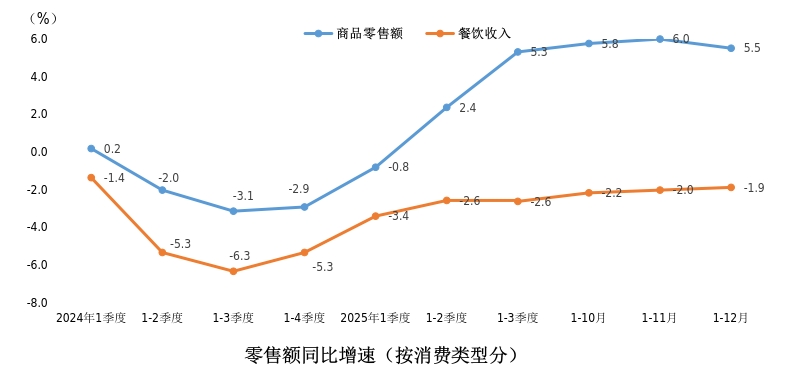
Core Viewpoint - The Shanghai government report for 2026 indicates a GDP growth target of around 5% for the city, maintaining the same target set for 2025, reflecting a shift towards high-quality development and a focus on building a self-reliant industrial and supply chain system [2][6]. Economic Performance - In 2025, Shanghai's GDP reached 5.67 trillion yuan, growing by 5.4%, which was better than expected [1]. - The total retail sales of consumer goods in Shanghai grew by 4.6% in 2025, surpassing the national average growth rate of 3.7% and reversing a decline of 3.1% in 2024 [1][6]. Consumption and Retail Strategies - Shanghai implemented various initiatives to boost consumption in 2025, including the issuance of "Le Shanghai" service consumption vouchers and the promotion of night economy and cultural tourism events [5][7]. - The number of tax refund stores for outbound tourists increased to 1,837, a growth of 136%, contributing significantly to the retail sales growth [6]. Industrial Development - The three leading industries in Shanghai—integrated circuits, biomedicine, and artificial intelligence—surpassed a combined scale of 2 trillion yuan in 2025 [8]. - Shanghai's focus on high-end industrial structure is evident, with significant advancements in strategic emerging industries [2][8]. Innovation and R&D - In 2025, Shanghai's total R&D expenditure was approximately 4.5% of its GDP, with a target of increasing this to 4.6% in 2026 [9]. - The city aims to enhance its innovation capabilities by establishing high-quality incubators and concept verification platforms, and by promoting the integration of technology and industry [8][9].
上海今年GDP目标增长5%:强化内需主导,全力稳外资外贸
第一财经· 2026-02-03 06:31
Core Viewpoint - Shanghai's economy is showing resilience with a GDP growth of 5.4% in 2025, exceeding expectations, and a clear target of 5% growth for 2026, emphasizing the importance of domestic demand and external trade stability [5][8]. Economic Performance - Shanghai's GDP reached 5.67 trillion yuan, with a growth rate of 5.4%, outperforming expectations [5]. - The total import and export volume reached 4.51 trillion yuan, growing by 5.6%, with exports increasing by 10.8% [5]. - Actual foreign investment amounted to 16.06 billion USD, equivalent to 114.8 billion yuan [5]. Foreign Trade and Investment - Shanghai's foreign trade achieved counter-cyclical growth, attributed to targeted policies and diversified trade partnerships, with imports and exports to ASEAN and Belt and Road countries growing by 10.4% and 12.1%, respectively [6]. - The city has implemented measures to support foreign investment, including a plan to encourage reinvestment by foreign enterprises and the establishment of foreign-funded projects in key sectors like new energy vehicles and biomedicine [6][11]. Future Economic Goals - The government aims for a GDP growth target of around 5% for 2026, focusing on enhancing domestic demand and integrating consumption and investment strategies [9]. - Plans include boosting consumption through various initiatives, such as enhancing service consumption and promoting tourism, while also stabilizing foreign trade and investment [10][11]. Five-Year Plan and Development Goals - The "15th Five-Year Plan" outlines ambitious goals for Shanghai, including doubling per capita GDP from 2020 levels by 2035 and achieving significant advancements in high-quality development and urban governance [13][14]. - The plan emphasizes the development of five centers: international economic, trade, shipping, financial, and technological innovation centers, with a focus on enhancing the service sector and fostering world-class enterprises [15][16]. Collaborative Development - The government stresses the importance of synergistic development among the five centers to enhance overall effectiveness and regional coordination [17].
上海市市长龚正:加强科创板制度建设,培育壮大长期资本、耐心资本丨聚焦2026地方两会
证券时报· 2026-02-03 04:23
Economic Growth and Development - Shanghai's GDP is projected to reach 5.67 trillion yuan with a growth rate of 5.4% by 2025 [2] - The total import and export volume is expected to reach 4.51 trillion yuan, with exports growing by 10.8% [6] Financial and Technological Reforms - The government aims to enhance the construction of the Sci-Tech Innovation Board and promote financial system reforms [2] - A focus on developing offshore financial systems and improving cross-border financial services is highlighted [2] Industry and Innovation - R&D expenditure is expected to account for approximately 4.5% of Shanghai's GDP by 2025 [4] - The output of strategic emerging industries is projected to grow by 6.5%, with integrated circuits, biomedicine, and artificial intelligence expected to exceed 2 trillion yuan [4] Foreign Investment and Projects - Actual foreign investment is anticipated to reach 16.06 billion USD (approximately 114.8 billion yuan) [6] - The government plans to attract foreign investment in advanced manufacturing, modern services, and high-tech industries [6] Consumer Market and Tourism - The government aims to boost consumption and develop Shanghai into an international consumption center [8] - Plans include enhancing service consumption and promoting various tourism initiatives [8] Cultural and Creative Industries - The report emphasizes the importance of cultural industry projects and the development of new cultural formats [9] - The government aims to improve the capabilities of the cultural industry, including film production and creative design [9]
烟火气拉满,江苏消费“上新”了
Xin Hua Ri Bao· 2026-02-02 23:33
□ 本报记者 王梦然 陈珺璐 消费是畅通经济循环的关键环节,是增进民生福祉的重要载体。围绕省"十五五"规划纲要中"全方位扩 大内需"的具体部署,代表委员们纷纷建言献策,从政策引导、企业实践、产业融合等多个维度,勾勒 出江苏以"新消费"点亮美好生活的生动图景。 "人民商场的核心竞争力,不只是商品本身,还有那沉淀了90多年的情感链接和信任基石。"省人大代 表、苏州人民商场女装部副经理沈黎萍介绍,为打破传统零售边界,商场加速数字化转型,通过微商 城、会员体系直播带货,将线下服务延伸至线上场景。新的一年,商场将着力把首店做成"恒店",让网 红焕发"长红"活力。她表示,将继续创新服务路径,将苏式文化元素融入现代消费场景,让购物与社 交、文化体验深度融合,在首发经济、旅游经济、银发经济、美丽经济、宠物经济等"新赛道"上发 掘"新增长",扩大优质商品和服务供给,满足不同年龄段的个性化消费期待。 在省政协委员,扬州瘦西湖旅游度假投资管理集团董事长,江苏扬城一味餐饮管理有限公司董事长、总 经理陈万庆看来,文旅行业特别是住宿餐饮业,既是拉动消费的重要领域,也是实现产业联动、畅通经 济循环的重要纽带,在推动消费结构升级、促进内需持 ...
以新质生产力推进转型发展 山西:2026年GDP增长目标为4.5%至5%
Shang Hai Zheng Quan Bao· 2026-02-02 18:44
Economic Growth Targets - Shanxi Province aims for a GDP growth target of 4.5% to 5% for 2026, with fixed asset investment and social retail sales also targeted to grow by 5% [1] - The province emphasizes the importance of high-quality development and comprehensive transformation during the 14th Five-Year Plan period [1] Key Development Strategies - Shanxi will focus on ten key tasks including expanding domestic demand, promoting energy transition, upgrading industries, and fostering moderate diversification [1] - The province plans to continue major project construction, targeting over 600 billion yuan in transportation infrastructure investment, over 220 billion yuan in water conservancy investment, and over 600 billion yuan in municipal infrastructure investment [1] Energy Transition Initiatives - Energy transition is highlighted as a critical focus, with plans to implement nine paths for energy technology innovation and build a new energy system [2] - Specific initiatives include constructing 60 intelligent coal mines, expanding wind and solar power installations, and developing smart grids and virtual power plants [2] Industrial Upgrading Efforts - Shanxi aims to strengthen emerging pillar industries through innovation and large-scale application of new technologies [3] - The province will focus on developing new materials, high-end equipment manufacturing, and electronic information industries, while also promoting sustainable development in non-coal mining [3]
热点思考 | 地方“两会”观察:二十省市,三大特征(申万宏观·赵伟团队)
赵伟宏观探索· 2026-02-02 16:04
Group 1 - The average GDP growth target for 2026 set by twenty provinces is 5.1%, a decrease of 0.2 percentage points compared to the 2025 target, but an increase of 0.1 percentage points compared to the actual growth rate in 2025 [2][11][44] - Eight regions, including Beijing and Shandong, have set their GDP growth targets at around 5% or higher, while Hainan and Xinjiang lead with targets of approximately 6% and 5.5%-6%, respectively [2][11][44] - Economic powerhouses like Guangdong, Henan, and Zhejiang have adopted a more positive tone in their reports, emphasizing the goal of achieving better results in actual work [3][11][44] Group 2 - Investment growth targets show significant regional differentiation, with western regions like Xinjiang setting a high target of around 8%, while coastal provinces generally target around 5% [4][15][44] - Most regions have set their retail sales growth targets higher than the actual performance in 2025, with notable increases in targets for Henan and Xinjiang, while Hebei and Guangdong maintain targets around 5% [20][44] Group 3 - Employment remains a priority, with provinces like Guangdong, Shandong, and Henan setting targets for over 1 million new urban jobs, reflecting a strong focus on job creation [5][27][40] - Environmental indicators are becoming more stringent, with regions like Beijing and Shandong specifying PM2.5 concentration control targets [5][27][40] Group 4 - The expansion of domestic demand is a primary task, shifting from traditional physical consumption to a balance of physical and service consumption, with policies like "old-for-new" becoming normalized [6][29][44] - Service consumption is being elevated, with various regions focusing on "first-release economy" and "silver economy" to create new demand [6][29][44] - The concept of "new quality productivity" is gaining attention, with regions leveraging their unique advantages for differentiated development, such as Beijing focusing on AI and quantum technology, and Zhejiang aiming for integrated circuit clusters [6][29][44]
九部门联手送福利:一图纵览“乐购新春”春节特别活动全攻略!
Xin Lang Cai Jing· 2026-02-02 12:49
来源:商务微新闻 乐 购 新 春 纵览 E 节 特 别 活 动会攻略 本要 - E 贯彻落实党中央、国务院关于扩大 内需、提振消费系列决策部署,深入实 施提振消费专项行动,打造"购在中 国"品牌,紧扣年俗文化、家庭团圆、 购物出行等核心需求,聚焦首发经济、 数字消费、绿色消费、智能消费、健康 消费、入境消费等领域,商务部、中央 宣传部、文化和旅游部、中国人民银 And Line Lot For 1]、立融量官芯同、| 电芯同、14月心 局、中国民航局、国铁集团等9单位组 织开展2026"乐购新春"春节特别活 动,更好满足人民美好生活需要。 Fritatio 2月15日至23日 (春节9天假期) 好吃 ·马上尝鲜品年味 ★ 组织餐饮名店、老字号餐饮企业 推出年夜饭套餐、新春团圆宴。鼓励 推出美食增值服务,如现场表演、免 费小吃、幸运抽奖等。 ★ 鼓励各地发布美食地图,结合本 地实际在步行街、公园、社区等设置 年味美食市集,举办美食大赛、厨艺 比拼、晒晒我家的团圆饭等活动。 * 联动家居卖场、家电品牌、家 装企业,推出"新春焕新家"惠民 促销。 * 组织连锁酒店、精品民宿、度 假村等,开展"新春好好住"主题 活动 ...


九部门:鼓励金融机构与重点商户合作,策划春节专属活动
Xin Lang Cai Jing· 2026-02-02 09:03
Core Viewpoint - The "2026 'Buy Spring Festival' Special Activity Plan" aims to stimulate consumer spending and enhance cultural life during the Spring Festival, aligning with national economic policies to boost demand and consumption [1][3][4]. Group 1: Activity Overview - The Spring Festival will have a 9-day holiday from February 15 to 23, 2026, designed to create a festive consumer atmosphere and promote cultural activities [3][18]. - The plan emphasizes government guidance, market leadership, and public participation, focusing on cultural traditions, family reunions, and shopping needs [4][17]. Group 2: Activity Content - Culinary activities will include traditional food fairs and special dining packages, encouraging local food markets and competitions to attract consumers [7][19]. - Housing promotions will involve discounts from home goods and hospitality sectors, offering special packages for families and extended stays [20]. - Transportation enhancements will include increased capacity in air and rail services, special promotions for travelers, and improved services for special needs [20]. - Cultural and tourism events will feature seasonal activities, fairs, and exhibitions, promoting local heritage and tourism [8][21]. - Retail initiatives will focus on promotional events in key shopping areas, encouraging diverse product offerings and special sales [21]. - Entertainment options will include film promotions, cultural performances, and community sports events to engage the public [9][22]. Group 3: Support Measures - Incentives such as prize invoices and shopping lotteries will be implemented to encourage consumer participation [22]. - Trade-in programs for old products will be promoted to stimulate purchases in various sectors, including electronics and automobiles [22]. - Financial support will be enhanced through partnerships with merchants, offering discounts and incentives for digital currency usage [22][23]. - Cross-industry collaborations will be encouraged to create bundled offers that enhance consumer experiences across different sectors [23]. - Measures to facilitate inbound tourism will include multilingual guides and improved payment options for international visitors [23].