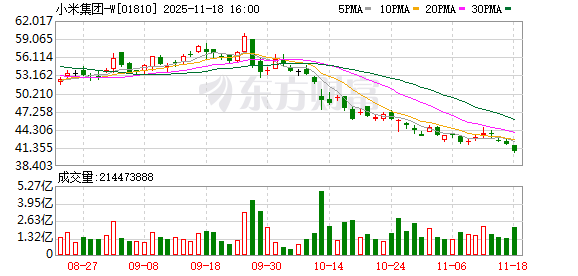
高端化战略

Search documents
小米集团斥资超5亿港元回购股份
Ju Chao Zi Xun· 2025-11-20 12:29
Core Viewpoint - Xiaomi Group is actively engaging in share buybacks and stock incentives to enhance shareholder value and retain talent, reflecting management's confidence in the company's future growth prospects [3][5]. Group 1: Share Buyback and Stock Incentives - On November 20, Xiaomi announced a buyback of 13.5 million Class B shares for a total of HKD 507.8 million, at a price of HKD 38.1 per share [1]. - This buyback is part of a broader strategy, with Xiaomi having repurchased approximately 15.4 million shares totaling around HKD 1.54 billion in the first three quarters of the year [3]. - Xiaomi also announced a stock incentive plan rewarding 3,334 selected participants with a total of 29.37 million shares, valued at approximately HKD 1.14 billion based on the closing price of HKD 38.82 per share on November 19 [3]. Group 2: Financial Performance and Business Segments - Xiaomi's third-quarter revenue exceeded HKD 100 billion for the fourth consecutive quarter, with the automotive segment achieving profitability for the first time [3]. - The revenue from the smart electric vehicle and AI segments reached HKD 29 billion, marking a year-on-year increase of over 199%, with smart electric vehicle revenue at HKD 28.3 billion [3]. - In the first three quarters, Xiaomi delivered over 260,000 vehicles, with a target of 350,000 for the year, despite potential challenges in 2024 due to reduced tax incentives and increased competition [4]. Group 3: Traditional Business and R&D Investment - Xiaomi's traditional business remains robust, with smartphone and AIoT revenue at HKD 84.1 billion in Q3, and smartphone revenue at HKD 46 billion, maintaining a top-three global position for 21 consecutive quarters [4]. - The IoT and lifestyle products segment generated HKD 27.6 billion, a year-on-year increase of 5.6%, while internet services revenue grew by 10.8% to HKD 9.4 billion [4]. - R&D expenditure reached HKD 9.1 billion in Q3, a 52.1% increase year-on-year, with total R&D investment for the first three quarters nearing last year's total [4].


小火靠产品,大火靠模式,小米正迈向模式级胜利
雷峰网· 2025-11-20 07:35
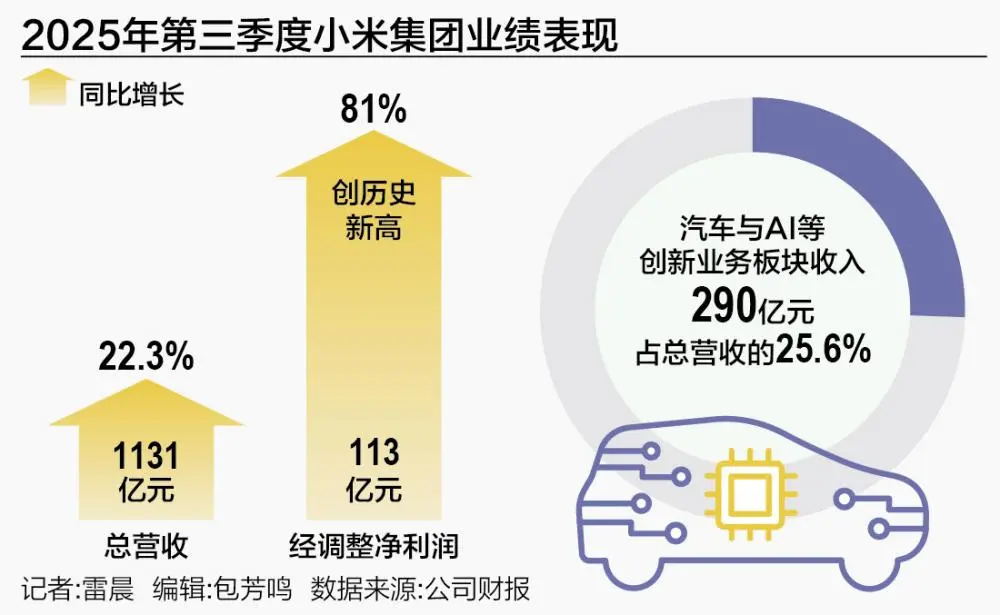
Core Viewpoint - The Q3 financial report of Xiaomi serves as a preview of the company's next growth phase rather than just a performance summary [1][7]. Group 1: Financial Performance - In Q3, Xiaomi's total revenue reached 113.1 billion RMB, a year-on-year increase of 22.3%, marking the fourth consecutive quarter of revenue exceeding 100 billion RMB [3][4]. - The overall gross margin for Q3 was 22.9%, up 2.5 percentage points year-on-year, setting a new historical record. Adjusted net profit surged 81% year-on-year to 11.3 billion RMB, exceeding major investment banks' expectations [4][5]. - For the first three quarters of 2025, total revenue reached 340.4 billion RMB, nearing last year's total, with adjusted net profit of 32.8 billion RMB, surpassing the total for 2024 [5]. Group 2: Business Segments - Xiaomi's growth is supported by three main business lines: smartphones, automotive, and IoT, all showing strong growth potential [10][20]. - The smartphone and AIoT business combined generated revenue of 84.1 billion RMB in Q3, with a gross margin of 22.1%, an increase from 20.8% year-on-year [10][11]. - The automotive segment saw revenue of 29 billion RMB in Q3, a year-on-year increase of over 199%, with the automotive business achieving profitability for the first time [12][15]. Group 3: Strategic Developments - Xiaomi's high-end smartphone strategy is yielding results, with Q3 smartphone shipments reaching 43.3 million units, maintaining a top-three global market position [23][24]. - The automotive business has rapidly become a new growth engine, with Q3 deliveries reaching 108,799 units, setting a new record for the quarter [30][32]. - The IoT business reported revenue of 27.6 billion RMB in Q3, with a gross margin of 23.9%, continuing a trend of revenue growth for seven consecutive quarters [38][40]. Group 4: Innovation and R&D - Xiaomi's R&D investment in Q3 reached 9.1 billion RMB, a 52.1% year-on-year increase, with total R&D personnel reaching 24,871 [47]. - The company is focusing on high-quality growth in its IoT business, with plans to enhance its product offerings and expand into overseas markets [39][40]. - The establishment of a new smart appliance factory marks a significant milestone for Xiaomi's home appliance business, supporting future growth [40][41].
小米汽车开始挣钱 卖一台车净赚6434元 雷军最新发声
2 1 Shi Ji Jing Ji Bao Dao· 2025-11-20 04:53
Core Insights - Xiaomi Group reported a total revenue of 113.1 billion yuan for Q3 2025, representing a year-on-year growth of 22.3%, with adjusted net profit reaching 11.3 billion yuan, up 81%, marking a historical high [1][4] - The company successfully transitioned between old and new growth engines, with innovative businesses like smart electric vehicles and AI achieving profitability for the first time in a single quarter, while the traditional smartphone business faced pressure due to rising memory costs [1][4] Financial Performance - The automotive business delivered 108,796 vehicles in Q3, with a total of 265,967 vehicles delivered in the first three quarters, and a monthly delivery of over 40,000 units in October, achieving profitability with a net profit of 6,434 yuan per vehicle sold [4][6] - The smartphone business faced challenges, with global shipments of 43.3 million units and revenue of 45.969 billion yuan, leading to a decline in gross margin to 11.1% due to rising costs of core components [6][5] Business Segmentation - Internet services generated revenue of 9.4 billion yuan in Q3, a 10.8% increase, primarily driven by strong advertising performance [7] - IoT business revenue reached 27.6 billion yuan, maintaining year-on-year growth for seven consecutive quarters, with a gross margin of 23.9% [9][8] R&D and Long-term Strategy - R&D expenditure in Q3 amounted to 9.1 billion yuan, a 52.1% increase, with total R&D investment for the first three quarters nearing last year's total, expected to exceed 30 billion yuan for the year [11][12] - The company is focusing on core technologies and frontier fields, with capital expenditure for the first three quarters at 13 billion yuan, reflecting long-term strategic investments [12][10] Market Outlook and Challenges - Despite achieving profitability in the automotive sector, the company anticipates challenges in 2026 due to reduced purchase tax subsidies and intensified competition [12] - The smartphone business continues to face long-term pressure from rising memory costs, while the IoT sector is experiencing a transitional phase in the domestic appliance market [12][6]
小米汽车开始挣钱,卖一台车净赚6434元,雷军最新发声
2 1 Shi Ji Jing Ji Bao Dao· 2025-11-20 04:53
Core Insights - Xiaomi Group reported a total revenue of 113.1 billion yuan for Q3 2025, representing a year-on-year growth of 22.3%, with adjusted net profit reaching 11.3 billion yuan, a significant increase of 81%, marking a historical high [1] - The financial report indicates a successful transition between old and new growth engines, with innovative businesses like smart electric vehicles and AI achieving profitability for the first time in a single quarter, while the traditional smartphone business faces pressure due to rising memory costs [1][3] - Xiaomi's partner and president, Lu Weibing, emphasized the importance of continuous capability building to enhance resilience against uncontrollable environmental factors [1] Innovative Business Performance - The smart electric vehicle and AI sectors became the core growth drivers, with Xiaomi delivering 108,796 vehicles in Q3 and a total of 265,967 vehicles in the first three quarters, achieving profitability for the first time with an operating profit of 700 million yuan [3] - The average profit per vehicle sold was 6,434 yuan, exceeding expectations and validating the product strength and business model of Xiaomi's automotive division [3] Smartphone Business Challenges - Xiaomi's global smartphone shipments reached 43.3 million units in Q3, generating revenue of 45.969 billion yuan, but the smartphone business faced a decline in gross margin to 11.1% due to rising costs of core components [5] - Lu Weibing noted that the current memory price increase is driven by strong demand for HBM (High Bandwidth Memory) from AI, leading to a long-term cost pressure on the smartphone segment [5] Internet Services Contribution - The internet services segment generated revenue of 9.4 billion yuan in Q3, reflecting a year-on-year growth of 10.8%, primarily driven by strong performance in advertising [6] IoT Business Growth - Xiaomi's IoT and lifestyle product revenue reached 27.6 billion yuan in Q3, maintaining year-on-year growth for seven consecutive quarters, with a gross margin of 23.9% [8] - The overseas market has become a significant growth driver for IoT, with record revenue achieved in Q3, and plans for further expansion in Southeast Asia and Europe [8] R&D Investment and Long-term Strategy - Xiaomi's R&D expenditure in Q3 amounted to 9.1 billion yuan, a 52.1% increase year-on-year, with total R&D investment for the first three quarters nearing last year's total [10] - The company aims to become a global leader in core technology through substantial investments in foundational technologies, particularly in AI [10] Future Challenges and Strategic Focus - Despite achieving profitability in the automotive sector, challenges are anticipated in 2026 due to reduced purchase tax subsidies and intensified competition [11] - The smartphone business continues to face long-term cost pressures, while the IoT sector is navigating a transitional phase in the domestic appliance market [11] - Xiaomi plans to focus on consolidating automotive profitability, advancing smartphone premiumization, and leveraging opportunities in AI to achieve high-quality growth [11]

小米汽车开始挣钱,卖一台车净赚6434元,雷军最新发声
21世纪经济报道· 2025-11-20 04:49
Core Insights - Xiaomi Group reported a total revenue of 113.1 billion yuan for Q3 2025, a year-on-year increase of 22.3%, with adjusted net profit reaching 11.3 billion yuan, up 81%, marking a historical high [1] - The company successfully transitioned between old and new growth engines, with innovative businesses like smart electric vehicles and AI achieving profitability for the first time in a single quarter, while the traditional smartphone business faced pressure due to rising memory costs [1][4] - Xiaomi's President Lu Weibing emphasized the importance of resilience through continuous capability building in response to uncontrollable environmental factors [1] Revenue and Profitability - The innovative business segment, including smart electric vehicles, delivered a significant turnaround, achieving a profit of 700 million yuan in Q3 after a loss of 300 million yuan in Q2, with an average profit of 6,434 yuan per vehicle sold [4] - The smartphone business faced challenges, with global shipments of 43.3 million units and revenue of 45.969 billion yuan, leading to a decline in gross margin to 11.1% due to prolonged cost pressures from core components [6] Business Segmentation - Internet services generated revenue of 9.4 billion yuan in Q3, reflecting a 10.8% year-on-year growth, primarily driven by strong performance in advertising [7] - The IoT business reported revenue of 27.6 billion yuan, maintaining a growth streak for seven consecutive quarters, with a gross margin of 23.9% [9] Strategic Initiatives - Xiaomi is increasing its R&D investment, with Q3 spending reaching 9.1 billion yuan, a 52.1% increase year-on-year, and total R&D expenditure expected to exceed 30 billion yuan for the year [11] - The company is focusing on high-end product strategies to counteract cost pressures, achieving a market share increase in the 4,000-6,000 yuan price segment by 5.6 percentage points to 18.9% [6] Future Outlook - Despite achieving profitability in the automotive sector, challenges remain, including reduced purchase tax subsidies and intensified competition expected in 2026 [12] - Xiaomi aims to solidify its automotive profitability, further penetrate the high-end smartphone market, and leverage opportunities in AI and physical world integration for long-term strategic goals [12]

汽车业务首度盈利、高端化创新业务全面兑现 小米Q3业绩打破增长天花板
Xin Lang Zheng Quan· 2025-11-19 11:52
Core Insights - Xiaomi Group reported a record-breaking Q3 performance with revenue of 113.1 billion yuan, a year-on-year increase of 22.3%, marking the fourth consecutive quarter exceeding the 100 billion yuan threshold [2][3] - Adjusted net profit reached 11.3 billion yuan, surging 80.9% year-on-year, setting a historical high [2][3] - The company’s total revenue for the first three quarters reached 340.4 billion yuan, nearing last year's total, with adjusted net profit surpassing the entire previous year's figure [2][3] Financial Performance - Q3 revenue was 113.1 billion yuan, up 22.3% year-on-year, with adjusted net profit at 11.3 billion yuan, exceeding Bloomberg's consensus estimate [3][4] - For the first three quarters, total revenue was 340.4 billion yuan, with adjusted net profit of 32.8 billion yuan, indicating strong growth momentum [3][4] - Gross margin for Q3 reached 22.9%, reflecting a 2.5 percentage point increase year-on-year, showcasing the effectiveness of the company's product structure optimization [6] Business Segments - Revenue from the smartphone and AIoT segment was 84.1 billion yuan, with smartphone revenue at 46 billion yuan, maintaining a top-three global position for 21 consecutive quarters [3][4] - IoT and lifestyle product revenue was 27.6 billion yuan, up 5.6% year-on-year, while internet services revenue reached 9.4 billion yuan, growing 10.8% [3][4] - The automotive and AI innovation segment generated 29 billion yuan, with electric vehicle revenue at 28.3 billion yuan, achieving a quarterly delivery record of 109,000 units [3][4] Strategic Initiatives - Xiaomi's R&D investment for Q3 was 9.1 billion yuan, a 52.1% increase year-on-year, with total investment for the first three quarters nearing 23.5 billion yuan [2][10] - The company aims to be a "contributor to industrial value" and "promoter of industrial progress," focusing on innovation rather than price competition [4][10] - The high-end strategy has shown results, with market share in the 4,000-6,000 yuan smartphone segment reaching 18.9%, a 5.6 percentage point increase year-on-year [7][11] Future Outlook - The automotive business, international expansion, and high-end strategy are expected to drive future growth [11][12] - Xiaomi has raised its 2025 delivery target for vehicles from 300,000 to 350,000 units, with some forecasts suggesting it could reach 400,000 [8][11] - The company maintains a strong cash reserve of 236.7 billion yuan, positioning itself for future growth opportunities [11][12]
小米的周期对冲法:新引擎盈利,旧引擎转型
2 1 Shi Ji Jing Ji Bao Dao· 2025-11-19 07:33
Core Insights - Xiaomi Group's Q3 2025 financial results show a total revenue of 113.1 billion yuan, a year-on-year increase of 22.3%, and an adjusted net profit of 11.3 billion yuan, up 81%, marking a historical high [2][3] - The company successfully transitioned from traditional smartphone business to new growth engines, particularly in smart electric vehicles and AI, which achieved quarterly profitability for the first time [2][3] - The smartphone segment is under pressure due to rising memory costs, impacting gross margins, while the company is focusing on high-end strategies to enhance product structure and resilience [2][4] Financial Performance - Xiaomi's revenue from innovative businesses, including smart electric vehicles and AI, reached 29 billion yuan, accounting for 25.6% of total revenue, with a gross margin of 25.5% and a profit of 700 million yuan in the quarter [3][4] - The smartphone business saw a shipment of 43.3 million units, generating revenue of 45.969 billion yuan, with a gross margin dropping to 11.1% due to supply chain cost pressures [3][4] Strategic Initiatives - Xiaomi is implementing three core strategies to build long-term competitiveness: increasing R&D investment, advancing high-end strategies, and exploring new growth opportunities in global markets [2][3] - The company plans to enhance its R&D capabilities, with Q3 spending reaching 9.1 billion yuan, a 52.1% increase year-on-year, and total R&D investment expected to exceed 30 billion yuan for the year [8][9] Market Trends - The current memory price increase is driven by strong demand for HBM (High Bandwidth Memory) from AI applications, differing from previous cycles driven by mobile and laptop demand [4] - Xiaomi's IoT business generated 27.6 billion yuan in revenue, maintaining growth for seven consecutive quarters, with a gross margin of 23.9% [5][6] Operational Developments - Xiaomi has expanded its automotive sales network, with 402 stores in 119 cities in mainland China, and aims to deliver 350,000 vehicles by the end of the year [3][6] - The company has launched a new smart appliance factory in Wuhan, enhancing its production capabilities and supporting its high-end strategy [6][9] Challenges and Outlook - Despite achieving profitability in the automotive sector, challenges remain, including reduced purchase tax subsidies and increased competition expected in 2026 [9] - The smartphone segment faces ongoing pressure from rising memory costs, while the IoT business must navigate a competitive landscape and potential price wars [9]
小米集团20251118
2025-11-19 01:47
Xiaomi Group Q3 2025 Earnings Call Summary Company Overview - **Company**: Xiaomi Group - **Date**: Q3 2025 Earnings Call Key Financial Highlights - Total revenue reached **RMB 113 billion**, a **2.5%** year-over-year increase, marking a historical high [2][3] - Adjusted net profit was **RMB 11.3 billion**, up **81%** year-over-year, also a record [2][3] - Gross margin improved to **22.9%**, an increase of **2.5 percentage points** year-over-year [3] Smartphone Performance - Sales of the **Xiaomi 17 series** smartphones grew by **30%** compared to the previous generation, with high-end versions accounting for over **80%** of sales [2][4] - The **Pro Max** model achieved significant success in the **RMB 6,000+** price segment, indicating effective high-end strategy [4][7] - Xiaomi ranked among the top three in global smartphone shipments with a market share of **13.6%** [6] IoT and Smart Home Business - IoT revenue reached **RMB 27.6 billion**, showing continuous growth for seven consecutive quarters with a gross margin of **23.9%** [2][8] - The IoT platform connected over **1 billion devices**, indicating ongoing ecosystem expansion [8][21] - A new smart home appliance factory commenced production with an annual capacity of **7 million units** [8][12] Internet Services and User Engagement - Global monthly active users reached **742 million**, a **8.2%** increase year-over-year [2][9] - Internet services revenue was **RMB 9.4 billion**, up **10.8%**, with a gross margin of **76.9%** [2][11] - Advertising revenue grew to **RMB 7.2 billion**, reflecting a **17.4%** increase [2][12] Electric Vehicle (EV) Business - EV revenue amounted to **RMB 28.3 billion**, with **108,796** units delivered, averaging a post-tax price of **RMB 260,000** [5][14] - The EV segment is identified as a new growth driver for the company [5] Research and Development - R&D expenses reached **RMB 9.1 billion**, a **52.1%** increase year-over-year, with R&D personnel comprising **44.2%** of total employees [5][15] - The company plans to invest over **RMB 200 billion** in R&D over the next five years [10] Strategic Initiatives - Xiaomi aims to enhance product premiumization and intelligence through proprietary chip and operating system development [10] - The company targets entry into the top 100 of the Fortune Global 500 by **2030** [10] Market Position and Challenges - Xiaomi's market share in mainland China reached **14.9%**, with growth in all regions except India [6] - The company faces challenges from rising memory costs, which are expected to pressure gross margins in the coming years [19][30] - Strategies to mitigate cost pressures include price increases and product structure optimization [19] Sustainability and ESG Efforts - Xiaomi's MSCI ESG rating improved from B to A, marking the third consecutive year of improvement [18] Future Outlook - The company plans to continue expanding its overseas market presence, particularly in Southeast Asia and Latin America [27][32] - Xiaomi's strategy includes enhancing operational efficiency in existing stores rather than opening new ones [31][32] This summary encapsulates the key points from Xiaomi Group's Q3 2025 earnings call, highlighting financial performance, market position, strategic initiatives, and future outlook.

小米汽车业务首次单季盈利 预计本周完成全年交付目标
Zheng Quan Shi Bao· 2025-11-18 18:11
Core Insights - Xiaomi achieved its first quarterly profit in the automotive sector, amounting to approximately 700 million yuan [1] - The company reported a third-quarter revenue of 113.1 billion yuan, a year-on-year increase of 22.3%, marking the fourth consecutive quarter of exceeding 100 billion yuan [1] - Adjusted net profit for the third quarter reached 11.3 billion yuan, a significant year-on-year increase of 80.9%, setting a new historical high [1] Financial Performance - Total revenue for the first three quarters reached 340.4 billion yuan, nearing last year's total, with adjusted net profit of 32.8 billion yuan, surpassing last year's total [1] - The automotive and AI innovation segment generated revenue of 29 billion yuan, a year-on-year increase of over 199%, with smart electric vehicle revenue at 28.3 billion yuan [1] - The smartphone and AIoT segment generated revenue of 84.1 billion yuan, with smartphone revenue at 46 billion yuan, showing continuous growth for nine consecutive quarters [2] Automotive Business - Xiaomi's automotive division achieved a quarterly operating profit of 700 million yuan for the first time [1] - The company expects to meet its annual delivery target of 350,000 vehicles this week, with over 100,000 vehicles delivered in the third quarter and cumulative deliveries exceeding 260,000 for the year [1] Market Position - Xiaomi's global smartphone shipments reached 43.3 million units in the third quarter, marking nine consecutive quarters of year-on-year growth [2] - In the domestic market, Xiaomi maintained a top-two position in smartphone sales for six consecutive quarters, while ranking in the top three in 57 countries and regions internationally [2] IoT and AIoT Growth - The IoT and consumer products segment reported revenue of 27.6 billion yuan, a year-on-year increase of 5.6% [2] - As of September 30, the number of connected IoT devices on Xiaomi's AIoT platform surpassed 1 billion, a historical high, with users connecting five or more devices increasing by 26.1% year-on-year [2] High-End Strategy - Xiaomi is accelerating its high-end strategy across smartphones, automobiles, and major appliances, achieving market share growth even during traditional sales downturns [2] - In the high-end smartphone segment (priced between 4,000 and 6,000 yuan), Xiaomi's market share reached 18.9%, an increase of 5.6 percentage points year-on-year [2] R&D Investment - Xiaomi's R&D investment for the first three quarters totaled 23.5 billion yuan, nearing the full-year target of over 30 billion yuan, with third-quarter investment at 9.1 billion yuan, a year-on-year increase of 52.1% [3] - The company aims to transition from an "internet company" to a "hardcore technology company" through substantial investments in foundational technology [3]
小米三季报出炉,汽车业务首次实现单季盈利
Zhong Guo Zheng Quan Bao· 2025-11-18 15:25
Core Insights - Xiaomi Group reported a total revenue of 1131.21 billion yuan for Q3 2025, a year-on-year increase of 22.3% but a quarter-on-quarter decrease of 2.4% [2] - The net profit reached 122.57 billion yuan, up 129.5% year-on-year and 3.2% quarter-on-quarter [2] - The adjusted net profit was 113.11 billion yuan, reflecting an 80.9% year-on-year increase and a 4.4% quarter-on-quarter increase [2] Revenue Breakdown - Xiaomi delivered 108,796 new vehicles in Q3, with the smart electric vehicle and AI innovation segment generating 290 billion yuan in revenue, a 199.2% year-on-year increase, achieving a gross margin of 25.5% and a quarterly operating profit of 7 billion yuan [2][9] - The smartphone and AIoT segment revenue was 841 billion yuan, a 1.6% year-on-year increase, while smartphone revenue alone was 459.69 billion yuan, down 3.1% year-on-year [4] - The IoT and lifestyle products segment revenue reached 276 billion yuan, a 5.6% year-on-year increase, with a gross margin of 23.9% [6] Cost and Margin Analysis - The smartphone gross margin decreased to 11.1% from 11.7% year-on-year, attributed to intensified competition [4] - The average selling price (ASP) of smartphones fell by 3.6% to 1062.8 yuan [4] - R&D expenses surged to 91 billion yuan, a 52.1% year-on-year increase, with total R&D spending for the first three quarters reaching 235 billion yuan [2] Strategic Initiatives - Xiaomi is focusing on high-quality growth in its home appliance segment, with a strategy to avoid price wars and instead enhance product quality and ASP [6][7] - The company is expanding its IoT platform, which now connects over 1 billion devices, and plans to increase its overseas market presence in 2026 [6][7] - The new smart appliance factory, with an investment of over 2.5 billion yuan, is expected to enhance production capacity significantly [6] Future Outlook - The automotive segment is expected to face margin pressures in 2026 due to reduced subsidies and increased competition, despite achieving a gross margin of 25.5% in Q3 2025 [9] - The company anticipates a challenging smartphone market in the coming year, with significant upward pressure on retail prices [5]