净息差

Search documents
LPR年内首次下调,存款利率正式迈入“零时代”
第一财经· 2025-05-20 13:45
Core Viewpoint - The recent simultaneous reduction of the Loan Prime Rate (LPR) and deposit rates by major banks is aimed at addressing the declining net interest margin (NIM) of commercial banks, which has reached a historical low of 1.43% in Q1. The market is divided on whether this will alleviate or exacerbate pressure on banks' NIMs [1][8]. Group 1: LPR and Mortgage Rates - The reduction in LPR directly leads to lower mortgage rates, resulting in decreased financing costs for homebuyers. For instance, a 1 million yuan mortgage over 30 years sees monthly payments drop from approximately 4270 yuan to 4216 yuan, saving about 54 yuan monthly or 1.9 million yuan over the loan term [3]. - Different banks have adopted varied strategies in response to LPR changes, with some regions seeing an increase in mortgage rates to balance risk and profitability. For example, banks in Guangzhou and Xiamen have adjusted their rates upwards by 10 and 5 basis points, respectively [3][4]. - The adjustments in mortgage rates reflect a balance between maintaining NIM and promoting credit issuance, with expectations of further regional differentiation in mortgage pricing [4]. Group 2: Deposit Rate Adjustments - Major banks have lowered deposit rates, with the one-year deposit rate falling below 1% for the first time, and the three and five-year rates seeing a reduction of 25 basis points. The new rates for one-year deposits now range from 0.95% to 1.05% [5][6]. - The synchronization of deposit rate reductions with LPR adjustments is seen as a proactive strategy by banks to manage funding costs and stabilize NIM amid declining asset yields [6][7]. - The reduction in deposit rates is expected to provide banks with a cost buffer, helping to mitigate the impact of LPR reductions on asset yields and maintain profitability [7]. Group 3: Future Outlook on NIM - Despite the recent adjustments, some industry experts believe that the pressure on banks' NIM will persist due to a lag in loan demand recovery compared to interest rate declines. This suggests that banks may continue to face challenges in maintaining their NIM in the long term [8].







LPR如期下调 部分银行同步调降存款利率
Zheng Quan Shi Bao Wang· 2025-05-20 12:44
Group 1 - The Loan Prime Rate (LPR) and deposit rates of large commercial banks have both decreased, leading to a reduction in the overall financing costs in society and improving banks' liability costs [1][2] - The 1-year and 5-year LPRs have both dropped by 0.1 percentage points, now standing at 3.0% and 3.5% respectively, which is expected to stimulate effective financing demand and stabilize credit levels [1][2] - The reduction in deposit rates by state-owned and some joint-stock banks is aimed at lowering banks' liability costs, creating room for the LPR to decrease [1][3] Group 2 - The LPR serves as a primary reference for loan pricing, with the average interest rate for new corporate loans at approximately 3.2%, down about 50 basis points year-on-year, and for personal housing loans at about 3.1%, down about 55 basis points year-on-year [2] - The decrease in the 5-year LPR is beneficial for mortgage borrowers, reducing their interest burden and promoting consumption, with a calculated monthly payment reduction of approximately 54.88 yuan for a 1 million yuan mortgage over 30 years [2] - The recent decline in deposit rates marks the seventh round of such reductions since September 2022, reflecting banks' responses to market interest rate trends and deposit supply-demand dynamics [2][3] Group 3 - The banking sector has experienced a rapid decline in net interest margins, now at historical lows, prompting banks to adjust deposit rates to maintain a reasonable net interest margin [3] - The recent adjustments in deposit rates, along with a new round of reserve requirement ratio cuts, provide banks with the opportunity to alleviate net interest margin pressures and lower LPR pricing [3] - The interest rate transmission mechanism in China has gradually improved, forming a more complete interest rate system that influences consumption and investment, thereby enhancing overall social demand [3]
时隔7个月LPR降息10个基点 但银行的存款利率降幅更大
Jing Ji Guan Cha Wang· 2025-05-20 04:14
Core Viewpoint - The recent reduction in the Loan Prime Rate (LPR) signals a shift in monetary policy aimed at stimulating economic activity through lower borrowing costs for both businesses and individuals [2][3]. Group 1: LPR Reduction Details - The 1-year LPR and the 5-year LPR have been lowered by 10 basis points to 3.0% and 3.5%, respectively, marking the first reduction in 7 months since October 2024 [2]. - A decrease in LPR will lead to lower loan rates for businesses and individuals, with an example showing that a 10 basis point drop could save a homebuyer approximately 20,000 yuan in interest over a 30-year mortgage [2]. Group 2: Impact on Deposit Rates - On the same day as the LPR reduction, major state-owned banks and some joint-stock banks announced a decrease in deposit rates, with 1-year fixed deposit rates falling below 1% to 0.95% [2][5]. - The reduction in deposit rates is seen as a strategy to attract depositors before further declines, with some banks offering rates as low as 0.05% for demand deposits [2]. Group 3: Economic Context and Analysis - The LPR reduction is attributed to external economic pressures, particularly the escalation of the US-China trade conflict, necessitating a stronger counter-cyclical adjustment in macroeconomic policy [3]. - The weighted average interest rate for new corporate loans was approximately 3.2%, down about 50 basis points year-on-year, while the average for new personal housing loans was around 3.1%, down about 55 basis points [3]. Group 4: Bank Profitability and Future Outlook - The recent cuts in deposit rates are expected to help lower banks' funding costs, potentially allowing for further reductions in LPR [6]. - The net interest margin for commercial banks has been narrowing, with the latest data showing a decline to 1.43%, down 9 basis points from the previous quarter [6]. - Analysts predict that the recent LPR cut will lead to further decreases in loan rates, as banks adjust to maintain their interest margins [6].

新一轮存款降息来袭!大行、股份行领衔,一年期利率破1%
Bei Jing Shang Bao· 2025-05-20 04:09
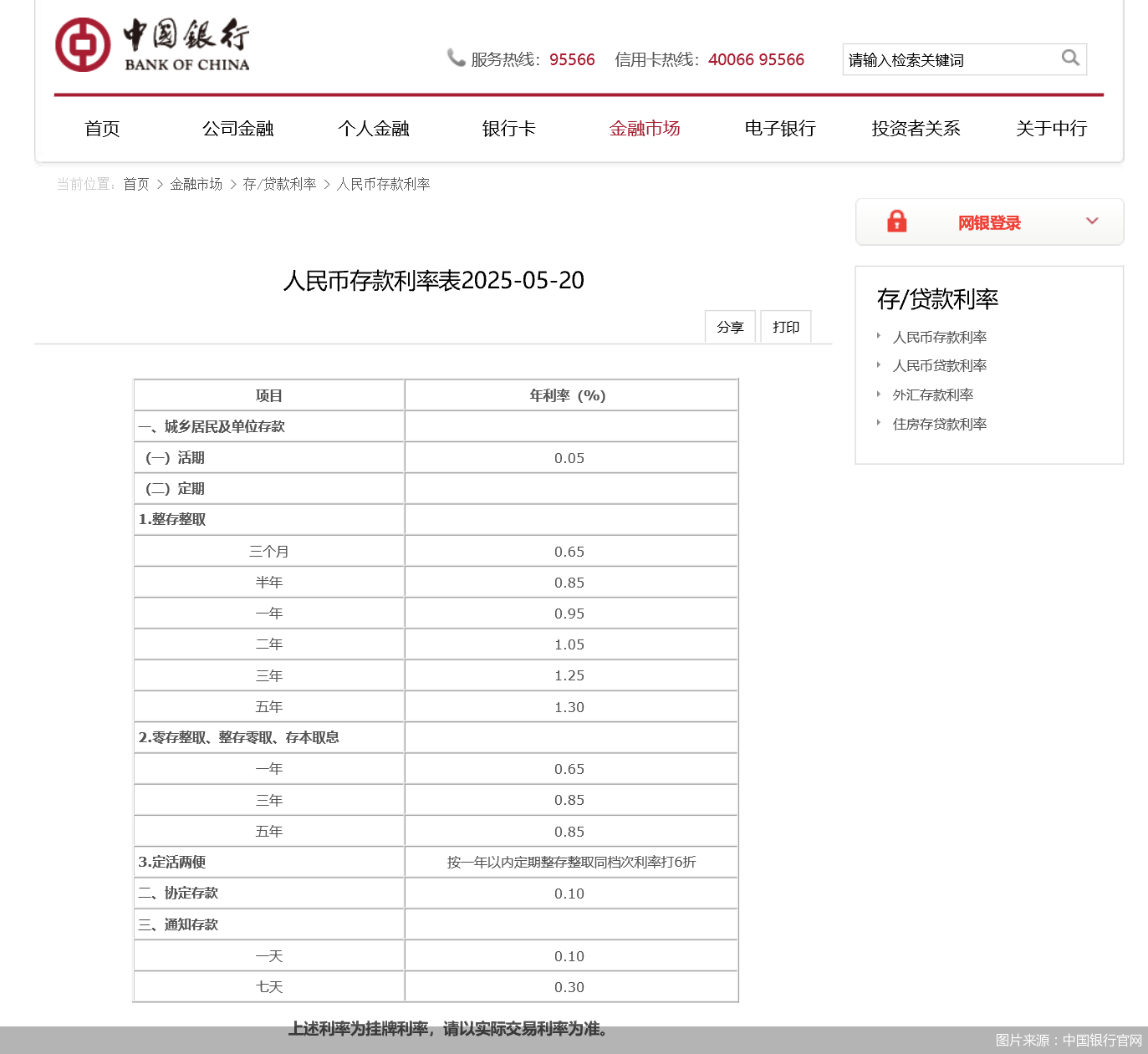
新一轮存款"降息"来了!5月20日,北京商报记者梳理发现,截至目前,已有包括国有六大行、招商银行、光大银行在内的8家银行宣布下调存款挂牌利率, 此次调整涉及活期存款、定期存款和通知存款等多种产品类型,下调幅度为5—25个基点。此次调整既是对人民银行政策利率传导的响应,也旨在缓解银行 净息差持续收窄的压力。分析人士认为,当前净息差处于低位,银行需要保持合理盈利以支撑信贷投放,在适度宽松货币政策导向下,存款利率仍有下调空 间。 | 唄 | 年利率(%) | | --- | --- | | 一、城乡居民及单位存款 | | | (一) 活期 | 0.05 | | (二) 定期 | | | 1.整存整取 | | | 三个月 | 0.65 | | 非年 | 0.85 | | 一年 | 0.95 | | 二年 | 1.05 | | 三年 | 1.25 | | 五年 | 1.30 | | 2.零存整取、整存零取、存本取息 | | | 一年 | 0.65 | | 三年 | 0.85 | | 五年 | 0.85 | | 3.定活两便 | 按一年以内定期整存整取同档次利率打6折 | | 二、协定存款 | 0.10 | | 三、通知 ...


五大国有银行同步下调存款利率 5年期以上LPR降息10基点助力房贷减负
Huan Qiu Wang· 2025-05-20 02:31
【环球网财经综合报道】今日,中国工商银行、农业银行、建设银行、中国银行、交通银行等五大国有商业银行宣布下调人民币存款挂牌利率, 涉及活期、定期整存整取、零存整取、通知存款等多个品种。同日,全国银行间同业拆借中心公布最新贷款市场报价利率(LPR),1年期和5年 期以上LPR均下调10个基点,进一步释放降低实体经济融资成本、提振市场信心的政策信号。 存款利率全面下调 长期定存降幅最大 根据调整方案,五大行活期存款利率由0.10%降至0.05%,下调5个基点;定期存款方面,三个月、半年、一年及二年期利率分别下调15个基点, 调整后依次为0.65%、0.85%、0.95%、1.05%;三年期和五年期利率降幅最大,均下调25个基点至1.25%和1.3%。此次调整后,国有大行存款利率 正式步入"1%时代",长期存款收益缩水显著。 业内人士分析,此次降息是银行应对净息差收窄压力的主动调整。国家金融与发展实验室研究员指出,当前CPI低位运行、企业融资需求待提 振,降低存款利率有助于缓解银行负债端成本,为贷款利率下行释放空间。 房贷利率再降 百万贷款月供减 56 元 同日,5年期以上LPR从3.60%降至3.50%,创历史新低 ...

媒体称多家国有大行将下调存款利率、最高降25基点,本周二公告
Hua Er Jie Jian Wen· 2025-05-19 16:27
Core Viewpoint - The upcoming adjustment in deposit rates will directly impact millions of savers and provide crucial support to the profitability of financial institutions amid ongoing pressure from narrowing net interest margins [1] Group 1: Deposit Rate Adjustments - Major state-owned banks and some joint-stock banks will lower the RMB deposit rates starting May 20, following the central bank's interest rate cut [2] - The highest reduction in deposit rates will be 25 basis points, affecting various types of deposit products, including current, fixed-term, and notice deposits [2] - Specific adjustments include a reduction of 5 basis points for current deposits to 0.05%, and fixed-term deposits will see reductions ranging from 15 to 25 basis points [2] Group 2: Policy Linkage - The deposit rate adjustment is a direct response to the People's Bank of China's (PBOC) recent policy interest rate cut of 10 basis points [3] - The PBOC has indicated that the adjustment in policy rates will guide commercial banks to lower deposit rates through a self-discipline mechanism [3] - The complete interest rate transmission path involves the impact of policy rate adjustments on money market rates, bond market rates, and ultimately on loan and deposit rates [3] Group 3: Banking Profitability - As of Q1, the net interest margin for commercial banks has decreased to 1.43%, down from 1.52% in the previous quarter, significantly below the regulatory acceptable level of 1.8% [4] - The continuous decline in net interest margins poses a severe challenge to the basic profitability of the banking sector [4] - The reduction in deposit rates is expected to alleviate some pressure on banks' interest margins [4] Group 4: Market Expectations - The PBOC is expected to announce a corresponding 10 basis point reduction in the Loan Prime Rate (LPR) on May 20, following the recent policy rate cut [5] - The simultaneous reduction in LPR and deposit rates will help balance the asset and liability sides of the banking system, supporting net interest margins and benefiting the real economy by lowering corporate financing costs [5] Group 5: Impact on Savers - The new round of deposit rate cuts will lower the opportunity cost of holding cash for savers, potentially driving more funds into stock markets, bond markets, and wealth management products [6]
一季度银行业成绩单出炉:核心监管数据向好,“不良”双升
Di Yi Cai Jing· 2025-05-19 12:33
Core Insights - The banking industry in China is showing a trend of "stable growth, structural adjustment, and risk control" as of Q1 2025, with total assets reaching 458.3 trillion yuan, a year-on-year increase of 6.7% [1][2] Asset Quality - The total non-performing loan (NPL) balance increased to 3.4 trillion yuan, up by 157.4 billion yuan from the previous quarter, resulting in a non-performing loan ratio of 1.51%, which is a slight increase of 0.01 percentage points [1][7] - Despite the rise in NPLs, the proportion of special mention loans decreased to 2.18%, indicating a reduction in potential risk loans [8] Regulatory Indicators - Key regulatory indicators such as capital adequacy ratio and provision coverage ratio remain strong, with the capital adequacy ratio at 15.28% and the provision coverage ratio at 208.13% [1][8] - The banking sector's risk resilience is further supported by a decrease in the NPL ratio by approximately 0.1 percentage points year-on-year, alongside a 10 percentage point increase in provision coverage ratio [8] Loan Growth and Focus Areas - The banking sector has shown significant growth in loans to small and micro enterprises, with a balance of 35.3 trillion yuan, reflecting a year-on-year increase of 12.5% [2][3] - Loans in key areas such as technology SMEs and green finance continue to grow at rates higher than the overall loan growth, with growth rates of 12.2% and 9.3% respectively [3] Net Interest Margin - The net interest margin (NIM) for commercial banks has continued to decline, reaching a historical low of 1.43% in Q1 2025, although the year-on-year decline has narrowed compared to previous periods [4][5] - The decline in NIM is attributed to pressures from lower loan pricing and insufficient credit demand, but improvements in liability management have helped mitigate some of these pressures [5][6]
上市银行25Q1业绩总结:其他非息拖累盈利,息差下行压力趋缓
Dongxing Securities· 2025-05-19 07:45
Investment Rating - The report indicates a cautious outlook for the banking sector, with expected revenue and net profit growth rates for listed banks in 2025 projected at approximately -1% and 0% respectively [3][9]. Core Insights - The overall revenue and net profit growth rates for listed banks in Q1 2025 were -1.7% and -1.2% year-on-year, reflecting a decline compared to Q4 2024 [3][9]. - The performance of different types of banks varied significantly, with city and rural commercial banks leading in growth due to improved scale and net interest margin, while state-owned banks showed weaker performance [3][10]. - The net interest margin for listed banks in Q1 2025 was 1.37%, a decrease of 13 basis points year-on-year, but the decline was less severe than in the previous year [3][9]. Summary by Sections Revenue and Profit Overview - Listed banks experienced a decline in revenue and net profit growth rates, with Q1 2025 figures at -1.7% and -1.2% respectively, marking a drop of 1.8 percentage points and 3.5 percentage points from Q4 2024 [3][9]. - The decline in net interest income was attributed to a narrowing interest margin and challenges in volume compensating for price [9]. Asset Quality and Provisioning - The asset quality remained stable, with a decrease in non-performing loan ratios and a reduction in provisioning pressure, as banks continued to report lower provisions in a challenging income environment [3][9]. - The provision coverage ratio for listed banks decreased to 238% in Q1 2025, reflecting a trend of reduced provisioning amid stable asset quality [3][9]. Investment Recommendations - The report suggests that the banking sector's configuration value is enhanced by both fundamental and liquidity factors, with a focus on key index-weighted stocks such as China Merchants Bank and Industrial and Commercial Bank of China [3][9]. - The report highlights the potential for mid-sized banks to attract capital for growth, particularly in the context of capital replenishment and profitability [3][9].



金融监管总局最新发布,释放重要信号
Jin Rong Shi Bao· 2025-05-18 05:02
Core Insights - The banking sector in China shows growth in total assets and financial services, with total assets reaching 458.3 trillion yuan, a year-on-year increase of 6.7% [1] - The balance of inclusive loans to small and micro enterprises reached 35.3 trillion yuan, growing by 12.5% year-on-year, while inclusive agricultural loans increased to 13.7 trillion yuan, up by 795.5 billion yuan since the beginning of the year [1] - The overall asset quality of commercial banks remains stable, but there is an increase in non-performing loans (NPLs) and NPL ratios, with NPLs rising to 3.4 trillion yuan, an increase of 157.4 billion yuan from the previous quarter, and an NPL ratio of 1.51%, up by 0.01 percentage points [1] Regulatory Indicators - The banking capital adequacy ratio and insurance solvency ratio are stable and improving, with the NPL ratio decreasing by approximately 0.1 percentage points year-on-year and the provision coverage ratio increasing by about 10 percentage points [2] - In the first quarter, commercial banks achieved a net profit of 656.8 billion yuan, with both average capital return on equity and average asset return on equity rising, although the net interest margin has narrowed [2] Profit Growth Strategies - To alleviate profit growth pressure, banks should optimize their business structure, enhance investment banking and wealth management, and improve non-interest income ratios [3] - Banks are advised to implement refined pricing management and strengthen risk control to lower credit costs, with the current provision coverage ratio at 208.13% providing a buffer against margin pressure [3] Capital Adequacy - As of the end of the first quarter of 2025, the capital adequacy ratio for commercial banks (excluding foreign bank branches) was 15.28%, with a tier one capital adequacy ratio of 12.18% and a core tier one capital adequacy ratio of 10.70%, all within reasonable ranges but showing a slight decline from the previous quarter [3] - The decline in capital adequacy ratios is attributed to rapid asset expansion, an increase in NPLs, and slowing profit growth, indicating a growing balance pressure between credit expansion and risk resistance [3] Capital Supplementation - Banks are encouraged to actively respond to the pressure of declining capital adequacy ratios by solidifying their capital base, utilizing various channels for capital replenishment, including issuing ordinary shares, preferred shares, and convertible bonds [4] - The Ministry of Finance has announced the issuance of 500 billion yuan in special government bonds to support major banks in replenishing core tier one capital [4] - Banks should enhance internal capital accumulation by improving profitability and optimizing asset structures to focus on high-quality asset investments while reducing high-risk, low-efficiency assets [4][5]
国泰海通证券:银行浮盈被动“兑现”,缺负债明显缓解
Ge Long Hui· 2025-05-16 08:36
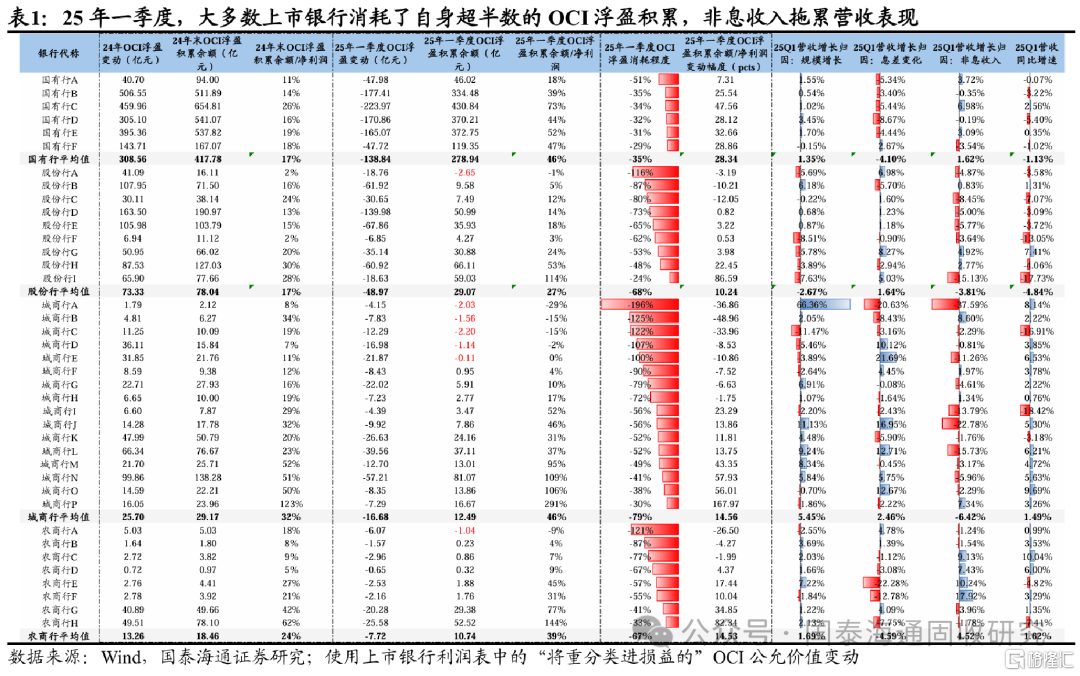
Core Viewpoint - The accumulation of OCI (Other Comprehensive Income) floating profits in banks has been largely consumed, primarily due to passive consumption from a weak bond market rather than active selling by banks. The pressure on net interest margins is mainly observed in large banks, and with the alleviation of the "lack of liabilities" issue in Q2, a clearer bottom for net interest margins is expected [1][15]. Group 1: OCI Floating Profit Consumption - Most banks have consumed over half of their OCI floating profit accumulation, with some banks even turning to floating losses. Among the six major banks, one has consumed about half of its floating profit accumulation, while others have consumed around one-third. In total, 25 out of 33 listed banks have consumed more than half of their OCI floating profits, with 7 turning to floating losses [2][5]. - The low performance of bond market investment returns has significantly dragged down the revenue performance of listed banks. In Q1, non-interest income reduced the revenue growth of joint-stock banks and city commercial banks by 3.81 percentage points and 6.42 percentage points, respectively, while the contribution to rural commercial banks dropped from 7.30 percentage points to 4.52 percentage points [2][5]. Group 2: Net Interest Margin Pressure - The pressure on net interest margins and the resistance to recovery are primarily seen in large banks, which have passively shifted to interbank certificates of deposit and interbank fixed deposits due to a "lack of liabilities" in Q1. The average net interest margin for large banks narrowed by 0.10 percentage points to a low of 1.39% in Q1 [15]. - The alleviation of the "lack of liabilities" pressure and the stabilization of interbank deposit scale and prices are expected to lead to a significant easing of net interest margin narrowing pressure for large banks in Q2, reflecting the effectiveness of previous measures to reduce funding costs [15]. Group 3: Retail Loan Risks - Risks in retail loans remain, with no consistent trend of alleviation observed. Banks with a higher proportion of retail loans face greater difficulty in reducing non-performing loan rates compared to their peers, and the speed of provision consumption is faster [9]. - An analysis of three state-owned banks with retail loan ratios exceeding 50% shows a divergence in the direction and magnitude of changes in provision coverage ratios, the proportion of loans under scrutiny, and non-performing loan rates [9].