
碳中和

Search documents
福斯特涨2.00%,成交额7858.83万元,主力资金净流入200.38万元
Xin Lang Cai Jing· 2026-01-06 02:16
Core Viewpoint - Foster's stock price has shown a slight increase of 2.08% year-to-date, with a notable decline of 10.77% over the past 60 days, indicating potential volatility in the market [2]. Group 1: Financial Performance - For the period from January to September 2025, Foster reported a revenue of 11.788 billion yuan, reflecting a year-on-year decrease of 22.32% [2]. - The net profit attributable to shareholders for the same period was 688 million yuan, down 45.34% compared to the previous year [2]. - Cumulatively, Foster has distributed 3.669 billion yuan in dividends since its A-share listing, with 1.361 billion yuan distributed over the last three years [3]. Group 2: Stock and Market Activity - As of January 6, Foster's stock price was 14.25 yuan per share, with a market capitalization of 37.175 billion yuan [1]. - The trading volume on January 6 reached 78.5883 million yuan, with a turnover rate of 0.21% [1]. - The net inflow of main funds was 2.0038 million yuan, with significant buying and selling activity from large orders [1]. Group 3: Shareholder Structure - As of September 30, 2025, the number of shareholders for Foster was 64,900, a decrease of 9.54% from the previous period [2]. - The average number of circulating shares per shareholder increased by 10.55% to 40,208 shares [2]. - Major shareholders include Hong Kong Central Clearing Limited, which holds 70.465 million shares, a decrease of 25.3784 million shares from the previous period [3].

包钢股份涨2.06%,成交额4.87亿元,主力资金净流入4961.26万元
Xin Lang Zheng Quan· 2026-01-06 02:00
Core Viewpoint - Baosteel Co., Ltd. has shown a mixed performance in stock price and financial results, with a notable increase in net profit despite a decline in revenue [1][2]. Group 1: Stock Performance - On January 6, Baosteel's stock price increased by 2.06%, reaching 2.48 CNY per share, with a trading volume of 4.87 billion CNY and a turnover rate of 0.63%, resulting in a total market capitalization of 112.316 billion CNY [1]. - Year-to-date, Baosteel's stock price has risen by 4.20%, with a 3.33% increase over the last five trading days, a 0.40% increase over the last 20 days, and a 2.36% decline over the last 60 days [1]. Group 2: Financial Performance - For the period from January to September 2025, Baosteel reported an operating revenue of 48.08 billion CNY, a year-on-year decrease of 3.58%, while the net profit attributable to shareholders increased by 145.03% to 233 million CNY [2]. - Since its A-share listing, Baosteel has distributed a total of 4.487 billion CNY in dividends, with 90.577 million CNY distributed over the past three years [3]. Group 3: Shareholder Structure - As of December 19, Baosteel had 869,100 shareholders, a decrease of 2.65% from the previous period, with an average of 36,105 circulating shares per shareholder, an increase of 2.73% [2]. - The second-largest shareholder is China Securities Finance Corporation, holding 767 million shares, while Hong Kong Central Clearing Limited, the third-largest shareholder, reduced its holdings by 574 million shares [3].

德固特涨2.27%,成交额9536.46万元,近5日主力净流入886.96万
Xin Lang Cai Jing· 2026-01-05 19:09
Core Viewpoint - The company, DeGute, is experiencing growth driven by its focus on energy-saving and environmental protection technologies, particularly in the fields of carbon neutrality, waste treatment, and hydrogen energy production [2][3][4]. Group 1: Company Overview - DeGute specializes in the design, manufacturing, and sales of energy-saving and customized equipment, with a revenue composition of 76.84% from energy-saving heat exchange equipment [8]. - The company was established on April 5, 2004, and went public on March 3, 2021, with a current market capitalization of 3.579 billion yuan [8]. - As of December 19, the number of shareholders is 18,200, a decrease of 2.45% from the previous period [9]. Group 2: Financial Performance - For the period from January to September 2025, DeGute reported a revenue of 382 million yuan, a year-on-year decrease of 9.29%, and a net profit attributable to shareholders of 72.26 million yuan, down 26.39% year-on-year [9]. - The company has distributed a total of 87.668 million yuan in dividends since its A-share listing, with 67.668 million yuan distributed over the past three years [10]. Group 3: Market Position and Strategy - DeGute has established a strategic focus on energy conservation and environmental protection since its inception, with a competitive advantage in the field of waste treatment [2][3]. - The company has entered the hydrogen energy production sector, providing energy-saving heat exchange and storage equipment to various clients [2]. - DeGute has been recognized as a "specialized and innovative" small giant enterprise, which signifies its strong market position and technological capabilities [3]. Group 4: Recent Market Activity - On January 5, DeGute's stock rose by 2.27%, with a trading volume of 95.3646 million yuan and a turnover rate of 4.51% [1]. - The company benefits from a 59.28% share of overseas revenue, positively impacted by the depreciation of the yuan [4].
新能源板块全线走强,储能电池ETF易方达(159566)全天净申购达5600万份
Sou Hu Cai Jing· 2026-01-05 12:11
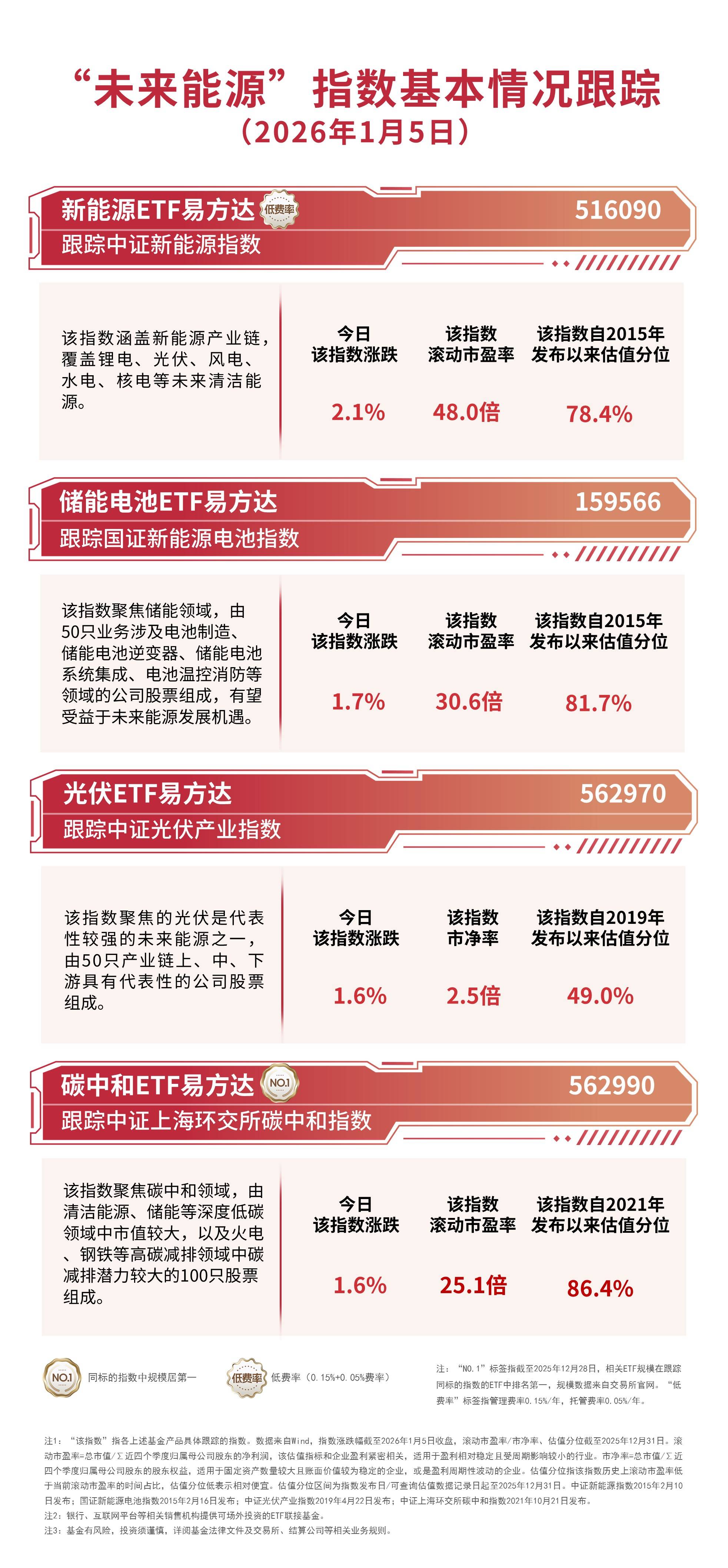
Group 1 - The new energy sector showed strong performance today, with the China Securities New Energy Index rising by 2.1%, the National Securities New Energy Battery Index increasing by 1.7%, and both the China Securities Photovoltaic Industry Index and the China Securities Shanghai Carbon Neutrality Index up by 1.6% [1] - The E Fund Energy Storage Battery ETF (159566) saw a net subscription of 56 million units throughout the day, indicating strong investor interest in related ETFs [1] - Huatai Securities emphasized the importance of accelerating the construction of a new energy system during the 14th Five-Year Plan, focusing on the development of new energy storage and the acceleration of smart grid construction [1] Group 2 - The index focusing on the energy storage sector consists of 50 companies involved in battery manufacturing, energy storage battery inverters, energy storage battery system integration, and battery temperature control and fire protection, which are expected to benefit from future energy development opportunities [4] - The E Fund Photovoltaic ETF tracks the China Securities Photovoltaic Industry Index, which includes 50 representative companies across the upstream, midstream, and downstream of the photovoltaic industry chain [6]

2024 年全球光伏市场进展概述
Xin Lang Cai Jing· 2026-01-05 10:44
Global Photovoltaic Market Overview - In 2024, the global photovoltaic (PV) market is expected to add 530 GW of new installed capacity, a year-on-year increase of approximately 30%, surpassing 2000 GW in cumulative installed capacity [5][42] - China continues to lead the global PV market, contributing over 270 GW of new installed capacity in 2024, with both centralized and distributed PV development [5][42] - The United States is projected to add about 50 GW of new PV capacity in 2024, driven primarily by utility-scale PV projects [5][42] - India is emerging as a significant PV market, setting a record with 30 GW of new installed capacity in 2024, reflecting a 145% year-on-year increase [5][42] - Brazil and Germany are accelerating their PV project layouts, with new installed capacities of 14 GW and 17 GW respectively in 2024 [5][42] - Japan's PV market remains stable, with an expected new installed capacity of 5.5 GW in 2024 [5][42] Key Countries' PV Market Situations China - In 2024, China's new PV installed capacity reached 278 GW, a historical high, with centralized PV contributing 159 GW and distributed PV contributing 118 GW [8][45] - The market share of n-type monocrystalline silicon solar cells increased from 30% in 2023 to over 70% in 2024, becoming the market mainstream [11][48] - By the end of 2024, China's cumulative PV installed capacity exceeded 880 GW [10][48] United States - The U.S. PV market saw a strong growth with 50 GW of new installed capacity in 2024, accounting for 66% of the total new grid capacity [12][49] - The demand for electricity from data centers has surged, reaching 45 GW in 2024, driving continued investment in the PV sector [12][49] - The Inflation Reduction Act (IRA) signed in 2022 supports domestic PV manufacturing and installation through various subsidies [12][49] India - India aims for "energy independence" by 2047, with significant measures to enhance renewable energy utilization [14][51] - The cumulative installed capacity of PV in India reached approximately 61% of its total renewable energy capacity by the end of 2024 [14][51] - The government has introduced several supportive policies, including fixed price purchase systems and substantial subsidies for PV projects [15][52] Brazil - Brazil's new PV installed capacity reached 14 GW in 2024, with a cumulative capacity of about 52 GW, representing 20% of the national power capacity [17][54] - Large-scale PV projects are progressing well, particularly in the northeastern regions, attracting significant investments [17][54] - The government has initiated the "New Industrial Brazil" plan to provide incentives for renewable energy technologies [19][56] Germany - Germany's new PV installed capacity was approximately 17 GW in 2024, with a renewable energy share of 59% in total energy generation [20][57] - The country aims to achieve at least 80% renewable energy in its power supply by 2030 [20][57] - Recent legislative changes have reinforced the priority of renewable energy development in achieving carbon neutrality [21][58] Japan - Japan's PV market is expected to add about 5.5 GW of new capacity in 2024, with a cumulative capacity of around 100 GW [22][59] - The introduction of the Feed-in Premium (FIP) system aims to promote market-driven renewable energy development [22][59] - By 2030, Japan targets a cumulative PV capacity of 129-146 GW to meet its greenhouse gas reduction goals [22][59] Development Trends - In the short term, the global PV market is expected to face challenges in maintaining rapid growth due to various factors, including international trade and market capacity [23][24] - By 2025, the global PV market is projected to reach 580 GW in new installed capacity, with China continuing to hold a significant market share [24][25] - Long-term prospects for the global PV market remain strong, with expectations of reaching 7 TW in cumulative installed capacity by 2030 [25][26]

中国社会科学院国家全球战略智库:在开放合作中推动全球绿色发展
Jing Ji Ri Bao· 2026-01-05 10:21
Core Viewpoint - Green development has become a global consensus, emphasizing the need for cooperation in promoting low-carbon transitions amidst climate change and economic challenges [1] Group 1: Historical Context and Development - Environmental issues have transitioned from the periphery to the mainstream agenda since the 1960s, with significant milestones such as the publication of "Silent Spring" in 1962 and the 1972 UN Conference on the Human Environment [2] - The concept of sustainable development was first articulated in the 1987 report "Our Common Future," leading to frameworks like the 1992 UN Conference on Environment and Development [2] - From the early 2000s to 2015, green trade and clean energy investments surged, with emerging market economies playing a crucial role in global climate negotiations [3] Group 2: Current Trends in Green Development - A comprehensive green low-carbon policy framework is being established globally, with countries setting carbon neutrality goals and developing carbon markets [4] - The scale of green investments is expanding, with global renewable energy investments projected to reach $807 billion in 2024, including solar investments exceeding $554 billion [4] - Green trade is emerging as a new growth point, with exports of solar and wind products expected to reach $443 billion and $245 billion respectively in 2024 [5] Group 3: Regional Practices and Innovations - Different regions are exploring diverse paths for green transformation, with the EU focusing on a market-driven approach and the Asia-Pacific region emphasizing industrial upgrades and financial collaboration [6][7] - Africa is leveraging its renewable energy resources through initiatives like the African Green Energy Initiative, with clean energy investments projected to reach $40 billion in 2024 [8] - Latin American countries are implementing green development plans based on their resource endowments, with Argentina's lithium exports expected to grow by 26% in 2024 [9] Group 4: China's Role in Global Green Development - China is committed to a green low-carbon development path, actively participating in global green governance and contributing to sustainable development [10] - The country has established a comprehensive carbon reduction policy framework and is enhancing its international cooperation in green technology and standards [11] - China's green investment initiatives, such as the "Belt and Road" initiative, are aimed at supporting global green infrastructure and energy projects [12] Group 5: Future Opportunities and Challenges - The urgency of climate change and rising consumer awareness are driving demand for green products, with new growth points emerging in green technology services and carbon trading [13][14] - The transition to a low-carbon economy is expected to increase investment needs across various sectors, including renewable energy and smart transportation [14] - However, international competition in the green sector is intensifying, with trade protectionism and geopolitical tensions posing challenges to global green development [15]
全球石脑油市场迎来三岔路口,2026年供需格局将如何演绎?
Jin Rong Jie· 2026-01-05 09:44
Group 1: Global Market Outlook - The global naphtha market is expected to continue its differentiated trends across Asia, Europe, and the United States by 2026 [1] Group 2: Asia Market Dynamics - In East Asia, capacity optimization adjustments are the core factor affecting demand, with South Korea planning to reduce ethylene capacity by 2.7 to 3.7 million tons per year by 2025 [1] - Japan's naphtha demand is experiencing a steady decline due to low petrochemical product profits and planned facility shutdowns, with the Maruzen Chiba plant set to close its naphtha cracking facility between 2026 and 2027 [1][2] - Uncertainty regarding Russian supply is a significant variable in the Asian market, with buyers reducing purchases of Russian naphtha due to stricter scrutiny since U.S. sanctions began in October 2025 [2] Group 3: European Market Challenges - The European market is facing structural contraction, with traditional oil-based naphtha demand expected to decrease at an average annual rate of 1.2% due to deepening carbon neutrality policies and refinery shutdowns [2] - The EU carbon border tax is projected to increase production costs by $25 per ton, further suppressing demand [2] - However, the demand for aviation fuel blending and the advancement of bio-based naphtha projects may partially offset the downward pressure [2] Group 4: U.S. Market Recovery - The U.S. market is anticipated to see a moderate recovery, with naphtha demand growth expected to rebound to 1.8% due to the easing of ethane substitution effects and the commissioning of new petrochemical projects along the Gulf Coast [3] - Flexible feedstock units are expected to increase naphtha procurement to optimize profits, while stable demand for high-octane gasoline blending supports naphtha consumption [3] - Increased exports of light naphtha from the U.S. to Europe may further stimulate domestic demand [3]
《分布式能源规划员》(综合能源服务方向)培训通知丨系列培训
中国能源报· 2026-01-05 09:35
Core Viewpoint - The article emphasizes the importance of developing distributed energy and integrated energy services as a crucial path towards carbon neutrality, highlighting the need for interdisciplinary talent in energy planning and management [1]. Group 1: Training Information - The training titled "Distributed Energy Planner (Integrated Energy Services Direction)" will be held online from January 14 to 17, 2026 [2]. - The training is organized by the Human Resources and Social Security Department's Social Security Capacity Building Center and hosted by China Energy News Co., Ltd [2]. Group 2: Target Audience - The training is aimed at various stakeholders including provincial and municipal power companies, energy groups, and enterprises involved in renewable energy such as wind, solar, and storage [2]. - It also targets energy service companies, equipment manufacturers, research institutions, and investment firms interested in the integrated energy sector [2]. Group 3: Course Outline - The course will cover an overview of integrated energy services, including its driving forces and current development status both domestically and internationally [3]. - It will include modules on customer demand analysis, distributed photovoltaic projects, natural gas distributed energy applications, smart microgrids, hydrogen energy applications, new energy storage, and zero-carbon factory assessments [4]. Group 4: Training Fees - The training fee is set at 3600 yuan per person, which includes training, materials, and certification costs [5]. Group 5: Contact Information - For inquiries, contact Yang at 15801248899 or Wang at 15201547047 [6].

碳中和50ETF(159861)涨超1.2%,硅基负极技术突破或成电池升级关键
Mei Ri Jing Ji Xin Wen· 2026-01-05 07:08
Group 1 - The core viewpoint is that the solid-state battery industry is accelerating its industrialization process, with innovations in materials and equipment systems [1] - Sulfide electrolytes are expected to become the mainstream route due to their high conductivity and flexibility, with a projected market share exceeding 40% by 2035 [1] - Silicon-based anodes are seen as a development direction in the short to medium term, while lithium metal anodes will be the long-term iteration direction due to their higher energy density [1] Group 2 - China is expected to dominate global solid-state battery production, with an estimated production capacity exceeding 80% by 2025, and current planned and under-construction capacity reaching 85.5 GWh [1] - Demand for power batteries is driving large-scale applications, with the semi-solid state battery installation volume of Weilan New Energy surpassing 1.2 GWh in the first half of 2025 [1] - The cost of sulfide all-solid-state batteries is currently high, but the price of lithium sulfide is expected to decrease by over 60% to 1950 RMB/kg by early 2024, which is crucial for cost reduction [1]
双良节能跌2.14%,成交额4.56亿元,主力资金净流出5416.14万元
Xin Lang Cai Jing· 2026-01-05 05:59
Core Viewpoint - The stock of Shuangliang Energy has experienced a decline of 2.14% on January 5, 2025, with a current price of 6.40 CNY per share and a market capitalization of 11.992 billion CNY, indicating a mixed performance in recent trading days [1]. Group 1: Stock Performance - As of January 5, 2025, Shuangliang Energy's stock has decreased by 2.14% year-to-date, but has increased by 10.73% over the last five trading days, 17.00% over the last twenty days, and 3.56% over the last sixty days [1]. - The trading volume on January 5, 2025, reached 4.56 billion CNY, with a turnover rate of 3.76% [1]. Group 2: Financial Performance - For the period from January to September 2025, Shuangliang Energy reported a revenue of 6.076 billion CNY, a year-on-year decrease of 41.27%, while the net profit attributable to shareholders was -544 million CNY, reflecting a year-on-year increase of 59.42% [2]. - The company has distributed a total of 4.089 billion CNY in dividends since its A-share listing, with 1.16 billion CNY distributed over the past three years [3]. Group 3: Shareholder Information - As of September 30, 2025, the number of shareholders for Shuangliang Energy was 108,500, a decrease of 3.85% from the previous period, with an average of 17,277 circulating shares per shareholder, an increase of 4.01% [2]. - Notable changes in institutional holdings include Hong Kong Central Clearing Limited becoming the fourth largest shareholder with 27.8148 million shares, an increase of 16.8256 million shares from the previous period [3].
