
自动驾驶

Search documents
All in AI!别再把特斯拉看成汽车公司
Hua Er Jie Jian Wen· 2026-02-03 05:34
Group 1 - Deutsche Bank's latest report redefines Tesla as a technology company focused on artificial intelligence, robotics, and autonomous driving, rather than just an automotive company [1] - Tesla plans to increase capital expenditures to over $20 billion, primarily for AI training systems, data centers, custom chips, robotic factories, and new platforms [1][2] - The bank maintains a buy rating on Tesla but lowers the target price from $500 to $480, reflecting more conservative expectations for vehicle sales and new model launches [1] Group 2 - Tesla is undergoing a capital-intensive transformation, with billions allocated for computing infrastructure to support large-scale training for autonomous driving and robotics [2] - The autonomous driving and robotics segments are central to Deutsche Bank's long-term outlook, with expectations of up to $10 billion in annual revenue from the FSD subscription service and over $15 billion from the robotaxi network by the end of the decade [2] - Analysts express cautious optimism regarding Tesla's humanoid robot, Optimus, while acknowledging challenges such as engineering complexity and supply chain issues that may limit short-term production [2] Group 3 - The report highlights several risk factors, including weak demand for electric vehicles, intense competition, high execution barriers in AI and robotics, regulatory scrutiny, and reliance on Elon Musk [3] - Despite these risks, Deutsche Bank believes Tesla's scale, data accumulation, and vertical integration provide a strong competitive advantage if the strategy succeeds [3] - The report positions Tesla as a company undergoing significant transformation, aiming to become a leader in AI-driven mobility and automation, with the potential to reshape multiple industries over the next decade [3]

疯狂!也就2500辆车上路,完成8760亿估值新融资
量子位· 2026-02-03 04:52
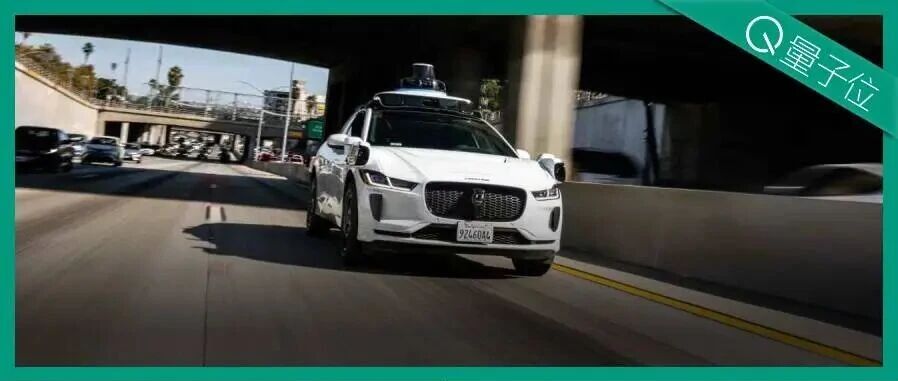
Core Viewpoint - Waymo has successfully completed a financing round of $16 billion, raising its valuation to $126 billion, which is a significant increase of nearly three times compared to 19 months ago [3][11]. Financing Details - The latest financing round raised $16 billion, surpassing the total of previous rounds [7]. - Key investors include Google, Sequoia Capital, Dragoneer Investment Group, and DST Global, with Google reportedly investing $13 billion [9][10]. - Historical financing amounts and valuations are as follows: - March 2020: $3.2 billion, $30 billion valuation - June 2021: $2.5 billion, valuation reportedly halved - July 2024: $5 billion, $45 billion valuation - February 2026: $16 billion, $126 billion valuation [8]. Business Focus - Waymo's current business focus is on global expansion, declaring that the era of large-scale autonomous driving has arrived [4]. - The company aims to enter over 20 cities globally, including London and Tokyo [13]. Robotaxi Performance - Waymo's Robotaxi service has achieved over 400,000 weekly orders across six major U.S. metropolitan areas, with a projected total of 15 million orders for 2025, more than double that of 2024 [13]. - The total autonomous driving mileage has exceeded 200 million kilometers, with a fleet size of approximately 2,500 vehicles [13]. New Business Ventures - Waymo is exploring new business opportunities, including: - Delivery services using Robotaxi for food delivery [15]. - Restarting its Robotruck division for long-haul transportation [18]. - Licensing autonomous driving technology to original equipment manufacturers (OEMs), although this has not yet materialized [20]. Industry Comparison - Other players in the Robotaxi space, such as Loong, WeRide, and Pony.ai, are also making strides in the market, with Loong operating in over 10 cities and achieving significant order volumes [21]. - WeRide is recognized for its diverse product offerings, including Robotaxi and Robobus, with a market capitalization of $2.63 billion [23]. - Pony.ai has also made progress in Robotaxi commercialization, with a market cap of $5.78 billion [25]. Market Valuation Discrepancies - Despite advancements in commercialization, there remains a significant valuation gap between Waymo and its Chinese counterparts, with Waymo's valuation being tenfold or more compared to others [27]. - The recent valuation increase of Waymo raises questions about whether similar re-evaluations should occur for Chinese L4 players [27].

九识智能:致敬百度Apollo开源战略 通过L4技术构建城市运力新基建
Jin Rong Jie· 2026-02-03 04:34
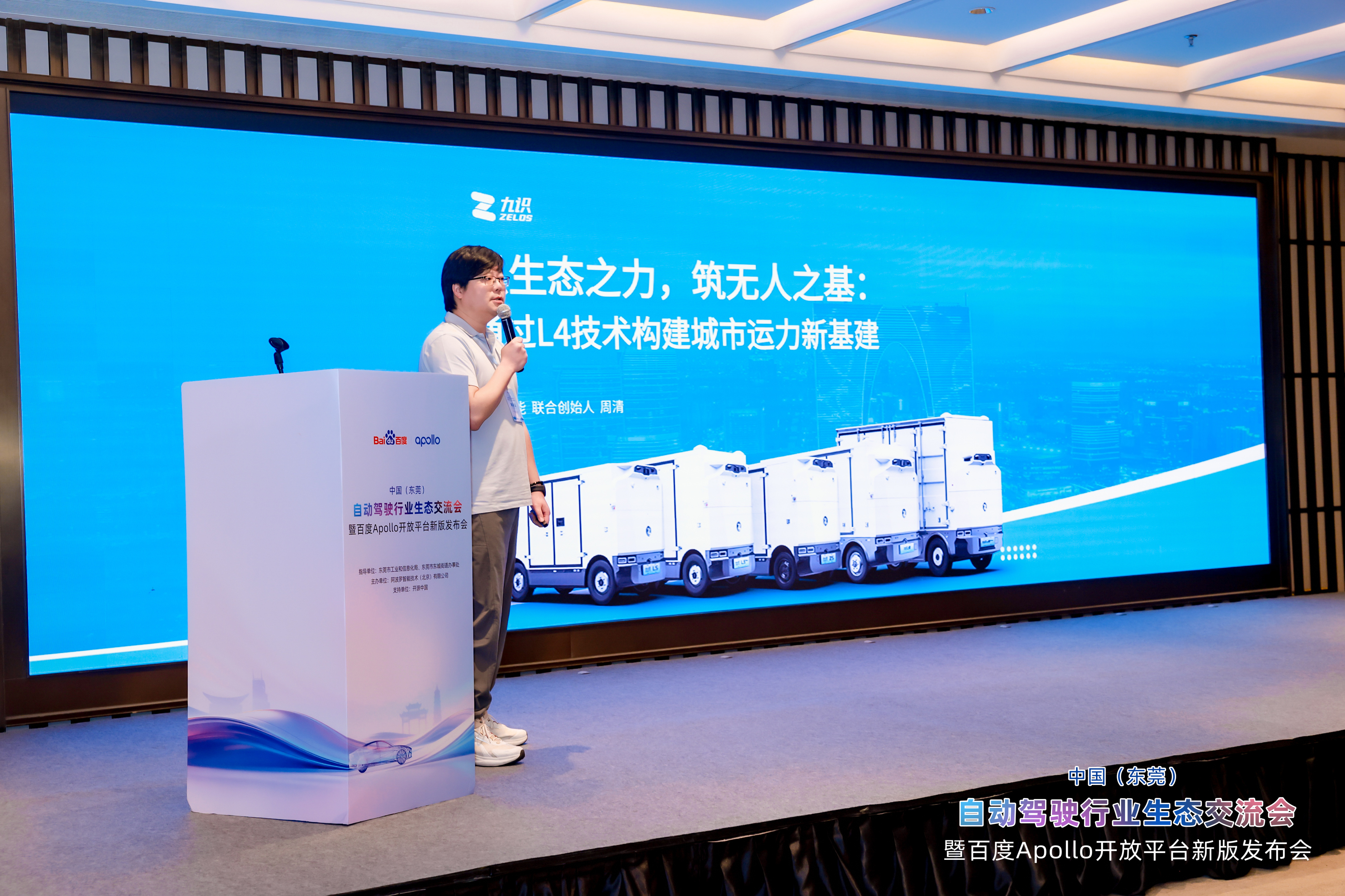
Core Insights - The article discusses the launch of the upgraded Baidu Apollo platform, marking a shift from "technology open-source" to "scenario-driven + ecosystem co-construction" in the autonomous driving sector [1] - Jiushi Intelligent, a leading L4 autonomous delivery vehicle company, emphasizes the rapid commercialization and deployment of unmanned logistics vehicles, which have outpaced smart electric vehicles in achieving L4-level autonomous driving [4][6] Group 1: Industry Development - The global autonomous driving landscape was significantly influenced by Baidu's Apollo project, which initiated a wave of entrepreneurship in the field [5] - The traditional logistics system, based on "manpower + fuel vehicles," is increasingly unable to meet the demands of the booming e-commerce sector, leading to structural inefficiencies [7] - National policies have created a favorable environment for the development of unmanned logistics vehicles, with over 103 cities in China granting road rights for such vehicles [9][10] Group 2: Jiushi Intelligent's Strategy and Achievements - Jiushi Intelligent has developed a comprehensive L4 autonomous driving technology and has deployed over 17,000 vehicles across more than 300 cities globally, achieving over 80 million kilometers of operational mileage [12][20] - The company offers a subscription service for its fully autonomous driving technology, significantly lowering the entry barrier for logistics companies [13] - Jiushi Intelligent has captured a 76% market share among major logistics clients in China and has been selected as a primary supplier for a large-scale procurement project by China Post [20][22] Group 3: Impact on Logistics Efficiency - The introduction of Jiushi Intelligent's unmanned delivery vehicles has led to significant improvements in delivery efficiency, with some clients reporting a 27% increase in delivery performance [16] - The use of these vehicles has also enhanced the logistics experience for rural residents, increasing their online shopping frequency by approximately 30% [18] - Jiushi Intelligent's vehicles have reduced delivery costs by around 60% in certain regions while also contributing to lower carbon emissions through the use of new energy sources [18]

美国自动驾驶公司Waymo完成新一轮融资 投后估值达1260亿美元
Xin Lang Cai Jing· 2026-02-03 04:21
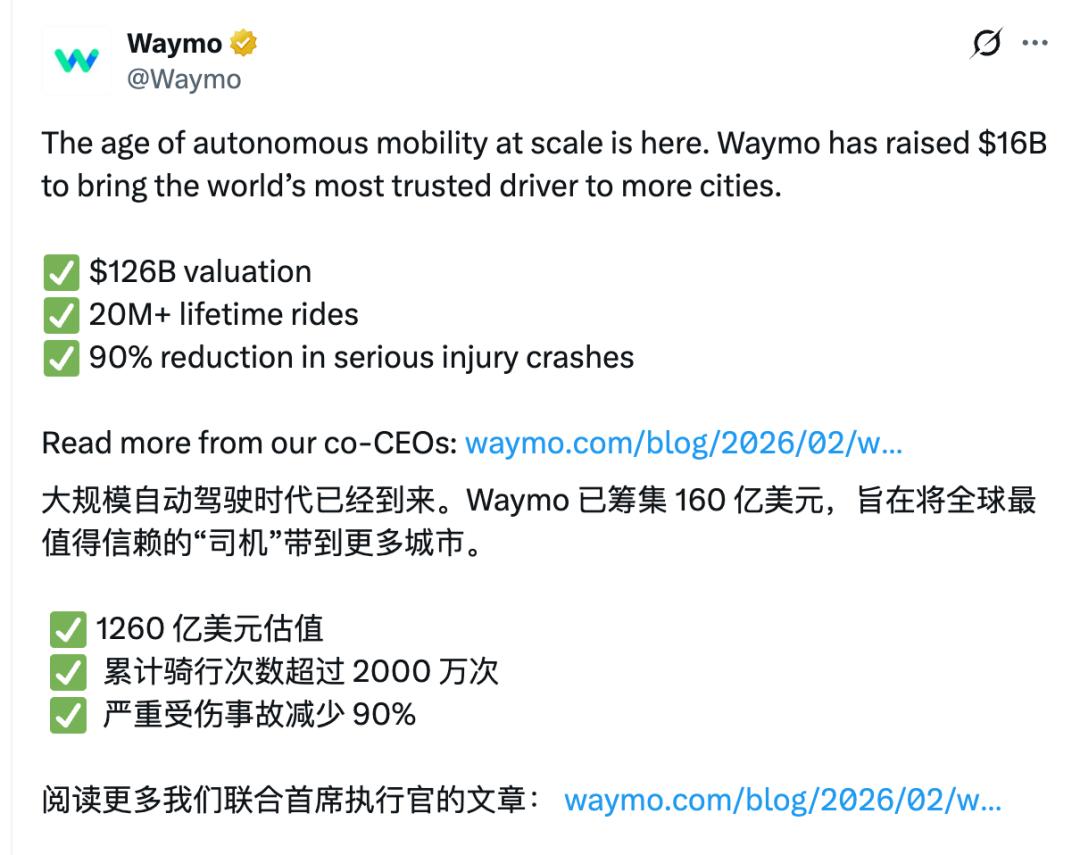
Group 1 - Waymo has raised $16 billion in funding at a valuation of $126 billion, highlighting its rapid rise as a leader in the autonomous taxi service sector [1] - The funding round was led by new investors Sequoia Capital, DST Global, and Dragoneer Investment Group, with Alphabet participating with an investment of $13 billion [1] - Waymo operates fully autonomous ride-hailing services in approximately six cities in the U.S. and plans to accelerate domestic expansion and enter the UK market this year [1] Group 2 - Waymo's per-vehicle cost is estimated to be two to three times that of Tesla's autonomous vehicles, which currently limits the expansion of its fleet size [1]

疯狂,也就2500辆车上路,完成8760亿估值新融资
3 6 Ke· 2026-02-03 04:20
Core Insights - Waymo has successfully raised $16 billion in its latest funding round, significantly increasing its valuation to $126 billion, which is nearly three times its valuation from 19 months ago [1][2][3] - The company aims to focus on global expansion, declaring that the era of large-scale autonomous driving has arrived [1][4] Funding Details - The latest funding round includes major investors such as Google, Sequoia Capital, Dragoneer Investment Group, and DST Global, with Google reportedly investing $13 billion [2][3] - Previous funding rounds included $3.2 billion in March 2020, $2.5 billion in June 2021, and $5 billion in July 2024, with the total amount raised now surpassing previous rounds combined [3] Business Segments - Waymo's operations are divided into two main segments: the core Robotaxi service and new business ventures [4][5] - The Robotaxi service has achieved over 400,000 weekly orders across six major U.S. metropolitan areas, with a projected total of 15 million orders for 2025, more than double that of 2024 [4] New Business Ventures - Waymo is exploring new business opportunities, including food delivery using Robotaxis, where meals are placed in the trunk for customers to pick up [5][7] - The company is also looking to license its autonomous driving technology to original equipment manufacturers (OEMs), although this segment has not yet seen significant progress [7] Market Competition - Other players in the autonomous driving sector, such as RoboTaxi, WeRide, and Pony.ai, are also expanding their operations, with RoboTaxi operating in over 10 cities and achieving significant order volumes [8][11] - Waymo's re-entry into the autonomous trucking market is noted, focusing on long-haul transportation after previously shutting down its truck division due to regulatory challenges [9] Valuation Discrepancies - Despite advancements in autonomous driving, there remains a significant valuation gap between Waymo and its competitors, with Waymo's valuation being tenfold or more compared to others in the market [15] - The recent funding and valuation increase for Waymo may prompt a reevaluation of other players in the autonomous driving space, particularly those in China [15]
异动盘点0203 | MINIMAX-WP早盘涨超12%,工程机械股延续涨势;航空、邮轮等旅游概念股齐升,迪士尼开盘跌7.4%
贝塔投资智库· 2026-02-03 04:02
Group 1 - SF Express (09699) expects a profit of no less than RMB 238 million for the year ending December 31, 2025, representing an increase of at least 80% compared to 2024. Adjusted net profit is projected to be no less than RMB 376 million, a growth of at least 158%, with revenue expected to reach no less than RMB 22 billion, a 40% increase from 2024 [1] - Fuhong Hanlin (02696) shares rose nearly 5% following a successful offline researcher meeting in San Francisco regarding its international multi-center Phase III clinical study for HLX22, a new anti-HER2 monoclonal antibody [1] - Xpeng Motors (09868) saw a decline of over 2.2% as it reported January vehicle deliveries of 20,011 units, a year-on-year decrease of 34.07% and a month-on-month decrease of 46.65% [1] Group 2 - Engineering machinery stocks continued to rise, with Zoomlion (01157) up 7.47% and Sany International (00631) up 3.57%. The total import and export trade of engineering machinery in China for 2025 is projected to be USD 62.743 billion, a year-on-year increase of 13.2% [2] - Ruipu Lanjun (00666) shares increased over 5% after announcing its first profit forecast since listing, expecting a net profit of RMB 630 million to RMB 730 million for the year ending December 31, 2025 [2] - Pony.ai (02026) shares rose over 2.5% following a partnership with Aitbot to build a fully autonomous driving service fleet [2] Group 3 - MINIMAX-WP (00100) shares surged over 12.7% after the release of the MiniMax Music 2.5 audio model, which achieved breakthroughs in "paragraph-level strong control" and "physical-level high fidelity" [3] - China International Marine Containers (02039) shares rose over 12% after discussing its data center business and container manufacturing performance in an investor relations activity [3] Group 4 - WanGuo Gold Group (03939) shares increased over 6.8% after announcing an expected profit of approximately RMB 1.4 billion to RMB 1.5 billion for 2025, a year-on-year increase of about 143% to 161% due to rising sales volume and prices of gold products [4] - Junda Co., Ltd. (02865) shares rose over 13% after completing a placement agreement [4] Group 5 - Carnival Cruise Line (CCL.US) shares rose 8.09% as U.S. House Speaker Mike Johnson expressed confidence in gaining Republican support to end the government shutdown [5] - Major tech stocks like AMD (AMD.US) and Intel (INTC.US) saw gains, with AMD up 4.03% and Intel up 5.04%, following unexpected expansion in U.S. manufacturing activity [5] - The storage sector strengthened, with SanDisk (SNDK.US) up 15.44% as demand for AI and data centers continues to drive price increases in DRAM and NAND Flash products [6] Group 6 - Disney (DIS.US) shares fell 7.4% despite reporting a 5% year-on-year revenue increase to USD 26 billion for Q1 2026, exceeding analyst expectations [7] - Coterra Energy (CTRA.US) shares dropped 3.6% following Devon Energy's announcement of a significant acquisition deal [6] - Oracle (ORCL.US) shares declined 2.75% as the company plans to raise USD 45 billion to USD 50 billion for expanding its cloud infrastructure [8]



国联民生证券:自动驾驶受益于RoboX规模化商用 规模化应用加速
Zhi Tong Cai Jing· 2026-02-03 03:14
Group 1: RoboX Industry Insights - RoboX is accelerating its industrialization, transitioning from technology validation to large-scale deployment, driven by strong policy support and urgent demand for cost reduction and efficiency improvement [1] - Since 2020, the Chinese government has introduced numerous supportive policies, enhancing institutional guarantees for RoboX's development [1] - The penetration rate of L2 and above intelligent functions in passenger vehicles is rapidly increasing, leading to significant cost reductions in core components like lidar and computing chips [1] - The demand for intelligent driving solutions is fueled by multiple factors, including cost reduction, safety enhancement, and labor shortages, positioning RoboX as a core driver of this industrial transformation [1] Group 2: Robotaxi Market Dynamics - Robotaxi's core advantage lies in its significant cost reduction, with operational costs expected to be $0.2 per km by 2027, a 50% decrease compared to traditional ride-sharing platforms [2] - The reduction in human error is anticipated to significantly lower accident rates, enhancing safety, with the global market projected to reach a trillion-dollar scale by 2030 [2] - The decline in hardware costs and improved operational efficiency are key factors driving the commercialization of Robotaxi, with Tesla entering the market using a pure vision approach [2] - Full autonomous commercialization is gradually being implemented in major cities in China, transitioning from technology validation to a commercial closed loop [2] Group 3: Robovan Demand and Supply - The demand for Robovan is driven by labor shortages and high costs in last-mile delivery, making it a critical solution for various high-frequency scenarios [3] - The price of unmanned delivery vehicles is expected to drop significantly from 500,000-600,000 yuan to around 20,000 yuan due to economies of scale in core components [3] - The penetration rate of L2 and above functions in passenger vehicles is projected to exceed 90% by 2030, facilitating the mass production of essential components [3] - Policy support is accelerating with the introduction of hard indicators for deploying unmanned vehicles, promoting the transition from demonstration to large-scale application [3] Group 4: Robotruck Commercialization - Robotruck applications are primarily in closed environments like ports and mines, as well as trunk logistics, with the market size expected to reach a trillion yuan [4] - The successful implementation of L4 in closed scenarios demonstrates the capability for high-intensity operations, while trunk logistics is becoming a core commercial direction [4] - Robotruck utilizes a "virtual driver" to significantly reduce the operating costs of electric tractors, enhancing its commercial viability [4] - National support is clear, but local authorities remain cautious due to the high accident risks associated with heavy trucks, with integrated vehicle-road-cloud trials expected to accelerate cross-province collaboration [4]

Model S/X停产,这次真是资本做局
创业邦· 2026-02-03 03:09
Core Viewpoint - Tesla's annual revenue has declined for the first time, with a 10% year-over-year drop in automotive business deliveries, indicating a shift in focus away from traditional automotive production towards AI and robotics initiatives [6][25]. Group 1: Financial Performance - Tesla's Model S/X will cease production by the end of Q2, with the Fremont production line being repurposed for the Optimus robot, targeting an annual capacity of 1 million units [6][12]. - The sales figures for Model S/X have been low, with projections indicating that by 2025, combined sales for these models will be less than 50,000 units, significantly overshadowed by Model 3/Y's 1,585,300 units [7][14]. - In 2017, Model S/X accounted for 99% of Tesla's deliveries, contributing over $10 billion in revenue, but since then, their importance has diminished as Model 3 and Model Y have taken precedence [14][18]. Group 2: Strategic Shift - Tesla's strategy has focused on reducing production costs to offer cheaper vehicles, contrasting with traditional automakers that cover various price segments [12][13]. - The company's long-term vision, articulated in its Master Plan, emphasizes using profits from higher-priced models to fund the development of more affordable vehicles [13][16]. - The upcoming Cybercab is designed to optimize autonomous driving costs, with a target production cost below $30,000, reflecting Tesla's commitment to cost efficiency [21][26]. Group 3: Market Perception and Future Outlook - The capital market's focus has shifted from Tesla's automotive performance to its AI and robotics initiatives, with investors showing less concern for declining vehicle sales [25][26]. - Following the latest earnings report, analysts adjusted their price targets based on AI-related developments, with optimistic views on Robotaxi and FSD services, while some expressed concerns over high capital expenditures [27][28]. - Tesla's future plans include significant investments in AI infrastructure and robotics, indicating a strategic pivot away from traditional automotive manufacturing [30][31].
日经BP精选:Waymo新款自动驾驶出租车采用极氪的车辆
日经中文网· 2026-02-03 02:53
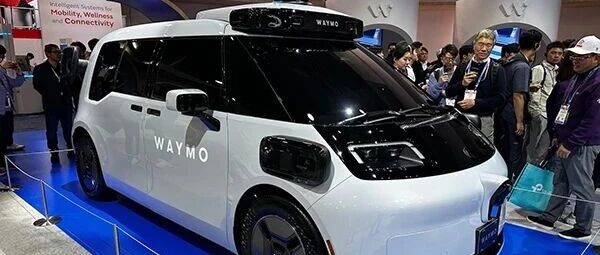
Core Viewpoint - Waymo, a subsidiary of Alphabet, is set to expand its autonomous taxi business with the introduction of a new electric MPV model named "Waymo Ojai," which features advanced automation and a reduced number of cameras [5]. Group 1: Company Overview - Waymo is a leader in the autonomous driving sector and is leveraging partnerships to enhance its vehicle offerings [5]. - The new model "Waymo Ojai" is based on the high-end electric vehicle brand Zeekr, owned by China's Geely Holding Group, showcasing international collaboration in the EV market [5]. Group 2: Product Details - The "Waymo Ojai" model will be unveiled at CES 2026 in Las Vegas, emphasizing its role in the future of autonomous transportation [5]. - The vehicle will be produced at a new factory in Mesa, Arizona, where Waymo's sixth-generation autonomous driving system, "Waymo Driver," will be installed [5]. - The model was previously referred to as "Zeekr RT" and is expected to hit the roads in 2026, marking a significant step in Waymo's vehicle lineup [5].
千里科技20260202
2026-02-03 02:05
Summary of Qianli Technology Conference Call Company Overview - Qianli Technology has transitioned from a traditional motorcycle and passenger vehicle manufacturer to an AI-driven automotive technology company, introducing new shareholders such as Geely Group and rebranding itself. [4] - The company focuses on smart driving, intelligent cockpits, and Robot Taxi businesses, marking a significant strategic shift. [2] Key Developments - Qianli Technology and Geely jointly launched the "Qianli Haohan" autonomous driving solution, covering levels L2 to L4, and showcased new autonomous driving products at CES. [2][6] - The company has partnered with Cao Cao Mobility to actively develop the Robot Taxi sector. [2][6] - The intelligent cockpit has integrated an AI Agent version capable of understanding complex commands, with rapid revenue growth in new business segments, although profit scalability is still developing. [2][7] Financial Performance - Post the 2024 equity restructuring, Qianli Technology's financial situation has improved significantly, with profits rising from 24 million yuan in 2023 to 40 million yuan in 2024, and reaching 53 million yuan in the first three quarters of 2025, surpassing the total for 2024. [8] - The gross margin remains stable, and the expense ratio is well-controlled, indicating a positive outlook for new business segments as key growth drivers. [8] Industry Trends - The automotive industry is expected to focus on robotics, smart driving, high-end products, and international expansion by 2026, with significant growth anticipated in the smart driving sector. [3] - Autonomous driving technology is maturing, with notable reductions in hardware and software costs, and several regions have begun conditional testing for L3 autonomous driving. [9] Market Dynamics - The smart driving support market is dominated by OEMs and third-party suppliers, with companies like Momentan and Huawei holding 60% and 21% market shares, respectively. Qianli Technology collaborates with Geely and Chongqing Maichi to offer L2 to L4 level smart driving solutions. [11] - The penetration rate of L2 and above smart driving models reached 65.38% in 2025, with a projected global market size of approximately 300 billion yuan by 2025, expanding to 844.8 billion yuan by 2030, with China expected to account for 33.2% of the global market. [10] Robot Taxi Sector - The Robot Taxi industry is anticipated to experience significant growth in 2026, with major players including Tesla, Xiaopeng, and mobility platforms like Cao Cao Mobility. [13] - Qianli Technology plans to deploy over 1,000 Robot Taxis in 10 cities globally within the next 18 months, leveraging strategic partnerships and support from Geely Group. [14] Investment Outlook - Despite its current focus on traditional vehicle manufacturing, Qianli Technology's transformation into a technology company is expected to reshape its valuation. Revenue projections for 2025 to 2027 are estimated at 8.681 billion, 10.495 billion, and 12.415 billion yuan, respectively, with an average annual growth rate of 20%. [15]
