
贸易投资一体化

Search documents
“促进贸易投资一体化”鱼你在一起携加盟商出海
Sou Hu Wang· 2025-12-11 03:14
Core Insights - The Malaysian Chinese cuisine market is experiencing significant growth, particularly in the fast-casual segment represented by dishes like sour fish, with a projected market size of $23.95 billion by 2029 and a compound annual growth rate (CAGR) of 12.81% from 2024 to 2029 [1] - The local Chinese restaurant market is highly fragmented with low chain penetration, presenting substantial consolidation opportunities for established Chinese chain brands [1] - Recent policy signals emphasize a structured and collaborative approach to overseas expansion, moving from individual brand efforts to partnerships with franchisees for mutual success [1] Market Trends - The Malaysian restaurant service market is expected to grow significantly, attracting attention from domestic investors [1] - A delegation of Chinese restaurant franchisees and investors recently conducted a four-day field study in Malaysia to explore real opportunities and foster collaboration [1] Investment Opportunities - The Malaysian government offers incentives such as up to 70% corporate tax relief for five years, making it an attractive destination for Chinese restaurants [5] - Observations from local malls showed high local customer engagement, indicating that the business is not solely reliant on tourists [8] Successful Business Models - The "Yummy Together" brand has established a replicable business model in Malaysia, with franchisees reporting high turnover rates and successful operations [11] - The brand provides comprehensive support to franchisees, including site selection, product development, and employee training, which lowers operational barriers for new entrants [13] Strategic Vision - The mission of "Yummy Together" includes empowering franchisees and investors, transitioning from individual expansion to a collaborative approach [15] - This model of "brand platform and franchisee performance" may offer a sustainable new paradigm for the globalization of Chinese cuisine [15]


江小涓:国内体制改革不到位,开放就不能放开步伐
和讯· 2025-12-01 10:52
Core Viewpoint - The article emphasizes the importance of expanding institutional openness and promoting bilateral investment cooperation as outlined in the "Suggestions for Formulating the 15th Five-Year Plan for National Economic and Social Development" by the Central Committee of the Communist Party of China [2][3] Group 1: Institutional Openness - Institutional openness requires alignment with high-standard international trade agreements, which is both an opening and a reform process [4][6] - The main features of institutional openness include proactive alignment with international high-standard trade rules across various sectors such as property rights protection, industrial subsidies, environmental standards, labor protection, government procurement, e-commerce, and finance [6][7] Group 2: Bilateral Investment Cooperation - The article highlights the need to expand the space for bilateral investment cooperation and promote the integration of trade and investment, guiding the reasonable and orderly cross-border layout of industrial and supply chains [2][3][10] - The Comprehensive and Progressive Agreement for Trans-Pacific Partnership (CPTPP) is cited as a reference for high-standard international rules, covering aspects like tariff and market access, service trade, e-commerce, intellectual property protection, and environmental standards [5][6] Group 3: Domestic Reform Coordination - Domestic reforms must be coordinated with institutional openness; without adequate domestic reforms, the pace of opening cannot be accelerated [8][9] - The article discusses the negative impacts of imbalances in domestic economic variables and market distortions on international investment behaviors [9][10] Group 4: Equal Treatment of Cross-Border Flows - The article advocates for equal treatment of goods and factor flows across borders, emphasizing the importance of both exports and imports in promoting development and cooperation [11][12] - It also stresses the equal importance of foreign investment and outward investment, as well as the dual flow of technology, which is crucial for enhancing domestic industry competitiveness [12][13]

21社论丨中国正以更自信的态度推动开放
21世纪经济报道· 2025-11-03 23:28
Core Viewpoint - The "15th Five-Year Plan" emphasizes the importance of expanding domestic demand and building a strong domestic market, while also promoting international circulation and sharing opportunities with the world [1][3]. Group 1: Domestic Market and Demand - The plan highlights the strategic importance of expanding domestic demand, leveraging China's large population of over 1.4 billion and more than 400 million middle-income groups, which contribute nearly 50 trillion RMB in consumption and over 20 trillion RMB in imports annually [1]. - The "15th Five-Year Plan" aims to further enlarge China's super-large market, promoting a strong domestic circulation [1]. Group 2: International Trade and Investment - The plan advocates for a balanced development of trade and investment, focusing on market diversification and the integration of domestic and foreign trade [3]. - It proposes to enhance bilateral investment cooperation, attract foreign investment, and promote orderly cross-border layout of industrial and supply chains [3]. - The plan also emphasizes the internationalization of the RMB and the establishment of a self-controlled cross-border payment system, reflecting a proactive approach compared to previous plans [3]. Group 3: Service Trade Development - Service trade is identified as a key area for development, with a focus on expanding market access and encouraging service exports [2]. - The plan aims to improve the management of cross-border service trade and enhance the standardization of service trade [2]. - China's service industry is currently lagging behind in comparison to its global trade and manufacturing sectors, but recent efforts are being made to relax restrictions in telecommunications, internet, education, culture, and healthcare [2]. Group 4: Global Economic Engagement - China is adopting a more confident approach to opening its market, providing development opportunities for other countries while also increasing outbound investments [4]. - The country aims to share its market and technological advantages with the world, promoting a fair and cooperative international economic order [5].

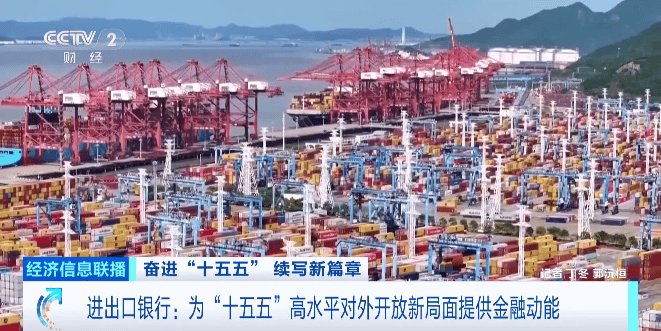
进出口银行:为“十五五”高水平对外开放新局面提供金融动能
Sou Hu Cai Jing· 2025-11-01 14:59
Group 1 - The "14th Five-Year Plan" emphasizes the need to actively expand autonomous openness, promote trade innovation, and enhance bilateral investment cooperation [1][3] - The Export-Import Bank of China will increase resource investment to support high-quality development of foreign trade [3][5] - The bank aims to provide better financial services to export-oriented, private, and small and micro enterprises, while also expanding trade in intermediate goods, green trade, service trade, and digital trade [5][9] Group 2 - The plan requires the expansion of bilateral investment cooperation and the integration of trade and investment, guiding the rational and orderly cross-border layout of industrial and supply chains [7] - The Export-Import Bank will leverage its role as a policy bank to increase medium- and long-term loan disbursements, supporting traditional industry upgrades and the growth of emerging industries [9] - High-quality co-construction of the "Belt and Road" initiative and the improvement of a multi-dimensional connectivity network are also key tasks outlined in the "14th Five-Year Plan" [11][13]
截至7月中国对上合组织其他成员国 投资存量超840亿美元
Zhong Guo Zheng Quan Bao· 2025-08-27 20:39
Group 1 - The 2025 Shanghai Cooperation Organization (SCO) Summit will be held in Tianjin from August 31 to September 1, 2025, highlighting the ongoing investment cooperation between China and SCO member countries [1] - As of July 2025, China's investment stock in other SCO member countries exceeds $84 billion, with cooperation expanding from traditional sectors like oil and gas to emerging fields such as digital economy and green development [1] - China has signed investment protection agreements with all member countries, including upgraded agreements with Russia, Kazakhstan, and Tajikistan, enhancing mutual investment protection and improving investment access [1] Group 2 - Trade between China and other SCO member countries reached a record high of approximately $512.4 billion in 2024, a 2.7% increase year-on-year, doubling the trade volume since the 2018 Qingdao Summit [2] - In the previous year, China imported nearly $90 billion worth of oil, natural gas, and coal from SCO member countries, with energy products accounting for about one-fifth of China's total imports [2] - The establishment of a connectivity network among SCO countries is rapidly progressing, with significant infrastructure projects like the China-Russia Tongjiang Railway Bridge and the China-Kyrgyzstan-Uzbekistan Railway [2] Group 3 - Following the Tianjin Summit, the Ministry of Commerce will send a delegation to Russia for the 24th SCO Economic Ministers' Meeting on September 6, focusing on implementing the economic outcomes from the Tianjin Summit [2] - Future regional economic cooperation within the SCO will focus on integrated trade and investment development, deepening international supply chain cooperation, and enhancing connectivity [2]
截至7月中国对上合组织其他成员国投资存量超840亿美元
Zhong Guo Zheng Quan Bao· 2025-08-27 20:17
Group 1 - The 2025 Shanghai Cooperation Organization (SCO) Summit will be held in Tianjin from August 31 to September 1, 2025, highlighting the ongoing investment cooperation between China and SCO member countries [1] - As of July 2025, China's investment stock in other SCO member countries exceeds $84 billion, with cooperation expanding from traditional sectors like oil and gas to emerging fields such as digital economy and green development [1] - China has signed investment protection agreements with all member countries, including upgraded agreements with Russia, Kazakhstan, and Tajikistan, enhancing mutual investment protection and improving investment access [1] Group 2 - Trade between China and other SCO member countries reached a record high of approximately $512.4 billion in 2024, representing a year-on-year increase of 2.7%, and is double the trade volume during the 2018 Qingdao Summit [2] - In the previous year, China imported nearly $90 billion worth of oil, natural gas, and coal from other member countries, with energy products accounting for about one-fifth of China's total imports [2] - The connectivity network between China and SCO countries is rapidly forming, with significant infrastructure projects like the China-Russia Tongjiang Railway Bridge and the China-Kyrgyzstan-Uzbekistan Railway underway [2] Group 3 - Following the Tianjin Summit, the Ministry of Commerce will send a delegation to Russia for the 24th SCO Economic Ministers' Meeting on September 6, focusing on implementing the economic outcomes from the Tianjin Summit [3] - Future regional economic cooperation within the SCO will focus on integrated trade and investment development, deepening international supply chain cooperation, and enhancing connectivity [3] - The Ministry of Commerce aims to further improve the regional economic cooperation framework by upgrading trade and investment agreements with more member countries and promoting the coordinated development of goods, services, and digital trade [3]
商务部:研究推进上合组织贸易投资一体化发展
2 1 Shi Ji Jing Ji Bao Dao· 2025-08-27 12:13
Core Viewpoint - The upcoming Shanghai Cooperation Organization (SCO) summit in Tianjin in 2025 is expected to be the largest since the organization's inception, presenting significant opportunities for regional economic cooperation [1] Trade Cooperation - In 2024, trade between China and other SCO member countries is projected to reach approximately $512.4 billion, marking a 2.7% year-on-year increase and doubling the trade volume from the 2018 Qingdao summit [2] - China imported nearly $90 billion worth of oil, natural gas, and coal from other member countries last year, along with $13.66 billion in agricultural products, with energy imports accounting for about one-fifth of China's total imports [2] - Exports of electromechanical products from China to SCO member countries amounted to $210 billion, representing 63% of total exports [2] Investment Cooperation - Investment cooperation among SCO member countries is deepening, with China signing investment protection agreements with all member states and upgrading investment agreements with Russia, Kazakhstan, and Tajikistan [3] - As of July 2025, China's total investment stock in other member countries exceeds $84 billion, with cooperation expanding from traditional sectors like oil and gas to emerging fields such as digital economy and green development [3] Connectivity Projects - Significant progress has been made in connectivity projects, including the successful operation of the China-Central Asia natural gas pipeline and the China-Russia oil and gas pipeline [3] - Infrastructure projects like the China-Russia Tongjiang Railway Bridge and the Heihe Highway Bridge have been completed, and the China-Europe Railway Express has operated over 110,000 trains, ensuring stable regional supply chains [3] Future Cooperation Initiatives - The Ministry of Commerce plans to send a delegation to Russia for the upcoming SCO Economic Ministers' meeting to discuss the implementation of agreements reached at the Tianjin summit [4] - Future initiatives for enhancing regional economic cooperation include integrated trade and investment development, deepening international supply chain cooperation, and improving the regional economic cooperation framework [5] - The SCO member countries share common development goals and cooperation intentions, aiming to implement the economic outcomes achieved at the Tianjin summit [5]