
AI工厂

Search documents
一文读懂老黄ComputeX演讲:这不是产品发布,这是“AI工业革命动员令”
华尔街见闻· 2025-05-19 13:50
Core Viewpoint - Nvidia is transitioning from a technology company to an AI infrastructure company, marking the beginning of a new era of AI factories that utilize energy as input and produce tokens as output, representing a third infrastructure revolution following electricity and the internet [3][2]. Group 1: AI Infrastructure and Chip Platforms - Nvidia introduced the Grace Blackwell GB200 chip and NVLink architecture, which features a core interconnect module with a bandwidth of 130 TB/s, surpassing the entire internet's data throughput [4]. - The GB200 chip integrates 72 GPUs and is designed to perform at the level of the 2018 Sierra supercomputer [4]. - Nvidia plans to launch the GB300 chip in Q3, which will enhance inference performance by 1.5 times, increase HBM memory by 1.5 times, and double network bandwidth while maintaining physical compatibility with the previous generation [6]. Group 2: NVLink Fusion and Ecosystem - The NVLink Fusion architecture allows seamless integration of CPUs/ASICs/TPUs from other manufacturers with Nvidia GPUs, enabling a "semi-custom infrastructure" [8]. - This technology addresses communication speed issues between GPUs and CPUs in AI servers, providing up to 14 times the bandwidth compared to standard PCIe interfaces, thus enhancing scalability and energy efficiency [10]. Group 3: Personal Supercomputing and Enterprise AI - The DGX Spark personal AI computer is set to launch soon, targeting AI researchers who wish to own their supercomputers [12]. - Nvidia's RTX Pro enterprise AI server supports traditional IT workloads and can run graphical AI agents, indicating a shift towards integrating AI into the workforce [14]. Group 4: Robotics and AI Applications - Nvidia is developing robotic systems alongside the automotive industry, utilizing the Isaac Groot platform powered by the Jetson Thor processor, aimed at applications from autonomous vehicles to human-machine systems [18]. - The company believes that robotics will become a trillion-dollar industry, emphasizing the need for scalable solutions [22]. - Nvidia is collaborating with DeepMind and Disney Research to develop the advanced physics engine Newton, which will be open-sourced in July [23].



扶持“新势力”、牵手“国家队”,英伟达对“最大客户”时刻提防
Hua Er Jie Jian Wen· 2025-05-18 06:43
Core Strategy - Nvidia is actively pursuing a diversification strategy to reduce its reliance on major tech giants like Microsoft, Amazon, and Google [1][5] - The company is establishing "sovereign AI" partnerships with countries such as Saudi Arabia and the UAE, aiming to create new revenue streams outside of traditional tech clients [1][2] Sovereign AI Initiatives - Nvidia has secured a multi-billion dollar chip deal with Saudi Arabia's Humain and is collaborating with the UAE to build one of the largest data centers globally [2] - These sovereign AI projects are a crucial part of Nvidia's strategy to diversify its customer base, with multiple governments expressing interest in procuring chips for similar initiatives [2] Support for New Cloud Platforms - Nvidia is supporting emerging cloud platforms like CoreWeave, Nebius, Crusoe, and Lambda, positioning them as competitors to established giants like AWS, Azure, and Google Cloud [3] - These new cloud partners gain priority access to Nvidia's internal resources, including consulting teams for data center optimization [3] Market Outlook - Nvidia's CEO Jensen Huang expressed increased confidence in business opportunities beyond major cloud service providers, predicting that every industry will have its own "AI factory" [4] - This shift represents potential sales opportunities worth hundreds of billions of dollars [4] Competitive Landscape - Despite its diversification efforts, Nvidia's recent regulatory filings indicate continued reliance on a limited number of clients, primarily large tech companies [5] - These tech giants are developing their own AI chips, posing a challenge to Nvidia's market dominance, particularly with Amazon entering the AI training space [5]
腾讯研究院AI速递 20250514
腾讯研究院· 2025-05-13 15:57
Group 1: OpenAI Developments - OpenAI has launched a new PDF export feature for Deep Research, which supports tables, images, and clickable reference links, receiving positive feedback from users [1] - This update marks the first action under the new head of the application division, Fidji Simo, indicating OpenAI's acceleration towards enterprise market transformation [1] - The competition among AI research assistants is intensifying, shifting from feature comparison to optimizing user experience and workflow integration, with PDF export becoming a basic requirement for enterprise-level AI tools [1] Group 2: Lovart Design Agent - Lovart is the first design-specific agent that can generate design specifications, images, and execute plans based on professional design knowledge [2] - The product supports a full design workflow, integrating various tools to convert static images into dynamic videos [2] - This signifies a major transformation in design workflows, moving from mere creation to complete product asset delivery, with vertical agents likely becoming a trend in the industry [2] Group 3: Kunlun Wanwei's Matrix-Game - Kunlun Wanwei has open-sourced Matrix-Game, an interactive world model capable of generating coherent game interaction videos based on user input, surpassing existing open-source models in visual quality and physical consistency [3] - The model employs a two-phase training process and a unique architecture for high-precision action response and scene generalization [3] - This represents a significant breakthrough in spatial intelligence, applicable not only in game development but also in film, advertising, and XR content production [3] Group 4: Tencent's Unified Reward Model - Tencent has launched the UnifiedReward-Think, a unified multi-modal reward model with long-chain reasoning capabilities, enhancing evaluation ability through a three-phase training process [4][5] - This model addresses the limitations of existing reward models, demonstrating explicit and implicit reasoning capabilities, significantly improving performance in image generation and understanding tasks while maintaining high interpretability [5] - UnifiedReward-Think has been fully open-sourced, marking a shift from simple scoring systems to intelligent evaluation systems with cognitive understanding [5] Group 5: Manus AI's Free Access - Manus AI has removed the invitation system, allowing free access for all users, with each user receiving daily free task credits and a one-time bonus [6] - The platform offers three paid subscription tiers, unlocking additional features and priority services, while free credits are valid for one day only [6] - Manus AI recently completed a $75 million funding round, raising its valuation to $500 million, with plans to expand into overseas markets [6] Group 6: US AI Regulation Changes - The US Department of Commerce has repealed the Biden-era AI diffusion rules, citing concerns over innovation and diplomatic relations, while proposing new simplified regulations [7] - The new rules will strengthen controls on overseas AI chip exports, particularly targeting Huawei's Ascend chips, and may push tech giants towards Chinese AI technologies [7] - Saudi Arabia has pledged to invest $600 billion in various sectors, including AI data centers, leading to a surge in tech stocks like NVIDIA [7] Group 7: OpenAI's HealthBench - OpenAI has introduced the HealthBench, a medical evaluation benchmark developed with the participation of 262 doctors, containing 5,000 real dialogues for comprehensive AI model assessment [8] - The latest model, o3, scored 60%, significantly outperforming earlier GPT models, with notable performance improvements in smaller models and reduced costs [8] - The project has been open-sourced, providing a complete evaluation tool that aligns model scoring with physician judgments [8] Group 8: NVIDIA's AI Factory Vision - NVIDIA's CEO Jensen Huang believes AI factories will lead the next industrial revolution, with plans to invest $50-60 billion in building large-scale AI factories over the next decade [9] - AI is seen as a true digital labor force expansion, impacting nearly all industries and becoming a new generation of infrastructure following information and energy [9] - NVIDIA is transitioning from a chip company to an AI infrastructure company, investing $20-30 billion annually in R&D to establish global AI ecosystem standards [9] Group 9: Future of AI Agents - OpenAI aims to develop ChatGPT into a personalized AI service, with predictions of widespread AI agent applications by 2025 and capabilities for knowledge discovery by 2026 [10] - The team focuses on maintaining an efficient structure and rapid iteration, positioning itself as a core AI subscription service provider [10] - Different age groups perceive AI applications differently, with younger generations viewing AI as an operating system [10]
科技晚报AI速递:今日科技热点一览 丨2025年5月1日
Xin Lang Cai Jing· 2025-05-01 13:24
Group 1: AI and Technology Developments - Nvidia CEO Jensen Huang urged the Trump administration to revise AI chip export regulations, highlighting that China's AI technology is rapidly catching up and that current restrictions harm U.S. competitiveness [1] - OpenAI's GPT-4o faced criticism for being overly agreeable, prompting a rollback to address concerns about AI's emotional responses and the risk of misinformation [2] - Microsoft launched the Phi-4 reasoning model series, which includes three versions designed for complex reasoning tasks, outperforming some larger models in various tests [3] Group 2: Legal and Regulatory Challenges - A U.S. federal judge ruled that Apple violated a 2021 court order by not allowing external payment options in its App Store, indicating potential adjustments in Apple's payment policies to mitigate legal risks [1] - Google CEO Sundar Pichai warned that a proposed antitrust measure requiring the sharing of search data could have devastating effects on Google's search business, potentially stifling innovation and compromising user privacy [4] Group 3: Market Dynamics and Employment Trends - Shopify's CEO announced a mandate for all employees to utilize AI, marking a significant shift towards AI-driven operations and potentially leading to job cuts, as the U.S. white-collar job market faces its lowest recruitment levels in 12 years [4] - Ele.me entered the competitive landscape of food delivery with a substantial subsidy plan, aiming to regain market share amidst aggressive competition from JD and Meituan [5] Group 4: Advancements in AI Models - DeepSeek released the DeepSeek-Prover-V2 mathematical reasoning model, showcasing significant improvements in reasoning capabilities and marking a shift towards structured logical reasoning in AI [6]
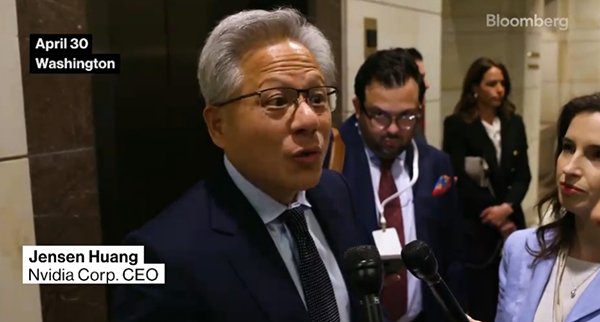
黄仁勋劝特朗普:AI芯片出口规则得改,中国紧追其后
Xin Lang Cai Jing· 2025-05-01 07:24
Core Viewpoint - Nvidia's CEO Jensen Huang emphasizes the need for the U.S. government to revise chip export regulations to accelerate the global dissemination of American AI technology, highlighting that China is not lagging in AI development [1][2][4]. Group 1: Nvidia's Position and Actions - Nvidia has become one of the most valuable tech companies globally by selling AI chips, but U.S. export controls have restricted its ability to sell advanced products to China since 2022 [1][4]. - Huang criticized the Biden administration's export rules, suggesting that limiting sales to China threatens U.S. technological leadership and hinders American companies' growth [4][5]. - Huang plans to attend a closed-door meeting with the U.S. House Foreign Affairs Committee to discuss Nvidia's compliance with export controls [4]. Group 2: China's AI Development - Huang acknowledges that China is emerging as a strong competitor in technology, with local companies making significant advancements in computing and software capabilities, driving AI development [2][4]. - He asserts that China is not behind but is very close to the U.S. in AI technology [2]. Group 3: Future of AI and Manufacturing - Huang envisions a future where AI is integral to manufacturing, proposing the concept of an "AI factory" that serves as a one-stop shop for AI chips, software, and infrastructure [5]. - He believes that the ongoing construction of AI-enabled data centers will create new job opportunities across various sectors [5]. Group 4: Government Relations and Investments - Huang praises the Trump administration's efforts to revitalize U.S. manufacturing, stating that it is crucial for Nvidia's development of next-generation technologies [6]. - Nvidia recently announced a $500 billion investment plan to build AI infrastructure in the U.S., which received positive remarks from Trump [5][6].
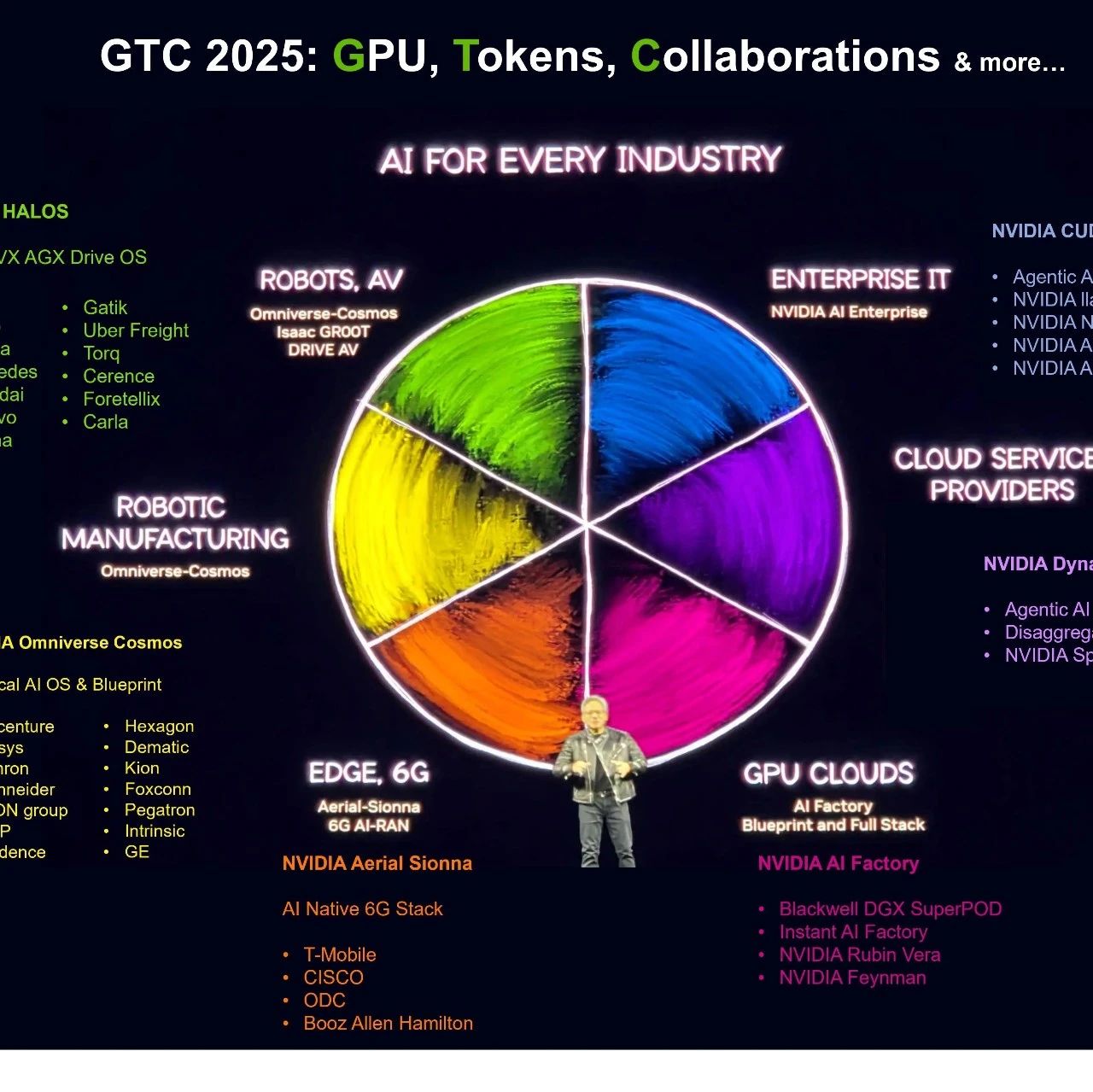
NVIDIA GTC 2025:GPU、Tokens、合作关系
Counterpoint Research· 2025-04-03 02:59
Core Viewpoint - The article discusses NVIDIA's advancements in AI technology, emphasizing the importance of tokens in the AI economy and the need for extensive computational resources to support complex AI models [1][2]. Group 1: Chip Developments - NVIDIA has introduced the "Blackwell Super AI Factory" platform GB300 NVL72, which offers 1.5 times the AI performance compared to the previous GB200 NVL72 [6]. - The new "Vera" CPU features 88 custom cores based on Arm architecture, delivering double the performance of the "Grace" CPU while consuming only 50W [6]. - The "Rubin" and "Rubin Ultra" GPUs will achieve performance levels of 50 petaFLOPS and 100 petaFLOPS, respectively, with releases scheduled for the second half of 2026 and 2027 [6]. Group 2: System Innovations - The DGX SuperPOD infrastructure, powered by 36 "Grace" CPUs and 72 "Blackwell" GPUs, boasts AI performance 70 times higher than the "Hopper" system [10]. - The system utilizes the fifth-generation NVLink technology and can scale to thousands of NVIDIA GB super chips, enhancing its computational capabilities [10]. Group 3: Software Solutions - NVIDIA's software stack, including Dynamo, is crucial for managing AI workloads efficiently and enhancing programmability [12][19]. - The Dynamo framework supports multi-GPU scheduling and optimizes inference processes, potentially increasing token generation capabilities by over 30 times for specific models [19]. Group 4: AI Applications and Platforms - NVIDIA's "Halos" platform integrates safety systems for autonomous vehicles, appealing to major automotive manufacturers and suppliers [20]. - The Aerial platform aims to develop a native AI-driven 6G technology stack, collaborating with industry players to enhance wireless access networks [21]. Group 5: Market Position and Future Outlook - NVIDIA's CUDA-X has become the default programming language for AI applications, with over one million developers utilizing it [23]. - The company's advancements in synthetic data generation and customizable humanoid robot models are expected to drive new industry growth and applications [25].
黄仁勋年度演讲来了,Scaling Law失效只是假象,推理需求暴涨100倍,AI模型优化迎来新挑战|GTC 2025
AI科技大本营· 2025-03-19 01:49
作者 | 王启隆 出品 | CSDN(ID:CSDNnews) 北京时间 3 月 19 日凌晨,NVIDIA GTC 2025 的主会开场演讲来了! 在黄仁勋的这场演讲前,英伟达股票还是 119.53 美元 。刷推的时候又发现,马斯克的 Grok AI 都 在和网友们吐槽英伟达今年开年不济,相当艰难,需要一场演讲拯救股市,振奋投资者。还有些直 播,直接开了个股市页面实时盯着 NVDA 涨涨停停,画面相当喜感。 两小时的演讲结束后,股价居然还跌了将近 3%…… 今年的演讲主题是「 AI 工厂 」。 英伟达创始人兼 CEO 黄仁勋身穿标志性的皮衣,潇洒上台。 下面先简单总结演讲的内容有哪些(正好黄仁勋自己在最后强调了一遍本次主会的 五大亮点 ),后 文我们再来个 "事无巨细"的 全面回顾 ,带大家云体验一遍全程。 Blackwell 全面投入生产 第一代 Blackwell 芯片还没热乎,英伟达就推出了下一代 Blackwell Ultra,旨在 提升训练和扩展 推理能力。主会上展示了两个版本: 顺带一提,看外媒的现场返图,英伟达这次在 GTC 大会会馆前 摆了个摊卖煎饼 ,黄仁勋 亲自上阵 边吃边卖, 里面穿着 ...