新能源

Search documents
硅宝科技(300019.SZ):公司未与马斯克团队接触交流
Ge Long Hui· 2026-02-09 07:23
Core Viewpoint - Silicon Treasure Technology (300019.SZ) is positioned as a leading company in the organic silicon sealing materials industry, focusing on technological innovation and product development to meet market demands [1] Group 1: Company Overview - The company’s products are widely used across various segments of the new energy industry, including power generation, transmission, and storage [1] - The rapid development of related industries is expected to bring significant growth prospects and opportunities for the entire market [1] Group 2: Market Engagement - The company has not engaged in any communication with Elon Musk's team [1] - The company will closely monitor market dynamics and actively seize development opportunities [1]

新能源周报:节前宏观情绪趋弱,商品价格巨震-20260209
Guo Mao Qi Huo· 2026-02-09 06:19
1. Report Industry Investment Rating - The investment ratings for industrial silicon, polysilicon, and lithium carbonate are "oscillation" for industrial silicon and lithium carbonate, and "wait - and - see" for polysilicon [7][8][73] 2. Report's Core View - Before the holiday, the macro - sentiment weakened, and commodity prices fluctuated greatly. For industrial silicon, the supply in the northwest decreased, and demand entered the off - season, with both supply and demand decreasing and prices expected to oscillate. For polysilicon, the existing contracts have poor liquidity, and investors are advised to be cautious. For lithium carbonate, the pre - holiday restocking is basically completed, and attention should be paid to the battery rush - to - export market from after the holiday to the end of the first quarter [2][7][8][73] 3. Summary by Relevant Catalogs 3.1 Industrial Silicon (SI) 3.1.1 Supply - The national weekly output was 63,300 tons, a week - on - week decrease of 14.05%. The number of open furnaces nationwide was 178, a decrease of 32 compared to the previous week. In January, the output was 375,500 tons, a month - on - month decrease of 5.44% and a year - on - year increase of 23.48%. The planned output in February is 273,700 tons, a month - on - month decrease of 27.12% and a year - on - year decrease of 5.63%. In the main producing areas, Xinjiang's weekly output was 38,500 tons, a week - on - week decrease of 20.86%, and the number of open furnaces decreased by 29. Yunnan's weekly output was 4,100 tons, a week - on - week decrease of 4.67%, and the number of open furnaces decreased by 2 [7] 3.1.2 Demand - For polysilicon, the weekly output was 19,200 tons, a week - on - week decrease of 0.05%. The factory inventory was 330,400 tons, a week - on - week decrease of 0.51%. The profit per ton was about 6,124 yuan, a week - on - week decrease of 642 yuan/ton. In January, the output was 100,800 tons, a month - on - month decrease of 12.73% and a year - on - year increase of 6.78%. The planned output in February is 79,700 tons, a month - on - month decrease of 20.93% and a year - on - year decrease of 11.54%. For organic silicon, the DMC weekly output was 41,300 tons, a week - on - week decrease of 1.90%. The factory inventory was 39,500 tons, a week - on - week decrease of 2.47%. The gross profit per ton was 1,956.25 yuan, a week - on - week increase of 97 yuan/ton. In January, the output was 203,900 tons, a month - on - month decrease of 4.85% and a year - on - year decrease of 7.61%. The planned output in February is 171,000 tons, a month - on - month decrease of 16.14% and a year - on - year decrease of 14.29% [7] 3.1.3 Inventory - The visible inventory was 506,500 tons, a week - on - week increase of 0.16%, with fluctuations and a year - on - year decrease of 29.00%. The industry inventory was 422,900 tons, a week - on - week decrease of 3.76%. Among them, the market inventory was 187,000 tons, a week - on - week decrease of 1.06%, and the factory inventory was 235,900 tons, a week - on - week decrease of 5.79%. The warehouse receipt inventory was 83,700 tons, a week - on - week increase of 26.12%, with inventory accumulation [7] 3.1.4 Cost and Profit - The national average cost per ton was 9,065 yuan, a week - on - week increase of 0.15%. The gross profit per ton was - 47 yuan, a week - on - week decrease of 36 yuan/ton. In the main producing areas, the gross profit decreased. The average gross profit per ton in Xinjiang and Yunnan was 263 yuan/ton and - 460 yuan/ton respectively, a decrease of 50 yuan/ton and 92 yuan/ton compared to the previous week [7] 3.1.5 Investment View and Trading Strategy - The investment view is "oscillation". Considering the high level of visible inventory, the impact of changes in supply and demand is weakened, and prices are expected to oscillate. The trading strategy for the single - side is "oscillation", and attention should be paid to the disturbances of large - scale plant production reduction and resumption and environmental protection policy changes [7] 3.2 Polysilicon (PS) 3.2.1 Supply - The national weekly output was 19,200 tons, a week - on - week decrease of 0.05%. In January, the output was 100,800 tons, a month - on - month decrease of 12.73% and a year - on - year increase of 6.78%. The planned output in February is 79,700 tons, a month - on - month decrease of 20.93% and a year - on - year decrease of 11.54% [8] 3.2.2 Demand - The weekly output of silicon wafers was 10.70 GW, a week - on - week decrease of 1.02%. The gross profit per GW was - 31,587 yuan, a week - on - week decrease of 15,495 yuan. The factory inventory was 28.32 GW, a week - on - week increase of 3.77%. In January, the silicon wafer output was 45.93 GW, a month - on - month increase of 4.62% and a year - on - year decrease of 0.15%. The planned output in February is 45.31 GW, a month - on - month decrease of 1.35% and a year - on - year decrease of 6.23%. In December 2025, the new installed capacity was 40.18 GW, a year - on - year decrease of 43.30% and a month - on - month increase of 82.47%. The total installed capacity in 2025 was 315.07 GW, a year - on - year increase of 13.67% [8] 3.2.3 Inventory - The factory inventory was 330,400 tons, a week - on - week decrease of 0.51%, with fluctuations. The registered warehouse receipts were 25,830 tons, a week - on - week increase of 17.62%, with continuous increase [8] 3.2.4 Cost and Profit - The national average cost per ton was 43,876 yuan, a week - on - week decrease of 0.51%. The gross profit per ton was 6,124 yuan, a week - on - week decrease of 642 yuan [8] 3.2.5 Investment View and Trading Strategy - The investment view is "wait - and - see". The existing contracts have poor liquidity, and investors should pay attention to price fluctuations and liquidity risks and participate with caution. The trading strategy for the single - side is "wait - and - see", and attention should be paid to the disturbances of large - scale plant production reduction and resumption and anti - involution policy changes [8] 3.3 Lithium Carbonate (LC) 3.3.1 Supply - The national weekly output was 20,700 tons, a week - on - week decrease of 3.82%. The weekly output of lithium extraction from spodumene was 12,454 tons, a week - on - week decrease of 5.96%. The weekly output of lithium extraction from lepidolite was 2,922 tons, a week - on - week increase of 3.18%. The weekly output of lithium extraction from salt lakes was 3,130 tons, a week - on - week decrease of 2.34%. In January, the lithium carbonate output was 97,900 tons, a month - on - month decrease of 1.31% and a year - on - year increase of 0.00%. The planned output in February is about 81,900 tons, a month - on - month decrease of 16.31% and a year - on - year increase of 27.92% [73] 3.3.2 Import - In December, the import volume of lithium carbonate was 24,000 tons, a month - on - month increase of 8.77% and a year - on - year decrease of 14.43%. Among them, the import volume from Chile was 13,500 tons, a month - on - month increase of 24.96% and a year - on - year decrease of 41.74%. In December, Chile's exports of lithium carbonate to China were 8,100 tons, a month - on - month decrease of 45.07% and a year - on - year decrease of 39.60%. In December, the import volume of lithium concentrate was 628,000 tons, a month - on - month decrease of 7.31% and a year - on - year increase of 30.22%. Among them, the import volume from Australia was 309,500 tons, a month - on - month decrease of 27.18% and a year - on - year increase of 1.89%. The import volume from Zimbabwe was 130,900 tons, a month - on - month increase of 21.15% and a year - on - year increase of 39.50% [73] 3.3.3 Demand - For lithium iron phosphate materials, the weekly output was 97,700 tons, a week - on - week decrease of 1.96%. The factory inventory was 95,000 tons, a week - on - week decrease of 1.85%. In January, the output was 396,600 tons, a month - on - month decrease of 1.81% and a year - on - year increase of 57.00%. The planned output in February is 354,000 tons, a month - on - month decrease of 10.74% and a year - on - year increase of 54.94%. For ternary materials, the weekly output was 18,500 tons, a week - on - week increase of 2.89%. The factory inventory was 18,200 tons, a week - on - week decrease of 2.40%. In January, the output was 81,100 tons, a month - on - month decrease of 0.89% and a year - on - year increase of 48.50%. The planned output in February is about 69,300 tons, a month - on - month decrease of 14.58% and a year - on - year increase of 43.45%. In December, the production volume of new energy vehicles was 1.718 million, a month - on - month decrease of 8.60% and a year - on - year increase of 12.29%. The sales volume was 1.71 million, a month - on - month decrease of 6.18% and a year - on - year increase of 7.14%. In December, the penetration rate of new energy vehicles was 52.26%, a month - on - month decrease of 0.90 pct. In November, the export volume of new energy vehicles was 300,000, a month - on - month increase of 17.19% and a year - on - year increase of 261.45%. In the first quarter, due to the preferential purchase tax for new energy vehicles and the withdrawal of national subsidies, combined with the pre - placement of demand in December, the production and sales of new energy vehicles may decrease month - on - month. In 2025, the total winning bid power/scale for energy storage was 77.69 GW/203.4 GWh, a cumulative year - on - year increase of 89.72%/123.98% [73] 3.3.4 Inventory - The social inventory (including warehouse receipts) was 105,500 tons, a week - on - week decrease of 1.88%, with continuous inventory reduction. The inventory of lithium salt factories was 18,400 tons, a week - on - week decrease of 3.40%. The inventory of downstream sectors (cathode material factories, battery factories, and traders) was 87,100 tons, a week - on - week decrease of 1.55%. Among them, the inventory of cathode material factories was 43,700 tons, a week - on - week increase of 7.53%, and the inventory of battery factories + traders was 43,500 tons, a week - on - week decrease of 9.25%. The warehouse receipt inventory was 33,800 tons, a week - on - week increase of 11.80% [73] 3.3.5 Cost and Profit - For lithium extraction from purchased ores, the cash production cost of lithium extraction from lepidolite was 140,070 yuan/ton, a week - on - week decrease of 8.57%. The production profit was - 1,420 yuan/ton, a week - on - week decrease of 10,391 yuan/ton. The cash production cost of lithium extraction from spodumene was 138,941 yuan/ton, a week - on - week decrease of 11.27%. The production profit was 3,100 yuan/ton, a week - on - week decrease of 6,103 yuan/ton. For integrated lithium extraction, the cash production cost of lithium extraction from lepidolite was 63,218 yuan/ton, and the cash production cost of lithium extraction from spodumene was 55,276 yuan/ton [73] 3.3.6 Investment View and Trading Strategy - The investment view is "oscillation". Affected by the weakening of macro - sentiment and the chain reaction of liquidity before the holiday, the price of lithium carbonate fluctuated greatly. In the short term, the pre - holiday stocking demand of downstream enterprises is basically completed, and the pre - holiday market may be dull. Attention should be paid to the battery rush - to - export market from after the holiday to the end of the first quarter. The trading strategy for the single - side is "oscillation", and attention should be paid to the disturbances of ore - end production reduction, environmental protection policy changes, and the disturbances of large - scale power plants [73]
周期淬炼龙头韧性,永臻股份多维蓄力拓新程
Quan Jing Wang· 2026-02-09 05:42
Core Viewpoint - The photovoltaic industry is undergoing a phase of adjustment, and companies are focusing on how to navigate through cycles, accumulate momentum, and explore new opportunities [1] Group 1: Company Performance - Yongzhen Co., a leading manufacturer of aluminum alloy structural components, expects a net profit of -235 to -175 million yuan for 2025, reflecting the industry's overall performance during this cyclical adjustment [1] - Despite the challenging environment, Yongzhen has expanded its market share in the photovoltaic sector, leveraging its advantages in cost control, financial strength, and capacity layout [1] Group 2: Strategic Initiatives - Yongzhen's strategic initiatives include a stock incentive plan with clear shipment targets, indicating management's confidence in the long-term growth prospects of its photovoltaic business [1] - The company has established a production base in Vietnam, which has significantly higher profitability compared to domestic operations, and is expected to contribute strong profit potential moving forward [2] Group 3: Diversification and New Ventures - Yongzhen's acquisition of Zhejiang Jienow Automotive Lightweight Technology Co. allows it to enter the thermal management liquid cooling sector, expanding its applications in electric vehicle battery trays and liquid cooling systems [3] - The company is also investing in a new energy storage project in Inner Mongolia, which is expected to benefit from stable revenue models and long-term policy support [3] Group 4: Emerging Technologies - Yongzhen is becoming a key supplier in the humanoid robotics sector, leveraging its expertise in aluminum alloy materials to supply critical components [4] - The company plans to collaborate with downstream clients to innovate new materials for robotics, positioning itself for future growth as the industry moves towards mass production [4] Group 5: Industry Outlook - The photovoltaic industry is expected to recover as supply-demand structures improve through capacity control, price stabilization, and innovation [1] - Yongzhen's diverse business layout and strategic foresight are being re-evaluated in the context of energy transition and industrial upgrades, providing a model for other companies navigating similar challenges [4]
国证国际港股晨报-20260209
国投证券(香港)· 2026-02-09 05:35
Group 1: Market Overview - The Hong Kong stock market indices experienced a decline, with the Hang Seng Index falling by 1.21%, the Hang Seng China Enterprises Index down by 0.68%, and the Hang Seng Tech Index decreasing by 1.11% [2] - Despite the drop in Hong Kong stocks, there is an expectation for a rebound following a strong performance in the US stock market, where the Dow Jones rose by 2.47%, reaching a historical high [4] - The trading volume in the Hong Kong market decreased to HKD 247.9 billion, with short-selling accounting for approximately 22.16% of the total [2] Group 2: Sector Performance - Large tech stocks faced pressure, with sectors such as mobile gaming, cloud computing, and AI applications showing weakness [3] - Conversely, the lithium battery and new energy vehicle sectors performed well, with NIO-SW forecasting its first quarterly profit in Q4 2025, boosting the automotive supply chain [3] - Consumer-related sectors, including tea beverages, dairy products, and tobacco, showed increased activity ahead of the Lunar New Year, indicating a rise in consumer demand [3] Group 3: Company Analysis - Geely Automobile - Geely Automobile reported a significant increase in January export sales, with total sales reaching 270,000 units, a year-on-year increase of 1%, and export sales soaring by 121% to 61,000 units [7] - The main brand, Lynk, and Zeekr brands showed varied performance, with Zeekr achieving a 100% increase in sales, highlighting its competitive edge in the high-end market [7] - Geely's AI and intelligent driving technologies are leading in the industry, with the introduction of the World Action Model (WAM) and the G-ASD intelligent driving solution, aiming for advanced autonomous driving capabilities [9] Group 4: Future Outlook - Geely is expected to see strong sales growth across its brands, supported by increased exports and a favorable product cycle, with a target price set at HKD 26 and a buy rating maintained [9]
科创板系列指数集体走强,科创50ETF易方达(588080)上周净流入近10亿元
Mei Ri Jing Ji Xin Wen· 2026-02-09 05:24
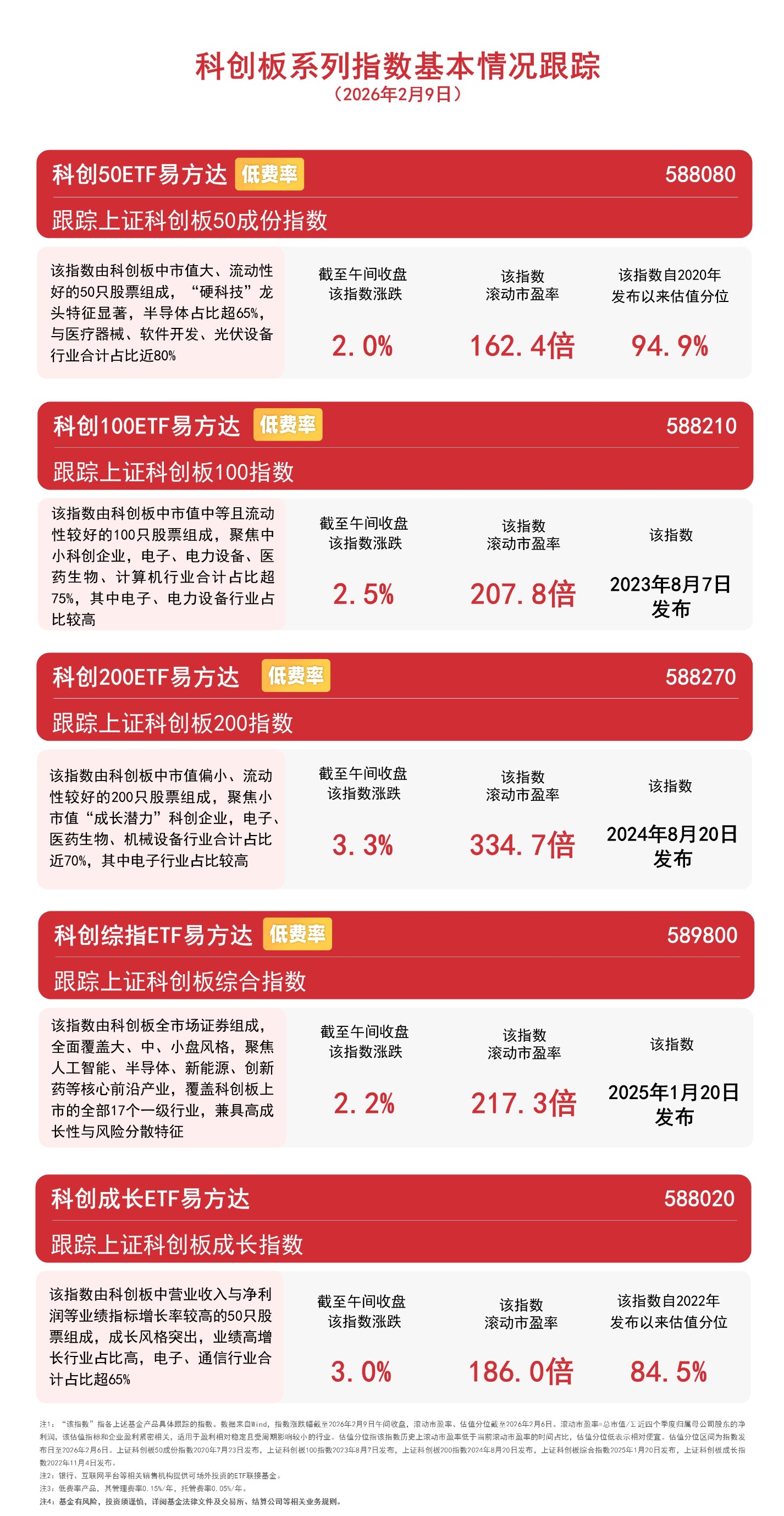
Group 1 - The article discusses the performance and characteristics of various ETFs tracking the STAR Market indices, highlighting their focus on high-growth sectors such as semiconductors, medical devices, and software development [2][3] - The STAR 50 ETF tracks the STAR Market 50 Index, which consists of 50 stocks with large market capitalization and good liquidity, with over 65% of its composition in the semiconductor sector [2] - The STAR 100 ETF follows the STAR Market 100 Index, focusing on medium-sized innovative companies, with over 75% of its composition in electronics, power equipment, and pharmaceutical industries [2] - The STAR 200 ETF tracks the STAR Market 200 Index, which includes 200 smaller-cap stocks, emphasizing growth potential, with a significant portion in electronics and biomedical sectors [2] - The STAR Composite Index ETF covers the entire STAR Market, focusing on core industries like artificial intelligence and new energy, and includes all 17 primary sectors listed on the STAR Market [3] - The STAR Growth ETF tracks the STAR Market Growth Index, consisting of 50 stocks with high growth rates in revenue and net profit, with over 65% in electronics and communications sectors [3] Group 2 - As of the midday close on February 9, 2026, the STAR 50 Index increased by 2.0%, while the STAR 100 Index rose by 2.5% [2] - The STAR Composite Index saw a rise of 2.2%, and the STAR Growth Index increased by 3.0% as of the same date [3] - The rolling price-to-earnings (P/E) ratios for the STAR 50, STAR 100, STAR 200, STAR Composite, and STAR Growth indices are reported at 207.8, 162.4, 217.3, and 186.0 times, respectively [2][3]

E目了然丨资源为王时代,有色指数投资该如何参与?
Xin Lang Cai Jing· 2026-02-09 05:13
Core Insights - The global demand for non-ferrous metals is expanding, driven by industries such as new energy, artificial intelligence, and high-end manufacturing, leading to a strategic shift in these metals from traditional cyclical commodities to essential assets in emerging technologies [1] - The supply of mineral resources is constrained due to long extraction cycles and low supply elasticity, resulting in a growing supply-demand gap [1] - The restructuring of global supply chains and adjustments in resource pricing power have made the non-ferrous metal sector a focal point for capital market investments [1] Summary by Category Definition and Categories of Non-Ferrous Metals - Non-ferrous metals encompass all metals except for iron, manganese, and chromium, forming a diverse family with extensive applications across various sectors of the economy [2] - They can be categorized into five core types based on their properties and applications, with distinct price-driving logic: precious metals (gold, silver) are driven by safe-haven attributes and inflation resistance; industrial metals (copper, aluminum, zinc, lead) are linked to macroeconomic recovery; energy metals (lithium, cobalt, nickel) are essential for new energy technologies; rare metals (rare earths, tungsten, molybdenum) are critical for high-end manufacturing and defense; and minor metals (germanium, gallium, antimony) are vital in niche high-tech applications [2] A-Share Non-Ferrous Metal Indices Overview - Multiple non-ferrous metal indices exist in the A-share market, each covering different dimensions from upstream mining to the entire industry chain [3][4] - The CSI Non-Ferrous Metal Mining Theme Index focuses on upstream resources, selecting 40 companies with non-ferrous metal reserves, reflecting investment value in resource assets [3] - The CSI Segmented Non-Ferrous Metal Industry Theme Index includes 50 companies across industrial, precious, energy, and minor metals, providing a balanced representation of the sector [3] - The CSI Non-Ferrous Metal Index covers 60 large, liquid companies across the entire non-ferrous metal value chain, while the CSI Shenwan Non-Ferrous Metal Index includes 50 companies from mining to application [4] - The CSI 800 Non-Ferrous Metal Index selects 37 large-cap stocks, providing a comprehensive view of the industry's development across all key segments [4] Choosing the Right Non-Ferrous Metal Index - Investors should align their choices with their investment goals and risk tolerance, focusing on indices that match their outlook on economic recovery, new energy growth, or resource scarcity [6] - For high elasticity, indices with fewer components and higher concentration in top weights are recommended; for balanced exposure, indices covering the entire industry chain are preferable; for a mix of growth and risk, the CSI Non-Ferrous Metal Mining Theme Index is suitable [6] Investment Opportunities - The recently launched Taikang CSI Non-Ferrous Metal Mining Theme ETF (Fund Code: 159163) is highlighted as a quality tool for investors looking to capitalize on the long-term value of resource scarcity in the non-ferrous metal sector [7][8]
北交所科技成长产业跟踪第六十三期(20260208):多家无人矿卡公司拟港交所上市,关注北交所矿车产业链标的
Hua Yuan Zheng Quan· 2026-02-09 04:47
Group 1 - The unmanned mining truck industry is expected to develop rapidly, with demand likely to continue growing. By 2025, the number of unmanned mining trucks in China's open-pit coal mines is projected to increase to 5,750 units, up from approximately 2,500 units in 2024. The average daily transportation volume of unmanned trucks is 15%-20% higher than that of human-driven trucks, leading to an overall capacity increase of 10%-15% in mining areas [7][13][19] - Berai Technology has submitted its prospectus to the Hong Kong Stock Exchange, aiming to become a leading provider of electric and automated mining solutions globally. The company focuses on a "unmanned + electrification" strategy to promote the green and intelligent transformation of the mining industry [7][8][9] - The unmanned mining truck market is characterized by a clear industry chain structure, with upstream components including sensors, chips, and automatic driving algorithms, while the downstream includes various mining sectors such as coal and metal mining [10][19] Group 2 - The North Exchange's technology growth stocks have shown a median price change of -1.83% as of February 6, 2026. Among 153 core stocks, 32 companies (21%) experienced price increases, with notable gainers including *ST Yun Chuang (+40.85%) and Optech (+14.44%) [35][37] - The median TTM price-to-earnings (P/E) ratio for the new energy industry has increased by 6.36% to 38.2X, while the electronic equipment sector's median P/E remains unchanged at 61.1X. The mechanical equipment sector's median P/E has decreased from 42.3X to 40.8X [40][44][62] - The North Exchange's mining truck industry chain includes seven companies, such as Tongli Co., which specializes in non-road wide-body dump trucks, and Wan Tong Hydraulic, which produces hydraulic cylinders for mining machinery. These companies are positioned to benefit from the growth in the unmanned mining truck market [21][24][25][31]
方盒子车围城
Zhong Guo Qi Che Bao Wang· 2026-02-09 03:35
Core Viewpoint - The "boxy" SUV has gained significant popularity in recent years, reflecting a trend towards personalized automotive design, while also influencing other vehicle styles [2][25]. Market Trends - Numerous "boxy" vehicles have been launched within the first month of the new year, indicating strong market interest [5]. - A recent survey shows that over 82% of mid-to-large "boxy" vehicle users are family-oriented, highlighting a shift in consumer demographics [6]. - The market for "boxy" vehicles is expanding, with a diverse range of models available, from budget-friendly options around 100,000 yuan to high-end models exceeding 1 million yuan [25]. Consumer Preferences - Consumers are increasingly attracted to the spaciousness and visibility offered by "boxy" vehicles, which are perceived as safer and more comfortable for family use [5][6]. - Young consumers dominate the "boxy" vehicle market, driven by a desire for trendy designs and advanced technology [7]. - Female consumers are becoming a significant demographic in the "boxy" vehicle market, with manufacturers adapting designs to meet their preferences [6]. Design and Performance - "Boxy" vehicles are characterized by their rugged design and spacious interiors, making them suitable for both urban and outdoor environments [10]. - However, challenges such as high wind resistance and energy consumption remain, particularly when compared to more aerodynamic SUV designs [11]. - The structural design of "boxy" vehicles varies, with some opting for a non-load-bearing structure for enhanced off-road performance, while others use a load-bearing structure for improved comfort [12]. Technological Innovations - New energy technologies are being integrated into "boxy" vehicles to address energy consumption issues, with advancements in suspension systems improving ride comfort [15][27]. - The introduction of multi-mode driving systems allows drivers to adapt their vehicle's performance to different driving conditions, enhancing user experience [21]. Future Directions - The market for "boxy" vehicles is expected to continue evolving, with a focus on creating versatile models that cater to both urban commuting and outdoor adventures [26]. - Manufacturers are encouraged to innovate in design and interior comfort to avoid market saturation and meet diverse consumer needs [28][29].

化工股强势拉升!政策与需求双驱动,化工ETF上探1.79%!
Xin Lang Cai Jing· 2026-02-09 02:54
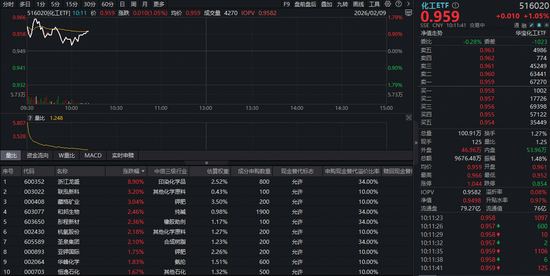
Group 1 - The chemical sector experienced a significant rise, with the Chemical ETF (516020) showing a maximum intraday increase of 1.79% and closing up by 1.05% [1] - Key stocks in the sector, including Zhejiang Longsheng, surged over 8%, while companies like Lianhong Xinke and Cangge Mining saw increases exceeding 3% [1] - The recent supply dynamics in the basic chemical industry have improved, with high-energy consumption capacities being phased out and industry concentration increasing [2][3] Group 2 - Demand for traditional products such as soda ash and PVC is recovering due to a rebound in real estate completions, while new sectors like new energy vehicles and photovoltaic installations are driving demand for lithium battery materials and EVA resins [2][3] - The self-sufficiency rate of high-end chemical materials in China has risen to over 80%, indicating accelerated industrial upgrades [2][3] - The Producer Price Index (PPI) decline in the basic chemical industry has narrowed, with investment growth rates in chemical raw materials and chemical fiber manufacturing also showing reduced declines [3] Group 3 - The chemical ETF (516020) tracks the CSI segmented chemical industry theme index, covering popular themes such as AI computing power, anti-involution, robotics, and new energy [3] - Investors can also consider the Chemical ETF linked funds (Class A 012537/Class C 012538) for exposure to the chemical sector [3] - The forecast for the petrochemical and chemical industry indicates an average annual growth of over 5% in value added from 2025 to 2026, with economic benefits stabilizing [3]