
人工智能(AI)

Search documents
AI需求推动-NAND与SSD供不应求有望持续
2026-01-13 01:10
Summary of Conference Call Records Industry Overview - The conference call discusses the NAND and SSD market, highlighting the impact of AI demand on storage needs, leading to a sustained supply-demand imbalance in the industry. The shift in data storage structure is driven by AI applications, particularly through RAG technology and KV caching, which significantly increase the demand for active data storage [1][2]. Key Points Market Dynamics - AI-driven storage structure transformation is expected to enhance the demand for active data storage, evolving from a traditional 2:3:5 hot-warm-cold ratio to a 3:7 ratio [1]. - SSDs outperform HDDs in high read/write speeds and low power consumption, making them more suitable for AI data centers. Enterprise NVMe SSDs can achieve continuous read speeds of up to 14,000 MB/s, significantly higher than HDDs [1][5]. - The global NAND and SSD market is anticipated to enter a prolonged boom cycle, with supply concentrated among major players like Samsung and Micron, who are focusing capital expenditures on HBM technology, limiting NAND investments [1][6][7]. Future Projections - Although NAND industry capital expenditures are expected to rebound in 2026 compared to 2023, they will remain below levels seen in 2020-2022. AI applications are projected to drive rapid growth in SSD usage, with global flash memory chip shipments expected to reach around 1,000 EB by 2025 [1][8]. - The domestic market is seeing accelerated progress in the localization of enterprise SSDs and NAND, enhancing the competitiveness of local brands [1][3]. Investment Opportunities - The storage industry presents significant investment opportunities in 2026, driven by AI demand. Key recommended sectors include semiconductor equipment, chip design, storage testing, and storage module manufacturers [2][9][10]. - Notable companies include: - **North Huachuang**: Achieved breakthroughs in high-end logic and storage chips, with advanced equipment in mass production [2][11]. - **Jiangbolong**: A leading storage module manufacturer, has launched innovative enterprise memory products and self-developed eMMC controller chips [2][13]. - **Zhongwei Company**: Focused on plasma etching equipment, showing strong growth in revenue and product advancements [12]. Risks to Monitor - Potential risks include: - AI applications not meeting expectations - Slower-than-expected technological advancements - Delays in domestic production progress These factors could impact industry growth and require strategic adjustments [14].
高盛-2026年美国股市主题展望
Goldman Sachs· 2026-01-13 01:10
Investment Rating - The report maintains a positive outlook for the S&P 500, projecting a target of 7,600 points for 2026, with a core logic based on expected earnings growth of 12% and a corresponding return rate of 12% for the index [2]. Core Insights - The S&P 500 is expected to see a price increase of 16% in 2025, with 14 percentage points attributed to earnings contributions. For 2026, earnings growth is anticipated at 12%, aligning with a 12% return rate for the index, while the price-to-earnings (P/E) ratio is projected to remain at 22 times [1][2]. - Despite rising interest rates, they remain below long-term averages, and the S&P 500's profitability has reached multi-decade highs. However, structural factors may hinder the reallocation of one-third of household portfolios into equities [1][5]. - AI-related spending by large enterprises is nearing $550 billion, reflecting a nearly 40% year-over-year growth, although the growth rate is beginning to slow. The focus of AI investments is shifting from infrastructure stocks to other sectors, with some companies demonstrating actual profitability impacts from AI applications [1][6]. - Productivity growth is forecasted at 0.5% for this year and 1.5% for the next, indicating a gradual increase despite modest figures [7]. - The IPO market is expected to improve in 2026, with macro indicators suggesting an increase in IPO numbers, which currently remain below long-term averages [8]. - Stock buybacks continue to be a significant demand source in the U.S. equity market, with daily demand estimated at $4 to $5 billion, although this demand is slowing down [9]. - The report highlights cyclical recovery opportunities, particularly in non-residential construction, transportation, building materials, and semiconductor sectors, with a focus on the middle-income consumer group [10]. Summary by Sections - **Earnings and Valuation**: The report indicates that the current P/E ratio of 22 is reasonable given the stability of macroeconomic factors such as interest rates and growth rates. The valuation is expected to remain below historical highs, with a potential upward bias in a healthy economic environment [3][4]. - **AI Investment Trends**: AI investments are projected to continue driving market growth, with significant spending expected to shift towards applications beyond infrastructure, indicating a maturation of the AI sector [6]. - **Productivity and IPO Outlook**: The anticipated gradual increase in productivity and a more favorable IPO environment in 2026 are seen as positive indicators for market health and investment opportunities [7][8].
全球智能手机出货量同比增长2%,AI功能正在成为购买的驱动力
Huan Qiu Wang· 2026-01-13 01:08
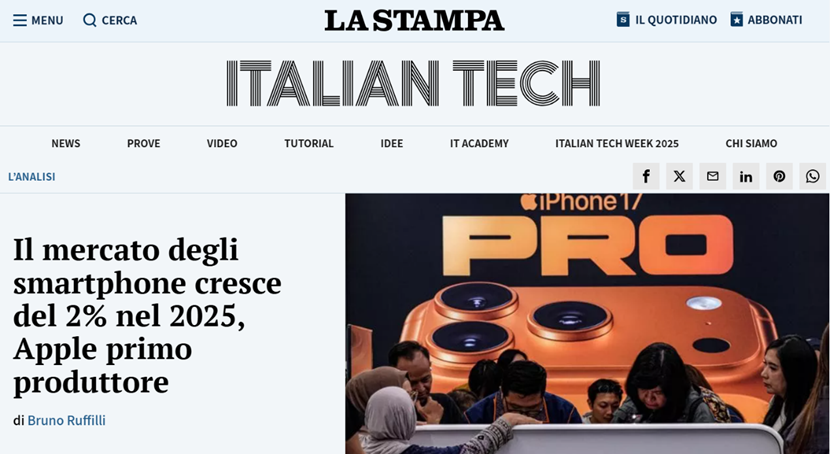
【环球网财经综合报道】市场研究机构Counterpoint表示,受新兴市场需求强劲和经济增长势头的提振,2025年全球智 能手机出货量同比增长2%。得益于新兴市场和中型市场的稳健需求,以及iPhone 17系列的强劲销售,苹果以20%的市 场份额领先市场。 《意大利新闻报》近日发文称,得益于高端需求提升、5G普及和融资购买方式的推动,2025年苹果成为第一大智能手 机生产商,三星和小米紧随其后;消费市场重心转向高端产品,AI功能和差异化设计成为购买驱动力。 路透社则将2025年部分增长动力归因于新兴市场中更好的需求和经济环境。Canalys则强调,一些在2024年增长的地区 开始显示出饱和迹象,而其他地区则因本地特定政策和积极的零售分销继续保持活跃。 报道还提到,需求端重心正向高端产品转移,这带动了价值、利润率和产品策略。同时,设备端的人工智能(AI)功 能正在成为购买的驱动力,而不仅仅是产品介绍中提到的特性。Gartner预计到2025年底,搭载能够运行小型语言模型 的NPU的智能手机支出将达到2982亿美元,并预计2026年将快速增长。 ...


“玩泥巴”的都在搞AI了,我们还在等什么?
吴晓波频道· 2026-01-13 00:30
Core Viewpoint - The article emphasizes the transformative impact of AI on the manufacturing industry, particularly in the ceramic tile sector, showcasing how AI enhances production efficiency, quality, and customization capabilities [1][15]. Group 1: AI Integration in Manufacturing - The company has transitioned from a labor-intensive model to an intelligent, automated workshop, significantly reducing human presence and improving environmental conditions [3][4]. - AI is utilized to manage raw material warehouses, ensuring consistent quality by automatically adjusting compositions based on real-time data [4][12]. - The drying process of raw materials is optimized through AI, which maintains energy efficiency and ensures uniform moisture levels, leading to a cleaner production environment [4][5]. Group 2: Quality Control and Standards - The introduction of the 5A ceramic tile standard, which aligns with international benchmarks, enhances product differentiation and consumer trust in quality [11][12]. - AI-driven quality inspection systems have drastically reduced defect rates, improving accuracy and efficiency in identifying product flaws [12][13]. - The integration of AI allows for real-time adjustments in production processes, ensuring high-quality outputs that meet the new standards [13][15]. Group 3: Future of Manufacturing - The combination of AI and the 5A standard is expected to revolutionize the ceramic industry, creating a new paradigm for quality and consumer awareness [15][16]. - The article suggests that AI will fundamentally reshape the value chain in manufacturing, influencing production, innovation, and business models [15][16]. - The shift towards AI in traditional industries signifies a broader trend of modernization and competitiveness in the Chinese manufacturing landscape [16].

携程全员收到离职通知?知情人士:误操作;曝追觅CEO自比黄仁勋马斯克,称将打造首个百万亿美金生态;章泽天播客将对话刘嘉玲丨邦早报
Sou Hu Cai Jing· 2026-01-13 00:17
Group 1 - Zhang Zetian launched her personal podcast named "Xiao Tian Zhang" on the Xiaoyuzhou platform, with the first guest being Liu Jialing. Her Xiaohongshu account has gained 74,000 followers [1] Group 2 - The CEO of Chasing Technology, Yu Hao, claimed that the "Chasing ecosystem" will become the first company ecosystem valued at one hundred trillion USD. He compared this to the current highest market value company, Nvidia, which is valued at 4.5 trillion USD [4][5] - Yu Hao predicts that the current generation of entrepreneurs, including Jensen Huang and Elon Musk, will elevate the highest market value companies to 8-10 trillion USD. He believes he can push the value of the highest companies up by an order of magnitude [5] Group 3 - Wang Teng announced that his startup team will adopt a flexible working system, allowing employees to work eight hours a day at their convenience, with weekends off [9] Group 4 - The "Dead or Not" app team stated they are still in financing negotiations and have not been sold yet, with the current round of financing expected to close within the week [11] - Google announced a partnership with Walmart and other retailers to expand its AI model shopping capabilities, allowing for direct transactions through its AI assistant [11] - Xiaomi's president, Lu Weibing, addressed rumors of his resignation by stating he is at work, effectively denying the claims [11] Group 5 - Meta Platforms Inc. appointed Dina Powell McCormick to a new senior management position focused on AI partnerships, while also promoting Santosh Janardhan and Daniel Gross to lead the "Meta Compute" initiative [13] - Apple announced a major upgrade to Siri, which will be based on Google's Gemini model, marking a significant collaboration between the two tech giants [13] Group 6 - Mercedes-Benz projected a 9% decline in car sales for 2025, estimating sales to drop to 1.8 million units, with a notable 12% decrease in the U.S. market due to inventory management amid trade disputes [19] Group 7 - Self-variable Robotics completed a 1 billion RMB A++ round of financing, with investments from major firms including ByteDance and Sequoia China [19] - Star Ring Energy announced a 1 billion RMB A round of financing, aimed at advancing the construction of next-generation fusion devices [20] - Jiangsu Xiqian Semiconductor completed a strategic financing round of over 100 million RMB to accelerate technology iteration and market expansion [20]




三组数字看城市通勤
Ren Min Ri Bao Hai Wai Ban· 2026-01-12 22:50
Core Insights - The report from the China Urban Planning and Design Institute outlines the commuting landscape in major Chinese cities, highlighting improvements in commuting efficiency and convenience due to the expansion of urban transportation networks [1][4]. Commuting Efficiency - The average proportion of commuters in major cities who can reach their destinations within 45 minutes is 77%, an increase of 1 percentage point since 2020 [4][5]. - Approximately 1 billion people use rail transit daily, with an equal number using buses and taxis, showcasing the robust urban transportation system [2][4]. Urban Transportation Development - China's urban rail transit network spans about 11,000 kilometers, the largest in the world, with bus routes totaling 1.75 million kilometers [4]. - From 2020 to 2024, 3,700 kilometers of new rail lines are expected to be added in major cities, with cities like Hangzhou, Chengdu, and Qingdao each adding over 100 kilometers [4]. Commuting Patterns - Nearly 400 million people commute across city borders daily in 22 major cities, with the Guangdong-Hong Kong-Macao Greater Bay Area showing the strongest intercity commuting connections [6][7]. - The majority of intercity commuting (64%) occurs between the outskirts of different cities, with an average commuting distance of nearly 25 kilometers [7][8]. Commuting Happiness - Over 52% of urban residents achieve "happy commuting," defined as commuting within 5 kilometers of their workplace [9]. - The average commuting distance for super-large cities is 4.5 kilometers, while for large cities, it is 3.9 kilometers, indicating a trend towards better work-life balance [9][10]. Urban Planning Recommendations - To enhance commuting efficiency, urban planners are encouraged to develop employment and living spaces along major transportation corridors, thereby reducing commuting distances and improving overall quality of life [10].
Bernstein Lifts UPS (UPS) Price Target on Margin Improvement Outlook
Yahoo Finance· 2026-01-12 21:55
Group 1 - United Parcel Service, Inc. (UPS) is recognized as one of the 13 best dividend stocks, offering a yield over 6% [1] - Bernstein analyst David Vernon raised UPS's price target to $125 from $122, citing improved margin outlook and an expectation for growth in higher-return markets [2] - UPS shares experienced a nearly 20% decline in 2025, resulting in a high dividend yield of 6% and a dividend payout ratio of approximately 98%, raising concerns about dividend sustainability [3] Group 2 - UPS has maintained or increased its dividend annually since going public in 1999, emphasizing its commitment to dividends as a core principle [3] - The company is restructuring its business model, including reducing reliance on lower-margin Amazon volume, which is expected to improve the payout ratio as earnings recover [3] - Analysts project earnings per share to increase by about 4% in 2026 and 11% in 2027, contingent on the successful execution of UPS's strategic plans [3]

武汉汉正街“服二代”学AI
Shang Hai Zheng Quan Bao· 2026-01-12 18:35
◎记者 覃秘 和鲁老板一起来上课的还有他女儿。"我女儿在读研究生,正好这几天在家,我请她过来帮我学习,到 时候再教我。"鲁老板解释。 授课老师杨建是一位"90后",大学毕业后一直从事服装设计工作,三年多前接触AI后果断转型,并最终 选择创业,帮助更多的服装从业者用好AI。 "AI是个超级工具。大型服装企业,AI应用已经比较成熟,众多的中小服装企业,也在积极探索尝 试。"杨建说,AI已经渗透到服装行业的各个环节,从设计、生产到营销、零售,正带来革命性的变 化。 这是杨建第一次来到武汉,来到汉正街。他说,很多年前就听说过"对内搞活看汉正街",和"服二代"深 入交流后,感受到市场的活力。"来之前,我以为是个老批发市场,过来后发现,街面很新,老板们也 很年轻,那就有很多合作的机会。" 这一堂课程从1月9日开始,已持续三天。学员们主要是汉正街年轻的老板,又被称为"服二代"。 "大家的学习热情非常高。"活动组织者王瑞珏对上海证券报记者说,大多数学员都听完了全部课程,还 不断有新的学员加入。 王瑞珏是云尚产业互联网负责人。他打开自己的手机,工作微信群聊天记录显示,从1月8日下午发出培 训通知开始,不断有商户接龙报名,一直到 ...
Bristol-Myers Squibb Company (NYSE:BMY) FY Conference Transcript
2026-01-12 16:32
Summary of Bristol-Myers Squibb Company (NYSE:BMY) FY Conference Call Company Overview - **Company**: Bristol-Myers Squibb Company (BMY) - **Event**: 44th Annual JPMorgan Healthcare Conference - **Date**: January 12, 2026 Core Industry Insights - **Focus**: The company aims to build a financially strong organization capable of delivering sustainable growth into the 2030s and beyond [2][16] - **Growth Portfolio**: Increased by 17% in the first nine months of 2025, with four products each generating over $1 billion in annual sales [3][2] - **Key Products**: - Opdualag (melanoma) - Breyanzi (CAR-T therapy for lymphoma) - Camzyos (treatment for obstructive HCM) - Reblozyl (annualizing over $2 billion in sales) [3][2] Financial Performance - **Debt Management**: Achieved a $10 billion debt paydown ahead of schedule, resulting in a stronger balance sheet [5][4] - **Cost Optimization**: On track to deliver $2 billion in cost savings, enhancing financial discipline [4][18] - **Shareholder Returns**: Returned over $22 billion to shareholders in the last three years and increased dividends for 17 consecutive years [15][16] Pipeline and R&D Developments - **Pipeline Progress**: Significant advancements in the pipeline with multiple late-stage assets expected to deliver value [5][11] - **Key Late-Stage Assets**: - **Cobenfy**: Approved for schizophrenia; pivotal studies in Alzheimer's disease psychosis expected to read out this year [6][11] - **Milvexian**: A Factor XIa inhibitor with potential in atrial fibrillation and secondary stroke prevention; phase III results anticipated [6][11] - **Admilparant**: Targeting pulmonary fibrosis with phase III results expected [7][11] - **Iberdomide and Mezigdomide**: Oral CELMoDs in multiple myeloma, with promising data leading into phase III trials [9][11] Strategic Focus Areas - **Business Development**: Completed $30 billion in deals over the past 24 months, with a focus on enhancing the growth profile [16][26] - **Execution and R&D**: Emphasis on improving execution across the organization, leveraging AI and machine learning to enhance R&D efficiency [13][30] - **Therapeutic Areas**: Continued focus on building depth in core therapeutic areas while exploring opportunities in adjacent markets [27][28] Market Position and Competitive Landscape - **Confidence in Product Portfolio**: Strong confidence in the existing product portfolio, with Eliquis continuing to perform well despite patent expirations [21][22] - **Diversified Pipeline**: The company has a diversified set of assets, reducing reliance on any single product for growth [23][24] - **Regulatory Engagement**: Positive engagement with the administration regarding Medicaid and pricing strategies, aiming to simplify the healthcare ecosystem [49][50] Conclusion - **Outlook for 2026**: The company is positioned for a busy year with multiple data readouts and product launches expected, focusing on commercial execution and maintaining financial discipline [47][48] - **Long-Term Vision**: Aiming for sustained growth through a diversified portfolio and strategic investments in R&D and business development [12][16]

2026年全球医疗健康行业私募股权报告(英文版)-贝恩公司
Sou Hu Cai Jing· 2026-01-12 16:26
Core Insights - The global healthcare private equity (PE) market is set for a strong recovery in 2025, achieving record levels in deal value and volume, with significant regional differentiation and sector evolution [1][2][3] Group 1: Market Performance - In 2025, the global healthcare PE transaction value exceeded $191 billion, marking a substantial increase from 2024 and surpassing the previous peak in 2021 [1][2] - The number of transactions reached 445, making it the second-highest annual total in history [1][2] - Exit values also surged to $156 billion, the second-highest on record, driven by an increase in large transactions, with over 40 exits exceeding $1 billion [1][2][3] Group 2: Regional Market Dynamics - Europe saw a doubling of transaction value to $59 billion, primarily due to strong growth in biopharma and healthcare services [2][3] - North America experienced a temporary pullback in the second quarter but still achieved a healthy exit value of $90 billion, supported by 26 transactions over $1 billion [2][3] - The Asia-Pacific region set a historical record for transaction value, growing over 30% compared to 2021, with significant contributions from China, Japan, and India [2][3] Group 3: Sector Trends - Biopharma continued to dominate the market, with transaction value reaching $80 billion, accounting for a significant share of overall deal volume [2][3] - Healthcare IT transactions doubled to $32 billion, driven by technology-enabled assets and a focus on analytics and workforce optimization [2][3] - Medtech showed remarkable growth, with transaction value nearly doubling to $33 billion, highlighting its emergence as a new growth engine [2][3] Group 4: Transaction Models - Sponsor-to-sponsor transactions rebounded strongly, with over 150 deals valued at more than $110 billion, indicating a robust market environment [3] - Public-to-private and carve-out transactions also gained traction, reflecting evolving investment strategies [3] - The overall increase in large transactions has led to a significant rise in average deal sizes, with more than 30 deals exceeding $1 billion [3][3] Group 5: Future Outlook - The healthcare PE market is expected to remain active in 2026, driven by high levels of dry powder and a growing number of sponsor-owned assets reaching the end of their fund lives [3] - Key questions for the future include the sustainability of European growth, the trajectory of healthcare IT, and the potential for biopharma activity to open up [3][3]
