
战略性新兴产业

Search documents
中国联通:下属公司参与出资央企战新基金
Zheng Quan Shi Bao Wang· 2025-10-29 09:40
Core Insights - China Unicom's subsidiary, Unicom Innovation and Entrepreneurship Investment Co., plans to invest 1.5 billion yuan in a state-owned enterprise's new strategic fund, representing a 2.94% stake [1] Group 1: Investment Details - The fund will focus on strategic emerging industries to support industrial development [1] - Unicom Innovation and Entrepreneurship Investment Co. is a wholly-owned subsidiary of China Unicom [1] Group 2: Management Changes - Chen Zhongyue has submitted his resignation as Chairman and Director of China Unicom, effective October 29, 2025 [1] - The resignation includes his roles in the Development Strategy Committee and the Nomination Committee [1]

央企战略性新兴产业发展基金公司登记成立,注册资本510亿
Xin Lang Cai Jing· 2025-10-29 06:51
Core Viewpoint - The establishment of a new state-owned strategic emerging industry development fund with a registered capital of 51 billion RMB aims to enhance private equity and venture capital investment management services in China [1] Group 1 - The fund is named "Central Enterprise Strategic Emerging Industry Development Fund Co., Ltd." and is represented by Huang Jie [1] - The registered capital of the fund is 51 billion RMB [1] - The fund's business scope includes private equity investment fund management and venture capital fund management services [1] Group 2 - The fund is jointly held by several major entities, including China National New Energy Holdings Co., Ltd., Beijing Financial Street Capital Operation Group Co., Ltd., China Mobile Capital Holdings Co., Ltd., Sinopec Capital Co., Ltd., Kunlun Capital Co., Ltd. of China National Petroleum Corporation, and China Telecom Group Investment Co., Ltd. [1]
本轮牛市会在4000点上方停留多久?
Mei Ri Jing Ji Xin Wen· 2025-10-29 04:58
Core Viewpoint - The market has recently broken through the 4000-point mark for the first time in a decade, indicating a significant milestone in the current market cycle [1][9]. Market Performance - The current bull market is characterized by extreme differentiation, with high-growth sectors like AI hardware being highly valued and traditional sectors like certain cyclical and consumer sectors remaining at relatively low valuations [2][3]. - The A-share market saw a slight decline today, with the Shanghai Composite Index, Shenzhen Component Index, and ChiNext Index dropping between 0.15% and 0.44% [9]. - Trading volume in the Shanghai and Shenzhen markets reached 21,479 billion, a decrease of 1,923 billion from the previous day [9]. Strategic Insights - The "15th Five-Year Plan" emphasizes technology as a key investment area, focusing on strategic emerging industries such as new energy, aerospace, and advanced materials [6][7][8]. - The plan is expected to direct resources and funding towards the technology sector over the coming years, potentially boosting related stocks [8]. Sector Analysis - The technology sector is showing promising signs, with core stocks like Industrial Fulian and Hua Hong Semiconductor breaking through their September highs, indicating a potential upward trend [17]. - The PCB and its upstream sectors have also performed well recently, suggesting a growing interest in these areas [17]. Market Outlook - The market is expected to experience some short-term adjustments, with a focus on the 4000-4180 point range for the Shanghai Composite Index as a critical observation point [11][13]. - Despite potential short-term pullbacks, the overall sentiment remains bullish, with an emphasis on identifying solid investment opportunities in high-potential sectors like AI hardware and military electronics [17].
国企利润累计降幅连续两个月收窄,国资将加快布局新兴产业
Xin Lang Cai Jing· 2025-10-29 03:10
记者 辛圆 10月29日,财政部公布了2025年1-9月全国国有及国有控股企业经济运行情况。 数据显示,1-9月,全国国有及国有控股企业(以下称国有企业)营业总收入同比增长0.9%,涨幅较前8 个月上升0.7个百分点。利润总额同比下降1.6%,降幅较前8个月收窄1.1个百分点,为连续两个月收 窄。 国资委近期对下一阶段国资国企工作进行了前瞻性部署。 据国务院国资委网站10月23日发布消息,近日,国资委在京召开中央企业"十五五"规划工作座谈会,听 取军工、应急行业部分中央企业关于"十五五"规划编制的意见建议。会议强调,要突出规划产业导向, 着眼现代化产业体系建设,立足国家所需、产业所趋、央企所能,深入推进布局优化和结构调整。 9月23日至24日,国资委主任张玉卓在广东调研时提到,持续提高企业价值创造能力和可持续发展能 力,努力开启增长的"第二曲线",加快建设世界一流企业,不断增强核心功能、提升核心竞争力。 在此之前的4月22日,在中央组织部、中央金融工委、国务院国资委联合举办的"弘扬企业家精神,加快 建设世界一流企业"专题研讨班上,张玉卓也提到,当前中央企业要加快发展新质生产力,大力培育一 批具有核心竞争力的战 ...
电池股、算力硬件股表现活跃,关注科创板50ETF(588080)、创业板ETF(159915)等产品投资价值
Mei Ri Jing Ji Xin Wen· 2025-10-29 02:54
Core Viewpoint - A-shares opened higher with active performance in battery and computing hardware stocks, driven by significant gains in companies like Western Superconducting and Sihuan Group, reflecting a positive market sentiment towards technology and innovation sectors [1] Group 1: Market Performance - The three major A-share indices collectively opened higher, with the ChiNext Index rising by 1.5% and the STAR Market 50 Index increasing by 0.7% [1] - Notable stock performances included Western Superconducting and Sihuan Group, both rising over 9%, while Baiwei Storage and Sunshine Power saw increases of over 8% and 7%, respectively [1] Group 2: Policy and Industry Development - The "14th Five-Year Plan" emphasizes the implementation of the "AI+" initiative to seize the leading position in AI industry applications, focusing on nurturing emerging industries and future sectors [1] - Strategic emerging industries such as new energy, new materials, aerospace, and low-altitude economy are highlighted for development, with a focus on innovation infrastructure, technology R&D, and product upgrades [1] Group 3: Index Composition and Investment Opportunities - The STAR Market 50 Index consists of 50 stocks with high market capitalization and liquidity, predominantly in the semiconductor sector, which accounts for over 65% of the index [1] - The ChiNext Index includes 100 stocks from the ChiNext market, with over 90% representation from strategic emerging industries, and a combined weight of approximately 60% from AI hardware and new energy sectors [1] - The STAR Market 50 ETF and ChiNext ETF are leading products in their categories, offering low management fees of 0.15% per year, facilitating cost-effective investment in technology growth sectors [1]

京蓝科技股份有限公司2025年第三季度报告
Shang Hai Zheng Quan Bao· 2025-10-28 23:26
Core Viewpoint - The company, 京蓝科技股份有限公司, has disclosed its third-quarter financial report for 2025, ensuring the accuracy and completeness of the information presented, and has made several important decisions regarding board and committee appointments [7][12][20]. Financial Report Summary - The third-quarter financial report has not been audited [6]. - The company confirms that there are no adjustments or restatements required for previous accounting data [3]. - There are no non-recurring profit and loss items reported [3]. Shareholder Information - The company has provided details on its major shareholders and their holdings, although specific figures are not disclosed in the provided text [5]. Board Meeting Details - The 19th temporary meeting of the 11th Board of Directors was held on October 28, 2025, with all 7 directors present [8][9]. - The board unanimously approved the third-quarter report, confirming its compliance with relevant laws and regulations [12]. - The board also approved the appointment of a new independent director and adjustments to the board's specialized committees [13][15][18]. Internal Audit Changes - The company has appointed a new internal audit head, 徐立身, following the resignation of the previous head due to work adjustments [27][30]. Investment Fund Establishment - 京蓝科技 is collaborating with professional investment institutions to establish the 哈尔滨交润兴材创业投资基金, with a total investment scale of 300 million RMB, of which 京蓝科技 will contribute 50% [41][42]. - The fund aims to invest primarily in new materials and related industries, with a minimum of 60% of the fund's capital allocated to this sector [65].

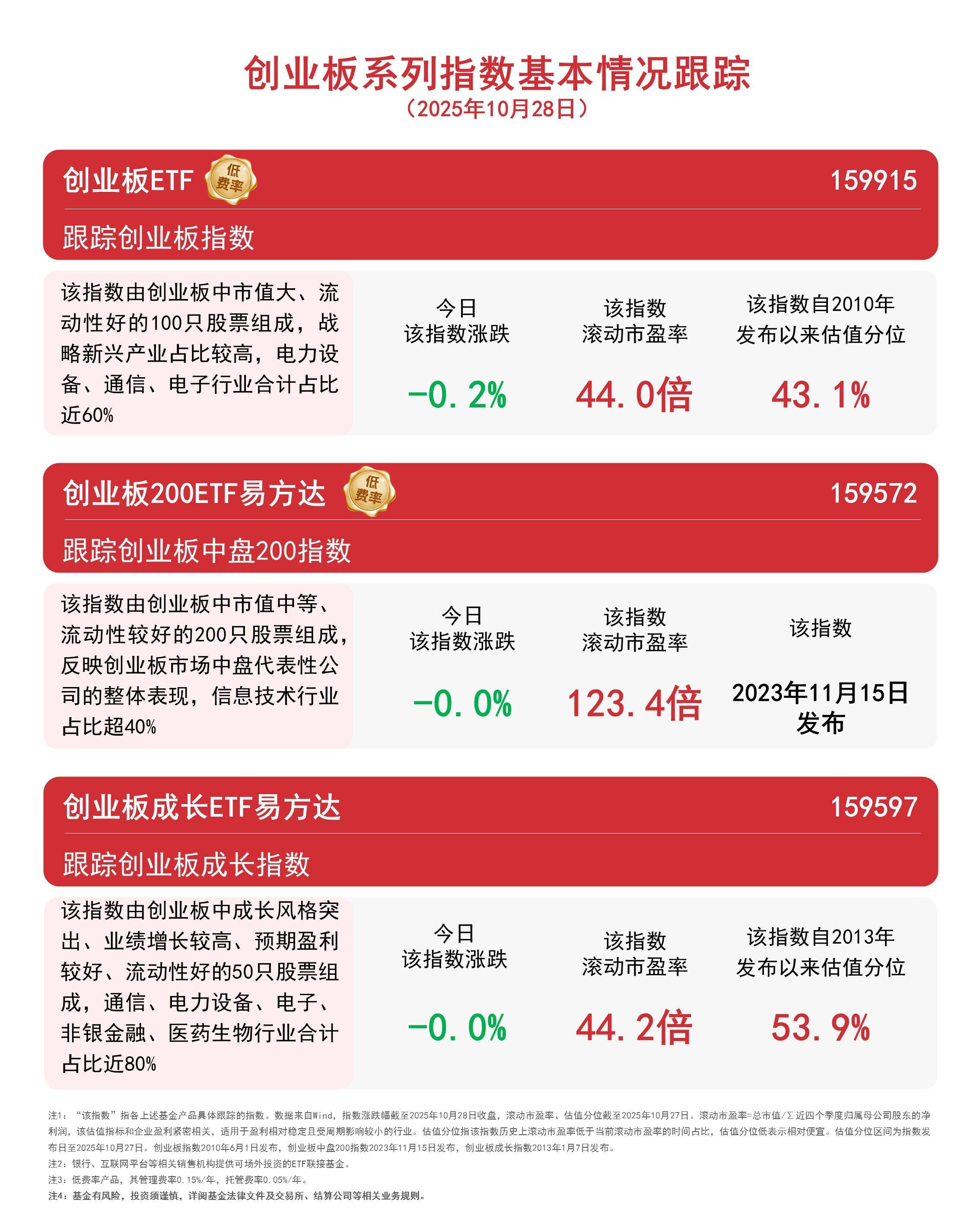
政策加码新兴产业和未来产业,关注创业板ETF(159915)等产品投资价值
Sou Hu Cai Jing· 2025-10-28 11:00
Group 1 - The ChiNext market indices showed slight declines, with the ChiNext Mid 200 Index down 0.01%, the ChiNext Growth Index down 0.03%, and the overall ChiNext Index down 0.2% [1] - The "14th Five-Year Plan" emphasizes the cultivation and expansion of emerging and future industries, focusing on building new pillar industries and implementing innovation projects [1] - Strategic emerging industry clusters such as new energy, new materials, aerospace, and low-altitude economy are prioritized for development [1] Group 2 - The ChiNext Growth ETF tracks the ChiNext Growth Index, which consists of 50 stocks characterized by growth style, high performance, and good liquidity, with over 80% representation from the telecommunications, power equipment, electronics, non-bank finance, and pharmaceutical sectors [3] - The ChiNext Index was launched on June 1, 2010, and the ChiNext Mid 200 Index was launched on November 15, 2023 [3]

东莞松山湖百亿产投母基金完成备案
FOFWEEKLY· 2025-10-28 10:06
Group 1 - The establishment of the Songshan Lake parent fund, with a total scale of 10 billion yuan and an initial scale of 2.5 billion yuan, marks a significant step in the innovation of the industrial investment and financing system in Songshan Lake [1] - The fund will focus on strategic emerging industries such as new generation information technology, intelligent connected vehicles, robotics, semiconductors, biomedicine, and new materials, aiming to invest in key links of the industrial chain [1] - The fund aims to create a fund system covering the entire lifecycle of enterprises, with a total scale of approximately 30 billion yuan to support industrial development in Songshan Lake [1] Group 2 - Songshan Lake plans to leverage the establishment of the 100 billion yuan parent fund to attract more leading industry institutions and establish diversified industrial funds, including angel funds and industry chain parent funds [2] - The initiative aims to further mobilize high-quality domestic and foreign capital resources into Songshan Lake, moving towards a trillion-level fund aggregation ecosystem [2]

煤炭和汽车双轮驱动,陕西前三季度GDP增长5.3%
Di Yi Cai Jing· 2025-10-28 07:31
Core Insights - Shaanxi's industrial value added above designated size grew by 8.5% year-on-year, surpassing the national average by 2.3 percentage points, ranking fifth among all provinces in China [1][2] - The province's GDP reached 25,771.37 billion yuan, with a year-on-year growth of 5.3%, supported by robust performance in key industries such as coal and automotive [1] Industrial Performance - The coal mining and washing industry saw a value added increase of 11.5%, while the equipment manufacturing sector grew by 11.0%, with electrical machinery and equipment manufacturing rising by 35.4% and automotive manufacturing by 24.8% [2] - Over 80% of industries in Shaanxi reported positive growth, indicating strong resilience in production operations [1][2] Emerging Industries - Strategic emerging industries in Shaanxi grew by 5.9% year-on-year, outpacing the GDP growth rate, with high-end equipment manufacturing increasing by 6.1% and digital creative industries by 8.7% [3] - The solar photovoltaic industry chain experienced a remarkable growth of 36.9%, while the drone industry chain grew by 12.4%, highlighting a trend towards high-end, intelligent, and green development [3] Trade Dynamics - Shaanxi's total import and export value reached 3,780.78 billion yuan, marking a year-on-year increase of 12.0%, with exports growing by 14.8% and imports by 6.2% [4] - The trade structure improved, with general trade imports and exports rising by 14.0%, and the share of mechanical and electrical products in exports reaching 85.7% [4] - Notably, exports of "new three types" products surged by 32.6%, with lithium-ion batteries increasing by 120% and electric vehicles by 79.7% [4]
电力设备及新能源行业点评:四中全会思考:聚焦“新”方向,关注储能、氢能、固态三大主线
Ping An Securities· 2025-10-28 06:21
Investment Rating - The industry investment rating is "Outperform the Market" [1][17] Core Viewpoints - The report emphasizes the importance of focusing on three main directions: energy storage, hydrogen energy, and solid-state batteries, which are expected to have significant growth potential and market opportunities in the new development phase [4][10][15] - The report highlights that energy storage is a crucial technology for energy transition, with a projected installed capacity of 180 GW by 2027, driving an investment of approximately 250 billion yuan [11] - Hydrogen energy is identified as a "future industry" with substantial growth potential, supported by government policies and expected to contribute significantly to the economy over the next decade [12][13] - Solid-state batteries are recognized as key technologies for emerging industries such as low-altitude economy and humanoid robots, with ongoing advancements in production processes [14] Summary by Sections Section 1: Meeting Spirit Learning - The Fourth Plenary Session of the 20th Central Committee emphasized accelerating the construction of a new energy system as part of the broader goal of achieving a green transformation in the economy and society [5][7] - New energy is positioned as a "new emerging pillar industry" and a "strategic emerging industry," with hydrogen energy and nuclear fusion energy highlighted as future industries [9] Section 2: Focus on New Directions - The report suggests that energy storage, hydrogen energy, and solid-state batteries are the three key areas to focus on, with energy storage being essential for building a new energy system [10][11] Section 3: Investment Recommendations - For energy storage, the report recommends companies with high growth potential in energy storage systems and cells, specifically mentioning Haibosi Chuang, Shangneng Electric, and Penghui Energy [15] - In the hydrogen energy sector, it suggests focusing on quality companies in equipment and project sectors, such as Kewell and Jidian Co [15] - For solid-state batteries, the report advises attention to companies involved in the early industrialization of solid-state battery equipment and lithium metal anodes, recommending companies like Xiandai Intelligent and Tiantie Technology [15]