
算力

Search documents
ETF盘中资讯|光模块CPO反弹!“易中天”涨超2%,创业板人工智能ETF(159363)冲高逾2%资金加码
Sou Hu Cai Jing· 2025-12-17 02:05
华泰证券认为海外CSP在加码AI算力投资的背景下,2026年400G、800G、1.6T等高速光模块需求预计仍将进一步显著扩张,有望带给新晋供 应商导入窗口期。我们建议关注在交付能力、技术实力、海外工厂产能等方面具备优势的新晋厂商(联特科技等),未来有望获得导入北美云 厂商供应链的机遇。 把握以光模块为核心的算力机会,建议重点关注全市场首只创业板人工智能ETF(159363)及场外联接(A类023407、C类023408),标的指 数重点布局光模块龙头"易中天",光模块含量最新超56%。从赛道分布看,逾七成仓位布局算力,超两成仓位布局AI应用,能够高效捕捉AI 主题行情。(截至2025.11.30) 同类对比看,截至12月8日,创业板人工智能ETF华宝(159363)最新规模超33亿元,近1个月日均成交额超6亿元,在跟踪创业板人工智能指 数的7只ETF中排行第一! 数据来源:沪深交易所等。注:"全市场首只"是指首只跟踪创业板人工智能指数的ETF。 风险提示:创业板人工智能ETF华宝被动跟踪创业板人工智能指数,该指数基日为2018.12.28,发布日期为2024.7.11。创业板人工智能指数 2020-2024 ...




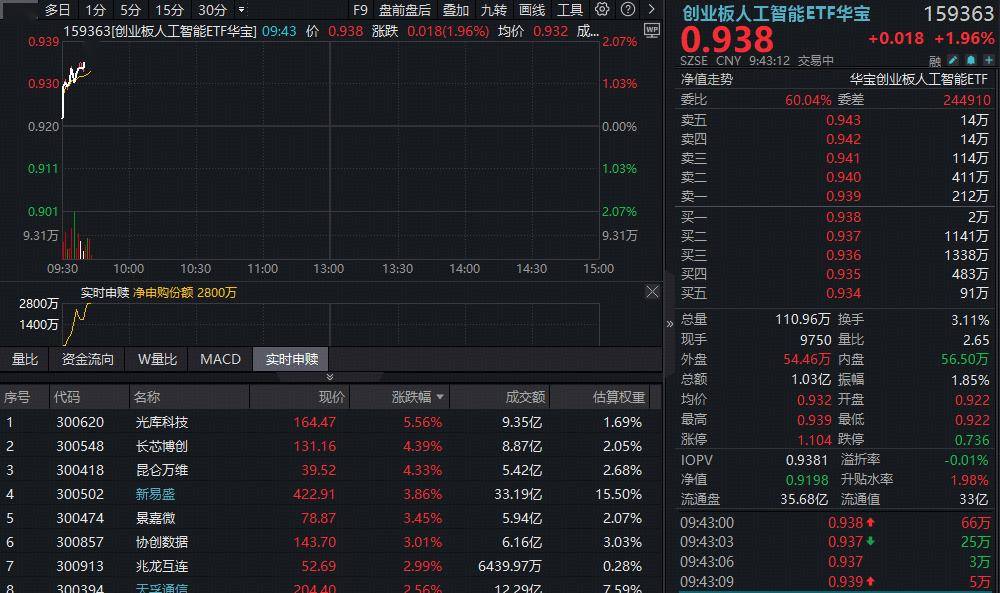
光模块CPO反弹!“易中天”涨超2%,创业板人工智能ETF(159363)冲高逾2%资金加码
Xin Lang Cai Jing· 2025-12-17 01:50
Group 1 - The core viewpoint of the news highlights a rebound in optical module CPO and related computing hardware, with significant gains in stocks like Guangku Technology and others, indicating a positive market sentiment in the sector [1][5] - The AI-focused ETF (159363) saw a rapid increase of 2% in early trading, with a real-time transaction amount exceeding 1 billion CNY and a net subscription of 28 million units, reflecting strong investor interest [1][5] - TrendForce forecasts that the global demand for optical transceiver modules exceeding 800G will reach 24 million units by 2025 and nearly 63 million units by 2026, representing a growth of 260% [1][6][7] Group 2 - Huatai Securities suggests that Chinese optical module companies may maintain a competitive edge by 2026, particularly in the North American market, as domestic manufacturers have gradually integrated into the supply chains of leading global cloud providers [3][7] - The demand for high-speed optical modules (400G, 800G, 1.6T) is expected to expand significantly, providing new opportunities for emerging suppliers in the context of increased AI computing investments [3][7] - The AI-focused ETF (159363) is noted as the first in the market tracking the AI index, with over 56% of its holdings in optical modules, and it has a recent scale exceeding 3.3 billion CNY, ranking first among similar ETFs [3][7]


【公告全知道】商业航天+无人驾驶+芯片+量子科技+无人机!公司星体系列业务主要聚焦于商业卫星和航天防务领域
财联社· 2025-12-16 15:06
Group 1 - The article highlights the importance of major announcements in the stock market, including "suspensions and resumption of trading, shareholding changes, investment wins, acquisitions, performance reports, unlocks, and high transfers" to help investors identify investment hotspots and mitigate risks [1] - The company focuses on commercial satellites and aerospace defense, with its Star series business primarily targeting these sectors [1] - Another company is involved in satellite communication modules based on high-orbit satellites, integrating technologies such as 6G, digital currency, and humanoid robots [1] - A third company has made a significant procurement of servers worth 9 billion, aimed at providing cloud computing services to its clients, leveraging storage chips and data centers [1]

明天9:25,A股暴富盛宴准时开始?
凤凰网财经· 2025-12-16 13:19
Core Viewpoint - The upcoming listing of Muxi Co., Ltd. on the STAR Market represents a significant milestone in the domestic GPU sector, highlighting the intersection of advanced technology and capital markets in creating wealth opportunities [3][4][6]. Group 1: Market Context - The GPU is referred to as the "crown jewel of hard technology" in the current era where computing power is paramount [5]. - The wave of domestic substitution has created a substantial market gap, setting the stage for this wealth event [6]. - The enthusiasm surrounding Muxi's listing is bolstered by the previous success of Moore Threads, which saw a significant surge on its debut [7][18]. Group 2: Capital Winners - Muxi's listing has attracted early investments from various capital players, indicating strong interest in the computing power sector [8]. - The founder, Chen Weiliang, holds 20.64% of the shares, valued at over 8.6 billion yuan based on the issuance price of 104.66 yuan per share, making him the largest wealth winner post-listing [12][13]. - Notable investors include private equity mogul Ge Weidong and leading firms like Matrix Partners and Sequoia Capital, collectively holding significant stakes [14][17]. Group 3: Subscription and Market Response - Muxi's IPO price of 104.66 yuan per share is the second highest for STAR Market listings this year, leading to high demand in the subscription phase [25][26]. - The final subscription rate for online investors was 0.03348913%, indicating a highly competitive environment for shares [27][28]. - Institutional investors showed strong interest, with major funds securing substantial allocations, reflecting the excitement around Muxi's potential [33]. Group 4: Potential Returns - If Muxi replicates the debut performance of Moore Threads, investors could see significant returns, with potential gains of nearly 250,000 yuan for a single subscription of 500 shares [36]. - Even with a conservative estimate based on the average first-day performance of new STAR Market stocks, the projected price could reach 333.78 yuan per share, yielding substantial profits [37].

科技与消费“冰火两重天”!公募跨年布局或迎仓位再平衡
券商中国· 2025-12-16 09:21
Core Viewpoint - The article highlights the contrasting performance of consumer and technology sector funds, indicating a significant shift in investment strategies among public funds as they navigate the challenges posed by underperforming consumer stocks and the rising appeal of technology investments [1][2]. Group 1: Performance Discrepancies - Consumer funds have been a drag on public fund performance, with a notable lack of valuation expansion logic leading to significant losses. For instance, the top-performing fund, Yongying Technology Smart Mixed Fund, achieved a return of 218%, while the worst-performing fund, Xinyuan Fund's Consumer Selection Mixed Fund, suffered a loss of 21% [3]. - The new consumption sector, once favored alongside technology, has seen a downturn in the second half of the year, resulting in consumer funds consistently lagging behind technology-themed funds [3][4]. - Several new consumption funds have experienced a complete reversal of gains from the first half of the year, leading to substantial performance losses as they grapple with the sector's decline [3]. Group 2: Shift in Investment Strategies - Many fund managers are losing patience with their holdings in new consumption stocks due to the significant underperformance compared to technology stocks, prompting a shift towards technology investments [5]. - The narrative surrounding technology investments, particularly in AI, is gaining traction, with fund managers predicting that the focus on technology will continue to drive excess returns in the coming years [5][6]. - Some funds, such as the China Universal Xin New Consumption Fund and the Invesco Great China QDII Fund, have begun to pivot their strategies, moving away from new consumption stocks to increase their holdings in technology companies like Tencent and Alibaba [6]. Group 3: Future Outlook and Opportunities - Fund managers believe that both technology and consumer sectors present investment opportunities, with technology stocks expected to remain a core focus due to their long-term growth potential [7]. - The article suggests that there is a structural migration occurring within the consumer sector, with institutional funds shifting from traditional physical consumption to sectors that provide emotional value, such as "spiritual consumption" and "online entertainment" [8].

中贝通信:目前公司已运营算力规模超过17000P
Mei Ri Jing Ji Xin Wen· 2025-12-16 08:57
中贝通信(603220.SH)12月16日在投资者互动平台表示,尊敬的投资者您好!目前公司已运营算力规 模超过17000P,为金山云、阶跃星辰、临港算力、青海联通、济南超级计算中心有限公司等客户提供 智算服务。公司将根据市场订单情况及公司资金情况制定合适的发展规划,发展智算业务,关于未来的 算力规模情况,请关注公司后续公告! (记者 曾健辉) 每经AI快讯,有投资者在投资者互动平台提问:目前中贝的算力总规模有多少了,预计明年能做到多 少? ...

天孚通信五连跌,创业板人工智能ETF(159363)失守10日线,机构看好2026年中国光模块企业机遇
Xin Lang Cai Jing· 2025-12-16 02:48
Core Viewpoint - The Chinese optical module industry is expected to maintain a competitive advantage, particularly in the North American market, with new suppliers likely to gain opportunities due to increasing demand for high-speed optical modules driven by AI computing investments [8][3]. Group 1: Market Performance - On December 16, the optical module CPO and related hardware experienced a continuous decline, with Tianfu Communication dropping over 4% for five consecutive days, and Xinyisheng and Zhongji Xuchuang falling over 3% and 1% respectively [1][6]. - The popular ETF, the ChiNext AI ETF (159363), which has over 56% optical module content, saw a further decline of 2%, falling below the 10-day moving average, with real-time trading volume exceeding 200 million yuan [1][6]. Group 2: Industry Outlook - Huatai Securities forecasts that the demand for high-speed optical modules (400G, 800G, 1.6T) will significantly expand by 2026, providing a window of opportunity for new suppliers to enter the North American cloud service provider supply chain [3][8]. - The domestic optical module manufacturers have gradually integrated into the supply chains of leading global cloud companies over the past decade, leveraging cost advantages, R&D capabilities, and rapid response to customer needs [8]. Group 3: Investment Recommendations - It is recommended to focus on new suppliers with advantages in delivery capability, technical strength, and overseas production capacity, such as Lian Te Technology, which may gain access to North American cloud service provider supply chains [3][8]. - The ChiNext AI ETF (159363) is highlighted as a key investment vehicle, with over 70% of its portfolio allocated to computing power and over 20% to AI applications, effectively capturing the AI theme market [3][8].

梁军履新一年,昉擎科技半年融三轮超5亿人民币
36氪· 2025-12-15 13:42
Core Viewpoint - The article discusses the recent Pre-A round financing of Fangqing Technology, a developer of AI chips and system architecture, highlighting the strategic importance of its innovative technology and the high-profile investors involved [6][9]. Financing and Investment - Fangqing Technology has completed its Pre-A round financing, with participation from industry investors such as a major internet company, Xianlian Capital, and Yima Capital, a fund under Hengsheng Electronics. Financial investors include Guangfa Xinde and a leading VC firm, with existing shareholders also increasing their stakes. The total financing amount has exceeded 500 million RMB in recent rounds [6]. - The company has rapidly attracted a prestigious group of shareholders, including internet giants, hardware leaders, automotive companies, and top VCs, indicating strong market confidence in its potential [10]. Technology and Innovation - Fangqing Technology proposes a new technology direction with a "context-aware" and "context-free" decoupled distributed computing architecture, separating feed-forward neural networks and attention mechanisms to enhance overall computational efficiency [7][9]. - The company aims to redefine AI hardware design by prioritizing scalable system design over single-chip performance, potentially leading to new market opportunities and innovative system forms [10][19]. Leadership and Vision - CEO Liang Jun, with extensive experience in the chip industry, emphasizes the need for a shift in chip design priorities towards scalable systems, which could liberate computing capabilities from traditional SoC constraints [10][18]. - The article highlights Liang's unique background and vision as a valuable asset in the current investment landscape, where capital is increasingly looking for breakthroughs in computational efficiency beyond traditional architectures [9][11]. Market Context - The article notes that 2025 is anticipated to be a pivotal year for AI applications, with significant investments from major players like ByteDance, Tencent, and Alibaba in AI infrastructure, intensifying the competition for computational resources [9]. - The shift in capital logic from seeking alternatives to Nvidia towards finding new species capable of overcoming Transformer architecture efficiency bottlenecks is discussed, positioning Fangqing Technology's approach as a timely innovation [9][10]. Future Outlook - Fangqing Technology's separation architecture is seen as a potential game-changer, allowing various devices like smartphones, smart glasses, and headphones to function as independent processing units, thus redefining their roles in the AI ecosystem [20][22]. - The company aims to accelerate innovation and define new forms of computing systems, rather than merely replacing existing ones, which could lead to significant market transformations [22].

谁将定义中国智算未来?从系统可用的算力基建,到产业认可的价值闭环丨GAIR 2025
雷峰网· 2025-12-15 07:44
Core Viewpoint - The future of intelligent computing will be defined by those who can establish standards, models, and foundational systems, leading to true dominance in the next generation of intelligent competition [2][3]. Group 1: Conference Overview - The GAIR 2025 conference, focusing on "AI Computing in the New Decade," was held in Shenzhen, aiming to connect technological advancements with industrial practices [2]. - The afternoon forum centered on the theme "Who Will Define the Future of Intelligent Computing," shifting focus from breakthrough innovations to systematic construction and value closure [2][3]. Group 2: Key Presentations - Wang Zhi from Tsinghua University discussed the challenges of industrial large models, emphasizing the need for a new paradigm of "training and inference collaboration" to drive intelligent manufacturing [4][6]. - Liu Xiangyang, an IEEE Fellow, highlighted that a company's AI capabilities are fundamentally determined by its digital foundation, stressing the importance of a robust digital infrastructure [9][11]. - Zhao Hongbing from Beijing Parallel Technology emphasized the need for computing services to transform from mere resources to productive forces, advocating for a user-centric approach in computing service operations [14][16]. - Shi Tianhui from Qingcheng Jizhi pointed out the importance of software in unlocking the value of computing power, advocating for the growth of the MaaS (Model as a Service) market [19][20]. - Lü Haifeng from Dingxi Zhichuang proposed a "wet and dry combined" approach to tackle data bottlenecks in AI and new materials, emphasizing the integration of AI in material design and development [22][24]. Group 3: Industry Insights - The current computing market faces challenges such as low utilization rates of computing resources, with many intelligent computing centers averaging below 40% [28]. - The transition from "building first, using later" to a more efficient model prioritizing cost-effectiveness and user scenarios is underway in the computing industry [28][29]. - The MaaS model is seen as a key to achieving a value closure in computing, allowing users to access computing power at lower costs while suppliers optimize their technology to reduce expenses [29][30]. - The future of AI in China is expected to shift from training to inference by 2025, with a growing emphasis on the MaaS market and the integration of domestic chips and cooling technologies by 2026 [30].

开放式基金周报(20251214)-20251215
Haitong Securities International· 2025-12-15 07:16
1. Report Industry Investment Rating - Not provided in the given content 2. Core View of the Report - It is recommended to allocate in a balanced and growth - oriented style, emphasizing technology growth - style funds and also considering large - financial and pro - cyclical assets [1][3][15] 3. Summary According to Relevant Catalogs 3.1 Last Week's Market Review - **A - shares**: A - shares fluctuated last week. The communication, national defense and military industry, and electronics sectors performed well. The Shanghai Composite Index fell 0.34% to 3889.35 points, and the Shenzhen Component Index rose 0.84% to 13258.33 points. The trading volume of the two A - share markets increased by about 1256.4 billion yuan compared with the previous week [6] - **Bond market**: The bond market rose. The CPI in November 2025 rebounded year - on - year to 0.7%, and the PPI fell year - on - year to - 2.2%. The yield of most bonds declined, and the main bond indexes showed a mixed performance [7] - **US stocks and commodities**: US stocks fluctuated. The Dow Jones Industrial Average rose 1.05%, the S&P 500 Index fell 0.63%, and the Nasdaq Index fell 1.62%. Oil prices fell, and gold and silver prices rose [8] 3.2 Last Week's Fund Market Review - **Stock - type funds**: Stock - type funds rose 0.38% overall. Some funds heavily invested in overseas computing power, chip semiconductors and other sectors performed well. Index funds related to communication equipment, artificial intelligence, and semiconductors also had good performance [10] - **Bond - type funds**: Bond - type funds rose 0.07% overall. Partial - debt bond funds and convertible - bond funds with equity assets in electronics, military industry and other sectors performed well [11] - **QDII funds**: The overall performance of QDII equity - hybrid funds declined by 1%, while some funds mainly investing in the global technology field performed well. QDII bond funds fell 0.07% [11] - **Other funds**: The annualized yield of money market funds was 1.21%. Gold ETFs and their linked funds rose 0.8%, and commodity - type funds rose 0.84% [11][12] 3.3 Future Investment Strategy - **Macro aspect**: The Fed cut interest rates by 25BP, and internal differences increased. It was more optimistic about the US economy and inflation, and started technical balance - sheet expansion. It is expected that interest rate cuts will continue in 2026, and US bond yields will first decline and then rise [12] - **Stock market**: The Chinese stock market is expected to enter a cross - year offensive. It is optimistic about technology, brokerage, and consumption sectors. It is recommended to invest in technology growth, large - financial, and pro - cyclical assets [13][15] - **Bond market**: In 2026, credit risk is expected to be generally controllable. It is recommended to focus on short - to - medium - term credit sinking to explore coupon payments and pay attention to trading opportunities of medium - and long - term bonds [13][14][15] - **Fund investment**: For stock - hybrid funds, allocate in a balanced and growth - oriented style, emphasizing technology growth - style funds and considering large - financial and pro - cyclical assets. For bond funds, focus on flexible - operation fixed - income products. For money market funds, there is no trend investment opportunity. For commodity funds, appropriately allocate gold ETFs [15] 3.4 Fund Market Latest Developments - **Regulatory policy**: The regulatory authorities issued a draft for soliciting opinions on standardizing the sales behavior of public - offering funds, including requirements for fund performance display [16][18] - **Industry development**: The public - offering index - enhancement business has developed rapidly. As of December 10, 168 new index - enhancement funds have been established this year, with a total new - issuance scale exceeding 92 billion yuan [19] - **New product issuance**: 23 new funds were established last week, with an average subscription period of about 13 days and an average raised share of 792 million shares [20] - **Fund dividends**: 84 funds will conduct equity registration in the coming days, and the most notable one is Huashang Advantage Industry A, with a dividend of 2.347 yuan per 10 shares [21]