不正当竞争

Search documents
携程、去哪儿等平台回应“抢票加速包是噱头”
Xin Lang Cai Jing· 2025-09-27 06:39
Core Viewpoint - The investigation by the Jiangsu Consumer Rights Protection Committee reveals that third-party train ticket platforms' "acceleration packages" do not actually enhance the chances of successfully purchasing tickets, as all requests must ultimately queue through the official 12306 system [1][3][11]. Group 1: Investigation Findings - Nine third-party ticket platforms were investigated, all claiming that purchasing "acceleration packages" would increase ticket success rates, but the actual experience showed that 12306 was the first to issue tickets [1][3]. - The prices for these "acceleration packages" range from 48 yuan to 60 yuan, marketed under various names such as "all-in-one ticket" and "reassured ticket" [1][5]. - 12306's official customer service confirmed that they do not provide acceleration services and that ticket allocation is based on the order of submission [1][3]. Group 2: Consumer Behavior and Reactions - Over 30% of surveyed consumers expressed doubts about the effectiveness of "acceleration packages," yet many still purchase them due to anxiety about ticket availability [8]. - Consumers indicated that the pressure to secure tickets leads them to consider these packages, even if they are aware of their questionable efficacy [9]. Group 3: Legal Perspectives - Lawyers indicated that if third-party platforms exaggerate the effectiveness of "acceleration packages," they could be liable for false advertising and unfair competition [2][11]. - The legal experts emphasized that if these services do not provide real benefits and mislead consumers, they could be considered fraudulent and subject to administrative or criminal penalties [11].



携程、去哪儿等平台回应“抢票加速包是噱头”
新浪财经· 2025-09-27 06:35
Core Viewpoint - The investigation by Jiangsu Consumer Protection Committee reveals that third-party train ticket platforms' "acceleration packages" do not effectively increase ticket purchasing success rates, as all requests must ultimately queue through the official 12306 system [2][4][6]. Group 1: Investigation Findings - Nine third-party platforms were investigated, all claiming that purchasing "acceleration packages" could enhance ticket success rates, but the actual experience showed that 12306 was the first to issue tickets [2]. - Prices for these "acceleration packages" range from 48 to 60 yuan, marketed under names like "all-in-one ticket" and "worry-free ticket" [2][7]. - 12306's official response indicates that they do not provide acceleration services and have not authorized third-party platforms, which cannot guarantee faster ticket acquisition [4][6]. Group 2: Customer Responses and Behavior - Despite over 30% of surveyed consumers expressing doubts about the effectiveness of "acceleration packages," many still purchase them due to anxiety over ticket availability [11]. - Consumers indicated that the pressure to secure tickets leads them to consider these packages, even when they are aware of their questionable efficacy [11]. Group 3: Legal Perspectives - Legal experts suggest that if third-party platforms exaggerate the effectiveness of "acceleration packages," they may be guilty of false advertising and could face legal consequences [13][14]. - The potential for these services to disrupt fair competition and market order raises concerns about their legality and ethical implications [13][14].

口令码分享为何纠纷频发︱法经兵言
Di Yi Cai Jing· 2025-09-24 13:24
Core Viewpoint - The frequent disputes over password code sharing reflect a competition for user relationship data among platforms, highlighting the importance of data protection and utilization in the digital economy [1] Group 1: Password Code Sharing and User Relationship Data - Password codes serve as temporary, one-time strings used for identity verification and access, and can facilitate the transfer of user relationship data between platforms [2][3] - Platforms can induce users to share password codes, which contain special identification information, allowing them to map relationships between users and expand their user networks [3] Group 2: Definition of Personal Information - Personal information is defined as data that can identify a specific individual, including names, contact details, and relationship data [4] - User relationship chains, as a reflection of personal contacts, qualify as personal information under legal definitions [4] Group 3: User Consent and Data Sharing - User sharing of password codes does not equate to informed consent for personal data processing, especially when users are incentivized without clear disclosure of data collection practices [5][6] - The practice of "induced sharing" obscures the true nature of data sharing, leading users to believe they are only sharing activity information rather than personal relationship data [6] Group 4: Competitive Interests in User Relationship Data - Platforms invest significant resources in developing and maintaining user relationship data, which should be recognized as a competitive asset [7] - Induced sharing practices can undermine the economic interests of platforms by allowing competitors to access valuable user relationship data without consent [7] Group 5: Importance of User Relationship Data for New Apps - The necessity for new apps to rely on user relationship data from established platforms raises questions about competitive fairness and the obligation to share such data [8] - User relationship data is a competitive resource that platforms are not obligated to share without user consent [8] Group 6: Industry Practices and Business Ethics - Industry norms do not equate to established business ethics, particularly in emerging sectors where practices are still evolving [9] - The prevalence of password code sharing among platforms may reflect a chaotic phase rather than an accepted ethical standard [9] Group 7: Legal Boundaries of Data Acquisition - The legal framework for data acquisition emphasizes the need for compliance with ethical standards and the protection of proprietary data [10][11] - Unauthorized data scraping can constitute unfair competition, necessitating regulatory oversight to protect data rights [11] Group 8: Tolerance Obligations Among Platforms - While platforms may have a tolerance obligation for link-sharing, this does not permit unrestricted access to user relationship data [12] - Unauthorized sharing of user relationship data through incentivized password code sharing harms both the data-holding platform and user privacy, warranting regulatory intervention [12]
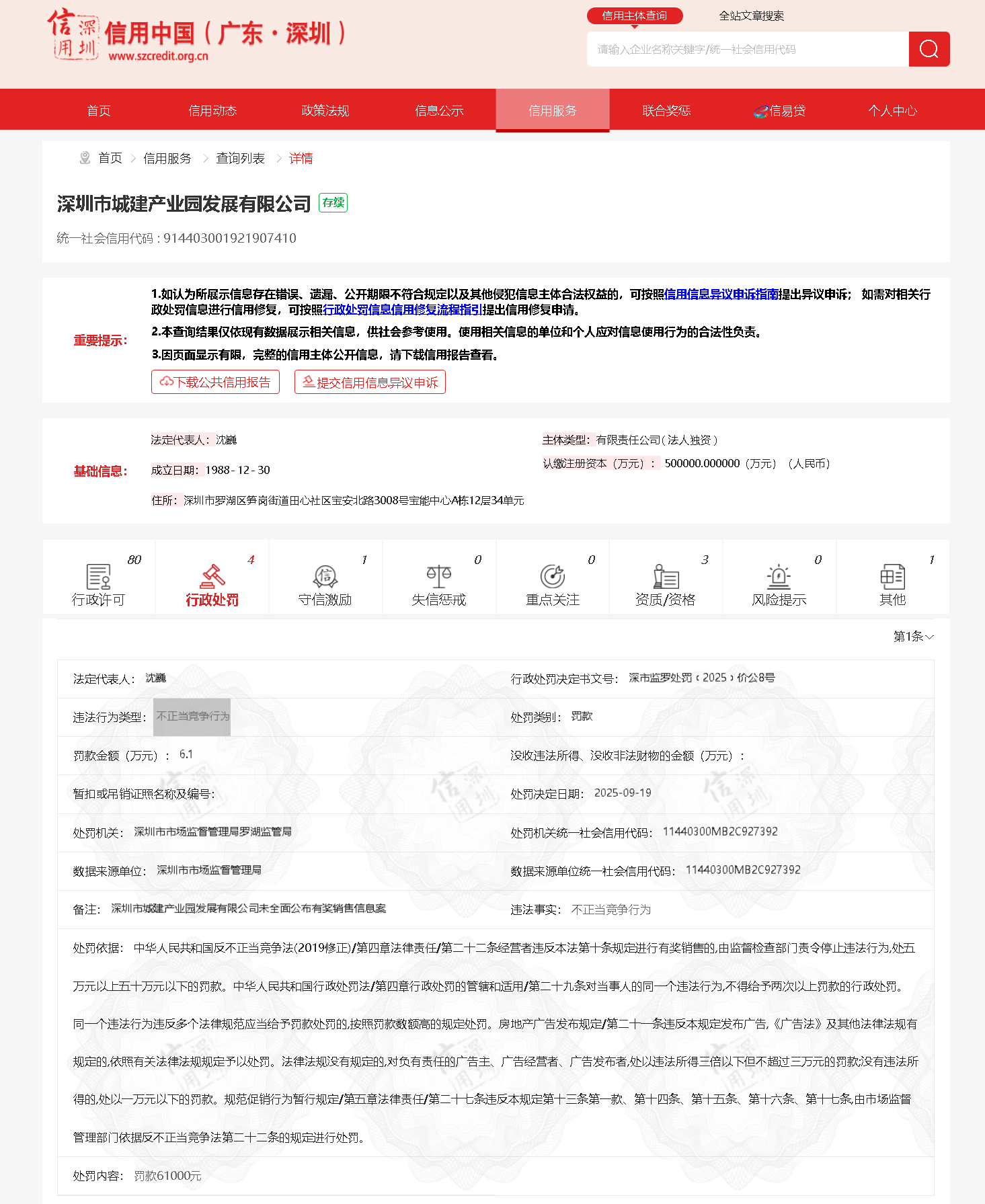
因不正当竞争行为,深圳市城建产业园发展有限公司被行政处罚
Qi Lu Wan Bao· 2025-09-23 00:06
Group 1 - Shenzhen Urban Construction Industry Park Development Co., Ltd. was fined 61,000 yuan for unfair competition practices by the Shenzhen Market Supervision Administration, Luohu Regulatory Bureau [1] - The company failed to fully disclose promotional sales information, which led to the penalty [1] - Shenzhen Urban Construction Industry Park Development Co., Ltd. was established on December 30, 1988, with Shen Wei as the legal representative [4] Group 2 - The sole shareholder of Shenzhen Urban Construction Industry Park Development Co., Ltd. is Shenzhen Urban Construction Development (Group) Co., Ltd. [6]
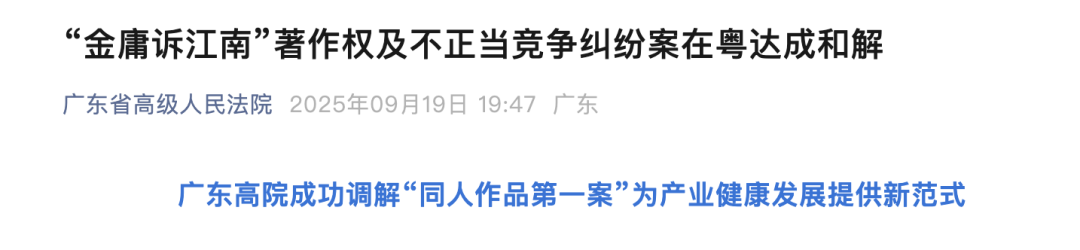
“金庸诉江南”案大结局!法院:当事人达成全面和解,“同意不算剽窃”!此前江南方被判赔188万元
Mei Ri Jing Ji Xin Wen· 2025-09-20 01:23
Core Viewpoint - The "Jin Yong vs Jiang Nan" case, a significant copyright dispute in the publishing and literary creation industry, has reached a comprehensive settlement after nine years of legal proceedings, marking the end of what is known as the "first case of fan works" in China [1][4]. Group 1: Case Background - The case originated from Jiang Nan's early novel "The Youth of This Place," which heavily utilized characters and elements from Jin Yong's classic martial arts novels, leading to allegations of copyright infringement and unfair competition by Jin Yong in July 2016 [2][3]. - The initial ruling by the Guangzhou Intellectual Property Court recognized the infringement and ordered Jiang Nan to cease the infringing activities, issue a public apology, and pay a total of 1.68 million yuan in damages, along with 200,000 yuan for reasonable expenses to stop the infringement [3]. Group 2: Settlement Details - The parties reached a settlement agreement that included several key points: - They agreed not to classify the actions as "plagiarism" - Jiang Nan acknowledged a lack of knowledge regarding copyright law and the resulting damage to Jin Yong [4] - Jiang Nan committed not to reprint "The Youth of This Place" in its original form and will not use original character names or related content from Jin Yong's works in future editions [4] - The subtitle used in the earlier version of the novel constituted unfair competition [4] - Jiang Nan has fulfilled the compensation amount determined in the previous ruling, and all prior judgments will no longer hold legal effect [4]. Group 3: Legal Implications - The case highlights the complexities surrounding "fan works" and copyright infringement, emphasizing that each situation must be analyzed on a case-by-case basis to determine whether a fan work infringes on the original author's rights [6]. - The court's approach focused on resolving disputes through dialogue rather than strict legal interpretation, aiming to clarify the legal boundaries of fan creations and the standards for recognizing copyright infringement [3][6].
借“暖暖”引流《以闪》落槌:叠纸胜诉,祖龙被裁定强制执行
Guo Ji Jin Rong Bao· 2025-09-19 14:18
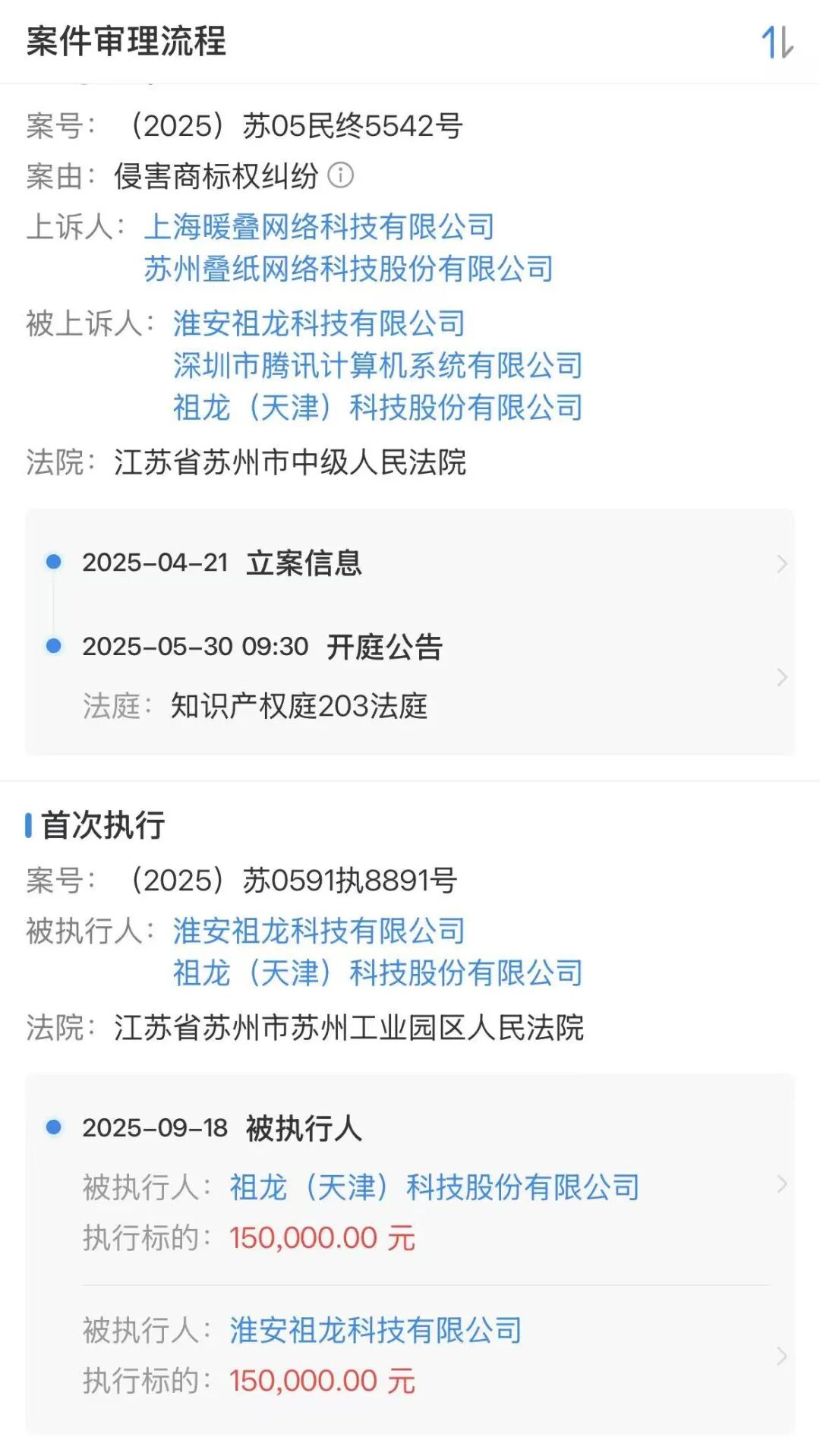
Core Viewpoint - The trademark infringement and unfair competition dispute between Die Paper and Zulong has concluded with Zulong being ordered to pay 150,000 yuan in damages, highlighting the importance of protecting intellectual property rights in the gaming industry [1][6][9]. Group 1: Legal Proceedings - The dispute originated in January 2024 when Die Paper discovered Zulong using its registered trademarks as search keywords on WeChat, leading to a lawsuit filed in March 2024 [6]. - The Jiangsu Provincial Intermediate People's Court upheld the initial ruling, confirming Zulong's infringement and ordering compensation of 150,000 yuan to Die Paper [6][9]. - Zulong failed to comply with the court's ruling, resulting in a forced execution of the payment [1][6]. Group 2: Company Backgrounds - Die Paper, established in 2013, has successfully dominated the dress-up game sector with its "Nuan Nuan" series and is expanding its IP through various initiatives, including a clothing brand and virtual idols [7]. - Zulong, founded in 1997 and listed on the Hong Kong Stock Exchange in 2020, has faced ongoing financial losses, with cumulative losses exceeding 2.4 billion yuan from 2020 to 2024 [9][10]. - Despite recent revenue growth of 44.4% in the first half of 2025, Zulong reported a net loss of 11.73 million yuan, indicating ongoing challenges in profitability [9][10]. Group 3: Industry Insights - The use of competitors' trademarks for promotional purposes is seen as a risky strategy that can lead to legal repercussions and may not be sustainable in a competitive market [7]. - The gaming industry is witnessing a shift, with companies needing to innovate to keep pace with rapidly evolving consumer preferences and competitive dynamics [10].
识破不正当竞争陷阱,守护投资者合法权益
Xin Lang Ji Jin· 2025-09-16 10:16
Core Viewpoint - The article emphasizes the importance of fair competition in the financial market to protect investors' rights and maintain market order, while highlighting various unfair competition practices that threaten investor safety [1]. Unfair Competition Behaviors - **False Advertising**: Misleading promotional activities that deceive investors into making irrational investment decisions due to a lack of understanding [3]. - **Technical Interference**: Utilizing technology to disrupt normal user choices and hinder the operation of legitimate network products or services [4]. - **Confusion Behavior**: Unauthorized use of influential names or similar logos that mislead investors into believing there is a specific connection with the impersonated institution or product [5]. - **Commercial Defamation**: Spreading false or misleading information online to damage the reputation of competitors or their products [6]. Prevention Strategies for Unfair Competition - **Proactive Information Gathering**: Investors should actively seek comprehensive information, monitor company announcements, and be vigilant about unusual trading data to prevent potential fraud [8]. - **Rational Risk Assessment**: Investors are advised to maintain a calm and rational mindset, carefully evaluate the feasibility of investment projects, and avoid blindly pursuing high returns [9]. - **Strict Verification of Institutional Qualifications**: Before engaging in financial activities, investors should verify the legitimacy and compliance of institutions, ensuring they choose qualified and reputable investment channels [10]. - **Legal Protection of Rights**: Investors should keep records of promotional materials and contracts, and seek legal remedies through litigation or arbitration if their rights are infringed [11].
抖音集团副总裁谈“字节离职赛道”
Di Yi Cai Jing Zi Xun· 2025-09-16 03:08
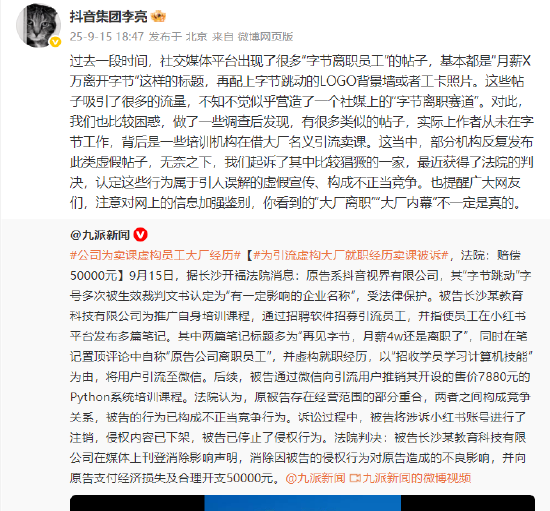
2025.09.16 第一财经持续追踪财经热点。若您掌握公司动态、行业趋势、金融事件等有价值的线索,欢迎提供。专 用邮箱:bianjibu@yicai.com (注:我们会对线索进行核实。您的隐私将严格保密。) 抖音集团副总裁李亮9月15日发文称,过去一段时间,社交媒体平台出现了很多"字节离职员工"的帖 子,基本都是"月薪X万离开字节"这样的标题,再配上字节跳动的LOGO背景墙或者工卡照片。这些帖 子吸引了很多的流量,不知不觉似乎营造了一个社媒上的"字节离职赛道"。做了一些调查后发现,有很 多类似的帖子,实际上作者从未在字节工作,背后是一些培训机构在借大厂名义引流卖课。这当中,部 分机构反复发布此类虚假帖子,无奈之下,公司起诉了其中比较猖獗的一家,最近获得了法院的判决, 认定这些行为属于引人误解的虚假宣传、构成不正当竞争。也提醒广大网友们,注意对网上的信息加强 鉴别,你看到的"大厂离职""大厂内幕"不一定是真的。 微信编辑| 七三 本文字数:436,阅读时长大约1分钟 ...

抖音集团副总裁谈“字节离职赛道”
第一财经· 2025-09-16 03:01
抖音集团副总裁李亮9月15日发文称,过去一段时间,社交媒体平台出现了很多"字节离职员工"的帖 子,基本都是"月薪X万离开字节"这样的标题,再配上字节跳动的LOGO背景墙或者工卡照片。这些 帖子吸引了很多的流量,不知不觉似乎营造了一个社媒上的"字节离职赛道"。 做了一些调查后发 现,有很多类似的帖子,实际上作者从未在字节工作 ,背后是一些培训机构在借大厂名义引流卖 课。这当中,部分机构反复发布此类虚假帖子,无奈之下,公司起诉了其中比较猖獗的一家,最近获 得了法院的判决,认定这些行为属于引人误解的虚假宣传、构成不正当竞争。也提醒广大网友们,注 意对网上的信息加强鉴别,你看到的"大厂离职""大厂内幕"不一定是真的。 微信编辑 | 七三 第 一 财 经 持 续 追 踪 财 经 热 点 。 若 您 掌 握 公 司 动 态 、 行 业 趋 势 、 金 融 事 件 等 有 价 值 的 线 索 , 欢 迎 提 供 。 专 用 邮 箱 : bianjibu@yicai.com 2025.09. 16 (注:我们会对线索进行核实。您的隐私将严格保密。) 本文字数:436,阅读时长大约1分钟 浦发银行 SPDBANK p 推荐阅读 ...

抖音集团副总裁李亮谈“字节离职赛道”:部分作者从未在字节工作,系培训机构引流卖课
Xin Lang Ke Ji· 2025-09-16 01:40
抖音集团副总裁李亮9月15日发文表示,过去一段时间,社交媒体平台出现了很多"字节离职员工"的帖 子,基本都是"月薪X万离开字节"这样的标题,再配上字节跳动的LOGO背景墙或者工卡照片。这些帖 子吸引了很多的流量,不知不觉似乎营造了一个社媒上的"字节离职赛道"。做了一些调查后发现,有很 多类似的帖子,实际上作者从未在字节工作,背后是一些培训机构在借大厂名义引流卖课。这当中,部 分机构反复发布此类虚假帖子,无奈之下,公司起诉了其中比较猖獗的一家,最近获得了法院的判决, 认定这些行为属于引人误解的虚假宣传、构成不正当竞争。也提醒广大网友们,注意对网上的信息加强 鉴别,你看到的"大厂离职""大厂内幕"不一定是真的。 责任编辑:李思阳 ...