全球治理倡议

Search documents
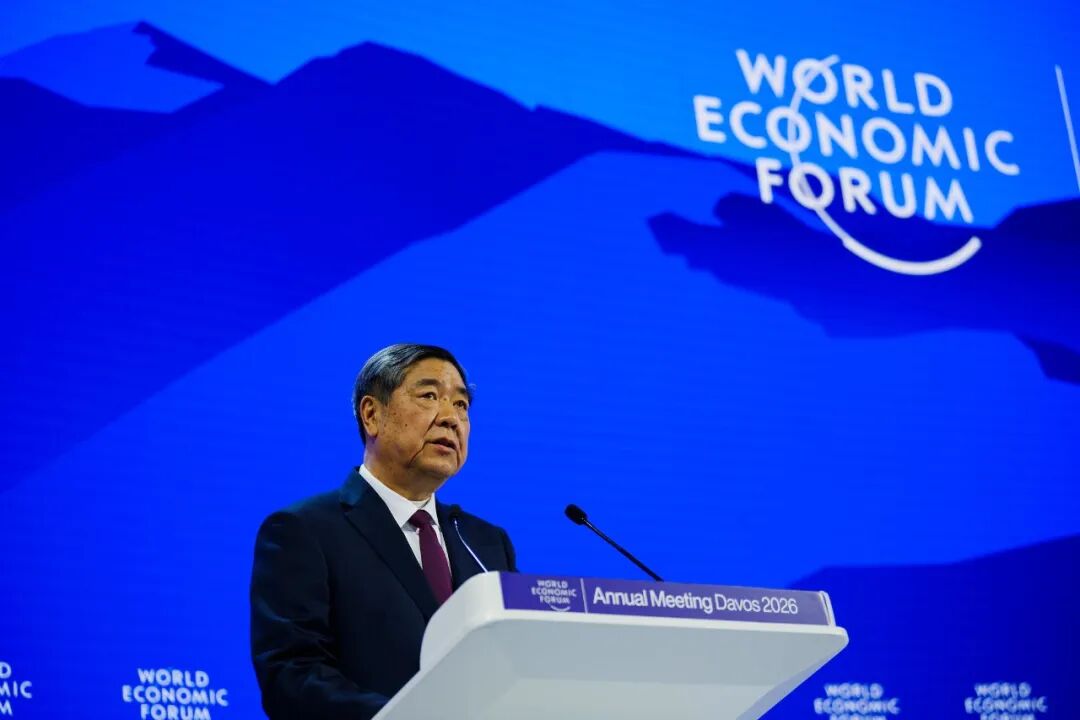
中华人民共和国国务院副总理何立峰在世界经济论坛2026年年会上的特别致辞
Xin Lang Cai Jing· 2026-01-21 06:12
新浪财经ESG评级中心提供包括资讯、报告、培训、咨询等在内的14项ESG服务,助力上市公司传播ESG理念,提升ESG可持续发展表现。点 击查看【 ESG评级中心服务手册】 尊敬的霍夫曼主席,芬克主席,布伦德总裁, 尊敬的各位嘉宾,女士们,先生们,朋友们: 2017年,面对逆全球化思潮,习近平主席在这里深刻作答"世界怎么了,我们怎么办"的问题,指出"让世界经济的大海退回到一个一个孤立的小湖泊、小 河流,是不可能的,也是不符合历史潮流的。"习近平主席的重要讲话拨云见日,被论坛方面誉为"为世界带来了阳光"。2021年,习近平主席提出,让多 边主义的火炬照亮人类前行之路。2022年,面对疫后重建的宏大课题,习近平主席强调,"在全球性危机的惊涛骇浪里,各国不是乘坐在190多条小船上, 而是乘坐在一条命运与共的大船上"。9年来,中国一直认真落实习近平主席重要讲话精神,践行人类命运共同体理念,坚定支持多边主义和自由贸易。今 天重温习近平主席的这些讲话,深感依然适用于当今世界,给人们带来深刻启示。 当前,世界百年变局加速演进,单边主义、保护主义抬头,叠加地区冲突和地缘政治的影响,全球经济贸易秩序发生新的变化。尤其是去年以来关 ...

为全球经济注入更多确定性力量
Sou Hu Cai Jing· 2026-01-20 15:08
Core Viewpoint - The World Economic Forum 2026 aims to explore stability and direction for the global economy amidst multiple uncertainties, emphasizing inclusive and resilient global development to inject more certainty and positive energy into the world economy [1][3]. Group 1: Global Economic Challenges - The latest report from the World Economic Forum indicates that the global economy will face multiple uncertainties over the next year, including asset revaluation, debt accumulation, geopolitical restructuring, and risks from artificial intelligence [3]. - The International Monetary Fund (IMF) highlights that trade tensions and escalating geopolitical conflicts may exert greater pressure on global economic activities [3]. - The U.S. government's new round of tariffs in 2025 and additional tariffs on European countries opposing U.S. claims over Greenland have led economists to express pessimism about the global economic outlook for 2026 [3]. Group 2: China's Economic Contribution - China's GDP is projected to exceed 140 trillion yuan in 2025, marking a 5.0% increase from the previous year, contributing approximately 30% to global economic growth, making it a stable and reliable driver for the world economy [6][7]. - China's commitment to high-level opening-up and the establishment of free trade zones are enhancing long-term confidence in cross-border investments [7]. Group 3: Importance of Global Cooperation - The current global landscape shows a weakening of cooperation related to trade, climate, technology, and security, yet innovative and smaller-scale cooperative mechanisms are emerging, indicating resilience and potential for global collaboration [8]. - Dialogue is emphasized as a cornerstone for cooperation, with the need to find common ground to address global priorities [8][9]. - China's initiatives on global development, security, civilization, and governance stress the importance of prioritizing development, win-win cooperation, and inclusive dialogue to ensure equitable benefits for all nations [8][9].

英国知名学者马丁·雅克:从“文明型国家”视角理解全球治理倡议
Xin Lang Cai Jing· 2026-01-19 01:53
Group 1 - The core idea of the article revolves around China's global governance initiative, which emphasizes five key principles: adherence to sovereign equality, compliance with international law, promotion of multilateralism, a people-centered approach, and action-oriented focus [1][9] - The initiative is seen as a means to repair and improve the existing international system rather than creating a new one, aiming to restore a rules-based order [2][10] - The concept of China as a "civilizational state" is highlighted as a perspective that can help understand its unique logic in global governance practices [1][10] Group 2 - The article discusses the challenges posed by the current "disorder" in the international system, particularly due to the United States' unilateral actions that undermine international law and multilateralism [4][12] - The need for a new international system that accurately reflects the realities of today's world, particularly the concerns of developing countries, is emphasized [7][13] - The proposed reforms aim to create a more just and inclusive international system that can adapt to the changing global development landscape [7][13]
万喆:以有效对话重建经济全球化共识
Jing Ji Ri Bao· 2026-01-19 00:12
Group 1 - The World Economic Forum 2026 will be held from January 19 to January 23 in Davos, Switzerland, with the theme "The Spirit of Dialogue," addressing core global challenges such as geopolitical tensions, economic conflicts, and the "information cocoon" of the digital age [1] - The global economy is expected to face continued slowdown, with the International Monetary Fund and other major institutions predicting a decline in growth due to uncertainty, protectionism, and structural imbalances in labor markets [2] - The World Trade Organization has significantly lowered its forecast for global goods trade growth in 2026 to 0.5%, down from 2.4% in 2025, indicating severe challenges in global trade dynamics [2] Group 2 - Protectionism is identified as a major threat to global dialogue and cooperation, undermining trust and the foundational rules of international relations [4] - Major economies are misusing national security concepts to impose tariffs and politicize trade relations, which distorts global resource allocation and increases costs for consumers and businesses [4] - China's global governance initiative, proposed in September 2025, aims to foster consensus on unity and dialogue, countering the trend of protectionism and promoting multilateralism [5][6] Group 3 - China is committed to high-level openness and has proposed zero-tariff treatment for the least developed countries, injecting new vitality into economic globalization [6] - The initiative emphasizes five core principles: equality of sovereignty, adherence to international law, multilateralism, a people-centered approach, and action-oriented strategies, addressing the shortcomings of current global governance [6] - China actively participates in reforming the WTO and seeks to join high-standard trade agreements, indicating a willingness to integrate into and enhance the global economic rule system [7]
以有效对话重建经济全球化共识
Jing Ji Ri Bao· 2026-01-18 22:17
Group 1: Global Economic Outlook - The World Economic Forum 2026 will be held from January 19 to January 23 in Davos, Switzerland, focusing on the theme of "the spirit of dialogue" to address global challenges such as geopolitical tensions and economic conflicts [1] - Major international organizations, including the IMF, predict a continued slowdown in global economic growth, with the WTO significantly lowering the 2026 global goods trade growth forecast to 0.5%, down from 2.4% in 2025 [2] - The trend of localization and regionalization in supply chains indicates a shift from efficiency-first globalization to a model prioritizing security and resilience [2] Group 2: Challenges to Global Dialogue - Protectionism poses a significant threat to global dialogue and cooperation, undermining trust and the foundational rules of international relations [4] - The misuse of national security concepts by major economies, including arbitrary tariffs and economic sanctions, distorts global resource allocation and increases uncertainty for businesses [4] - The narrative of zero-sum games, amplified by social media, complicates efforts for mutually beneficial dialogue and erodes the political will for strategic economic cooperation [4] Group 3: China's Role in Global Governance - China proposed a global governance initiative in September 2025, emphasizing unity over division and dialogue over confrontation, positioning itself as a staunch advocate for multilateralism and economic globalization [5][6] - The initiative includes five core principles aimed at addressing the shortcomings of global governance, such as insufficient representation and trust deficits, while opposing unilateralism and protectionism [6] - China actively participates in reforming the WTO and seeks to join high-standard trade agreements, indicating a willingness to integrate into and enhance the global trade rule system [7] Group 4: Future Economic Prospects - China's economic trajectory remains positive, with a commitment to providing stability and certainty to the global economy through high-level openness and development [8] - The emphasis on dialogue and cooperation is seen as essential for navigating the complexities of the global economy and achieving sustainable prosperity [8]
全球治理倡议助力外空治理改革
Xin Lang Cai Jing· 2026-01-18 18:28
Core Viewpoint - The article discusses the increasing challenges in outer space governance, highlighting the need for a more equitable and sustainable governance system, particularly in light of the rising militarization and competition for space resources. China's global governance initiative is presented as a constructive solution to these issues [1]. Group 1: Challenges in Outer Space Governance - The outer space governance system faces multiple deficits, including a representation deficit where global South countries lack adequate representation in decision-making processes [2]. - There is an authority deficit threatening the multilateral governance framework led by the United Nations, exacerbated by unilateral actions from countries like the U.S. that undermine established international laws [2]. - An effectiveness deficit is evident as current governance mechanisms are slow to respond to emerging challenges such as space debris and military ambitions, leading to regulatory gaps [2]. Group 2: China's Global Governance Initiative - China's initiative emphasizes five core principles to enhance outer space governance: equality of sovereignty, rule of law, multilateralism, human-centered values, and practical effectiveness [3]. - The principle of equality of sovereignty aims to democratize international relations in outer space, ensuring that the voices of global South countries are included [3]. - The initiative advocates for adherence to existing international legal frameworks, including the Outer Space Treaty, to maintain order in outer space governance [3]. Group 3: Constructing a Fairer Governance System - The article argues for reforming the existing governance system rather than completely overhauling it, emphasizing the importance of maintaining the core principles of the United Nations framework [4][5]. - It calls for inclusive participation from all countries in governance processes, particularly in critical areas like frequency allocation and space debris management [5]. - The need for international cooperation and capacity building for developing countries is highlighted to enhance their participation in outer space governance [5].
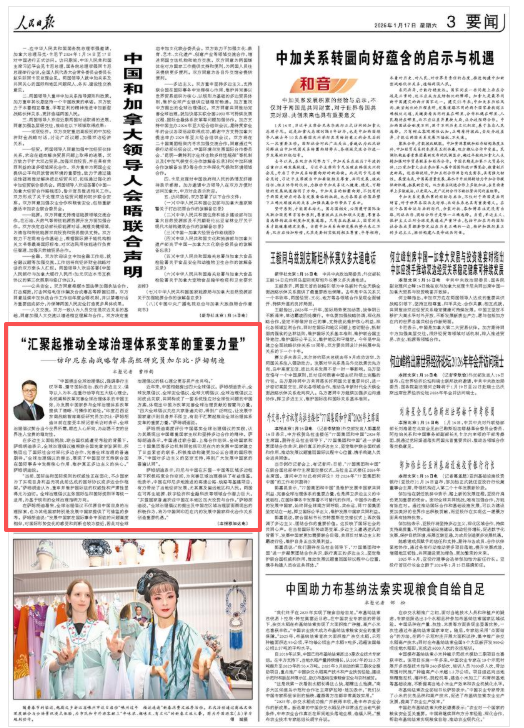
加尔比·萨姆胡迪:“汇聚起推动全球治理体系变革的重要力量”
Ren Min Ri Bao· 2026-01-17 11:49
Core Viewpoint - The global governance initiative proposed by China emphasizes five core principles: sovereign equality, adherence to international law, multilateralism, a people-centered approach, and action-oriented strategies, providing a clear and actionable path for developing countries to participate in global governance reform [1][2]. Group 1: Global Governance Initiative - The initiative aligns with the current global needs and injects valuable stability into a turbulent world, responding to the international community's expectations for deepening multilateral cooperation and improving global governance [1]. - The initiative is rooted in the principles of the UN Charter and demonstrates China's commitment to supporting the UN's core role in international affairs and maintaining true multilateralism [1][2]. - The authority of international law and rules is weakening, making it urgent to reaffirm and uphold their seriousness and applicability, guiding rule-based global governance [1]. Group 2: Relevance to Developing Countries - The global governance initiative not only stems from China's governance exploration but also serves as a reference for other countries, especially developing nations, which face similar issues in international affairs [2]. - The four global initiatives proposed by China—global development, global security, global civilization, and global governance—are interconnected and collectively address global issues, showcasing China's wisdom and strength in reforming global governance [2]. - These initiatives resonate with developing countries, helping them realize they are not isolated and mobilizing significant support for global governance reform [2]. Group 3: Regional Cooperation - Indonesia and China are actively expanding cooperation within the ASEAN-China multilateral framework, providing beneficial examples for regional governance improvement [3]. - China's infrastructure projects in Indonesia, such as highways and railways, significantly boost local economic development, particularly benefiting remote areas [3]. - There is substantial potential for cooperation between China and Indonesia in renewable energy, digital economy, and financial technology, with ASEAN countries generally welcoming increased Chinese investment and collaboration [3].
“汇聚起推动全球治理体系变革的重要力量” ——访印尼东南战略智库高级研究员加尔比·萨姆胡迪
Xin Lang Cai Jing· 2026-01-17 01:15
Core Viewpoint - China has proposed a global governance initiative emphasizing five core principles: sovereign equality, adherence to international rule of law, practice of multilateralism, human-centered approach, and action-oriented focus, providing a clear and actionable path for developing countries to participate in global governance reform [2][3] Group 1: Global Governance Initiative - The global governance initiative aligns with the current needs of the world and injects valuable stability into a turbulent environment, responding to the international community's expectations for deepening multilateral cooperation [2] - The initiative is rooted in the principles of the UN Charter and demonstrates China's commitment to supporting the UN's core role in international affairs and maintaining true multilateralism [2][3] - The initiative aims to reaffirm and maintain the authority and seriousness of international law and rules, indicating a pressing need for a unified application of these standards in global governance [2][3] Group 2: Relevance to Developing Countries - The global governance initiative not only stems from China's own governance exploration but also serves as a reference for other countries, particularly developing nations, which face similar issues in international affairs [3] - The four global initiatives proposed by China—global development, global security, global civilization, and global governance—are interconnected and collectively address global issues, showcasing China's wisdom and strength in improving global governance [3] - The initiatives have garnered widespread response, helping developing countries realize they are not isolated and fostering significant momentum for reforming the global governance system [3] Group 3: Regional Cooperation - Indonesia and China are actively expanding cooperation within regional multilateral frameworks, providing beneficial examples for improving regional governance [4] - China's infrastructure projects in Indonesia, such as highways and railways, have significantly boosted local economic development, particularly benefiting remote areas [4] - There is substantial potential for cooperation between China and Indonesia in renewable energy, digital economy, and financial technology, with ASEAN countries generally welcoming increased Chinese investment and collaboration [4]

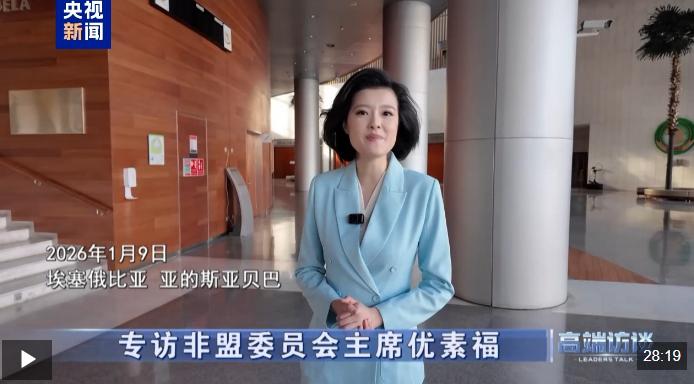
高端访谈丨专访非盟委员会主席优素福
Yang Shi Xin Wen Ke Hu Duan· 2026-01-17 01:04
Group 1 - The core viewpoint of the article emphasizes the strong partnership between Africa and China, highlighting that China is a true friend to African nations and actively supports their development, especially in infrastructure and key sectors [2][28]. - The African Union (AU) is committed to the One China principle and will always stand with China, reflecting a unified stance on international issues [2][49]. - The AU aims to strengthen cultural exchanges and cooperation with China, particularly in light of the upcoming 70th anniversary of diplomatic relations in 2026 and the establishment of the "Year of China-Africa Cultural Exchange" [2][23]. Group 2 - The AU, established in 2002, consists of over 50 member states and aims to achieve a unified, peaceful, and prosperous Africa by 2063 through its Agenda 2063 [6]. - The AU recognizes the importance of a partnership based on mutual respect and understanding with China, moving away from past hegemonic relationships [8]. - The AU has actively participated in the China-Africa Cooperation Forum, which has provided a constructive platform for collaboration over the past 26 years [12]. Group 3 - The AU is focusing on three key areas for Africa's development: industrialization, agricultural transformation, and increasing intra-African trade [30][33]. - The AU is working to enhance its internal trade mechanisms, including the African Continental Free Trade Area, to boost economic cooperation among member states [35]. - The AU's membership in the G20 is seen as a significant opportunity to amplify Africa's voice in global decision-making processes [37]. Group 4 - The AU is reforming its peace and security architecture, emphasizing preventive measures and the establishment of a rapid deployment force to address crises effectively [41]. - The AU's stance on international issues, such as the situation in Venezuela, reflects its commitment to upholding international law and the sovereignty of nations [43]. - The AU supports China's global initiatives, viewing them as essential for fostering multilateral cooperation and addressing global challenges [45].
“汇聚起推动全球治理体系变革的重要力量”——访印尼东南战略智库高级研究员加尔比·萨姆胡迪
Xin Lang Cai Jing· 2026-01-16 23:21
Core Viewpoint - China's global governance initiative emphasizes five core principles: equality of sovereignty, adherence to international rule of law, practice of multilateralism, human-centered approach, and action-oriented focus, providing a clear and actionable path for developing countries to participate in global governance reform [11][18]. Group 1: Global Governance Initiative - The global governance initiative aligns with the current needs of the world and injects valuable stability into a turbulent environment [11][18]. - The initiative is rooted in the principles of the UN Charter and responds to the international community's expectations for deepening multilateral cooperation and improving global governance [11][18]. - The initiative reflects China's determination to support the UN's core role in international affairs and uphold true multilateralism [11][18]. Group 2: International Law and Rules - The authority of international law and rules is weakening, with many countries ignoring previously agreed international agreements for their own interests [11][18]. - There is an urgent need to reaffirm and maintain the authority and seriousness of international law, with the initiative advocating for equal and unified application of international law and rules [11][18]. Group 3: Relevance to Developing Countries - The global governance initiative not only stems from China's governance exploration but also serves as a reference for other countries, especially developing nations, which face similar issues in international affairs [12][19]. - The four global initiatives proposed by China—global development, global security, global civilization, and global governance—are interconnected and form a systematic response to global issues, showcasing China's wisdom and strength in improving global governance [12][19]. Group 4: Regional Cooperation - Indonesia and China are actively expanding cooperation within the ASEAN-China multilateral framework, providing beneficial references for regional governance [20]. - China's infrastructure projects in Indonesia, such as highways and railways, significantly boost local economic development, especially benefiting remote areas [20][21]. - There is substantial potential for cooperation between China and Indonesia in renewable energy, digital economy, and financial technology, with ASEAN countries generally welcoming increased Chinese investment and cooperation in the region [20][21].