
商业秘密保护

Search documents
屹唐股份:起诉应用材料公司侵犯商业秘密
Zheng Quan Shi Bao Wang· 2025-08-13 09:48
Core Viewpoint - Yitang Co., Ltd. (屹唐股份) has accused Applied Materials, Inc. of illegally obtaining and using its core technology secrets related to plasma sources and wafer surface treatment, which has caused significant damage to its intellectual property and economic interests [1] Legal Action - The company has filed a lawsuit against Applied Materials in the Beijing Intellectual Property Court, claiming damages amounting to 99.99 million yuan [1] - The court has issued a notice of case acceptance and evidence submission, and the case has been officially registered, although it has not yet gone to trial [1]

屹唐股份起诉应材侵犯商业秘密,法院已立案
Ju Chao Zi Xun· 2025-08-13 09:24
Core Viewpoint - Yitang Semiconductor Co., Ltd. has filed a lawsuit against Applied Materials for illegally obtaining and using its trade secrets, claiming damages of 99.99 million yuan [1][4]. Group 1: Legal Action - The lawsuit was filed in Beijing Intellectual Property Court, with a claim amount of 99.99 million yuan [1]. - Yitang Semiconductor alleges that Applied Materials has violated the Anti-Unfair Competition Law of the People's Republic of China by disclosing and claiming ownership of its trade secrets through a patent application [4]. - The company has made six requests in the lawsuit, including a demand for Applied Materials to cease using the trade secrets and to compensate for economic losses with punitive damages [4]. Group 2: Technology and Expertise - Yitang Semiconductor's key technology involves the use of high-concentration, stable, and uniform plasma for wafer surface treatment, which is critical for its semiconductor processing equipment [1]. - The two employees involved in the case had previously worked for Yitang's wholly-owned subsidiary, Mattson Technology, Inc., and had signed confidentiality agreements regarding the trade secrets [1][4]. - Evidence suggests that after being hired by Applied Materials, these employees submitted a patent application that disclosed Yitang's trade secrets [1]. Group 3: Company Position and Impact - Yitang Semiconductor emphasizes its commitment to original research and development and the importance of protecting intellectual property [4]. - The company asserts that the lawsuit is a legitimate measure to protect its rights and maintain fair market competition, stating it will not significantly impact its operations [4][5]. - The actual impact of the lawsuit on the company's profits cannot be determined until the court reaches a final judgment [5].

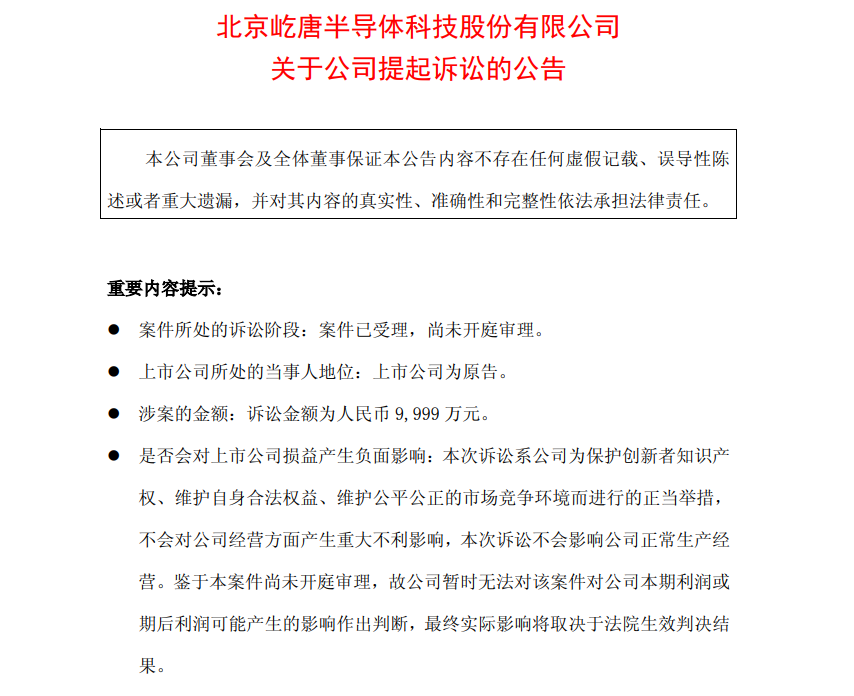
屹唐股份(688729.SH):公司对应用材料公司提起诉讼
Ge Long Hui A P P· 2025-08-13 09:12
Group 1 - The company, Yitang Co., Ltd. (688729.SH), has filed a lawsuit against Applied Materials, Inc. for allegedly illegally obtaining and using its core technology related to plasma sources and wafer surface treatment [1] - The lawsuit claims that Applied Materials disclosed the trade secrets by applying for patents in China and wrongfully claimed the patent rights, violating the Anti-Unfair Competition Law of the People's Republic of China [1] - The lawsuit has been accepted by the Beijing Intellectual Property Court, with a case number of (2025) Jing 73 Min Chu 908, and the claimed amount is RMB 99.99 million [1] Group 2 - As of the date of the announcement, the case has been filed but has not yet gone to trial [1]
科技大厂与前员工知识产权侵犯纠纷不断 创投机构紧急加强投前尽调“避雷”
Jing Ji Guan Cha Wang· 2025-08-09 03:24
Core Viewpoint - The increasing number of intellectual property and trade secret infringement disputes between large tech companies and their former employees has raised concerns in the venture capital community, impacting investment strategies and risk assessments [2][3][11]. Group 1: Recent Legal Cases - On July 28, a Shanghai court sentenced 14 former employees of Zunpai Communications Technology for infringing Huawei's trade secrets, resulting in a total fine of 13.5 million [2]. - JD.com reported that it has substantial evidence of intellectual property infringement against Jiushi Intelligent Technology, whose founding team previously worked in JD's autonomous vehicle division [2][6]. - CATL filed a lawsuit against Xiamen Haichen Energy Technology for unfair competition, highlighting the trend of former employees using proprietary technology from their previous employers [2][5]. Group 2: Impact on Venture Capital - Venture capital firms have become increasingly cautious, recognizing that lawsuits for intellectual property infringement can significantly affect the future prospects of startups and increase investment risks [3][11]. - Jiushi Intelligent recently completed a $300 million Series B funding round, and any legal issues could delay product launches, directly impacting business development and investor returns [3][11]. - Venture capitalists are enhancing their due diligence processes to assess potential conflicts between the technology developed by former employees and their previous employers' patents [3][11]. Group 3: Causes of Disputes - Many disputes arise because former employees inadvertently use research results obtained during their tenure at large tech companies, believing they have the right to do so [4][8]. - The lack of clear agreements regarding the ownership of research results often leads to misunderstandings and legal conflicts [4][8]. - The trend of former employees leveraging proprietary technology to gain competitive advantages in new ventures has intensified the scrutiny from their former employers [8][10]. Group 4: Recommendations for Resolution - Effective communication and preemptive agreements regarding the use of intellectual property are essential to mitigate disputes [4][10]. - Companies should implement comprehensive non-compete agreements and ensure they are enforced to prevent potential infringements [9][10]. - Venture capital firms are advised to include specific clauses in investment agreements to protect their interests in case of intellectual property violations by startup founders [13][14].



尊湃芯片窃密案细节曝光:有人白天在华为,晚上去尊湃
Guan Cha Zhe Wang· 2025-08-08 13:05
Core Viewpoint - The "Zunpai Theft of Huawei Chip Trade Secrets Case" has revealed shocking details about a group involved in stealing confidential information from Huawei, leading to the sentencing of 14 individuals for their roles in the crime [1][5]. Group 1: Case Background - The main perpetrator, Zhang Kun, recruited former Huawei employees to form a core team focused on WiFi chip development, with 60% of Zunpai's initial workforce being ex-Huawei staff [1]. - Employees left Huawei in stages to avoid detection, with some working at Zunpai during weekends while still employed at Huawei [2]. Group 2: Methods of Theft - Former Huawei employees accessed sensitive documents before leaving, using methods such as copying, photographing, and screenshotting to steal chip circuit diagrams and specifications [2]. - Internal collusion occurred, with individuals from Zunpai and current Huawei employees working together to extract confidential information [4]. Group 3: Legal Consequences - The case culminated in the arrest of 14 suspects, with significant evidence showing that the stolen technology had over 90% similarity to Huawei's trade secrets [5]. - Sentences varied, with Zhang Kun receiving a 6-year prison term and fines totaling 135 million RMB across all convicted individuals [6]. Group 4: Implications for the Industry - The case underscores Huawei's commitment to protecting its intellectual property through legal means, serving as a warning to companies about the importance of safeguarding trade secrets [8]. - It highlights the increasing enforcement of intellectual property laws in China, discouraging attempts to exploit loopholes for personal gain [8].

前海思14名员工窃取华为商业秘密被判刑
Hua Er Jie Jian Wen· 2025-08-08 12:00
如今随着法院的宣判,尊湃科技侵犯华为芯片技术商业秘密案尘埃落定。 风险提示及免责条款 市场有风险,投资需谨慎。本文不构成个人投资建议,也未考虑到个别用户特殊的投资目标、财务状况或需要。用户应考虑本文中的任何 意见、观点或结论是否符合其特定状况。据此投资,责任自负。 据此前警方通报,经查,2021年2月,华为海思原高管张某、刘某等人为牟取非法利益,在离职后设立 某科技公司,以支付高薪、股权利诱等方式,诱导多名原公司研发人员跳槽至其公司,并指使这些人员 在离职前通过摘抄、截屏等方式非法获取权利公司芯片技术信息,抄袭并运用于张某公司设计的同类型 芯片上,企图以此非法牟利。 经鉴定,侵权芯片技术有40个技术点与原商业秘密的密点具有90%以上同一性,构成实质性相同。张某 团伙的窃密行为,导致权利公司商业秘密灭失,应根据该项商业秘密的研究开发成本、实施该项商业秘 密的收益等商业价值来认定造成的权利公司损失。 2023年12月,公众号"上海经侦ECID"发文称,在公安部的指挥部署下,在江苏警方的大力配合下,上 海警方成功侦破一起侵犯芯片技术商业秘密案,抓获犯罪嫌疑人14名,查扣存储侵权芯片技术的服务器 7台。 近日,上海市 ...
台积电2nm泄密,日企解雇一人
Guan Cha Zhe Wang· 2025-08-08 06:14
Group 1 - Tokyo Electron announced the dismissal of an employee from its Taipei branch following the arrest of six individuals suspected of stealing TSMC's trade secrets, marking the company's first public statement on the matter [1] - TSMC confirmed the leak of trade secrets related to its 2nm process, resulting in the dismissal of multiple employees, and emphasized its zero-tolerance policy towards violations of trade secret protection [1][2] - An internal investigation revealed that approximately 10 individuals were involved in the leak, including a former TSMC employee who contacted R&D personnel to obtain confidential information [1] Group 2 - Three individuals involved in the 2nm trial production were found to have illegally connected to the internal network while working from home, capturing over 400 images of process integration technology and sharing them with Tokyo Electron employees [2] - The Japanese government-backed startup, Rapidus, announced significant progress in its $34 billion (approximately 2440.92 billion RMB) 2nm chip project, successfully producing Japan's first 2nm transistor [2] Group 3 - TSMC holds a dominant position in the global foundry market with a 67.6% market share, followed by Samsung at 7.7%, SMIC at 6.0%, UMC at 4.7%, and GlobalFoundries at 4.2%, collectively accounting for 90.2% of the market [3]

界面早报 | 就理想i8碰撞测试相关方发布联合声明;特朗普对印度加征25%的额外关税
Sou Hu Cai Jing· 2025-08-06 23:16
Group 1 - The summer box office in 2025 has surpassed 200 million viewers as of August 6, indicating a strong recovery in the film industry [1] - Ideal Automotive, China Automotive Research, and Dongfeng Liuzhou Motor issued a joint statement addressing the collision test incident involving the Ideal i8, emphasizing the need for industry self-discipline and integrity in product development and marketing [2] - TSMC confirmed the dismissal of multiple employees due to the leakage of 2nm process trade secrets, with investigations revealing that around 10 individuals were involved in the incident [3] Group 2 - *ST Dongtong announced that its actual controller and chairman, Huang Yongjun, is under investigation by the China Securities Regulatory Commission for suspected violations of information disclosure laws [4] - President Trump signed an executive order imposing a 25% additional tariff on goods from India in response to India's continued importation of Russian oil [5] - The White House announced that Apple will increase its investment commitment in the U.S. by $100 billion, reflecting the company's ongoing expansion plans [6] Group 3 - Federal Reserve official Kashkari indicated that two interest rate cuts this year may still be appropriate, suggesting a potential response to economic slowdown [7] - U.S. stock markets saw all three major indices close higher, with Apple shares rising over 5%, indicating strong performance in the tech sector [8]


董明珠那句话含金量还在上升!国产芯片监管需加强,堵住“后门”
Sou Hu Cai Jing· 2025-08-05 10:46
Core Viewpoint - The case of Zunpai Communications, which was found guilty of stealing Huawei's core chip technology, highlights the urgent need for stronger regulation in the domestic chip industry and raises concerns about internal security within companies [1][3][24]. Group 1: Case Summary - On July 28, 2025, the Shanghai Third People's Court sentenced Zhang Kun and 14 others for commercial secret infringement, with Zhang receiving a six-year prison term and a five-year industry ban [20]. - The total fines for the 14 individuals amounted to 13.5 million yuan, and Zunpai Communications, once valued at 1.5 billion yuan, had over 95 million yuan in cash frozen and was forced to dissolve [22]. - The case involved the theft of critical technology, with 90% similarity between Zunpai's products and Huawei's trade secrets, indicating a severe breach of trust and innovation [18][22]. Group 2: Industry Implications - The incident underscores the risks associated with a "fast capital" approach, where investors prioritize quick returns over thorough due diligence, leading to potential exploitation of proprietary technologies [9][12]. - The case serves as a cautionary tale about the vulnerabilities within companies, particularly regarding internal threats, as highlighted by the actions of former Huawei employees [16][29]. - The rise of domestic chip companies, such as Mengxin Technology and Longxin Zhongke, demonstrates a shift towards self-reliance and innovation in the industry, contrasting with the pitfalls of technology theft [27][29].

解开芯片高管“背叛”疑云
Ren Min Wang· 2025-08-04 00:48
Core Points - A senior executive from a chip company was found to have leaked core business secrets to a competitor, raising concerns about high-tech security [1][2] - The company, recognized as a high-tech enterprise, had implemented strict data protection measures, including physical isolation of servers and confidentiality agreements with employees [2][3] - The executive used a super administrator account to transfer sensitive data to a personal cloud storage, which included critical technology codes for an AI processor project [3][4] - The case highlights the challenges in calculating damages for stolen trade secrets, as the technology in question had not yet been commercially licensed [5][6] - The court utilized a cost-based method to assess the value of the stolen trade secrets, focusing on relevant research and development costs [5][7] - An expert advisor from the semiconductor industry was involved in the case to provide technical insights, reflecting the need for specialized knowledge in legal proceedings related to technology [6][7] - The court's ruling emphasized the importance of protecting intellectual property in the rapidly evolving tech sector, particularly in relation to AI and semiconductor industries [10][11] - The case serves as a precedent for future legal actions involving trade secret theft in high-tech industries, reinforcing the legal framework for protecting intangible assets [10][11]