太空经济

Search documents
2026,谁在竞逐“星辰大海”
Huan Qiu Shi Bao· 2026-01-16 22:44
Core Insights - The commercial space sector is experiencing rapid growth, with various countries and companies focusing on satellite networks and launch capabilities, indicating high commercial potential in this field [1][6][10] - The competition landscape is evolving, with key players like SpaceX leading in satellite deployment and launch frequency, while other nations and companies are striving to catch up [6][9][10] Group 1: Industry Dynamics - Commercial space activities are market-driven and include satellite manufacturing, rocket launches, satellite applications, and space tourism [1] - The focus on satellite launches is driven by the need for cost reduction through scale and the demand for commercial applications requiring extensive satellite networks [2][3] - The global competition in low Earth orbit (LEO) satellite networks is intensifying, with multiple countries planning to deploy over 100,000 satellites [2][6] Group 2: Technological Developments - The future of the space industry will heavily rely on advancements in reusable rocket technology, which is crucial for reducing launch costs [3][6] - The year 2026 is highlighted as a pivotal moment for breakthroughs in rocket recovery technology, with several companies planning tests [3][6] Group 3: Global Competition - The international landscape shows a clear division, with SpaceX at the forefront, followed by Chinese entities and other emerging players from Europe and Japan [6][9] - The U.S. commercial space sector benefits from supportive legislation and government collaboration, which has fostered innovation and competition [7][9] Group 4: Market Opportunities - The demand for satellite applications is expanding, particularly in areas like IoT, satellite communication, and space computing, which are expected to enhance economic growth [11][12] - Companies are exploring new applications for satellite technology, including direct satellite communication services that could become more affordable [11][12] Group 5: Space Governance - The increasing number of satellites raises concerns about orbital congestion and space debris, necessitating the establishment of a sustainable global space governance framework [13][14] - Experts emphasize the need for international cooperation to develop effective space traffic management rules and to monitor space objects [13][14]

马斯克:三年内星舰发射每小时一次!两融标的卫星产业ETF(159218)9个交易日累计成交122亿,紫光国微高开
Sou Hu Cai Jing· 2026-01-16 01:40
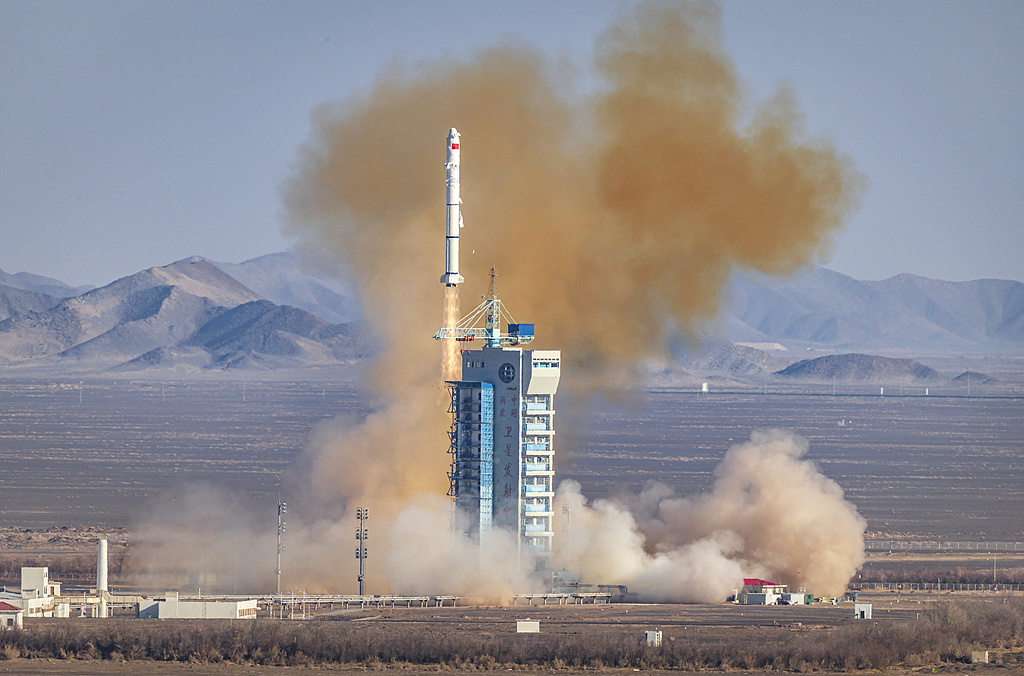
Group 1 - The global commercial space industry is experiencing a new wave of accelerated development, driven by dense policy and technological goals from both domestic and international sectors [3] - China Aerospace Science and Technology Corporation has prioritized breakthroughs in reusable rocket technology as a key annual task, with local policies supporting low-orbit satellite export businesses [3] - The upcoming launch of the "Gushenxing No. 1" rocket by Xinghe Power on January 17 marks the first attempt at a private space launch in China, highlighting the growing involvement of private capital in the space sector [3] Group 2 - SpaceX founder Elon Musk announced an ambitious roadmap aiming for a Starship launch frequency of over once per hour within three years, with plans to produce 10,000 Starship vehicles annually [3] - If successful, this initiative could significantly alter the cost structure of space launches and enhance space transportation capabilities [3] - The sustained high trading activity of the satellite industry ETF reflects a growing consensus in the market regarding the long-term prospects of the space economy [3]

太空光伏概念热度飙升,企业抢滩布局正酣!钙钛矿成潜力方向
Shang Hai Zheng Quan Bao· 2026-01-16 00:46
Core Insights - The space photovoltaic concept has gained significant attention in 2026, with brokerages predicting a "trillion-level market" and companies like JinkoSolar, Trina Solar, and Junda Co. actively disclosing their plans and progress in this field [1][2] - Industry experts highlight the potential of space photovoltaics amid the maturation of commercial space technology and the growing energy demands of AI computing centers, while also acknowledging the challenges of commercialization [1][4] Company Developments - Elon Musk discussed the future of space photovoltaics, emphasizing solar energy as the key to human energy freedom, with plans for 8,000 launches per year to deploy AI satellites that maximize sunlight utilization [2] - JinkoSolar signed a strategic cooperation agreement with Jingtai Technology to establish a joint venture focused on AI-based high-throughput perovskite tandem solar cells [2] - Junda Co. announced an investment of 30 million yuan to acquire a stake in Xingyi Chip Energy, aiming to expand into the space photovoltaic sector [2] Technological Advancements - GCL-Poly's chairman stated plans to collaborate with aerospace research institutions to test perovskite components in thin atmosphere regions, exploring commercial applications [3] - Lightyear Technology has been conducting ground simulations and space environment tests, having already sent perovskite components into orbit for testing [3] - Mingyang Smart Energy, a wind power leader, plans to acquire Dehua Chip, which focuses on space solar cells, indicating a cross-industry move into space photovoltaics [3] Market Potential - The interest in space photovoltaics is driven by the maturation of commercial space technology and the increasing value of the "space economy," which provides a solid foundation for development [4] - The main battery technologies for space photovoltaics include gallium arsenide, crystalline silicon, and perovskite, with perovskite being favored for its high efficiency and potential for lightweight and flexible applications [5][6] Commercialization Challenges - Despite the promising future, the commercialization of space photovoltaics faces significant challenges, including high launch costs and the stability of equipment in extreme space environments [7] - Analysts predict that large-scale commercial power supply from space photovoltaics may not be realized until after 2040, emphasizing the need for phased development and testing [8]




中国航天科技集团:全力突破!
Zhong Guo Ji Jin Bao· 2026-01-15 15:19
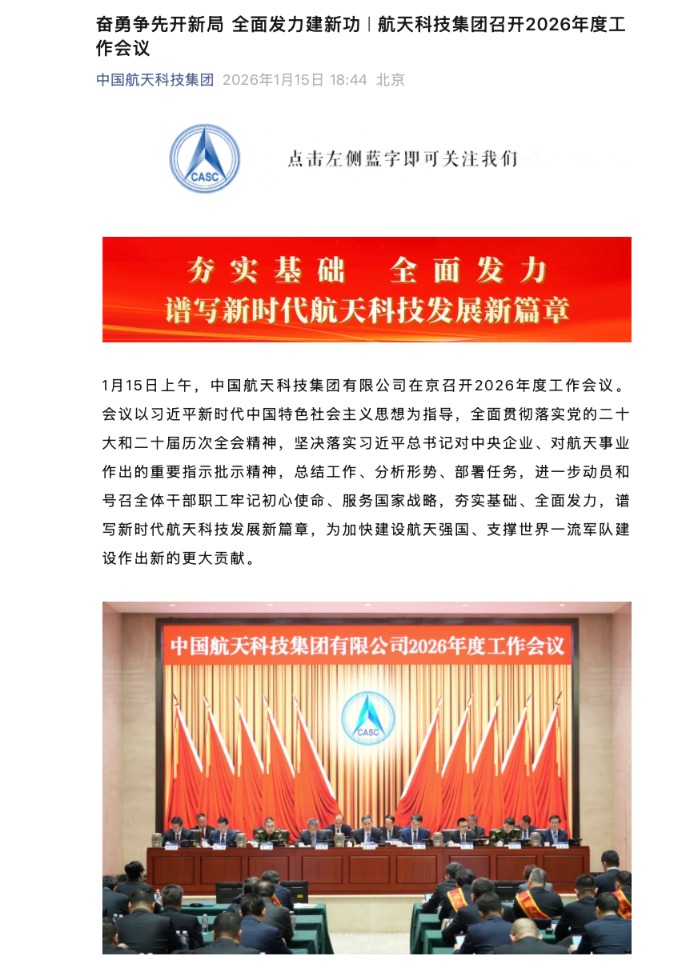
Group 1 - The core message emphasizes that 2026 is a pivotal year for the China Aerospace Science and Technology Corporation (CASC), marking the 105th anniversary of the Communist Party of China, the start of the 14th Five-Year Plan, and the 70th anniversary of China's space industry [1] - CASC aims to fully break through reusable rocket technology and accelerate the construction of a space power, while also promoting manned lunar missions and deep space exploration [1] - The company plans to optimize its industrial layout, adjust its industrial structure, and vigorously develop commercial aerospace and low-altitude economy, while also focusing on future industries like space digital intelligence [1] Group 2 - CASC was established in July 1999 and primarily engages in the research, design, production, testing, and launch services of various aerospace products, including launch vehicles, satellites, manned spacecraft, cargo spacecraft, deep space probes, and space stations [2] - The company also develops strategic and tactical missiles, unmanned systems, and is actively cultivating new productive forces in commercial aerospace and low-altitude economy, while advancing applications in hydrogen energy, high-end equipment, energy conservation, environmental protection, advanced materials, and next-generation information technology [2]

东方日升再签光伏项目 加速东南亚布局
Zheng Quan Ri Bao· 2026-01-15 13:16
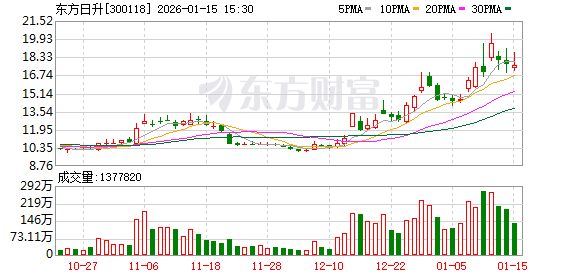
Group 1 - The core viewpoint of the news is the strategic partnership between Dongfang Risen and Eco Persona to develop commercial rooftop photovoltaic projects in Northern Malaysia, focusing on technology upgrades and high-efficiency energy solutions [2][3] - Dongfang Risen's heterojunction (HJT) photovoltaic modules have achieved a mass production power output exceeding 740Wp, positioning them among the highest power photovoltaic modules globally [2] - The partnership aims to leverage Dongfang Risen's advanced technology to enhance energy efficiency and reduce electricity costs in commercial rooftop applications, contributing to the green energy transition [3] Group 2 - Eco Persona has been providing comprehensive photovoltaic system services in Malaysia since its establishment in 2019, with a strong focus on customized rooftop solutions for the manufacturing sector [3] - The collaboration builds on a solid foundation, with multiple benchmark projects already completed in 2025, accumulating over a megawatt of installed capacity across various regions in Malaysia [3] - The partnership is expected to strengthen both companies' positions in the Malaysian photovoltaic market and facilitate the delivery of more efficient and reliable green energy solutions to global customers [3]

突破百亿天量!卫星产业ETF(159218)8日成交109亿,逾60家机构抢滩万亿太空赛道
Sou Hu Cai Jing· 2026-01-15 02:38
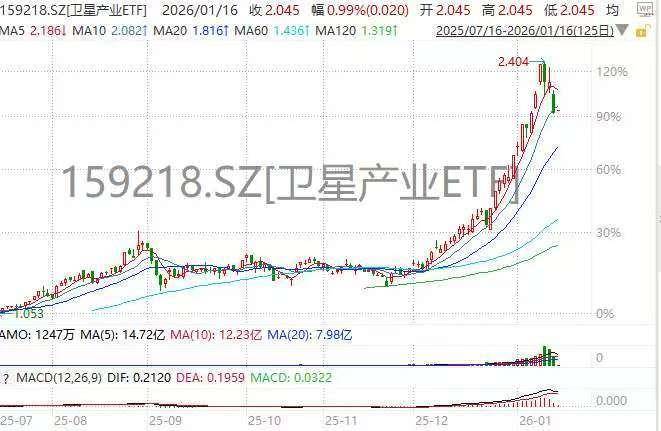
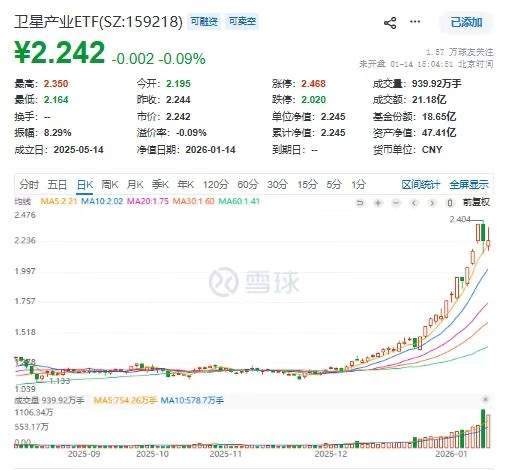
商业航天热度持续爆表,市场交投创下里程碑式纪录。数据显示,两融标的卫星产业ETF(159218)在 2026年开年仅8个交易日内,累计成交额已突破百亿大关,高达109.41亿元,其中1月14日单日成交额便 达21.2亿元,领跑全市场同标的ETF,彰显资金关注度与市场流动性。 作为全市场首只收益翻倍的卫星主题ETF,卫星产业ETF(159218)持续天量的成交,正是资本市场对 这场由国家力量主导、市场力量驱动的"太空经济"黄金浪潮,所投下的最具说服力的信心票。它已成为 投资者分享这一确定性时代红利的核心金融载体。 【免责声明】本文仅代表作者本人观点,与和讯网无关。和讯网站对文中陈述、观点判断保持中立,不 对所包含内容的准确性、可靠性或完整性提供任何明示或暗示的保证。请读者仅作参考,并请自行承担 全部责任。邮箱:news_center@staff.hexun.com 资金狂热涌入的背后,是产业基本面的历史性跃迁。最新消息显示,超过60家机构已向国际电信联盟 (ITU)提交了卫星资料申报,积极布局未来频轨资源。参与方阵容堪称"国家队"领衔的全明星阵容: 既包括中国星网、中国卫通等国家队主力,也有清华大学、中科院等顶 ...
突发两大利空!投机盛宴散场,黄金爆拉,资金悄悄转向这个新方向
Sou Hu Cai Jing· 2026-01-14 17:55
Market Overview - The A-share market experienced a rapid shift from "frenzy" to "panic," highlighted by a 1000% surge in the "Pentagon Pizza Index," indicating rising geopolitical tensions as the U.S. urged citizens to leave Iran [1] - The significant drop in A-shares on January 13, 2026, was primarily driven by internal factors, particularly the commercial aerospace sector, which faced a sudden downturn after being heavily speculated [3][4] Commercial Aerospace Sector - The commercial aerospace sector, previously in a "white-hot" state, saw leading stocks like Aerospace Development hit their daily limit down, catching many investors off guard [3] - Regulatory warnings were issued the previous evening regarding abnormal stock price fluctuations in companies like Aerospace Development and LeiKe Defense, leading to increased scrutiny and a halt in speculative trading [4] Market Sentiment and Reactions - The panic led to a chain reaction, with funds that had previously invested in high-flying sectors like commercial aerospace and AI applications quickly exiting the market [6] - A phenomenon of capital reallocation occurred, where funds from falling stocks were used to buy into perceived undervalued sectors, causing a broader market decline [8] Global Market Influences - Concurrently, external factors from the U.S. heightened market tensions, including a criminal investigation into Federal Reserve Chairman Jerome Powell, which undermined confidence in the Fed's independence [9][10][11] - This led to a "sell-off in America" trend, with gold prices soaring past $4600 per ounce, indicating a flight to safety among global investors [13] AI and Healthcare Sector - Despite the overall market downturn, the AI healthcare and pharmaceutical sectors showed resilience, driven by significant partnerships like NVIDIA and Eli Lilly's $1 billion investment in a joint research lab [14] - Stocks in the AI healthcare space, such as Hongbo Pharmaceutical and Berry Genomics, saw strong gains, contrasting sharply with the commercial aerospace sector's decline [14] Policy Developments - The Ministry of Industry and Information Technology released a plan for the high-quality development of industrial internet platforms from 2026 to 2028, which was viewed positively by some market participants [16] - Local government initiatives, such as Jiangsu Province's AI action plan, further emphasized the strategic direction of integrating AI with traditional industries [16] Market Performance Data - As of January 13, 2026, the Shanghai Composite Index fell by 0.64%, while the ChiNext Index dropped by 1.96%, with a notable increase in trading volume to 3.69 trillion yuan, indicating active capital movement [17] - Defensive sectors like oil, pharmaceuticals, and banking showed relative strength, while defense, electronics, and technology sectors faced declines, reflecting a broader risk-off sentiment [17] Hong Kong Market Context - The Hong Kong market exhibited different dynamics, with the Hang Seng Index rising by 0.90%, suggesting that the issues affecting A-shares had a more indirect impact on Hong Kong stocks [19] - Analysts noted that the commercial aerospace sector's rapid price increase had outpaced previous hot sectors, indicating a potential shift in the upward trend of this sector [19]

锐科激光:未来将与航天科研机构及商业航天企业合作 研发更先进的太空激光制造解决方案
Zheng Quan Shi Bao Wang· 2026-01-14 07:45
Core Viewpoint - Ruike Laser is leveraging domestic laser technology to contribute to the aerospace sector, collaborating with Kuaizhou Rocket to apply domestic laser manufacturing technology in space applications, aiming to enhance China's space economy and secure a leading position in the space industry [1] Group 1 - Ruike Laser has been empowering the aerospace dream with domestic laser technology [1] - The company is collaborating with Kuaizhou Rocket to implement domestic laser manufacturing technology in the aerospace field [1] - Future plans include partnerships with aerospace research institutions and commercial space enterprises to develop advanced space laser manufacturing solutions [1]

中科星图、中国卫通等四大权重现涨停奇观!两融标的卫星产业ETF(159218)上市来38次新高!力鸿一号首飞成功
Sou Hu Cai Jing· 2026-01-13 02:11
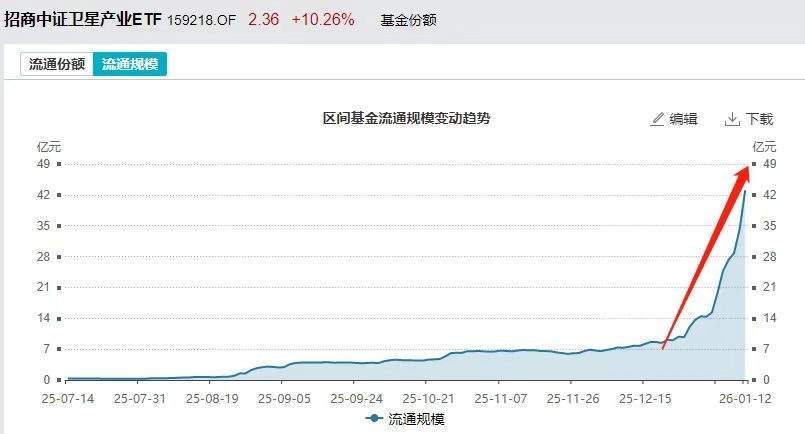
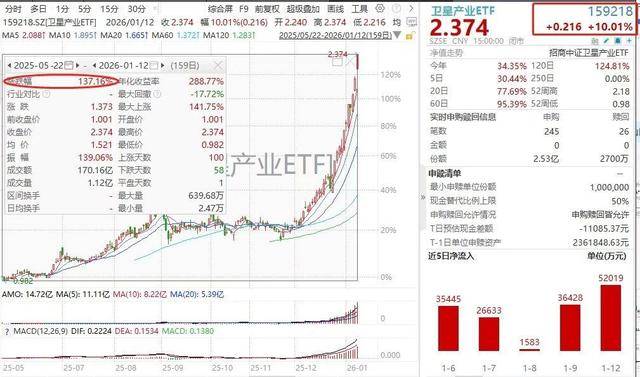
Core Viewpoint - The commercial aerospace sector is experiencing a booming market, with significant attention and investment flowing into satellite-related ETFs, indicating a strong belief in the industry's growth potential [1][4]. Group 1: Market Performance - The Satellite Industry ETF (159218) has shown robust performance, closing with a 10.01% increase and reaching 38 new highs since its listing [1]. - The ETF has demonstrated strong capital inflow, with net inflows for seven consecutive trading days, accumulating over 1.9 billion yuan [1]. - Year-to-date, the ETF's shares and scale have surged by 107.68% and 181.20%, respectively, setting historical records [1]. Group 2: Industry Catalysts - The sector's heat is driven by global industrial catalysts, expanding from traditional communication infrastructure to cutting-edge research fields [3]. - Notable advancements include the successful completion of the first human "space brain-computer interface experiment" by the Brain-Machine Sea River Laboratory, marking a milestone in space life sciences [3]. - Internationally, a contract between European satellite communication companies and Airbus aims to manufacture 340 new OneWeb low-orbit satellites, continuing the global satellite constellation construction trend [3]. - Domestic progress includes the successful first flight of the Lihong-1 returnable suborbital vehicle, validating key technologies in space 3D printing and recovery [3]. Group 3: Future Outlook - With technological breakthroughs, policy support, and international competition driving the sector, commercial aerospace is entering a high-growth phase with high certainty [4]. - The Satellite Industry ETF (159218) serves as a precise tool covering the entire industry chain, reflecting market sentiment and a consensus on the "golden development period" for China's commercial aerospace industry [4]. - As frontier exploration continues to advance and industrialization progresses, the sector is expected to attract long-term investment interest as a core component of the "space economy" [4].

6天翻倍!两融标的卫星产业ETF(159218)份额、规模持续创历史新高!首次“太空脑机接口实验”完成
Sou Hu Cai Jing· 2026-01-13 01:44
Core Insights - The satellite sector continues to experience significant growth, with the first satellite industry ETF (159218) rising by 10.01% on January 12, driven by major stocks like Aerospace Electronics, China Satellite, and others reaching their daily limit [1][3] - The ETF has seen a net inflow of over 1.9 billion in the past seven days, with its share expanding by 107.68% and its scale increasing by 181.20%, both reaching historical highs [1][4] Industry Developments - Internationally, the European satellite company has signed a new contract with Airbus to manufacture an additional 340 low-orbit satellites, increasing the total order to 440 [3] - Domestically, the successful first flight of the Lihong-1 returnable suborbital vehicle has validated key technologies for space 3D printing and rocket recovery, with future applications in suborbital space tourism [3] - The Brain-Machine Interface Laboratory has completed the first human "space brain-machine interface experiment," marking significant progress in the integration of space life sciences and cutting-edge technology [3] Technological Advancements - The global market for reusable rockets is entering a phase of intensive test flights, with predictions indicating that the second quarter of 2026 will see the most concentrated testing period in history, involving multiple rocket models [3] - Policy support is strengthening, with Zhejiang Province recently announcing plans to focus on satellite manufacturing, satellite internet, rocket manufacturing, and key component industries [3] Market Sentiment - The commercial space industry is entering a rapid development phase driven by technological breakthroughs, policy support, and international competition, with the satellite industry ETF reflecting strong market confidence in the long-term prospects of the "space economy" [4] - The ETF, which tracks the China Satellite Industry Index, includes companies across the satellite manufacturing, launch, and navigation communication sectors, indicating a clear market consensus on the golden development period for China's commercial space industry [4]