技术赋能

Search documents
娱乐无国界:TikTok公会如何用技术打破文化与商业壁垒
Sou Hu Cai Jing· 2025-05-25 13:12
Core Insights - TikTok entertainment guilds are leveraging technology to break cultural and commercial barriers, creating a new global entertainment economy [1] Group 1: Technological Empowerment - TikTok provides full-chain technological support, enhancing both content production and operational efficiency, with daily original video output increasing by 10 times [3] - AI technologies like ChatGPT-6 and Stable Diffusion 3.0 are utilized to optimize content, resulting in a 200% increase in video views for tailored scripts [3] - Quantum computing algorithms predict traffic peaks 48 hours in advance, leading to significant viewer engagement, with one live stream surpassing 2 million views and generating over 50,000 euros in tips [3][4] Group 2: Cultural Adaptation - TikTok guilds are innovating content through "cultural translation" and "cultural co-creation," overcoming cultural barriers in entertainment globalization [5] - In the Middle East, guilds have successfully combined Arabic and Chinese for live streams, achieving over 1 million views for culturally relevant content [5] - Latin American guilds have seen a 5-fold increase in followers by integrating local cultural elements into their content strategies [5] Group 3: Commercial Barrier Breakthrough - The monetization model of TikTok guilds is evolving from single revenue streams to diversified income sources, including membership subscriptions and brand collaborations [7] - In the U.S., a collaboration with a beauty brand led to a 40% increase in fan conversion rates [7] - E-commerce integration has become a significant revenue driver, with localized content achieving 190% higher interaction rates compared to generic content [7] Group 4: Compliance Operations - Compliance is essential for sustainable development in global operations, with guilds establishing a three-tiered system for data protection and local team oversight [8] - German guilds have implemented measures to avoid potential fines of 20 million euros by adhering to GDPR regulations [8] - Tax compliance is also critical, with guilds optimizing operations to reduce costs by 15% through VAT deductions [8] Group 5: Case Validation - Successful practices in the Latin American market provide a replicable model for global expansion, with German guilds achieving over 10 million euros in monthly GMV through localized content [9] - The combination of technology, compliance, and localized content has proven effective in engaging audiences and generating revenue [9] Group 6: Future Outlook - As TikTok expands in Europe, the Middle East, and Latin America, guilds will play a crucial role in the global strategy of Chinese content creators [10] - Future strategies will focus on a five-dimensional capability system, including precise positioning, diversified monetization, data-driven content strategies, and compliance operations [10] - TikTok entertainment guilds are positioned as cultural disseminators and commercial innovators in the globalized entertainment economy [10]


2024年KOL发展年报
Sou Hu Cai Jing· 2025-05-22 10:59
Core Insights - The 2024 KOL industry report indicates a trend of "slowing growth and structural optimization," with nearly 15 million creators having over 10,000 followers, reflecting a 5% annual growth rate [1][2] - The content ecosystem is rapidly integrating various formats such as short videos, live streaming, long videos, and audio, with significant growth in niches like culture and agriculture, where cultural content saw a fan growth rate of 32.3% [1][2] - The report highlights the significant head effect of platforms like Douyin and Kuaishou, with Douyin's top KOLs showing strong commercial conversion rates, while Xiaohongshu is expanding beyond its "female-centric" label into lifestyle services [1][2] Industry Overview - The KOL industry is transitioning from "traffic competition" to "value competition," with Douyin's e-commerce GMV reaching 3.5 trillion yuan and Xiaohongshu's "buyer e-commerce" model emerging [2] - Brand investments are becoming more rational, with Douyin favoring cost-effective traffic from mid-tier KOLs, Xiaohongshu focusing on precise outreach to lower-tier KOLs, and Bilibili concentrating on mid-tier niche collaborations [2] - The report emphasizes the importance of technological empowerment, with AI-generated content tools lowering creation barriers and innovative formats like virtual hosts enhancing user interaction [2] Platform Dynamics - Douyin and Kuaishou exhibit significant head effects, while Xiaohongshu is enhancing its "practical community" attributes and expanding into various lifestyle sectors [1][2] - Bilibili is deepening its focus on niche content, with knowledge-based creators performing well and commercializing across diverse fields [1][2] - The report notes that the KOL ecosystem is characterized by differentiated strategies across platforms, with Douyin prioritizing traffic conversion, Xiaohongshu emphasizing precise marketing, and Bilibili focusing on cultural communities [1][2] Creator Landscape - The number of creators with over 10,000 followers is projected to reach nearly 15 million in 2024, with a 5% annual growth rate, indicating a shift towards mid and lower-tier KOLs as the main growth drivers [1][2] - The report identifies a trend of decentralization in platform ecosystems, with mid and lower-tier creators gaining prominence, particularly in Xiaohongshu and Bilibili [1][2] - The growth of mid and lower-tier KOLs is supported by the platforms' recommendation mechanisms and user preferences for practical and vertical content [1][2]

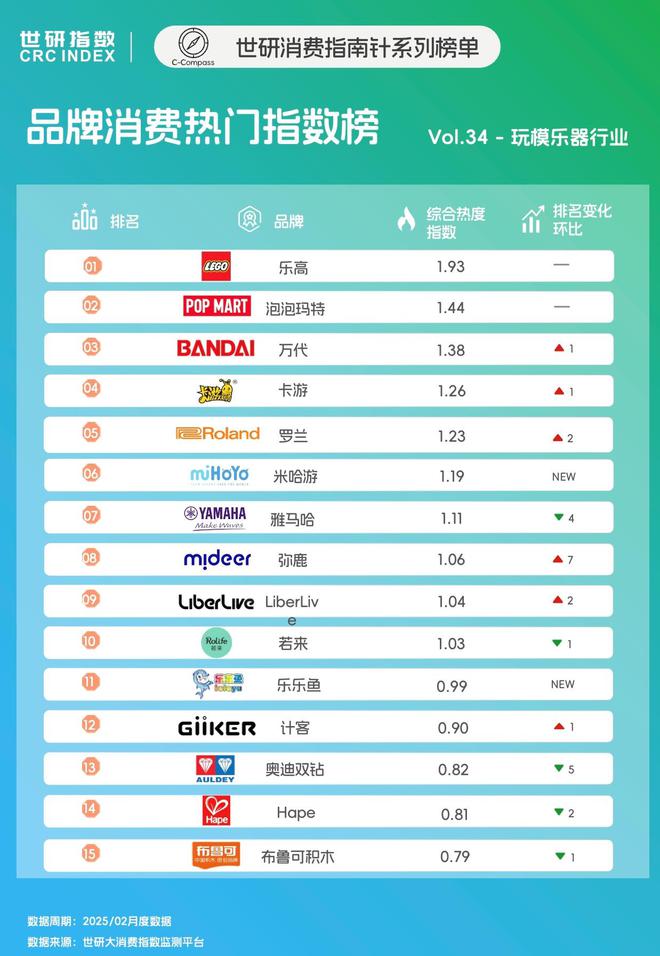
2月玩模乐器品牌TOP榜,IP驱动社交玩法创新|世研消费指数品牌榜
3 6 Ke· 2025-05-13 07:17
Group 1 - The core trend in the industry is driven by IP and social engagement, with leading brands like LEGO, Pop Mart, Bandai, and miHoYo focusing on emotional connections with users through strong IP content and immersive experiences [2] - LEGO maintains the top position with a heat index of 1.93, leveraging classic building blocks combined with popular IPs from films and games, appealing to a wide age range [2] - Pop Mart is expanding its product categories and enhancing its brand experience, as evidenced by the opening of its global flagship store in Shanghai, which has generated significant social media buzz [2] Group 2 - Technology empowerment and scene innovation are key competitive factors, with brands like GİİKER, Ruolai, and Mideer making notable advancements in their respective niches [3] - GİİKER focuses on smart toys and games, introducing products that cater to parents' demands for STEAM education [3] - Mideer has successfully differentiated itself in the puzzle segment by developing products that incorporate Chinese historical stories and cultural themes, enhancing educational value [3]

百胜中国一季度营收创新高,同店交易量连续九个季度实现同比增长
Zheng Quan Zhi Xing· 2025-04-30 11:40
Core Insights - Yum China Holdings, Inc. reported strong Q1 2025 results driven by efficiency and innovation, achieving an overall operating profit margin of 13.4% and same-store sales growth for nine consecutive quarters [1] Group 1: Financial Performance - The total number of stores reached 16,642 by the end of March, leading the restaurant industry in China [1] - KFC's system sales increased by 3% year-over-year, attributed to innovative product offerings [3] - Pizza Hut's system sales grew by 2% year-over-year, with a significant 17% increase in same-store sales [3] Group 2: Brand Strategy and Consumer Engagement - KFC's innovative approach included launching a spicy version of its classic chicken to celebrate its 85th anniversary, successfully blending Western and Chinese flavors [3] - Pizza Hut's strategy focused on cost control and revenue enhancement, exemplified by its 35th-anniversary promotion of the Super Supreme Pizza [3] - Membership numbers exceeded 540 million, with 66% of revenue coming from member purchases, indicating strong brand loyalty [4] Group 3: Expansion and Innovation - KFC's coffee brand, K Coffee, opened 1,000 stores in two years, with plans to reach 1,500 by the end of 2025, targeting young consumers with affordable premium coffee [5] - Pizza Hut's WOW model is expanding into lower-tier markets, appealing to a broader consumer base with a flexible and low-cost approach [5] Group 4: Technological Integration - The company utilizes AI technology across various operational aspects, achieving a 90% resolution rate for customer complaints through AI-driven customer service [7] - Yum China plans to open 1,600 to 1,800 new stores in 2025, demonstrating resilience and commitment to growth despite market changes [7]

北京人力(600861):政府补贴助力利润增长 关注后续政策催化&技术赋能
Xin Lang Cai Jing· 2025-04-29 02:35
Core Viewpoint - The company reported a revenue of 43.03 billion yuan in 2024, representing a year-on-year increase of 12.3%, and a net profit attributable to shareholders of 790 million yuan, up 44.4% [1][2]. Financial Performance - In 2024, the company achieved a revenue of 43.03 billion yuan (+12.3%) and a net profit of 790 million yuan (+44.4%). The non-recurring net profit was 530 million yuan (+106.9%), with government subsidies contributing 565 million yuan [2]. - For Q1 2025, the company reported a revenue of 10.84 billion yuan (+2.7%) and a net profit of 590 million yuan (+180.4%), with government subsidies amounting to 418 million yuan [2]. Revenue Breakdown - The revenue from various business segments in 2024 was as follows: personnel management (990 million yuan, -9.06%), compensation and benefits (1.2 billion yuan, +4.68%), business outsourcing (36.05 billion yuan, +13.96%), and recruitment and flexible employment services (4.34 billion yuan, +12.60%) [2]. Profitability Metrics - The overall gross margin for the company in 2024 was 5.48%, a decrease of 0.72 percentage points. The gross margins for specific services were: business outsourcing (3.22%), personnel management (82.30%), compensation and benefits (18.41%), and recruitment and flexible employment services (3.17%) [3]. - The net profit margin attributable to shareholders was 1.8%, an increase of 0.4 percentage points [3]. Strategic Initiatives - The company added 30 large clients in 2024 and is actively pursuing international expansion, having signed global cooperation agreements with companies like the Adecco Group and Huawei [3]. - The company plans to distribute a cash dividend of 0.70 yuan per share (including tax), totaling 396 million yuan, with a cash dividend payout ratio of 50% [3]. Industry Outlook - The domestic recruitment market has shown steady recovery since 2025, and the company is expected to benefit from the improving industry conditions. The competitive landscape in the human resources sector is favorable and fragmented, positioning the company well for long-term growth [4].

海优汇商城以技术 + 政策双轮驱动的全球化生态护城河
Sou Hu Cai Jing· 2025-04-29 01:45
Core Viewpoint - The rise of Haiyouhui Mall represents a quiet revolution in cross-border trade, leveraging global resource integration and policy benefits to reshape the underlying logic of global trade through a dual approach of "supply chain deepening + technological empowerment" [1][8]. Group 1: Policy and Market Strategy - The dynamic adjustment of tariff policies signifies a reshuffling of global resource allocation, with Haiyouhui Mall's founding team identifying policy opportunities early on, particularly through the "pilot" policy matrix formed by 165 cross-border e-commerce comprehensive pilot zones in China [3]. - Haiyouhui Mall benefits from the zero-tariff policy on 90% of goods among RCEP member countries, establishing overseas procurement centers in Vietnam and Thailand to directly connect with original manufacturers [3]. - For instance, the cost of Thai latex pillows is reduced by 40% compared to traditional trade through a "factory direct procurement + ASEAN tariff reduction" model, alongside 72-hour cross-border logistics to domestic bonded warehouses [3]. Group 2: Supply Chain and Quality Control - Haiyouhui Mall has established operational centers in key cross-border trade hubs such as Shanghai, Ningbo, and Guangzhou, creating a multi-dimensional supply chain network characterized by "global selection - bonded warehousing - intelligent distribution" [5]. - A "three-dimensional review system" is implemented to ensure supply chain quality, requiring overseas brands to provide international certifications like FDA and CE, while domestic partners must be among the top 20% of merchants on platforms like Tmall International and JD International, with annual sales of no less than 50 million RMB [5]. - Only first or second-level authorized agents are permitted, eliminating risks associated with multi-layer distribution, and monthly evaluations of brand sales data, complaint rates, and return rates are conducted to maintain high activity levels in the platform's brand library [6]. Group 3: Innovation and Future Outlook - Unlike traditional cross-border e-commerce that relies on traffic thinking, Haiyouhui Mall builds a "customized cross-border e-commerce operating system," marking a transition from "policy arbitrage" to "value creation" at the intersection of tariff policy and technological revolution [8]. - The practices of Haiyouhui Mall demonstrate that the core of global competition lies in accurately decoding policy benefits, deeply integrating supply chain resources, and continuously innovating technological tools [8]. - As traditional trade grapples with tariff rates and traffic thinking reaches a bottleneck, Haiyouhui Mall is innovating its cost structure through model innovation, establishing a new ecosystem for global trade driven by "supply chain + technology" [8].

谢军:以规则创新重塑国际经贸治理范式
Huan Qiu Wang· 2025-04-28 22:31
Core Viewpoint - The U.S. government's imposition of "reciprocal tariffs" is destabilizing global supply chains, particularly impacting small and medium-sized enterprises (SMEs) in various countries [1] Group 1: International Trade Dynamics - The international economic and trade competition is shifting from traditional "price games" to deeper "rule games," requiring SMEs to focus on the interpretation of international rules and compliance discourse [1] - SMEs should not merely react to tariff changes but should innovate through rule adaptation, technological empowerment, and system optimization to convert external pressures into growth opportunities [1] Group 2: Legal Strategies and Compliance - Chinese companies are employing legal tools strategically to counteract U.S. tariffs, such as invoking WTO dispute resolution mechanisms to address trade damages while avoiding excessive retaliation [1][2] - Examples include a cross-border e-commerce platform utilizing RCEP rules to optimize operations and reduce tariff costs, and a medical device company leveraging the Singapore Mediation Convention to negotiate technology licensing agreements [2] Group 3: Technological Empowerment - Long-term resilience against sanctions for Chinese SMEs will stem from technological empowerment, fostering independent innovation, and creating a self-defense system of intellectual property [3] - Companies are developing systems like tariff pressure testing models and intelligent classification systems to enhance compliance and reduce operational risks [3] Group 4: New Frontiers in Compliance - Digital technologies are opening new avenues for compliance and counteraction, such as using blockchain to provide verifiable evidence against U.S. claims of forced labor [4] - The integration of technology into compliance strategies is transforming how Chinese companies engage in international trade, allowing them to proactively redefine rules and standards [4] Group 5: Strategic Rule Creation - China is transitioning from being a "rule taker" to a "rule creator" in global governance, exemplified by its comprehensive rule frameworks in sectors like rare earths [6] - The collaboration between enterprises and government to leverage China's market size for rule-making power is crucial for reshaping international economic order [6]
元培工匠职业技能鉴定中心在家政服务消费扩容升级中的行动路径
Jin Tou Wang· 2025-04-27 04:45
数字化不仅是政策要求的落地工具,更是行业升级的底层逻辑。元培工匠职业技能鉴定中心将以三大技 术基座助推行业发展:开发家政服务能力图谱系统,可视化呈现从业人员技能成长路径;搭建虚拟仿真 培训平台,通过VR技术复现高空擦窗、婴幼儿急救等高危场景;构建区块链认证体系,使每个服务节点 的技能档案不可篡改。此般创新绝非技术堆砌,而是直击行业痛点的深度改造,如情感计算算法量化服 务温度,将难以言传的"眼力见"转化为可评估参数;通过重构数字化重构服务定价权,打破传统计时收 费的窠臼,建立以技能货币化为核心的新机制,实现从劳动力密集型向技术赋能型的产业跃迁。 四、构建跨域协同网络,释放政策乘数效应 政策的实施效果取决于协同各方的利益契合度。元培工匠职业技能鉴定中心要当好"价值枢纽",在三个 维度实现突破:纵向打通"政策-市场"传导链,助力将国家战略转化为地方行动方案;横向编织跨行业"技 能图谱",助推物业、医疗、养老等领域的资质互认与协同创新;轴向构建"教育-就业"直通车,以"双证 融通"重塑人才培养路径。通过培训质量与就业薪酬挂钩、院校考核与企业需求匹配等制度创新,将政 策势能转化为市场动能。唯有形成"政策引导-市场驱动- ...
技术赋能 四川探索主流媒体系统性变革之路
Zhong Guo Fa Zhan Wang· 2025-04-23 08:42
Core Viewpoint - The event "2025 Tianfu Media Forum" held in Chengdu focused on the theme of "Technological Empowerment for Systematic Reform of Mainstream Media," discussing how innovative integration strategies and practical experiences can drive the sustainable development of the Tianfu Media Union and deepen the systematic reform of mainstream media [1][2]. Group 1: Event Overview - The forum was guided by the Sichuan Provincial Party Committee's Publicity Department and attended by over 300 guests, including experts and media representatives from various levels of government [1]. - The event featured keynote speeches, expert lectures, and the release of research topics, emphasizing the importance of digital transformation and intelligent revolution in mainstream media [2]. Group 2: Expert Insights - Li Peng, Secretary of the Party Committee and Director of Sichuan Radio and Television Station, highlighted the need for comprehensive digital transformation to achieve higher quality development in media [2]. - Professor Zhou Yong from Renmin University analyzed the paradigm shift in mainstream media from simple information output to using information as a tool for empowering diverse scenarios, providing theoretical guidance for media transformation [2]. - Professor Zhang Zhian from Fudan University discussed practical methods for implementing systematic reform in mainstream media, covering strategic planning, organizational adjustments, and content production optimization [2][3]. Group 3: Collaborative Ecosystem - Professor Zeng Xiangmin from Communication University of China emphasized the necessity of building a collaborative ecosystem for mainstream media reform, integrating internal and external resources to create a sustainable media ecology [3]. - The "Tianfu Media Union 2024 Development Report" was released, reviewing the past year's achievements and challenges in structural innovation and providing practical examples for media integration [3][4]. Group 4: Achievements and Innovations - Sichuan has made significant strides in mainstream media reform, establishing the Tianfu Media Union to enhance collaboration among various media entities, resulting in a sixfold increase in article views compared to the period before the union's formation [5]. - New media brands such as Chuan Guan News and Sichuan Observation have been developed, collaborating with major media and launching unique programs to enhance public engagement [6]. Group 5: Future Directions - The event adopted a hybrid format, allowing over 10,000 media professionals to participate online, facilitating the dissemination of cutting-edge theories and practices in the media industry [7]. - The Tianfu Media Union aims to continue addressing industry pain points and trends, contributing to the media integration development in Sichuan and nationwide [8].
经济随笔丨义乌的韧性 中国的底气
Yang Shi Xin Wen Ke Hu Duan· 2025-04-13 14:12
Core Insights - Yiwu, known for its global trade connections, is facing challenges due to U.S. tariffs but is adapting through innovative strategies and market diversification [1][3][5] Group 1: Market Adaptation - Yiwu's exports to the U.S. account for only a small percentage, allowing for market diversification to mitigate risks [3] - The "Yiwu Selection" brand initiative is a key project for global market expansion, enhancing pricing power and resilience against external shocks [3][5] - Local businesses are leveraging AI technology to facilitate trade, translating promotional materials into multiple languages to overcome trade barriers [5] Group 2: Resilience and Innovation - Yiwu has established a robust international trade network despite being an inland city, focusing on comprehensive reforms in trade practices [5][8] - The city has seen a population increase, particularly among young people, indicating a dynamic labor force that supports innovation [6][8] - Yiwu's ability to quickly adapt to external pressures reflects a broader resilience found in many Chinese trade hubs [9][10]