
指数化投资

Search documents
规模破8000亿,债券ETF大扩容
Huan Qiu Wang· 2026-01-09 07:45
Core Insights - The bond ETF market has experienced significant expansion, surpassing 800 billion yuan in total scale last year, making it one of the fastest-growing segments in the ETF market [1] - As of December 31, 2025, the total scale of bond ETFs reached 829.02 billion yuan, a substantial increase of 655.05 billion yuan from the beginning of the year, marking the highest growth rate among all ETF categories [1] - The growth of bond ETFs is primarily driven by the introduction of benchmark market-making credit bond ETFs and sci-tech bond ETFs, which have rapidly accumulated scale since their launch in 2025 [1][3] Market Structure - The sci-tech bond ETFs have shown remarkable performance, with 16 products tracking the CSI AAA Sci-Tech Innovation Company Bond Index, totaling a management scale of 280.75 billion yuan; 6 products tracking the SSE AAA Sci-Tech Innovation Company Bond Index with a scale of 67.39 billion yuan; and 2 products linked to the SZSE AAA Sci-Tech Innovation Company Bond Index with a total scale of 7.19 billion yuan [1] - The benchmark market-making credit bond ETFs have also become a significant growth driver, with products tracking the SSE Benchmark Market-Making Corporate Bond Index reaching a management scale of 79.86 billion yuan, and those tracking the SZSE Benchmark Market-Making Credit Bond Index at 47.56 billion yuan [3] - Currently, there are 53 bond ETFs in the market, accounting for only 3.78% of all ETFs, but their net asset value has significantly increased to 13.77%, indicating strong investor recognition [3] Industry Trends - The continuous expansion of bond ETFs signifies a shift towards a more transparent and efficient index-based investment approach in the bond market [3] - Compared to traditional bond funds, bond ETFs offer significant advantages in trading mechanisms, transparency, and portfolio stability, making them attractive for medium to long-term investment in the current market environment characterized by declining interest rates and increasing credit differentiation [3] - The two new categories of bond ETFs serve distinct functions: benchmark market-making credit bond ETFs enhance trading efficiency and pricing continuity, while sci-tech bond ETFs provide investors with an alternative way to participate in financing within the technology sector [4]

规模破8000亿!债券ETF扩容领跑ETF市场,指数化投资成新趋势
券商中国· 2026-01-09 03:59
Core Viewpoint - The bond ETF market has experienced significant expansion over the past year, with total scale surpassing 800 billion yuan, marking it as one of the most concentrated segments within the ETF system [1][3]. Group 1: Market Expansion - As of December 31, 2025, the total scale of bond ETFs reached 829.024 billion yuan, an increase of 655.051 billion yuan from the beginning of the year, representing the highest growth rate among all ETF categories [3]. - The number of bond ETFs in the market has reached 53, accounting for 3.78% of all ETFs, with their net asset value now comprising 13.77% of the total ETF assets [3]. - The expansion of bond ETFs is primarily driven by the introduction of benchmark market-making credit bond ETFs and sci-tech bond ETFs, both of which were newly launched in 2025 and have rapidly accumulated scale [2][4]. Group 2: Structural Insights - In the sci-tech bond ETF segment, the CSI AAA Technology Innovation Company Bond Index has gained 16 ETF products, with a total management scale of 280.748 billion yuan by the end of 2025 [4]. - The Shanghai Stock Exchange benchmark market-making corporate bond index has attracted ETF products with a total management scale of 79.857 billion yuan, while the Shenzhen benchmark market-making credit bond index has reached 47.560 billion yuan [4]. - The introduction of these new products has enriched the index-based investment tools available in the credit bond sector, providing new avenues for the expansion of bond ETFs [4]. Group 3: Investment Value - The ongoing expansion of bond ETFs signifies a shift in bond investment from traditional, institutional, and non-standardized methods towards a more transparent and efficient index-based approach [5]. - Bond ETFs are increasingly seen as essential tools for connecting capital with the bond market, moving beyond their previous role as supplementary instruments [5]. - Compared to traditional bond funds, bond ETFs offer advantages in trading mechanisms, transparency, and portfolio stability, making them attractive for medium to long-term capital allocation [6].

境内规模最大ETF今起变更简称
Zheng Quan Ri Bao· 2026-01-08 17:26
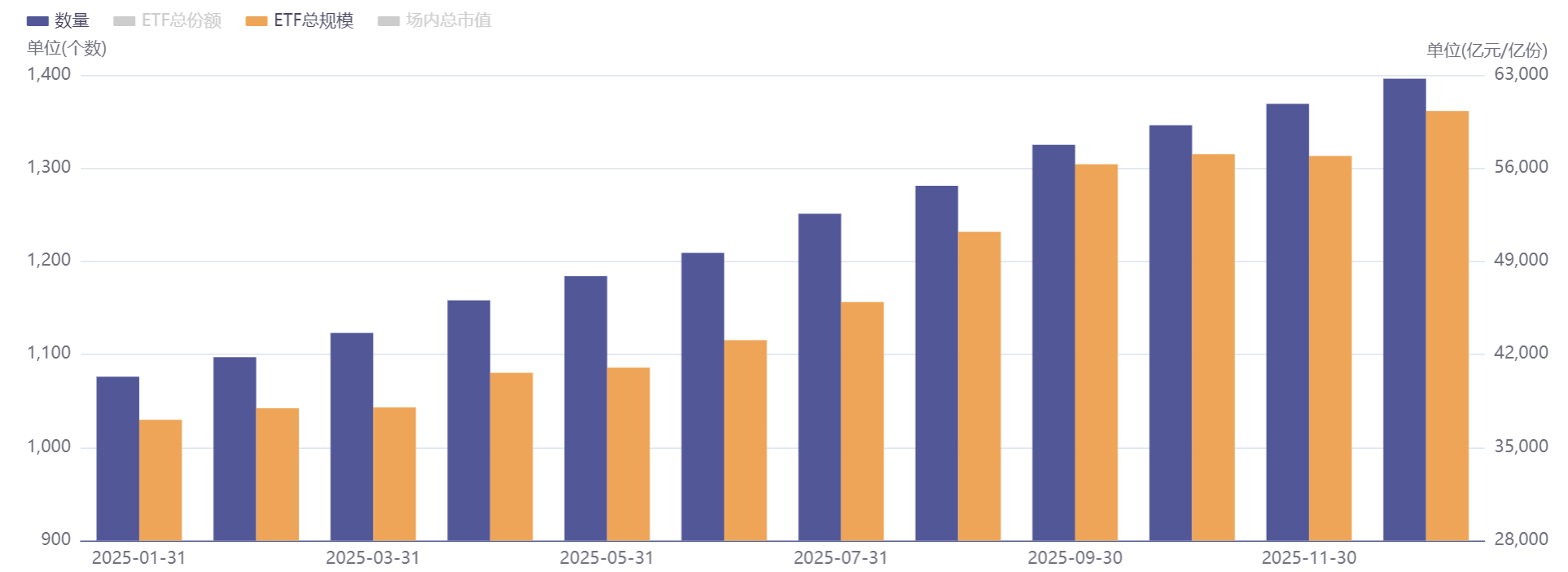
Core Viewpoint - The renaming of ETFs, including the Huatai-PB CSI 300 ETF, signifies a move towards standardization and transparency in the ETF market, enhancing investor recognition and reducing operational risks [1][3]. Group 1: ETF Renaming and Market Impact - The Huatai-PB CSI 300 ETF, established in May 2012, is the largest ETF in China with a scale of 436.6 billion yuan as of January 8, 2023, and has generated over 142.4 billion yuan in profits for holders since inception [2]. - The renaming aligns with the guidelines issued by the Shanghai and Shenzhen Stock Exchanges, which require the inclusion of the fund manager's name in the ETF's title to improve clarity and standardization [2][4]. - Other fund managers, including Fuguo Fund and E Fund, have also begun to rename their ETFs, indicating a broader industry trend towards standardization [4][5]. Group 2: Industry Development and Standardization - The total scale of China's ETF market has surpassed 6 trillion yuan, with nearly 1,400 products, highlighting the rapid growth and the need for improved market infrastructure [4]. - The recent guidelines aim to enhance the quality of index investment and require existing ETFs to complete renaming by March 31, 2026, marking a significant step towards a more structured investment environment [4]. - The renaming initiative is expected to lower decision-making costs for investors and shift industry competition towards quality and service improvements [4][5].
南方基金:1月9日24只ETF简称变更,提升辨识度
Sou Hu Cai Jing· 2026-01-08 02:55
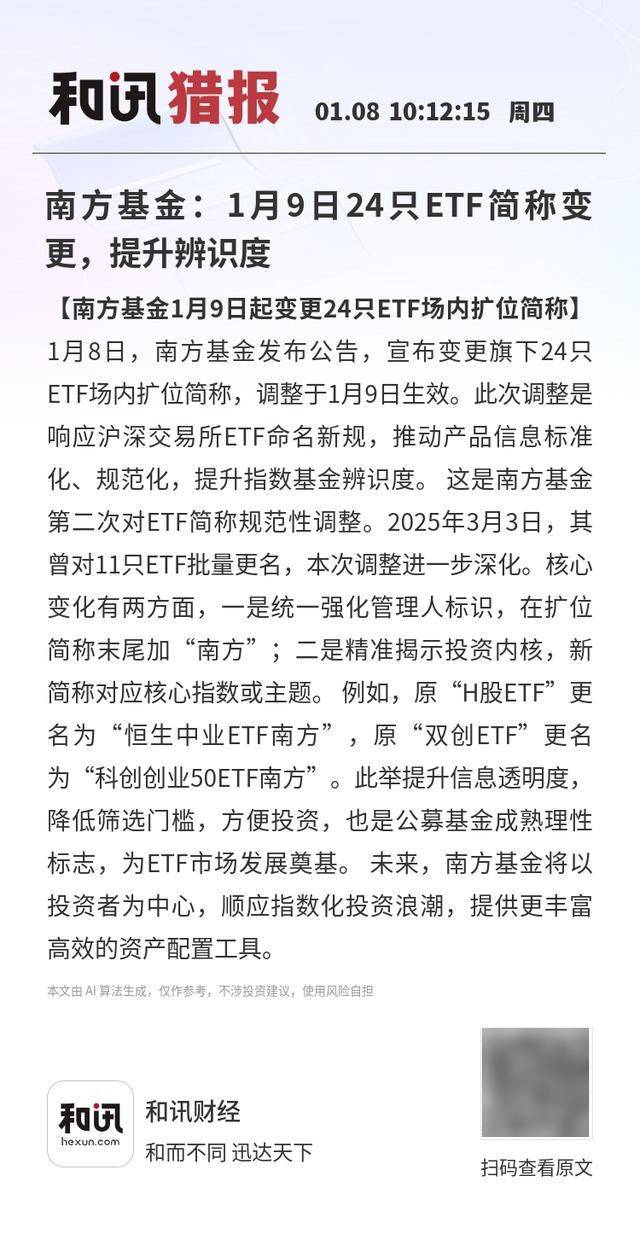
【南方基金1月9日起变更24只ETF场内扩位简称】1月8日,南方基金发布公告,宣布变更旗下24只ETF 场内扩位简称,调整于1月9日生效。此次调整是响应沪深交易所ETF命名新规,推动产品信息标准化、 规范化,提升指数基金辨识度。 这是南方基金第二次对ETF简称规范性调整。2025年3月3日,其曾对11 只ETF批量更名,本次调整进一步深化。核心变化有两方面,一是统一强化管理人标识,在扩位简称末 尾加"南方";二是精准揭示投资内核,新简称对应核心指数或主题。 例如,原"H股ETF"更名为"恒生中 业ETF南方",原"双创ETF"更名为"科创创业50ETF南方"。此举提升信息透明度,降低筛选门槛,方便 投资,也是公募基金成熟理性标志,为ETF市场发展奠基。 未来,南方基金将以投资者为中心,顺应 指数化投资浪潮,提供更丰富高效的资产配置工具。 标志,为ETF市场发展奠基。未来,南方基金将以 投资者为中心,顺应指数化投资浪潮,提供更丰富 高效的资产配置工具。 本文由 Al 算法生成,仅作参考,不涉投资建议,使用风险自担 和讯财经 和而不同 迅达天下 扫码查看原文 本文由 AI算法生成,仅作参考,不涉投资建议,使用风险 ...
还给基民500亿,机构的好日子结束了
Xin Lang Cai Jing· 2026-01-07 07:58
Core Insights - The public fund industry in China is transitioning from an "active era" to a "passive era," highlighted by the fierce competition surrounding the A500 ETF, which saw a significant increase in total scale by over 100 billion in December 2025 [5][31][28] - The A500 ETF's growth is accompanied by a comprehensive fee reform that will lead to a reduction of over 500 billion in revenue across the fund industry, impacting all stakeholders [31][40] - The upcoming introduction of options for A500 ETFs is expected to further intensify competition, with only a few funds likely to survive in the long term [30][47] Fund Performance and Competition - As of December 31, 2025, the A500 ETF rankings showed significant growth for major fund companies, with Huatai-PB leading at 494 billion, followed by Huaxia and Southern Fund [29][3] - The focus for fund companies has shifted from achieving high annual returns to securing a long-term position in the A500 ETF market [3][29] Fee Reform Impact - The fee reform initiated by the China Securities Regulatory Commission aims to reduce management fees, custody fees, transaction costs, and sales fees, with the first phase targeting management fees and custody fees [32][33] - The management fee cap for active equity funds has been reduced from 1.5% to 1.2%, resulting in an annual benefit of approximately 140 billion for investors [33][36] - The second phase of the reform addresses transaction costs, with new regulations limiting commission rates for passive equity funds, leading to an estimated annual benefit of 70 billion for investors [35][36] Sales Fee Regulations - The sales fee reform, effective from January 1, 2026, aims to reduce sales fees and regulate commission distribution, potentially benefiting investors by around 300 billion annually [38][40] - The sales fees have been a complex area with significant growth despite overall fee reductions, indicating a need for stricter regulations [37][40] Industry Outlook - The shift towards passive investment strategies, particularly ETFs, is seen as a necessary adaptation to the changing market dynamics, with the potential for a more stable business model despite lower fees [46][45] - The competitive landscape is expected to narrow, with only a few fund companies likely to thrive as the industry moves towards a more standardized and less personalized approach [47][48] - The future of public funds may become less exciting as the focus shifts to efficiency and cost control, potentially diminishing the role of individual talent in the industry [48][49]

2025年公募基金年度成绩单出炉 富国基金权益、固收、量化业绩全面飘红
Zhong Zheng Wang· 2026-01-06 06:13
Core Viewpoint - The A-share market concluded 2025 with strong gains, characterized by a structural bull market driven by hard technology sectors like artificial intelligence, leading to significant performance in industries such as electronics and communications [1] Group 1: Market Performance - The ChiNext Index surged by 49.57% for the year, leading the market, while the Shanghai Composite Index rose by 18.41%, marking its largest annual increase in nearly six years [1] - The total scale of the public fund industry in 2025 surpassed 37 trillion yuan, indicating a new milestone for the asset management sector [1] Group 2: Equity Fund Performance - In 2025, the active equity segment of the company saw over 30 products ranking among the top performers, with 31 active equity funds achieving annual returns exceeding 50%, including 12 funds surpassing 80% and 5 funds doubling their returns [2] - The company ranked second among 13 large public fund companies in terms of active management returns for equity products over the past three years, showcasing strong mid-to-long-term performance [2] Group 3: Technology and Healthcare Investments - The "Fuguo Technology Performance Team" excelled in the technology growth sector, with the Fuguo Innovation Technology A fund achieving a return of 133.99%, ranking second in its category [3] - In the healthcare investment space, the company focused on innovative drugs and medical devices, with the Fuguo Medical Innovation A fund returning 67.70%, ranking second in its category [3] Group 4: Fixed Income Performance - The fixed income team demonstrated strong performance in a challenging market environment, with the company ranking in the top 25% of peers over three, five, and seven-year periods [4] - Notable fixed income products included Fuguo Jiuli Stable Allocation A, which achieved a return of 37.04%, ranking second in its category [4] Group 5: Quantitative Investment - The company expanded its quantitative investment tools, with over 80 ETF products and a total scale exceeding 250 billion yuan, marking a significant increase of over 120 billion yuan in 2025 [6] - Nine quantitative products ranked among the top 10 in their categories, with the Communication Equipment ETF achieving a return of 121.01%, ranking second [6] Group 6: Future Outlook - The public fund industry is entering a critical phase focused on high-quality development centered on investor interests, with the company committed to long-term investment principles and enhancing its research systems across equity, fixed income, and quantitative platforms [7]
低利率时代下的基金选择:2025市场回顾与来年配置方向
Sou Hu Cai Jing· 2026-01-06 01:09
Core Insights - The key theme for the public fund market in 2023 is "index," with index fund scale surpassing 8 trillion yuan, indicating a shift towards index-based investment as a primary strategy [1] - The performance of A-share growth stocks has been particularly strong, with industry and thematic ETFs becoming central to investment strategies, driven by significant capital inflows into sectors aligned with national strategic directions [1] - Active equity funds have also performed well, with the highest return reaching 236.88%, potentially setting a record for annual returns in public fund history [1] Index Funds - The average return for all 2,362 passive index funds reached 23.68%, with over 90% of these funds achieving positive returns, and 11 funds exceeding 100% returns [1] - Index funds are characterized by their strong tool attributes and low fees, contributing to their unexpected explosive growth this year [1] Active Equity Funds - Active equity funds have an average annual return exceeding 30%, with 3,455 funds outperforming their benchmarks, representing nearly 80% of the total 4,378 funds [2] - The strong performance of active equity funds is supported by industry policies aimed at enhancing fund quality, encouraging a focus on performance over scale [2] Fixed Income Plus Funds - The "Fixed Income Plus" fund category has seen significant growth, approaching 2.5 trillion yuan in total scale, a more than 50% increase since the beginning of the year [3] - The overall performance of "Fixed Income Plus" funds has been positive, although there is a notable disparity in returns among different products, with performance differences exceeding 50 percentage points [3] Market Trends - The average yield of 10-year government bonds has reached 1.74%, a decrease of 48 basis points from the previous year, indicating a shift to a low-interest-rate environment [3] - The decline in yields and the withdrawal of certain bank deposit products reflect the broader impact of low interest rates on personal finance and investment strategies [3]

告别2025!6万亿战场,ETF巨头的“生态位”争夺战
Zheng Quan Shi Bao Wang· 2025-12-31 09:17
Core Insights - The year 2025 is highlighted as a significant year for Chinese assets, showcasing various leading themes and market highlights across different seasons, including technology, dividends, growth, and value [1] - The ETF market in China has surpassed 6 trillion yuan, with Huaxia Fund maintaining its position as the leading ETF provider in the country, achieving significant growth in both scale and liquidity [1] - Huaxia Fund has also improved its global ranking, moving from 19th to 18th among the top 20 global ETF providers, with a management scale of 126.8 billion USD [2] Group 1: Market Performance - The communication sector saw the highest growth, with the 5G communication ETF nearly doubling in value [1] - Gold prices reached 4,500 USD, marking a year-on-year increase of over 60%, with the gold ETF also surpassing 10 billion yuan in scale [1] - The total scale of ETFs in China reached approximately 5.5 trillion yuan, surpassing Japan and establishing China as the largest ETF market in Asia [3][4] Group 2: Huaxia Fund's Growth - Huaxia Fund's ETF business has been built on over 20 years of systematic internal development, combining scale, research capabilities, product ecosystem, and long-termism [2] - The company has created a comprehensive ecosystem that supports its leading position in the Chinese ETF market, with a total of 117 ETF products covering a wide range of asset classes [7][13] - Huaxia Fund's proactive research capabilities have redefined the value of ETFs, allowing them to anticipate industry trends rather than merely follow them [8][9] Group 3: Future Outlook - The Asian ETF market is projected to grow significantly, with estimates suggesting it could reach 8 trillion USD by 2035, surpassing current European levels [4][5] - Huaxia Fund aims to transition from being a regional option to a global standard, potentially creating a new trillion-dollar market [6] - The company's innovative approach, including a "Lego-style" asset allocation strategy, is designed to meet diverse investor needs and adapt to changing market conditions [12][13]
2025年ETF盘点:谁在遥遥领先?谁在表现低迷?
Sou Hu Cai Jing· 2025-12-31 09:10
Core Insights - The Chinese ETF market has experienced significant growth in 2025, with total market size increasing from 4 billion to 6 trillion yuan, representing a growth of over 60% within a year [1][4]. ETF Market Performance - The year 2025 has been characterized as the "era of ETFs," with a shift in investment habits towards index-based investments, moving from individual stock picking to a more diversified approach [4]. - The top-performing ETFs in 2025 were primarily in the technology and materials sectors, with seven ETFs achieving over 100% returns, particularly those related to communication and artificial intelligence [6][7]. - The communication sector saw significant growth, with leading companies like Zhongji Xuchuang and ZTE Corporation showing remarkable performance [7]. Sector Analysis - The materials sector, particularly non-ferrous metals, emerged as a strong performer in the second half of 2025, with an overall industry increase of 95.65% [7]. - The top-performing ETFs in the non-ferrous metals category also achieved over 100% returns, benefiting from the strong performance of individual stocks within the sector [7]. Fund Inflows and Growth - The broad-based ETFs, particularly those tracking the CSI 300 index, have been the main drivers of growth, with significant inflows into major funds like Huatai-PB and China Asset Management [8][10]. - The newly launched science and technology bond ETFs have gained traction, with a total scale reaching 257.66 billion yuan, marking a 269% increase from their initial issuance [9]. Underperforming Sectors - The food and beverage sector, particularly high-end liquor represented by Moutai, has struggled in 2025, with returns declining between -8% to -10% due to weak demand and falling prices [11]. - The Saudi ETFs, initially popular, faced significant declines after regulatory issues and market corrections, highlighting the volatility in certain segments of the ETF market [11]. Future Outlook - The ETF market in China is expected to continue evolving towards a more robust and diversified landscape, with improved investor experiences and regulatory frameworks anticipated for 2026 [12].
华龙证券:证券业加速向轻重资产业务协同发力 建议关注中信证券等
Zhi Tong Cai Jing· 2025-12-31 07:16
华龙证券发布研报称,证券行业正加速向轻重资产业务协同发力的结构性转型。监管导向从规模扩张转 向效率与回报考核,取消营收加分项、强化ROE导向,倒逼行业优化资源配置,提升资本使用效率,券 商迎来发展机遇期。维持证券行业"推荐"评级,头部券商凭借资本实力、客户基础与综合服务能力,有 望实现业绩修复与估值提升,建议关注中信证券(600030)(600030.SH)、国泰海通(601211) (601211.SH)等。 华龙证券主要观点如下: 证券行业正步入一个结构深刻变革、增长动能转换的新阶段 监管推动权益类公募基金发展与指数化投资,头部券商在代销非货币基金保有规模上优势明显。未来, 具备清晰并购战略、资本实力充足、子公司协同效应突出的中大型券商,将在行业洗牌中脱颖而出,逐 步填补传统头部与中小券商之间的断层,重塑行业竞争格局。 证券行业正加速向轻重资产业务协同发力的结构性转型 经纪、资管与投行业务在政策驱动与市场变革中形成有机联动,在不显著增加资本占用的前提下,盈利 能力实现提升。在服务新质生产力、中长期资金入市的背景下,券商正从单一通道服务商转型为综合金 融解决方案提供者,"十五五"规划背景下,证券行业有望向专 ...
