智能座舱

Search documents
全球市场进入“热战”阶段!车载显示屏与其他显示屏有何不同?
Zhong Guo Qi Che Bao Wang· 2026-01-19 04:13
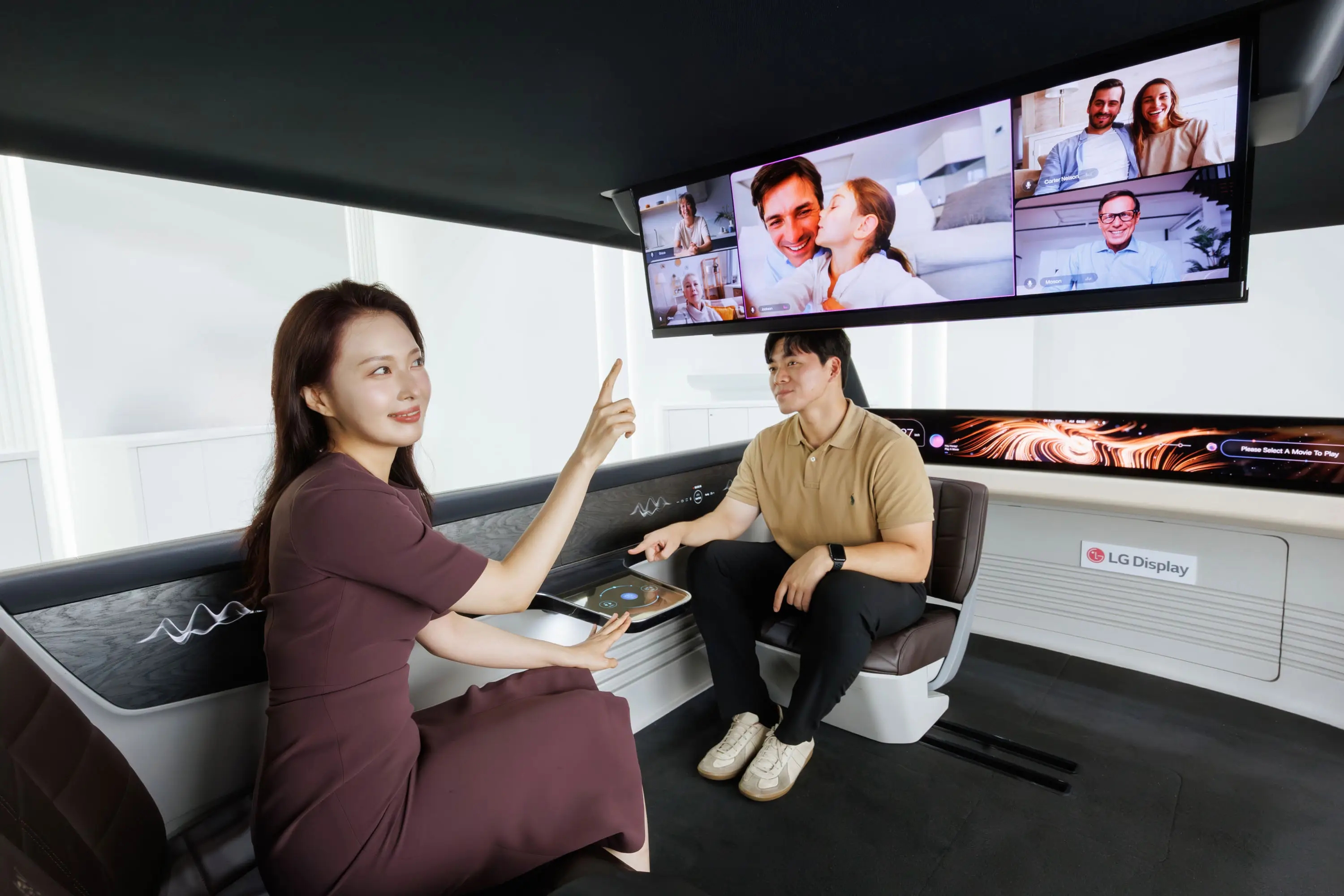
Core Insights - The automotive display market is experiencing rapid growth, driven by the increasing demand for larger and more interactive screens in vehicles [5][10] - LG Display has introduced advanced automotive displays, including a 51-inch P2P OLED display and a flexible OLED display for dashboards, highlighting the trend towards larger and more sophisticated in-car screens [4][5] - The transition from traditional displays to multifunctional, interactive screens is reshaping the automotive experience, making displays central to smart cockpit technology [10][12] Industry Trends - The global automotive display market is entering a competitive phase, with a shift from consumer electronics to automotive displays as a key growth driver [5][10] - The trend towards multi-screen setups in vehicles is becoming prevalent, with configurations including center screens, instrument panels, passenger entertainment screens, and rear displays [6][10] - The integration of advanced features such as touch interaction, voice control, and augmented reality navigation is enhancing the functionality of automotive displays [6][10] Technical Requirements - Automotive displays face unique challenges due to their operating environment, requiring them to withstand extreme temperatures (-30°C to 90°C) and vibrations from various road conditions [7][8] - The longevity of automotive displays is significantly higher than consumer electronics, with a lifespan of over ten years compared to 3-5 years for typical consumer displays [8] - Strict automotive certifications (e.g., IATF16949) ensure that automotive displays meet rigorous safety and performance standards, differentiating them from consumer-grade displays [8][9] Design Innovations - Special design features, such as anti-glare technology and multi-layer coatings, are being implemented to enhance visibility and user experience in automotive displays [9] - The future of automotive displays is leaning towards "display + interaction + intelligence" integration, which will require advanced technology and manufacturing capabilities [10][12] - Emerging display technologies like Mini-LED and MicroLED are gaining traction, promising higher brightness, contrast, and longevity for automotive applications [11][12] Market Opportunities - The automotive display market is poised for unprecedented growth, driven by the increasing adoption of smart cockpit concepts and the demand for larger, flexible displays [10][12] - Companies that invest in technology development and product innovation will be better positioned to compete in this evolving market landscape [12] - The automotive display is evolving from a simple display to a central hub for smart interactions, enhancing the overall travel experience for consumers [10][12]

上汽通用五菱赵奕凡透露华境现在是宝骏的一个系列,但必将成为新品牌
Xin Lang Cai Jing· 2026-01-19 01:21
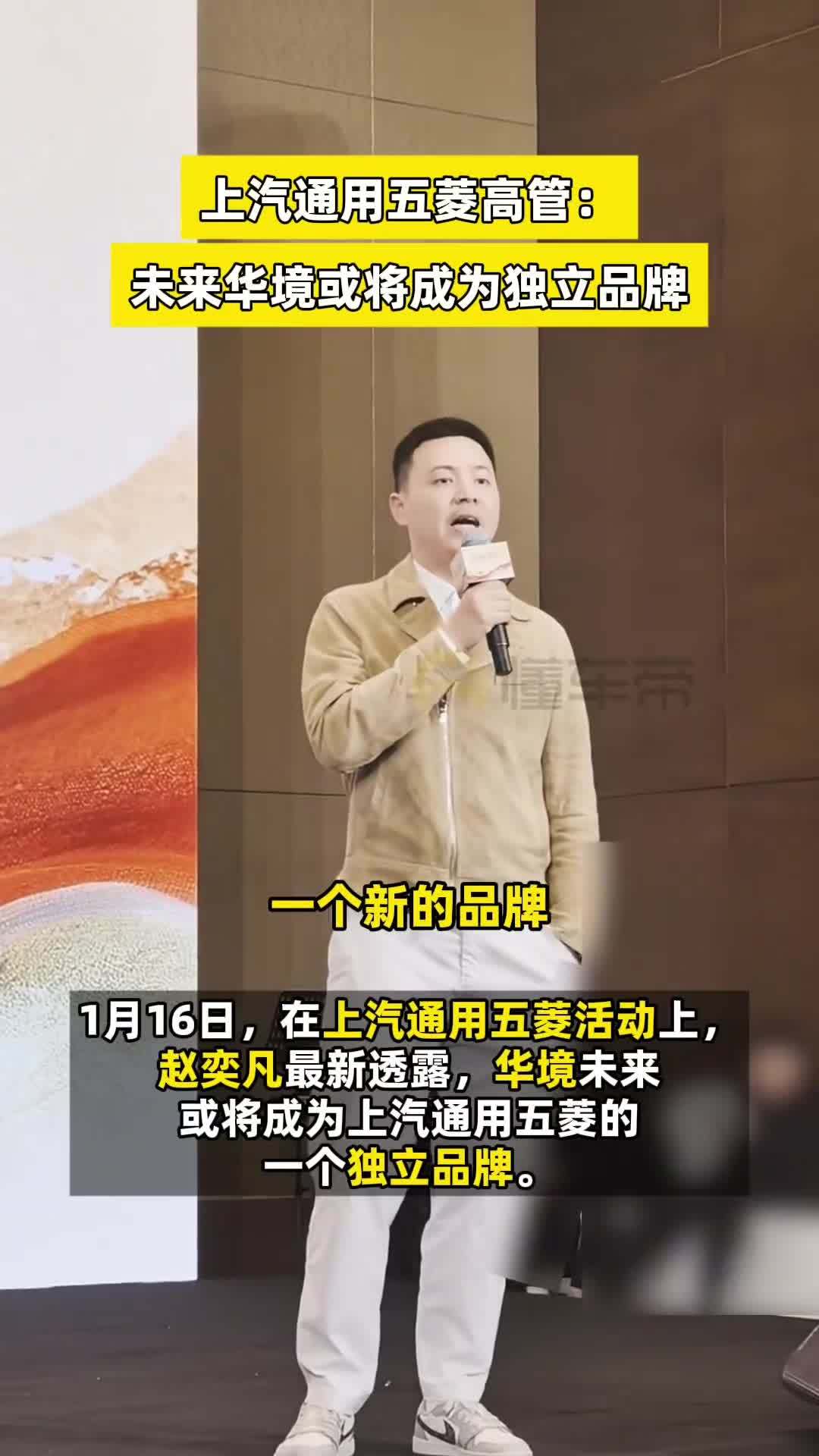
Core Viewpoint - SAIC-GM-Wuling is launching a new brand "Hua Jing" with its flagship model "Hua Jing S," which is set to be released in the first half of 2026 in collaboration with Huawei [5][14]. Group 1 - The "Hua Jing S" is currently part of the Baojun series but will evolve into a new brand under SAIC-GM-Wuling [9]. - The vehicle will be a large six-seat SUV equipped with Huawei's advanced technology, specifically the "Hua Wei Qian Kun" system [5][14]. - The "Hua Jing S" is produced in a national leading intelligent factory, marking it as the first product of the collaboration between SAIC-GM-Wuling and Huawei's "Three Intelligence" initiative, which includes intelligent manufacturing, assisted driving, and intelligent cockpit [12][14]. Group 2 - The "Hua Jing S" will feature standard Huawei Qian Kun technology, including Qian Kun Intelligent Driving ADS 4 Pro and Hongmeng cockpit [6][14]. - The manufacturing process utilizes a national leading intelligent factory's smart island manufacturing system [6][14]. - The vehicle incorporates the "Tian-Ling-Shen" technology system, which consists of Tian Yu architecture, Lingxi power, and Shen Lian battery [6].
一周新车盘点 | 全新一汽奥迪A6L首秀 北京越野BJ40增新车型
Xin Lang Cai Jing· 2026-01-18 12:26
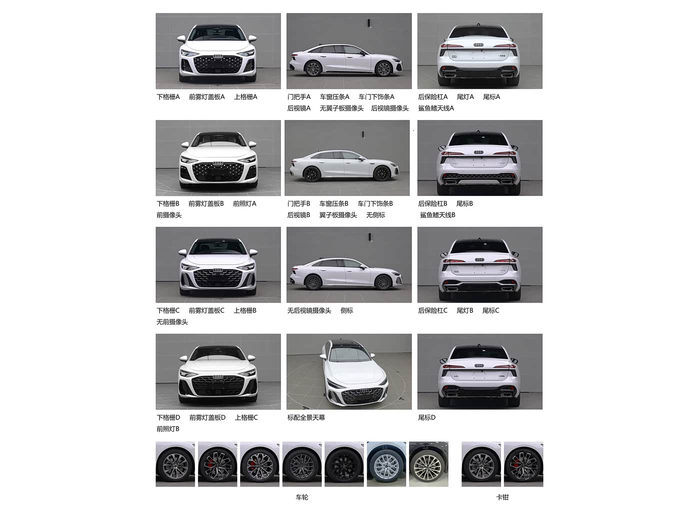
Group 1: New Audi A6L Launch - The new FAW Audi A6L was officially unveiled in China on January 15, featuring a comprehensive update in design, dimensions, and smart technology [1][3] - The vehicle's dimensions are 5142mm in length, 1874mm in width (1887mm with side cladding), and 1450mm in height (1464mm with side cladding), with a wheelbase of 3066mm, showing significant increases compared to the current model [1][3] - The new A6L will offer two engine options: a 2.0T with high power (272 horsepower) and low power (204 horsepower), and a 3.0T engine with a maximum power of 367 horsepower [6] Group 2: BJ40 Explorer Launch - The Beijing Off-road BJ40 Explorer was launched on January 15, with prices ranging from 149,900 to 159,900 yuan, offering both 2.0T gasoline and 2.0T diesel engine options [8][11] - The BJ40 Explorer features a new interior design with a 15.6-inch central control screen and Qualcomm Snapdragon 8155 chip, supporting Huawei's application ecosystem [9] - The vehicle's dimensions are 4630mm in length, 1925mm in width, and 1871mm in height, with a wheelbase of 2745mm, emphasizing its off-road capabilities [8][11] Group 3: Wuling Star 560 Launch - The Wuling Star 560 was officially launched on January 15, offering three powertrain options: gasoline, plug-in hybrid, and pure electric, with prices ranging from 62,800 to 98,800 yuan [14][19] - The vehicle's dimensions are 4745mm in length, 1850mm in width, and 1755mm in height, with a wheelbase of 2810mm, positioning it close to mainstream mid-size SUVs [14][19] - The Star 560's gasoline version features a 1.5T engine with a maximum power of 177 horsepower, while the pure electric version has a maximum power of 136 horsepower and a range of 500 kilometers [17][19] Group 4: Honda Fit Redesign - The new Honda Fit was launched on January 15, with a starting price of 66,800 yuan, available in a limited configuration [21][26] - The vehicle features a new split headlight design and a closed front grille, with dimensions of 4169mm in length, 1694mm in width, and 1537mm in height, showing an increase in length compared to the current model [22][23] - The Fit continues to use a 1.5-liter naturally aspirated engine with a maximum power of 124 horsepower, emphasizing fuel efficiency with a WLTC fuel consumption of approximately 5.6 liters per 100 kilometers [23][26]
天有为总经理吕冬芳:“屏”硬核实力打造全球汽车电子新标杆
Shang Hai Zheng Quan Bao· 2026-01-16 18:34
Core Viewpoint - The company aims to establish itself as a leading provider of smart mobility solutions by leveraging core technologies, intelligent manufacturing, and capital empowerment to enhance its competitiveness in the global automotive electronics market [1][6]. Group 1: Company Overview - Founded in 2003, the company specializes in the research, design, production, and sales of automotive instruments, including electronic combination instruments and full LCD combination instruments [2]. - The company has established long-term partnerships with major automotive manufacturers, including Hyundai and BYD, becoming a core supplier for various domestic and international automotive OEMs [2][3]. Group 2: Technological Advancements - The company emphasizes the importance of core technology in the automotive electronics industry, with a focus on continuous R&D as a key driver of growth [2][3]. - It has developed proprietary technologies such as composite screen technology and low-temperature optical bonding technology, which have successfully broken foreign technology monopolies [2][3]. Group 3: Capital Empowerment and Global Expansion - The company plans to go public in April 2025, aiming to raise 3.74 billion yuan to support its R&D and global expansion efforts [4]. - Significant orders have been secured, including a central display project for a well-known international automaker, with production expected to start in 2027 [4][5]. Group 4: Strategic Transformation - The company is transitioning from an automotive instrument supplier to a smart mobility solution provider, focusing on AR interaction, scenario-based smart cockpits, and vehicle-road collaboration ecosystems [6]. - It is actively developing new products in the full LCD instrument sector, including 3D and OLED instruments, with the first 2.5K ultra-thin full LCD instrument nearing mass production [6]. Group 5: Local Impact and Responsibility - The company has created nearly 5,000 jobs and collaborates with local educational institutions to train thousands of technical talents, contributing to the industrial cluster in its hometown [6]. - The company aims to enhance its identity on both national and international stages, aspiring to make "Chinese manufacturing" shine globally through continuous innovation and global expansion [7].
余承东发飙,狠批鸿蒙座舱愚蠢
3 6 Ke· 2026-01-16 12:31
Core Viewpoint - Huawei's Executive Director Yu Chengdong expressed strong dissatisfaction with the development of the HarmonyOS cockpit, criticizing its lack of intelligent features and calling it merely a "function cockpit" rather than a smart one [1][2]. Group 1: Criticism of HarmonyOS Cockpit - Yu Chengdong highlighted two main issues: the system fails to provide timely alerts for low tire pressure, which can lead to increased energy consumption, and it unnecessarily prompts users to open windows for ventilation while driving at high speeds, which is impractical and increases energy consumption [2][4]. - The current system is described as lacking proactive intelligent reminders, with Yu stating, "We have no qualification to call it HarmonyOS smart cockpit" [1][2]. Group 2: User Experience Issues - Users have reported significant problems with the touch response of the HarmonyOS cockpit, including screen lag and poor usability, particularly when trying to access information while driving [5][7]. - Some users noted that the voice assistant, "Xiao Yi," is not always responsive, leading to incorrect commands being executed [7]. Group 3: Historical Context and Development Challenges - The HarmonyOS cockpit previously gained attention for its innovative features, such as seamless unlocking with various devices and advanced voice command capabilities, but development has slowed due to resource allocation towards the native HarmonyOS system [9]. - Yu Chengdong acknowledged that while Huawei once led the smart cockpit industry, the focus on the HarmonyOS native system has hindered innovation speed in recent years [9]. Group 4: Future Prospects - Despite current challenges, there is optimism for improvements, as Yu Chengdong recently visited GAC Group to sign a cooperation agreement aimed at better integrating the intelligent assistant into the cockpit for a smarter next-generation experience [9].
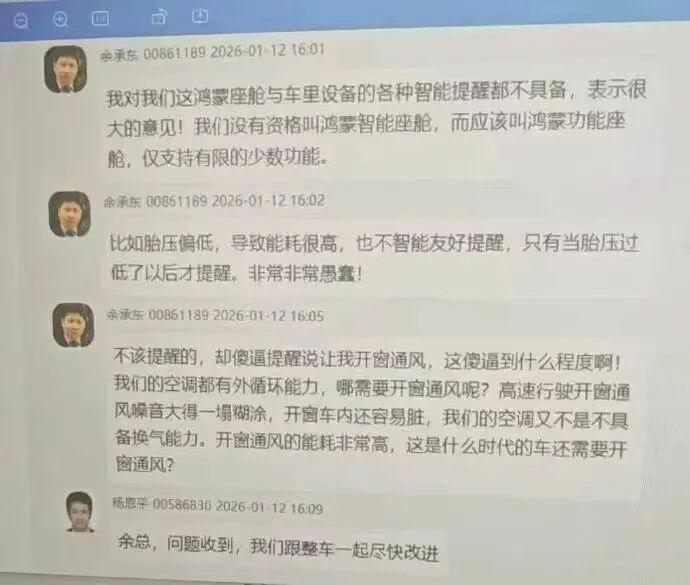
网传余承东工作群怒批鸿蒙座舱:各种智能提醒都不具备,非常非常愚蠢!
Xin Lang Cai Jing· 2026-01-16 07:37
Core Viewpoint - Huawei's Executive Director and Chairman of the Terminal BG, Yu Chengdong, has expressed strong dissatisfaction with the capabilities of the HarmonyOS cockpit, criticizing it for lacking essential smart reminders and suggesting it should be referred to as a "function cockpit" instead of an "intelligent cockpit" due to its limited functionalities [1][2]. Group 1 - Yu Chengdong criticized the HarmonyOS cockpit for not providing timely reminders for low tire pressure, which can lead to increased energy consumption, stating that it only alerts users when the pressure is critically low, calling this "very foolish" [1][2]. - He highlighted the issue of unnecessary reminders, such as suggesting to open windows for ventilation, arguing that modern vehicles equipped with air conditioning systems do not require this feature, especially at high speeds where it can create excessive noise and increase energy consumption [2][3]. - Yu Chengdong's comments indicate a need for significant improvements in the HarmonyOS cockpit's functionality to meet modern automotive standards [1][2].
联创电子跌2.00%,成交额2.08亿元,主力资金净流出2593.85万元
Xin Lang Cai Jing· 2026-01-16 02:18
Core Viewpoint - Lianchuang Electronics has experienced fluctuations in stock price and trading volume, with a recent decline in share price and mixed financial performance indicators, indicating potential investment opportunities and risks in the electronic optics sector [1][2]. Group 1: Stock Performance - As of January 16, Lianchuang Electronics' stock price decreased by 2.00% to 11.75 CNY per share, with a trading volume of 208 million CNY and a turnover rate of 1.66%, resulting in a total market capitalization of 12.401 billion CNY [1]. - Year-to-date, the stock price has increased by 6.62%, but it has declined by 4.16% over the last five trading days, while showing gains of 5.48% over the last 20 days and 13.20% over the last 60 days [1]. Group 2: Financial Performance - For the period from January to September 2025, Lianchuang Electronics reported a revenue of 6.489 billion CNY, reflecting a year-on-year decrease of 16.20%, while the net profit attributable to shareholders reached 50.92 million CNY, marking a significant year-on-year increase of 210.26% [2]. - The company has distributed a total of 274 million CNY in dividends since its A-share listing, with 9.662 million CNY distributed over the past three years [3]. Group 3: Shareholder Structure - As of January 9, the number of shareholders for Lianchuang Electronics reached 128,700, an increase of 15.00% from the previous period, with an average of 8,185 circulating shares per shareholder, down by 13.04% [2]. - Among the top ten circulating shareholders, Hong Kong Central Clearing Limited holds 23.5766 million shares, an increase of 5.6268 million shares from the previous period, while other ETFs have seen a decrease in holdings [3].

光庭信息跌2.00%,成交额1.77亿元,主力资金净流入950.17万元
Xin Lang Cai Jing· 2026-01-15 03:24
Core Viewpoint - Guangting Information's stock has shown a positive trend in recent months, with significant revenue and profit growth reported for the year 2025, indicating strong operational performance in the automotive electronics sector. Group 1: Stock Performance - On January 15, Guangting Information's stock price decreased by 2.00%, reaching 60.68 CNY per share, with a trading volume of 1.77 billion CNY and a turnover rate of 4.56%, resulting in a total market capitalization of 56.20 billion CNY [1] - Year-to-date, the stock price has increased by 7.89%, with a 2.66% rise over the last five trading days, a 25.71% increase over the last 20 days, and a 20.37% increase over the last 60 days [1] Group 2: Financial Performance - For the period from January to September 2025, Guangting Information achieved a revenue of 421 million CNY, representing a year-on-year growth of 23.05%, and a net profit attributable to shareholders of 44.78 million CNY, which is a significant increase of 308.53% year-on-year [2] - Since its A-share listing, the company has distributed a total of 83.36 million CNY in dividends, with 46.31 million CNY distributed over the past three years [3] Group 3: Shareholder Information - As of January 10, 2025, the number of shareholders for Guangting Information was 14,400, a decrease of 7.75% from the previous period, with an average of 4,341 circulating shares per shareholder, which is an increase of 8.40% [2] - As of September 30, 2025, the top ten circulating shareholders included Dazhong Zhongzheng 360 Internet + Index A, holding 295,200 shares, a decrease of 1,700 shares compared to the previous period [3]
从CES-2026看自动驾驶最新变化
2026-01-15 01:06
Summary of Key Points from the Conference Call Industry Overview - The conference call primarily discusses advancements in the **autonomous driving** industry, particularly highlighted during **CES 2026**. [1][3] Key Companies and Technologies - **Texas Instruments (TI)** introduced low-power chips and a new generation of imaging millimeter-wave radar, achieving a **30% performance improvement** while reducing costs. [1][3] - **Mobileye** launched the **IQ 7 series chips**, which outperform competitors in latency for visual Transformer and neural network models but fall short in floating-point computing power compared to top products like NVIDIA. [1][3] - **Qualcomm** showcased its **8,797 series cockpit platform**, priced around **$700-$800**, with **Li Auto** as the first mass-production partner. [1][6] - **Tesla** shifted its Full Self-Driving (FSD) model to a subscription service, lowering barriers for consumers and creating a new revenue stream. [1][4] - **NVIDIA** released the **AlphaMile model**, which demonstrates the capability to transition from L2 to L4 autonomous driving, thus lowering entry barriers for second and third-tier automakers. [1][11] Market Trends and Predictions - **2026** is anticipated to be a pivotal year for the mass production of **L3/L4 autonomous vehicles**, with traditional brands expected to launch several high-level intelligent driving models around the **Spring Festival**. [1][5] - The shift to subscription models and supportive policies in regions like **Shanghai** is expected to accelerate the adoption of advanced autonomous driving technologies. [1][4] - The **laser radar industry** is experiencing growth due to increased demand from service and industrial robots, with companies like **Hesai Technology** planning to double production capacity. [2][14] Additional Insights - **Qualcomm** views smart cockpits as a core direction for smart vehicle development, emphasizing the importance of differentiated innovation in high-end vehicles. [7] - **NVIDIA**'s advancements in AI and physical simulation are crucial for the development of autonomous systems, with their **COSMO simulator** aiding in generating test scenarios. [10] - The collaboration between companies like **Mobileye** and **Hesai Technology** in the robot and Robotaxi sectors indicates a strategic focus on expanding their market presence. [16] Conclusion - The autonomous driving industry is poised for significant growth, driven by technological advancements, new business models, and supportive regulatory environments. The competitive landscape is evolving, with major players investing heavily to maintain and expand their market positions. [18][19]


决战智能化下半场 CES见证 “AI+汽车”真落地
Zhong Guo Qi Che Bao Wang· 2026-01-14 05:59
Group 1: CES Overview - The International Consumer Electronics Show (CES) took place in Las Vegas from January 6 to 9, attracting over 4,000 exhibitors, with nearly 1,000 from China, second only to the U.S. [2] - Major automotive companies such as Mercedes-Benz, BMW, Honda, and Great Wall showcased their latest innovations, alongside tech giants like NVIDIA, Intel, and Amazon [2] - The theme of this year's CES focused on artificial intelligence (AI), emphasizing the transition from showcasing technology to practical applications in various sectors [2] Group 2: Automotive Innovations - AI is set to replace electric vehicles as the main focus of CES by 2024 and 2025, with automotive companies using electric vehicles as platforms to showcase AI technologies [3] - BMW's new iX3 model features an AI-driven personal assistant and a wide range of in-car entertainment applications, with a starting price of approximately $60,000 [3] - Mercedes-Benz is shifting its luxury focus from mechanical performance to software experiences, showcasing its new electric GLC with an advanced operating system and a 39.1-inch display [4] Group 3: Chinese Automotive Companies - Chinese automakers like Great Wall and Geely are emphasizing their technological frameworks and algorithm capabilities at CES, with Great Wall introducing ASL2.0 and VLA models [5] - Geely announced its AI technology system has evolved to version 2.0, integrating AI across various vehicle domains [5] Group 4: AI and Autonomous Driving - NVIDIA's CEO highlighted the arrival of autonomous vehicles as a key application of physical AI, with plans to test L4 Robotaxi by 2027 [7] - The new Alpamayo model from NVIDIA will enhance the L2 driving assistance capabilities in Mercedes-Benz's electric CLA, with initial deployment in the U.S. expected in Q1 2026 [8] - Geely's new G-ASD brand aims to cover L2 to L4 autonomous driving capabilities, with plans to roll out features by 2026 [8] Group 5: Chip and Sensor Developments - Major chip manufacturers like NVIDIA, AMD, and Qualcomm are competing in the automotive chip market, with Qualcomm and Leap Motor launching a central controller based on dual Snapdragon 8797 chips [10] - Valeo showcased a comprehensive range of advanced driver-assistance systems (ADAS) solutions, while Mobileye announced a $900 million acquisition of a humanoid robot company [9][17] Group 6: Robotics and Automation - The robotics sector is gaining traction, with companies like Hyundai and Boston Dynamics unveiling new robotic technologies, including the award-winning MobED robot [15] - Over half of the humanoid robot exhibits at CES were from Chinese companies, showcasing innovations in various applications [16] - Black Sesame Intelligence is expanding into robotics, presenting its SesameX platform aimed at commercializing robotic solutions [17][18]