民间投资

Search documents
财政部:实施中小微企业贷款贴息政策,延长个人消费贷款财政贴息政策实施期限
Sou Hu Cai Jing· 2026-01-20 07:48
Group 1: Small and Micro Enterprises Loan Interest Subsidy Policy - The policy provides a 1.5% annual interest subsidy for eligible small and micro private enterprises' fixed asset loans and new policy financial tools, with a maximum subsidy loan limit of 50 million yuan per enterprise [1][3][9] - The policy is applicable to loans issued from January 1, 2026, and is initially set to last for one year, with the possibility of extension based on future evaluations [1][3] - The focus is on key industries such as new energy vehicles, industrial mother machines, pharmaceuticals, artificial intelligence, and other emerging sectors [3][9] Group 2: Personal Consumption Loan Interest Subsidy Policy - The implementation period for the personal consumption loan interest subsidy policy has been extended to December 31, 2026, allowing residents to enjoy subsidies for eligible consumption during this period [5][15] - The policy now includes credit card installment payments with an annual subsidy rate of 1%, and removes previous restrictions on consumption fields [5][16] - The maximum annual subsidy per individual remains capped at 3,000 yuan, while previous limits on single transaction subsidies have been removed [5][16] Group 3: Private Investment Special Guarantee Plan - The plan has a total quota of 500 billion yuan, to be implemented over two years, aimed at supporting small and micro enterprises in various sectors including technology upgrades and service industry enhancements [2][7][22] - The guarantee fee for private enterprises is capped at 1%, with the government financing guarantee fund reducing re-guarantee fees by half [2][23] - The plan allows for a compensation rate increase from 4% to 5% for government financing guarantees, enhancing risk tolerance for medium to long-term loans [7][24]
财政部连发5个重要文件,事关消费贷、民间投资等
Sou Hu Cai Jing· 2026-01-20 07:14
Group 1 - The Ministry of Finance and other departments have released five documents related to consumer loans and private investment, aiming to stimulate consumption and expand domestic demand [1] - The loan interest subsidy policy for service industry operators has been extended until December 31, 2026, with specific provisions for loans issued between March 16, 2025, and December 31, 2025 [1][2] - The maximum loan amount eligible for interest subsidies has been increased to 10 million yuan, with a subsidy rate of 1% for a maximum period of one year [2][3] Group 2 - The scope of supported sectors has been expanded to include digital, green, and retail consumption areas, in addition to existing categories like catering, health, and tourism [2][3] - A total of 21 national banks and various commercial banks are designated as eligible institutions for processing these loans [3][4] - The funding mechanism for interest subsidies will adopt a "pre-allocation + settlement" approach, ensuring timely disbursement and accountability [4][5] Group 3 - A special guarantee plan for private investment has been introduced with a total quota of 500 billion yuan, to be implemented over two years [8][10] - The plan focuses on supporting small and micro enterprises in various sectors, including technology upgrades and consumption-related activities [10][11] - The risk-sharing ratio has been adjusted, with banks bearing at least 20% of the loan risk and the government guarantee system covering up to 80% [11][12] Group 4 - The equipment update loan interest subsidy policy has been optimized, with a subsidy rate of 1.5% for loans related to equipment updates, applicable for a maximum of two years [15][16] - The supported sectors for equipment updates have been broadened to include high-tech and green industries, enhancing support for modernization [16][17] - A total of 26 banks are authorized to handle these subsidy loans, ensuring a wide reach for the policy [17][18] Group 5 - The personal consumption loan interest subsidy policy has been extended until the end of 2026, with an emphasis on innovative financial products to boost consumer spending [22][23] - The subsidy rate for personal consumption loans has been set at 1%, with the removal of previous caps on subsidy amounts for individual borrowers [23][24] - The funding allocation for these subsidies will also follow a "pre-allocation + settlement" model to enhance efficiency [24][25]

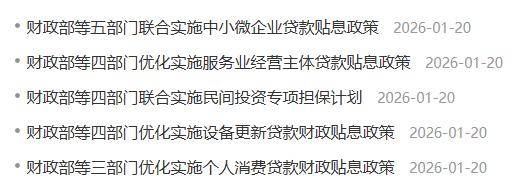
四部门:实施民间投资专项担保计划
Zhong Guo Jing Ji Wang· 2026-01-20 06:24
Core Viewpoint - The Ministry of Finance, the Ministry of Industry and Information Technology, the People's Bank of China, and the Financial Regulatory Administration jointly announced a special guarantee plan for private investment, aiming to stimulate private investment vitality and support key sectors such as expanding domestic demand and technological innovation [1][2]. Group 1: Overall Requirements - The plan is guided by Xi Jinping's thought and aims to enhance the government's financing guarantee capabilities, ensuring a multi-layered, broad coverage, and sustainable financing guarantee system to support private investment [2]. Group 2: Implementation Plan - The total amount of the special guarantee plan is set at 500 billion yuan, to be implemented over two years [3]. - Eligible small and medium-sized enterprises (SMEs) can access loans for various purposes, including equipment purchases, technological upgrades, and business operations, provided they meet specific criteria [3]. - Banks will bear at least 20% of the loan risk, while the government financing guarantee system will cover up to 80% [4]. - The guarantee fee rates will be reduced, with the central government supporting a halving of re-guarantee fees, ensuring that the actual fee for private enterprises does not exceed 1% [4]. - The single credit guarantee limit for loans under this plan is capped at 20 million yuan, with encouragement for support in key strategic areas [4]. - The compensation rate for government financing guarantees for SMEs' long-term loans will be increased from 4% to 5% [4]. Group 3: Risk Compensation and New Product Exploration - The central government will provide risk compensation for new compensation expenditures under this plan, with the annual scale of the financing guarantee fund determined by the Ministry of Finance based on financing needs [5]. - Innovative financing models, such as "supply chain + financing guarantee" and "scenario finance + digital currency," will be encouraged to support private investment [5]. - The central government will inject 5 billion yuan into the financing guarantee fund to enhance its capital strength and support effective government financing guarantee institutions [5]. Group 4: Organizational Implementation - The Ministry of Finance will oversee the risk compensation funds and ensure effective use of resources [6]. - Financial management departments will enforce strict loan purpose audits and increase long-term loan issuance [6]. - Local financial departments will provide support to guarantee institutions, considering various performance metrics in evaluations [6]. - The financing guarantee fund will refine operational arrangements with partner institutions and enhance monitoring of policy implementation [6].
政策协同发力 促民间投资高质量发展
Jing Ji Wang· 2026-01-20 06:05
Group 1 - Recent policies have been intensively released to enhance private investment, transitioning from "scale expansion" to "quality improvement" to inject endogenous momentum into high-quality economic development [1] - The State Council's meeting on January 9 focused on addressing pain points in private investment, deploying a series of fiscal and financial policies to form a robust support matrix [2][3] - The introduction of a special guarantee plan aims to alleviate risks for private investments, particularly in emerging industries and infrastructure, thereby increasing investor confidence [2][3] Group 2 - The establishment of a risk-sharing mechanism for private enterprise bonds is expected to lower financing costs and enhance the flexibility of financing channels for private enterprises [3] - Local governments, such as Jiangxi and Guizhou, have implemented specific measures to translate central policies into practice, focusing on innovation-driven and industrial upgrading [5][6] - The issuance of 83 infrastructure REITs projects has mobilized over 1 trillion yuan in new investments, effectively revitalizing existing assets and shortening investment recovery periods [4] Group 3 - The financial and fiscal policy combination is seen as a timely boost for private investment, with expectations for a shift from "cost-sensitive" to "quality-sensitive" investment strategies [7] - The commercial aerospace sector is witnessing significant innovation from private enterprises, exemplified by successful funding rounds and advancements in high-end manufacturing [8] - The collaboration of fiscal and financial policies is projected to reverse the decline in private investment growth, with an anticipated increase in fixed asset investment growth from -3.0% in 2025 to 2.5% in 2026 [8]
额度5000亿元 四部门发布实施民间投资专项担保计划
Yang Shi Wang· 2026-01-20 05:27
Core Viewpoint - The Chinese government is implementing a special guarantee plan for private investment, aiming to stimulate private investment vitality and support key sectors such as expanding domestic demand, technological innovation, and small and micro enterprises [1] Group 1: Overall Requirements - The plan aims to enhance the capacity of government financing guarantees through various measures, including risk compensation and fee subsidies, to create a sustainable and inclusive financing guarantee system [2] Group 2: Implementation Plan - The special guarantee plan has a total quota of 500 billion yuan, to be implemented over two years [3] - Eligible small and micro enterprises can access loans for various purposes, including equipment purchases, technological upgrades, and business operations, provided they meet specific criteria [3] - Banks will bear at least 20% of the loan risk, while the government financing guarantee system will cover up to 80% [4] - The guarantee fee rates will be reduced, with the central government supporting a 50% reduction in re-guarantee fees [4] - The maximum guarantee amount per loan is set at 20 million yuan, with encouragement for increased support for high-quality projects in key sectors [4] - The compensation rate for government financing guarantees for small and micro enterprises will be increased from 4% to 5% [4] Group 3: Risk Compensation and Innovation - The central government will provide risk compensation for new compensation expenditures under the plan, with the annual business scale of the guarantee fund determined based on financing needs [5] - The plan encourages the exploration of innovative financing products, such as "supply chain + financing guarantee" and "scene finance + digital RMB" [5] - The central government will inject 5 billion yuan into the guarantee fund to enhance its capital strength and support effective financing guarantee institutions [5]
四部门发布《关于实施民间投资专项担保计划的通知》
Sou Hu Cai Jing· 2026-01-20 04:55
Core Viewpoint - The notice outlines the implementation of a special guarantee plan for private investment, aiming to stimulate private investment vitality and support key sectors such as technology innovation and small and medium-sized enterprises (SMEs) [1][2]. Group 1: Overall Requirements - The plan is guided by Xi Jinping's thoughts and aims to enhance the capacity of government financing guarantees, ensuring a sustainable and inclusive financing guarantee system [2]. - The initiative seeks to channel financial resources to support the expansion of high-quality goods and services through private investment [2]. Group 2: Implementation Plan - The total amount for the special guarantee plan is set at 500 billion yuan, to be implemented over two years [3]. - Eligible SMEs can access loans for various operational activities, including equipment purchases, technological upgrades, and expansion in sectors like health, culture, and tourism [3]. - SMEs must meet specific criteria, such as not being listed as abnormal business entities or having a history of significant legal violations [3]. Group 3: Risk Sharing and Cost Reduction - Banks will bear at least 20% of the loan risk, while the government financing guarantee system will cover up to 80% [4]. - The guarantee fee rates will be reduced, with the central government supporting a halving of re-guarantee fees, ensuring that the actual burden on private enterprises does not exceed 1% [4]. - The maximum guarantee amount per loan is capped at 20 million yuan, with incentives for high-quality projects in key sectors [4]. Group 4: Compensation and Innovation - The government will provide risk compensation for new compensation expenditures related to the plan, with the annual business scale of the guarantee fund determined by financing needs [5]. - The plan encourages the development of innovative financing products, such as "supply chain + financing guarantee" and "scene finance + digital currency" [6]. - The central government will inject 5 billion yuan into the guarantee fund to enhance its capital strength and support effective institutions [6]. Group 5: Organizational Implementation - The Ministry of Finance will oversee the risk compensation funds and ensure effective risk control [7]. - Financial management departments will enforce strict loan usage audits and increase long-term loan issuance [8]. - Local financial departments are encouraged to support guarantee institutions with risk compensation and performance evaluations based on the plan's impact [8].
四部门:中央财政向融担基金注资50亿元
智通财经网· 2026-01-20 04:33
Core Viewpoint - The Chinese government has announced a special guarantee plan for private investment, aiming to enhance the capital strength of the financing guarantee fund and stimulate private investment, job creation, and risk prevention through a multi-tiered government financing guarantee system [1][3]. Group 1: Overall Requirements - The plan is guided by Xi Jinping's thoughts and aims to enhance the government's financing guarantee capabilities, ensuring a sustainable and inclusive financing guarantee system that supports private investment [4]. Group 2: Implementation Plan - The total amount for the special guarantee plan is set at 500 billion yuan, to be implemented over two years [5]. - Eligible small and medium-sized enterprises (SMEs) can access loans for various operational activities, including equipment purchases, technological upgrades, and expansion in sectors like hospitality, health, and culture [5]. - The risk-sharing ratio is structured such that banks bear at least 20% of the loan risk, while the government financing guarantee system covers up to 80% [6]. - The central government will support the reduction of guarantee fees, with a cap on direct guarantee fees not exceeding 1% [6]. - The maximum guarantee amount per loan is set at 20 million yuan, with encouragement for support in key strategic areas [6]. - The compensation limit for government financing guarantees for SMEs has been increased from 4% to 5% [7]. - The central government will inject 5 billion yuan into the financing guarantee fund to enhance its capital strength and support effective institutions [7]. Group 3: Organizational Implementation - The Ministry of Finance will oversee the risk compensation funds and ensure effective risk control and fund usage [8]. - Financial management departments will enforce strict loan usage audits and promote long-term loan issuance [8]. - Local financial departments are encouraged to support government financing guarantee institutions through risk compensation and performance evaluations [8].
广州市政协委员建言献策:既有对广州发展深度思考 更是对广州这座城市深深的热爱
Zhong Guo Fa Zhan Wang· 2026-01-20 01:44
Group 1 - The Guangzhou Municipal Political Consultative Conference emphasized the importance of building a modern industrial system, fostering emerging industries, and enhancing service quality through high-quality suggestions [1] - The conference highlighted the need to activate innovation capabilities, support the construction of innovation platforms, and strengthen talent support for technological advancements [1] - There is a focus on optimizing the business environment to promote a market-oriented, legal, and international first-class business environment [1] Group 2 - Eight representatives from the Guangzhou Political Consultative Conference discussed key issues related to urban development, artificial intelligence empowerment, and cultural soft power, reflecting a deep commitment to the city's long-term growth [2] - Proposals included expanding the scope of national subsidies for the aging-friendly home industry and promoting high-quality development in this sector, addressing significant social and strategic needs [3] - Recommendations were made to accelerate the intelligent upgrade of the customized home industry through AI integration, addressing challenges such as talent shortages and high operational costs [3] Group 3 - Proposals were made to establish a fault-tolerant mechanism for state-owned venture capital in Guangzhou to enhance the legal framework and provide a stable environment for investment [4] - The report noted a decline in private investment in Guangzhou, with a 16.7% year-on-year decrease in the first half of 2025, prompting suggestions to broaden investment fields and improve financing support [4] - Recommendations included creating a high-quality investment environment to support technological advancements and address challenges in fundraising and industry cultivation [5]

成都168个项目入围
Xin Lang Cai Jing· 2026-01-19 18:12
Core Insights - The Sichuan Provincial Government has announced the list of key projects for 2026, totaling 830 projects with an expected investment of 762.48 billion yuan [1] - Chengdu has 168 projects included in the annual key project list, with a total investment of nearly 1.3 trillion yuan, accounting for 20.2% and 24.4% of the province's total projects and investment respectively [1] Summary by Category - **Infrastructure Projects**: 318 projects with an expected investment of 360.32 billion yuan, including 48 highway projects (over 110 billion yuan) and 19 railway projects (over 60 billion yuan) [2] - **Industrial Projects**: 425 projects with an expected investment of 363.75 billion yuan, comprising 246 manufacturing projects (over 210 billion yuan), 54 energy projects (over 60 billion yuan), and 89 modern service projects (over 50 billion yuan) [2] - **Social and Livelihood Projects**: 63 projects with an expected investment of 26.52 billion yuan [2] - **Ecological and Environmental Projects**: 24 projects with an expected investment of 11.89 billion yuan [2] - **New Quality Productive Forces**: Over 240 projects with an expected investment exceeding 200 billion yuan, including 23 technology innovation infrastructure projects [2] - **Private Investment Projects**: Over 250 projects with an expected investment of nearly 200 billion yuan [2] - **Chengdu's Project Composition**: The industrial sector represents a significant portion of Chengdu's 2026 key projects, with 48.2% in number and 37.1% in investment amount [2]
瞭望 | 民资加码国民经济命脉行业
Sou Hu Cai Jing· 2026-01-19 08:23
Core Insights - The significant growth of private investment in key sectors of the national economy is driven by increased demand for private capital and the certainty of returns in these industries [3][4] Group 1: Private Investment Growth - Since 2020, the internal structure of private investment in China has changed, with more capital flowing into critical sectors like mining and infrastructure [3] - In 2024, private investment in the mining sector increased by 16.2% year-on-year, with a further growth of 19.8% in the first three quarters of 2025. Notably, investments in oil and gas extraction and non-ferrous metal mining surged by 50.5% and 36.6% respectively [3] - Private investment in the electricity, heat, water, and gas production and supply sector saw a year-on-year increase of over 30% in 2024, maintaining a growth rate of 20.2% in the first three quarters of 2025 [3] Group 2: Factors Driving Investment - The transformation and development of relevant industries have created more opportunities for private capital, particularly due to national policies promoting energy efficiency and carbon reduction [4] - The shift of state-owned capital towards high-end manufacturing and services has freed up more space for private investment, with state-owned mining sector investment growth slowing to 3.7% in the first three quarters of 2025, lagging behind private investment by 16.1 percentage points [4][5] - The current alignment of private capital demand with key economic sectors is high, as traditional manufacturing yields lower returns and investment risks have increased, leading to a decline in private capital's share in manufacturing from approximately 45% to 40% [5] Group 3: Management and Regulatory Changes - The increasing influence of private investment necessitates adjustments in management practices, shifting the relationship between government and enterprises from equity-based to trust-based [6] - A collaborative mechanism involving investors, financiers, main enterprises, local governments, and regulatory bodies should be established to ensure project stability and shared interests throughout the project lifecycle [6]