
现代化产业体系

Search documents
贵安新区管委会与广东凯金新能源科技股份有限公司 项目合作协议签约仪式举行
Xin Lang Cai Jing· 2026-02-13 19:33
Group 1 - The core agreement involves a collaboration between Gui'an New Area and Guangdong Kaijin New Energy Technology Co., Ltd. to establish a project for the integrated production of 200,000 tons of lithium battery anode materials annually, supporting the industrial development of Guiyang and Gui'an [2][1]. - The signing ceremony was attended by key officials from both parties, including Wang Hong, Deputy Secretary of the Party Working Committee and Director of the Management Committee of Gui'an New Area, and Yang Yunlin, President of Guangdong Kaijin New Energy [1][3]. - Wang Hong expressed gratitude for the investment in Gui'an New Area and emphasized the importance of strengthening communication and collaboration to identify more cooperation opportunities, aiming for a win-win development [1][2]. Group 2 - The project is part of a broader strategy to enhance the modern industrial system in Guiyang and Gui'an, focusing on cultivating six major industrial clusters [1]. - Kaijin New Energy is committed to accelerating the project's construction and production timelines, aiming for early operational effectiveness and contributing to local high-quality development [2][1].
构建现代化产业体系 需要构建统一大市场
Xin Lang Cai Jing· 2026-02-13 16:24
Group 1 - The article emphasizes the need for a unified national market to avoid issues like overcapacity seen in emerging industries such as solar energy due to local competition and redundant construction [1] - It highlights the importance of establishing uniform market rules, fair regulation, and high-standard connectivity of market facilities to facilitate the free flow of resources like capital, technology, data, and talent across regions [1] - Breaking down administrative barriers and regional blockades, as well as opposing administrative monopolies, is deemed crucial, with a focus on allowing market dynamics to dictate regional and industrial division of labor to prevent new rounds of overcapacity caused by excessive government intervention [1]
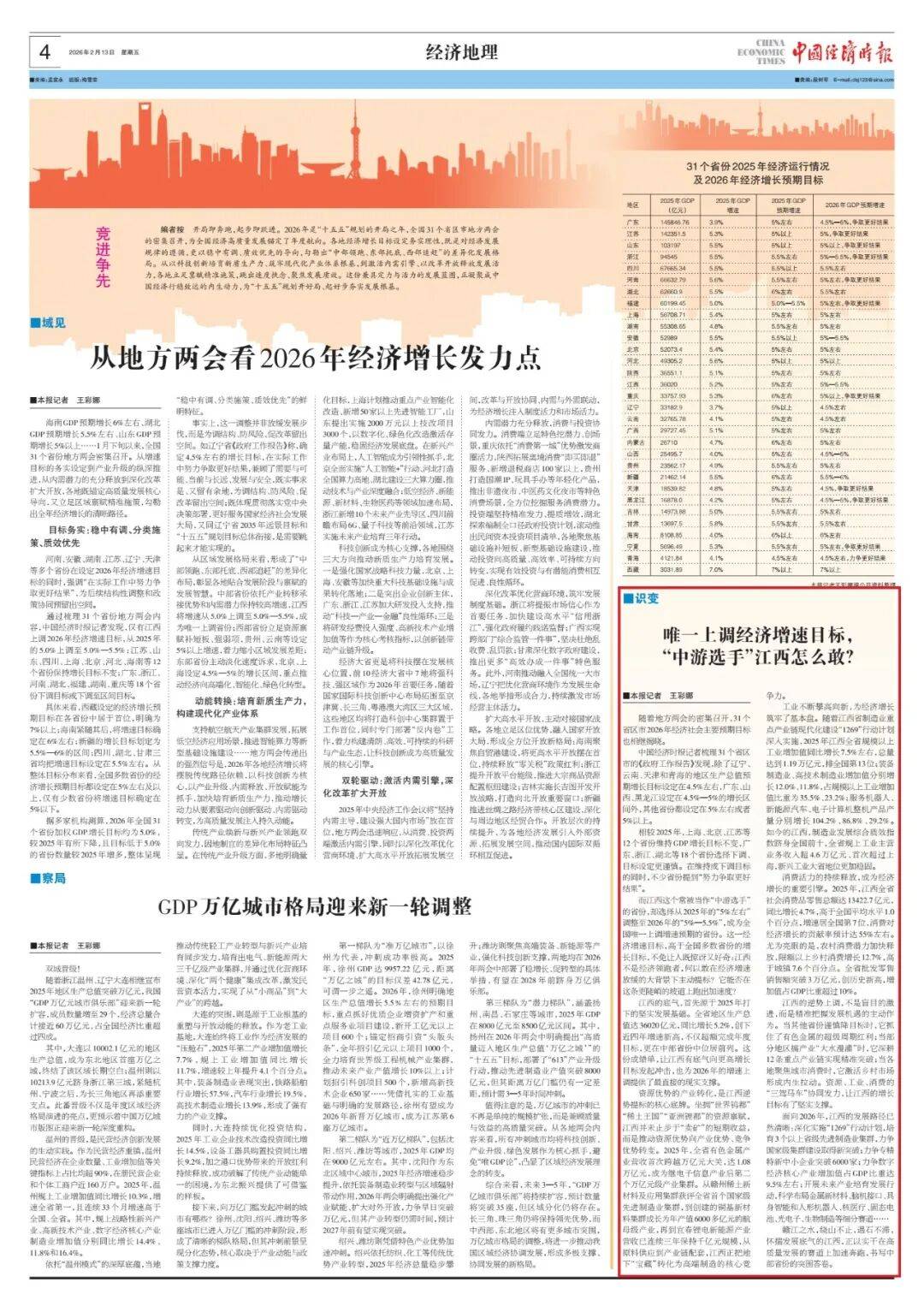
经济地理丨唯一上调经济增速目标, “中游选手”江西怎么敢?
Sou Hu Cai Jing· 2026-02-13 09:50
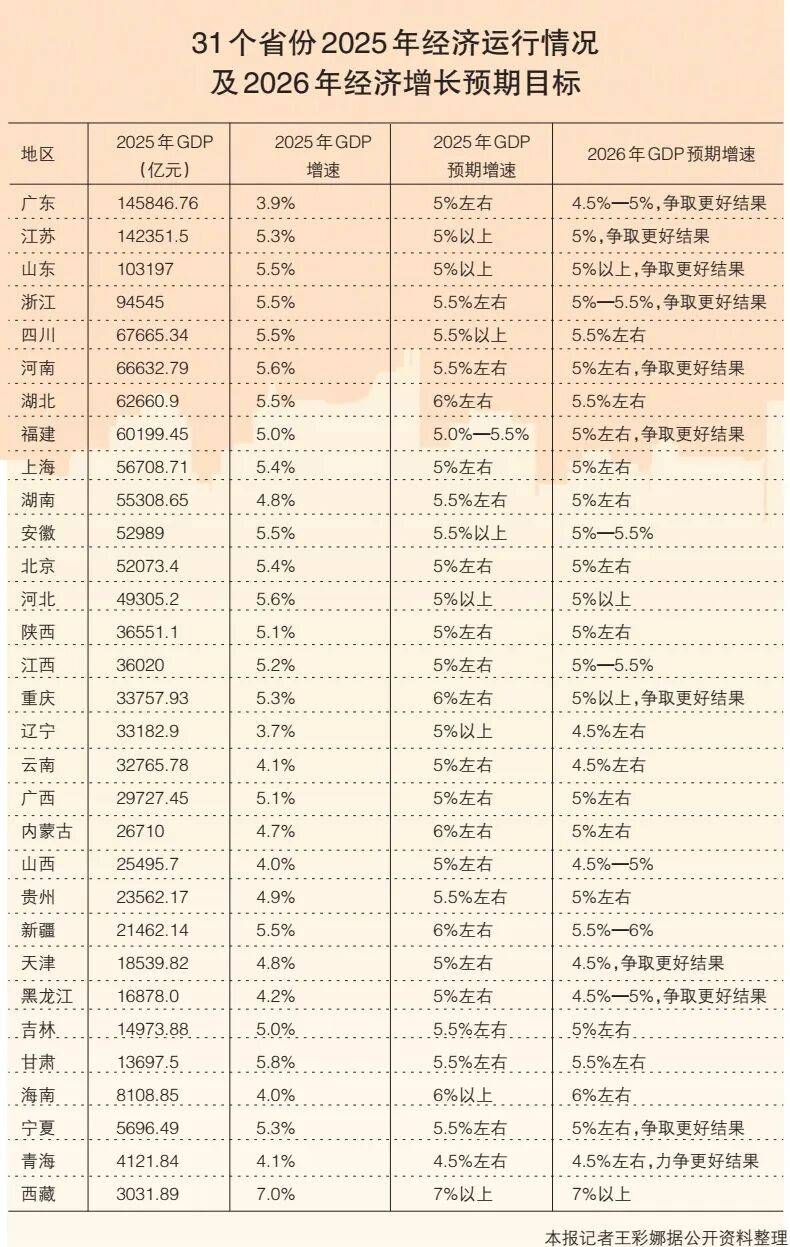
Core Viewpoint - The 2026 economic growth targets set by various provinces in China reflect a pragmatic approach, focusing on quality and efficiency rather than just speed, with a differentiated development strategy across regions [1][2][5]. Economic Growth Targets - Most provinces set their GDP growth targets around 5% or higher, with only a few like Liaoning, Yunnan, Tianjin, and Qinghai targeting around 4.5% [2][21]. - Jiangxi is the only province to raise its growth target from 5% to a range of 5% to 5.5%, indicating confidence in its economic potential despite a general trend of cautious target-setting among other provinces [2][5][21]. Economic Performance and Foundations - Jiangxi's GDP reached 36,020 billion yuan in 2025, growing by 5.2%, marking the highest growth rate in four years and exceeding its annual target [2][3][5]. - The province's robust performance in 2025 provides a solid foundation for its ambitious growth target for 2026 [2][5]. Resource and Industrial Transformation - Jiangxi is leveraging its rich natural resources, such as tungsten and rare earths, to transition from raw material sales to high-end manufacturing, with its non-ferrous metals industry revenue surpassing 1 trillion yuan for the first time in 2025 [3][13]. - The province has developed significant industrial clusters, including advanced manufacturing in rare earth materials and lithium battery production, contributing to its competitive edge [3][4][13]. Manufacturing and Industrial Growth - In 2025, Jiangxi's industrial output value increased by approximately 7.5%, reaching 11.9 trillion yuan, ranking 13th nationally [4][13]. - The province's high-tech manufacturing and equipment manufacturing sectors saw substantial growth, with increases of 12% and 11.8% respectively [4][13]. Consumer Market Dynamics - Jiangxi's retail sales reached 13,422.7 billion yuan in 2025, growing by 4.7%, which is above the national average, with rural consumption growing significantly [4][5][13]. - The contribution of consumption to economic growth is estimated to be around 55%, highlighting the importance of consumer spending in driving the economy [4][5]. Strategic Development Path - Jiangxi plans to implement the "1269" action plan, aiming to cultivate over three provincial-level advanced manufacturing clusters and increase the proportion of digital economy core industries to about 9.5% of GDP [5][14]. - The province is focusing on future industries such as new materials, brain-computer interfaces, and humanoid robots, indicating a strategic shift towards innovation-driven growth [5][14].

经济地理丨从地方两会看2026年经济增长发力点
Sou Hu Cai Jing· 2026-02-13 07:49
Core Viewpoint - The 2026 economic growth targets set by various provinces in China reflect a pragmatic approach, emphasizing quality over speed, with a focus on differentiated regional development strategies [1][2][3]. Group 1: Economic Growth Targets - Provinces such as Hainan and Hubei set GDP growth targets of around 6% and 5.5% respectively, while many others aim for approximately 5% [2][6]. - Only Jiangxi raised its growth target for 2026 from 5.0% to a range of 5.0%-5.5%, while 18 provinces lowered their targets or set them within a lower range [3][4]. - The overall weighted GDP growth target for all provinces is approximately 5.0%, indicating a decrease compared to 2025, with more provinces setting targets below 5% [6]. Group 2: Regional Development Strategies - A differentiated development pattern is emerging, characterized by "central regions leading, eastern regions supporting, and western regions catching up" [7]. - Central provinces are leveraging industrial transfer and domestic demand to maintain higher growth rates, while eastern provinces are focusing on high-end, intelligent, and green transformations [7]. Group 3: Innovation and Industrial Upgrading - The emphasis is on technological innovation as a core driver for economic growth, with local governments prioritizing the development of new productive forces and modern industrial systems [8][9]. - Traditional industries are being upgraded alongside the emergence of new industries, with specific targets set for technological improvements and digital transformation [8]. Group 4: Domestic Demand and Reform - The focus is on activating domestic demand through consumption and investment, with local governments implementing measures to enhance the business environment and expand high-level openness [10][11]. - Initiatives include enhancing consumer experiences and optimizing investment strategies to ensure effective and sustainable growth [10][11].
广西财政将聚力培育发展以人工智能为引领的新质生产力
Xin Lang Cai Jing· 2026-02-13 07:02
(来源:科创中国) 2月9日,广西财政工作会议在南宁召开。会议总结"十四五"特别是2025年财政工作,分析研判财政经济 形势、谋划"十五五"财政工作,部署2026年财政工作。广西壮族自治区财政厅党组书记、厅长李春阳作 工作报告。 会议强调,2026年,广西各级财政部门要坚持稳中求进工作总基调,紧紧围绕铸牢中华民族共同体意识 的主线和高质量发展的首要任务,完整准确全面贯彻新发展理念,着力落实更加积极的财政政策,提高 政策精准度和有效性,做优增量、盘活存量,着力扩内需、优结构、增动能、惠民生,支持"人工智能 +"赋能千行百业,着力加强财政科学管理,持续加强财源建设,坚持党政机关习惯过紧日子,优化财 政支出结构,着力兜牢基层"三保"底线,防范化解政府债务风险,以财政可持续发展推动经济实现质的 有效提升和量的合理增长,为实现全区"十五五"良好开局提供有力保障。 会议要求,2026年财政工作要围绕更好服务广西发展大局,保障重大决策部署落实落细。一是聚力培育 发展以人工智能为引领的新质生产力。加强财税政策供给,发展壮大智能经济,提升科技创新能力,加 快推动科技成果转化。二是聚力构建以制造业十大产业为支柱的现代化产业体系。 ...
未来产业是“将来时”也是“进行时”
Ren Min Wang· 2026-02-13 02:48
Group 1 - The core viewpoint emphasizes the importance of forward-looking layout and development of future industries, including quantum technology, biomanufacturing, hydrogen energy, nuclear fusion energy, brain-computer interfaces, embodied intelligence, and sixth-generation mobile communication as new economic growth points [1][2] Group 2 - Future industries are crucial for seizing technological and industrial high ground, which is significant for maintaining development initiative and reshaping competitive landscape [2] - They represent a new quality of productive forces and are essential for building a modern industrial system, linking technological innovation with both emerging and traditional industries [2] - The development of future industries aims to enhance the quality of life for people and promote comprehensive social progress, focusing on talent cultivation and meeting the aspirations of the populace [2]
“根在辽宁”全球辽宁人新春回乡联谊活动在沈阳举办
Xin Lang Cai Jing· 2026-02-12 14:22
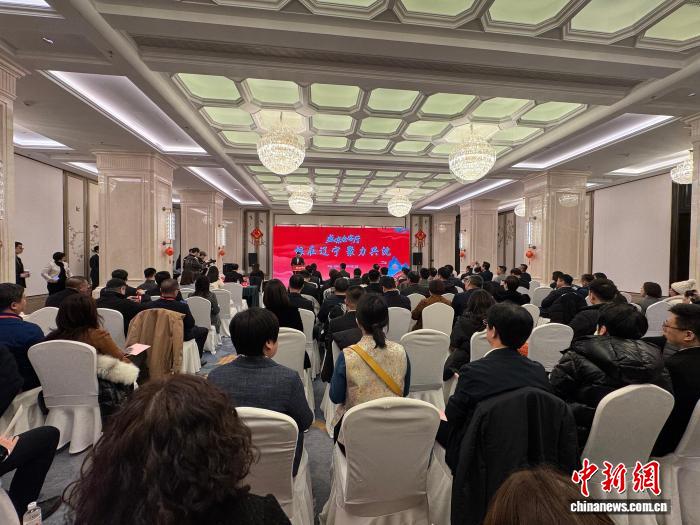
Group 1 - The event "Roots in Liaoning" gathered around 200 Liaoning natives from 38 countries and regions, focusing on themes of connection, return, and win-win cooperation [1][2] - Liaoning aims to leverage its rich industrial foundation, abundant scientific and educational resources, and unique open regional position to enhance its development, with a focus on cultivating new productive forces and optimizing the business environment by 2026 [2] - The event featured a themed exhibition showcasing local delicacies and geographical signature products, highlighting the development potential of Liaoning's characteristic industries [2] Group 2 - The event serves as a new starting point for consolidating global Liaoning resources, with plans to establish a regular communication mechanism and an online-offline contact platform to facilitate cooperation and project tracking [4] - Liaoning is committed to creating the best business environment to instill confidence in global Liaoning natives for returning to develop their hometown, ensuring that every Liaoning person becomes a participant, builder, and beneficiary of local revitalization [4]
天津市副市长谢元:深入推进港产城融合发展,加快天津现代海洋城市建设
Xin Lang Cai Jing· 2026-02-12 03:41
天津市副市长谢元表示,下一步,我们将聚焦滨海新区产业优势,强化产业承载主体功能,向创新协同 与区域带动延伸,深度融入"六链五群"产业布局,推动技术联合攻关、科技资源开放共享、应用场景联 建联用,合力建设世界级先进制造业集群,推动先进制造业与现代服务业深度融合,打造以实体经济为 支撑的现代化产业体系。聚焦世界一流的智慧、绿色、枢纽港口建设,以天津港为龙头,全方位深化津 冀港口联盟合作,强化北方国际航运核心区功能,打造便捷出海口。深入推进港产城融合发展,加快天 津现代海洋城市建设。聚焦全面深化改革开放,充分总结现有综合配套改革经验,创新推出一批首创 性、制度性、系统性改革举措,重点推进协同发展体制机制改革,为首都都市圈发展作出更多探索。充 分发挥国家级新区体制机制、产业基础等方面的优势,释放国家级开发区潜能,实施自贸试验区提升战 略,提升滨海新区创新引领力、产业支撑力和开放竞争力。 ...
省制造强省建设领导小组(扩大)会议暨补短板技术攻关工作推进会议召开 刘小涛出席并讲话 徐曙海在镇收听收看会议
Zhen Jiang Ri Bao· 2026-02-11 23:26
副省长沈剑荣主持会议。省政府秘书长赵建军,省有关部门和单位负责同志,制造业企业代表在主 会场参加会议。 副市长尹卫民,市政府秘书长戴卫东在镇江分会场参会。(王拓 李嘉豪 陈志奎) 2月10日下午,省制造强省建设领导小组(扩大)会议暨补短板技术攻关工作推进会议召开,深入 学习贯彻习近平总书记关于制造强国的重要论述和对江苏工作重要讲话精神,全面落实省委十四届十次 全会、省委经济工作会议和省两会部署要求,坚持智能化、绿色化、融合化方向,因地制宜加快发展新 质生产力,着力构建以先进制造业为骨干的现代化产业体系,突出抓好"增强补育"和人工智能赋能,促 进江苏制造迈向全球产业链价值链中高端。省长、省制造强省建设领导小组组长刘小涛出席会议并讲 话。市长徐曙海在镇江分会场收听收看会议。 会议强调,要强化产业体系整体跃升,实施新一轮重点产业链高质量发展行动,推动传统产业焕新 升级,壮大新兴支柱产业,加快培育未来产业,打造世界级先进制造业集群,促进先进制造业与生产性 服务业多领域深度耦合,构筑产业发展先导优势、特色优势和综合竞争优势。要强化补短板技术攻关, 科学论证、动态更新短板清单,布局建设省级制造业创新中心,揭榜挂帅、高效协 ...
范波吴庆文会见中国农业银行行长王志恒一行
Su Zhou Ri Bao· 2026-02-11 22:48
范波、吴庆文代表市委、市政府对中国农业银行给予苏州发展的关心支持表示感谢。范波说,当前 苏州正深入学习贯彻党的二十届四中全会精神和习近平总书记对江苏、苏州工作重要讲话重要指示精 神,牢牢把握"高科技创新和高质量发展""历史文化传承"两个重点,加快打造国际化现代化人民城市。 这离不开金融活水的精准浇灌。希望中国农业银行进一步发挥自身优势,围绕服务国家战略、推动科技 创新、构建现代化产业体系、促进城乡融合发展、推进乡村全面振兴等方面,深化与苏州的战略合作, 落地更多创新业务和金融资源,以高水平金融助推高质量发展。苏州将深入开展服务企业、服务项目、 服务园区和基层"三服务"专项行动,持续优化一流营商环境,支持中国农业银行各项业务发展。 王志恒对苏州给予中国农业银行的大力支持表示感谢。他说,苏州文化底蕴深厚、产业基础坚实、 创新活力充沛,近年来高质量发展蹄疾步稳,为各类金融机构展业兴业提供了广阔机遇。中国农业银行 将积极承担国有大行责任,聚焦主责主业,围绕苏州所需,竭尽自身所能,扎实做好金融"五篇大文 章",为苏州服务江苏挑大梁提供坚实金融支撑。 2月11日,市委书记范波、市长吴庆文会见了中国农业银行党委副书记、行长 ...
