网联化

Search documents
引领行业发展,2025中国摩博会火热开幕
Qi Lu Wan Bao· 2025-09-20 04:33
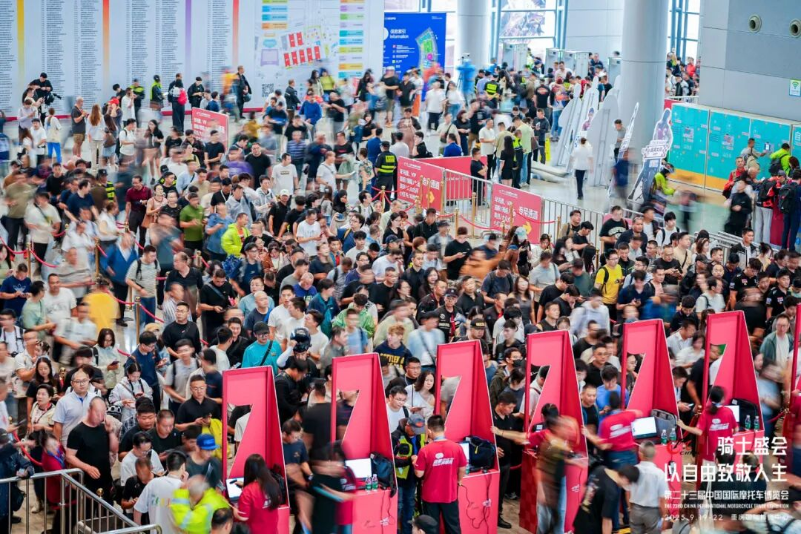
Group 1 - The China Motorcycle Expo has reached a record high with 950 participating companies, showcasing the growing appeal of the event [5][3] - The expo covers a total exhibition area of 160,000 square meters, focusing on the themes of electrification, intelligence, and connectivity [3][31] - The event features over 3,000 models on display, including motorcycles, parts, riding gear, and related services [5][9] Group 2 - The expo serves as a significant platform for international trade, with over 30 countries represented and nearly 20 international purchasing groups attending [7][31] - A total of 27 new product launch events are scheduled, with over 50 new models being unveiled [9][10] - The event highlights the latest innovations in the motorcycle industry, including advanced technologies such as E-Clutch 2.0 and new battery technologies [12][28] Group 3 - The expo includes various interactive experiences, such as test rides and a special e-commerce exhibition focused on cross-border trade [7][26] - The event also features cultural activities, including motorcycle competitions and a dedicated motorcycle town showcasing rare modified bikes [35][37] - The organizers have implemented measures to enhance visitor experience, including additional rest areas and clear exhibition guides [38]

武汉国际车展首日多款新车亮相
Chang Jiang Ri Bao· 2025-09-18 00:24
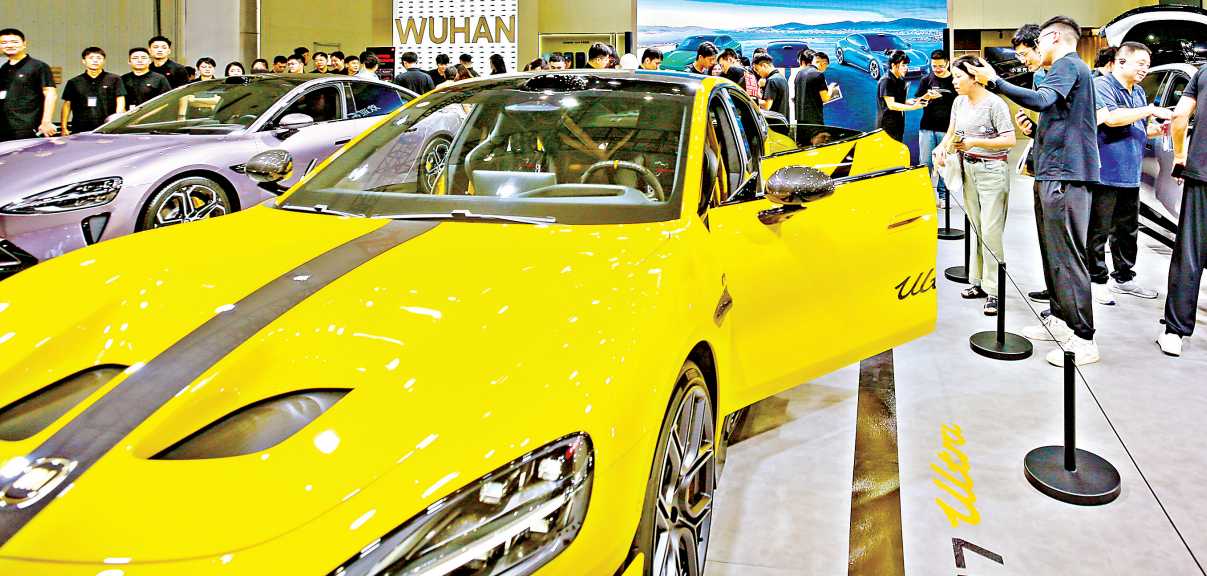
Group 1 - The 25th Wuhan International Auto Show opened on September 17, featuring a theme of "Smart Connected New World, Driving Fun New Life" with an exhibition area of 140,000 square meters and over a hundred brands participating [1] - Major automotive brands such as BYD, Dongfeng Nissan, and Xiaomi showcased new models, highlighting advancements in electrification, intelligence, connectivity, and sharing within the automotive industry [1] - Xiaomi's SU7 Ultra Nürburgring Limited Edition made its debut in Central China at the auto show, marking Xiaomi's first appearance at the event [1][3] Group 2 - The event featured a humanoid robot named "Photon," which won the group dance championship at the 2025 World Humanoid Robot Games, performing alongside a four-legged robot dog [2] - Various automotive cultural activities were organized, including a youth automotive design competition and multiple interactive events such as driving experiences and automotive stunt shows [4] - The show also hosted several important conferences, including the 2025 11th China (Wuhan) International New Energy and Intelligent Connected Vehicle Development and Cooperation Summit, focusing on the dual paths of intelligent automotive technology and international development [4]


汽车行业周报(25年第33周):斯拉机器人催化不断,带动汽车板块估值重塑-20250917
Guoxin Securities· 2025-09-17 15:24
Investment Rating - The automotive industry is rated as "Outperform" [1][4][5] Core Views - The report emphasizes the ongoing transformation in the automotive sector driven by electric and intelligent trends, highlighting opportunities in incremental components and the rise of domestic brands [3][13][24] - The report anticipates a strong new product cycle for companies like Huawei and Xiaomi in the automotive industry, particularly in the context of their entry into the market [3][24] Monthly Production and Sales Data - In August 2025, automotive production and sales reached 2.815 million and 2.857 million units, respectively, with month-on-month increases of 8.7% and 10.1%, and year-on-year increases of 13% and 16.4% [1][22] - For the week of September 1-7, 2025, retail sales of passenger cars were 304,000 units, a year-on-year decrease of 10% [2][23] Weekly Market Performance - During the week of September 8-12, 2025, the CS automotive index rose by 0.21%, while the CS passenger vehicle index fell by 0.37% [2][4] - The CS automotive sector has underperformed compared to the CSI 300 index by 1.72 percentage points year-to-date, with a total increase of 23.76% [2][4] Key Companies and Investment Recommendations - Recommended companies include: - Leap Motor, Geely, and JAC Motors for strong new product cycles [4][5] - Companies in the intelligent sector such as Coboda, Huayang Group, and Junsheng Electronics [4][5] - Robotics companies like Top Group and Sanhua Intelligent Control [4][5] - Domestic replacement companies including Xingyu, Fuyao Glass, and Jifeng [4][5] Profit Forecasts and Valuations - Profit forecasts for key companies indicate a positive outlook, with Leap Motor expected to have an EPS of 0.62 in 2025 and a PE ratio of 98 [5][12] - Geely is projected to have an EPS of 1.57 in 2025 with a PE ratio of 12, while JAC Motors is expected to have a significantly higher PE ratio of 495 due to lower earnings [5][12] Industry Trends and Future Outlook - The report highlights the transition of the automotive industry from growth to maturity, with a projected annual compound growth rate of 2% over the next 20 years [14][22] - The penetration rate of new energy vehicles is expected to continue rising, with sales projected to exceed 1.55 million units in 2025, reflecting a year-on-year growth of over 25% [25][29]





1至8月成都经开区整车产量54.49万辆 同比增长26.24%
Xin Hua Cai Jing· 2025-09-17 14:23
Core Insights - Chengdu Economic and Technological Development Zone signed major projects related to the automotive industry with a total investment of 13.35 billion yuan [1] - From January to August this year, the total vehicle production in Chengdu Economic Zone reached 544,900 units, representing a year-on-year increase of 26.24% [1] - The production of new energy vehicles surged to 149,300 units, marking a significant year-on-year growth of 301% [1] Investment Projects - The signing event included 17 major projects spanning manufacturing and related service industries, focusing on areas such as new energy vehicle batteries, intelligent cockpits, vehicle chassis, and autonomous driving [1] - Notable projects include: - Fusheng New Energy's commercial vehicle operation platform with an investment of 3.2 billion yuan, aimed at creating a data-driven rental operation platform for new energy commercial vehicles [1] - Jiuxin Technology's lithium-ion capacitor R&D and production base with an investment of 1.5 billion yuan, integrating R&D, production, and sales of high-power pulse capacitors and other technologies [1] Industry Development - Chengdu Economic Zone is positioning itself as a national industrial park and a key area for industrial development in Chengdu, focusing on strengthening the automotive industry [2] - The zone has attracted major automotive manufacturers such as FAW-Volkswagen and FAW-Toyota, along with over 800 supporting automotive parts companies, creating a comprehensive automotive industry chain [2] - The development strategy emphasizes stabilizing oil supply, enhancing electric vehicle production, and balancing the integration of various industry segments [2]
2024年中国摩托车产业:出口创新高,多元趋势下重塑发展新格局
Sou Hu Cai Jing· 2025-09-07 20:25
Core Insights - The Chinese motorcycle industry achieved significant growth in 2024, with total exports reaching 14.49 million units, a year-on-year increase of 27.01%, marking a historical peak [1] - Domestic production and sales exceeded 19.9 million units, reversing the decline seen in 2023 and demonstrating strong recovery momentum [1] Industry Development - The industry is undergoing a notable transformation, focusing on electrification, intelligence, connectivity, and leisure as core development directions [2] - The market share of electric motorcycles surpassed 30%, while sales of leisure and entertainment models grew by over 40% year-on-year [2] - The supply chain advantages are becoming a core competitive strength, with Chinese companies leading in manufacturing scale and cost control in the small-displacement fuel motorcycle sector [2] - Key indicators in the new energy technology field, such as battery energy density and charging efficiency, have reached internationally advanced levels [2] Market Trends - The overall development of the motorcycle industry in 2024 shows a steady increase in market size, with regional differentiation and electrification driving growth [5] - The industry is characterized by deep adjustments in electrification and an explosion in the high-end leisure market [5] - There is a deep integration of intelligence and new energy technologies, along with intensified head consolidation and cross-industry impacts [5] - Supply chain and consumer scenarios are being restructured, with policies being relaxed and standardized simultaneously [5] Global Competition - In response to intensified international market competition, industry strategies are diversifying, with leading companies deepening global layouts through overseas factories and technology collaborations [7] - Increased R&D investment has led to breakthroughs in frontier areas such as hydrogen fuel motorcycles and solid-state batteries [7] - Supply chain risk management mechanisms are being continuously improved, with extended key raw material reserve cycles and significant progress in diversified procurement channels [7]
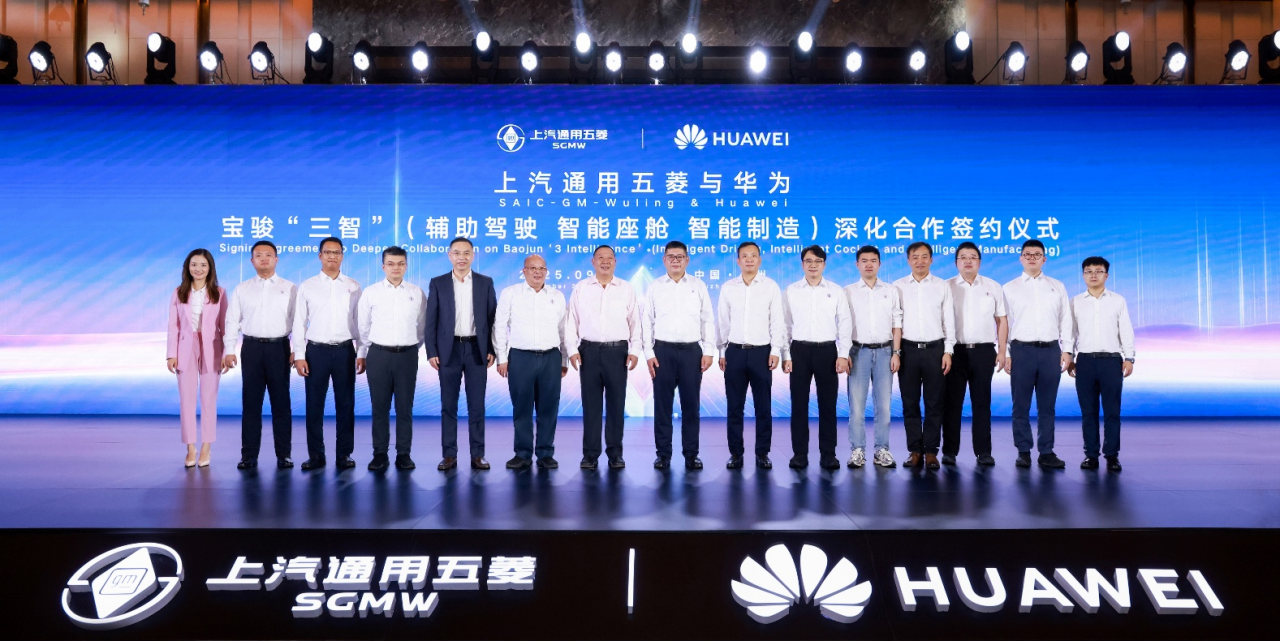
上汽通用五菱官宣与华为深化合作 双方共研成果将率先应用于宝骏华境S
Mei Ri Jing Ji Xin Wen· 2025-09-07 09:07
Core Insights - SAIC-GM-Wuling announced a comprehensive upgrade of its strategic partnership with Huawei, focusing on advanced driving assistance, intelligent cockpit, and smart manufacturing [1][3] - The technological outcomes of this collaboration will first be applied to the new flagship six-seat SUV, Baojun Huajing S, which will feature Huawei's advanced driving system and intelligent cockpit solutions [3] - The partnership aims to enhance product competitiveness by integrating Huawei's smart solutions with SAIC-GM-Wuling's proprietary technologies [3] Group 1 - The collaboration will leverage Huawei's intelligent solutions alongside SAIC-GM-Wuling's self-developed technologies, such as Lingmou driving assistance and Lingyu cockpit [3] - The focus on the "three smart" areas is expected to drive the intelligent and connected development of the automotive industry [3] - The partnership is seen as a way for SAIC-GM-Wuling to move beyond its "low-price" label and enhance brand value and per-vehicle profit [3] Group 2 - The collaboration may serve as a strategic test for Huawei to validate whether technology integration can drive sales [3]
比亚迪上半年营收3713亿元,研发投入超净利润一倍
Zhong Guo Jing Ji Wang· 2025-09-01 08:04
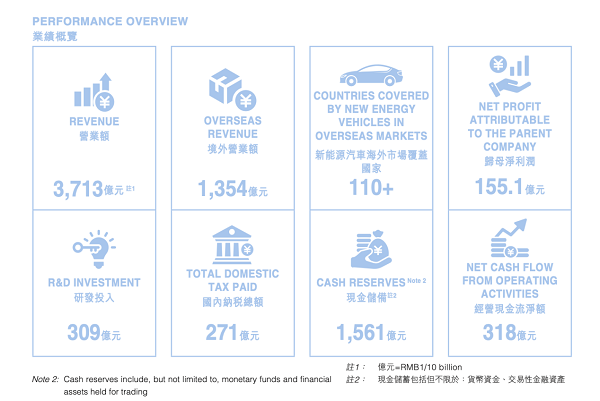
Core Viewpoint - BYD has demonstrated strong resilience in a complex automotive market, achieving impressive growth across key financial metrics in the first half of 2025 [1] Financial Performance - In the first half of 2025, BYD reported revenue of 371.3 billion yuan, a year-on-year increase of 23% [1] - The net profit attributable to shareholders reached 15.5 billion yuan, up 14% year-on-year [1] - Research and development (R&D) investment amounted to 30.9 billion yuan, reflecting a significant increase of 53% [1] - Cash reserves stood at 156.1 billion yuan, indicating a strengthening financial position [1] Key Indicators - R&D investment of 30.9 billion yuan and total domestic tax contributions of 27.1 billion yuan both exceeded the net profit by over 10 billion yuan, highlighting BYD's commitment to technology and social responsibility [2] - Global sales reached 2.14 million units in the first half of 2025, marking a 33% increase year-on-year, making BYD the seventh largest automotive company globally [2] - BYD maintained its position as the global leader in electric vehicle sales [2] Overseas Market Performance - In the first seven months of the year, BYD's overseas sales of passenger cars and pickups exceeded 550,000 units, representing a growth of over 130% compared to the previous year [2] - BYD's electric vehicles are now available in over 112 countries and regions, leading sales in several countries including Italy, Turkey, Spain, and Brazil [2] Competitive Landscape - BYD's export volume reached 553,000 units in the first seven months, a year-on-year increase of 130%, positioning it to potentially surpass Chery as the top domestic and overseas market player [3] - The strong performance in overseas markets has enhanced BYD's brand presence globally, showcasing the strength of Chinese automotive manufacturing [3] Technological Advancements - BYD has maintained a strong focus on technology and innovation, launching advanced systems such as the "Heavenly Eye" driver assistance system and the "Super e-platform" for fast charging [6] - The company has become the first globally to offer a comprehensive commitment to smart parking, reflecting its confidence in technological capabilities [6] Future Outlook - With ongoing technological advancements and deeper penetration into overseas markets, BYD is positioned to be a key player in driving the global automotive industry towards greener and smarter solutions [6]
江淮皮卡悍途PHEV/EV全球上市,管理体系持续对标华为
Zhong Guo Jing Ji Wang· 2025-08-30 00:22
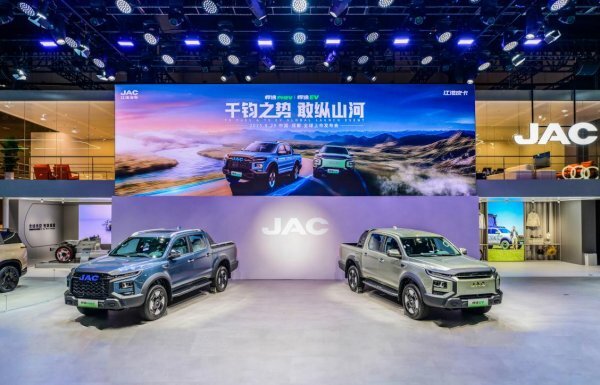
Core Insights - Jianghuai Automobile showcased multiple key models and technological achievements at the 2025 Chengdu Auto Show, including the global launch of the new energy pickup trucks, Hantu PHEV and Hantu EV, with starting prices of 159,800 yuan and 199,800 yuan respectively [1] - The company introduced the user brand "ING+" and initiated four major user programs aimed at creating a co-creation and sharing lifestyle platform, reflecting a shift in consumer trends from utility vehicles to lifestyle companions [1] - Jianghuai's collaboration with Huawei was highlighted, particularly with the launch of the ZunJie S800, which has received over 12,000 pre-orders within 87 days of its release, marking a significant breakthrough in the ultra-luxury smart electric vehicle sector [3][5] Product and Technology Development - The ZunJie S800 features advanced technologies such as the HUAWEI ADS 4 intelligent driving system, Tuling Longxing digital chassis, and an 800V high-voltage architecture, supported by the ZunJie Super Factory, recognized as a national-level intelligent manufacturing benchmark [5][9] - The Hantu PHEV, as the world's first thousand-torque electric hybrid pickup, boasts a maximum torque of 1000 N·m, an electric range of 100 kilometers, and a total range exceeding 1000 kilometers, while the Hantu EV Glory Edition is the first non-bearing pure electric four-wheel drive pickup in China with a CLTC range of over 500 kilometers [7][9] Strategic Partnerships and Investments - Jianghuai Automobile is committed to dual-track strategies of independent innovation and open collaboration, with R&D investment reaching 2.216 billion yuan in the first half of 2025, a year-on-year increase of 34.47%, accounting for 11.44% of revenue [9][10] - The company has expanded its strategic partnership with Huawei, signing a cooperation agreement in June to work on smart automotive solutions, digital transformation, and green low-carbon initiatives, aiming to drive the electric, intelligent, and connected development of the automotive industry [9][10]

中通客车上半年净利润同比增长71.61% 新能源客车出口获关键突破
Zheng Quan Ri Bao Wang· 2025-08-26 13:48
Core Viewpoint - Zhongtong Bus reported significant growth in revenue and net profit for the first half of 2025, driven by favorable market conditions and strategic product transformations [1][2]. Financial Performance - The company's revenue for the first half of 2025 reached 3.941 billion yuan, representing a year-on-year increase of 43.02% [1]. - Net profit attributable to shareholders was 190 million yuan, showing a year-on-year growth of 71.61% [1]. Industry Trends - The overall market size of the bus industry is experiencing growth, particularly in the domestic market, supported by the continuation and enhancement of subsidies for new energy buses and battery updates [1]. - The tourism bus market has entered an adjustment phase after previous growth, with demand shifting towards high-end, customized, and smaller vehicles [1]. - In the overseas market, the demand for buses is increasing due to economic development and public transportation needs, with Chinese bus products becoming more competitive, leading to sustained export growth [1]. Sales and Market Strategy - Zhongtong Bus sold 5,839 buses during the reporting period, marking a year-on-year increase of 2.38% despite pressures in the domestic tourism bus market [1]. - The company is actively promoting product structure transformation and enhancing product performance and after-sales service, achieving growth against market trends [1]. Research and Development - The company invested 125 million yuan in R&D, focusing on new energy, intelligence, connectivity, safety, reliability, economy, and comfort in bus technology [2]. - Notable advancements include the launch of tour buses equipped with AMT automatic transmission, which improved driving comfort and received high customer recognition [2]. - The company is advancing its intelligent driving initiatives, with a 12-meter intelligent driving bus operating regularly in Jinan [2]. Market Expansion - Zhongtong Bus is optimizing its market structure and leveraging resources from Shandong Heavy Industry Group to respond to the "Belt and Road" initiative, achieving breakthroughs in new energy bus exports [2]. - Overseas revenue reached 2.757 billion yuan, a year-on-year increase of 49.94%, accounting for 69.96% of total revenue [2].

率先布局“AI+两轮电动车”,首驱科技获亿元级天使轮融资丨硬氪首发
3 6 Ke· 2025-08-22 01:05
Core Insights - Shouqu Technology has recently secured nearly 100 million yuan in angel round financing, which will primarily be used for the development of an intelligent cockpit platform, application development of the S-Smart system, and mass production of new national standard products, while accelerating global market expansion [1][4] - The company focuses on the short-distance electric transportation sector, aiming to provide innovative and reliable two-wheeled electric mobility solutions, with over 70% of its R&D team having experience in leading international automotive manufacturers and related industries [1][4] - The product lineup includes three main series: new national standard electric self-series, pedal series, and cross-riding series, targeting younger demographics such as post-2000 and post-2005 generations [1][4] Industry Overview - The two-wheeled electric vehicle market in China has surpassed 400 million units in ownership and annual sales exceed 50 million units, with a market size exceeding 100 billion yuan as of December 2024 [4] - The global market is expected to exceed 800 billion yuan by 2027, driven by the replacement of old models due to new national standards and growing demand in Southeast Asia and India [4] - The industry faces challenges including price wars affecting profit margins, insufficient charging infrastructure, and rapid technological advancements requiring higher R&D capabilities from traditional manufacturers [4][6] Competitive Advantages - Shouqu Technology emphasizes a user-centric approach, focusing on social safety, driving safety, and after-sales service experience [6] - The company leverages AI algorithms to enhance product performance, achieving a 10%-15% improvement in battery management and a 5%-10% increase in motor performance [6][5] - The product positioning is mid-to-high-end, with price ranges from 5,000 to over 500,000 yuan, and the company has already begun generating revenue despite being newly established [11][12]