财政贴息

Search documents
如何理解个人消费贷款贴息政策?
Sou Hu Cai Jing· 2025-08-13 05:25
核心观点 年内降息概率下降,需求端政策或使得通胀预期得以延续,对债市形成持续性压制,债市做多窗口或进一步后移。 1. 年内降息概率进一步下降。年内降息概率或在"财政替代货币、结构替代总量、预期管理"三重效应下进一步下降。首先,财政贴息≈定向降息,央行总 量工具必要性下降;其次,结构性政策或抑制"全面降息"空间,更有利于防止资金空转;最后,通胀预期升温,央行降息更加谨慎,年内降息概率进一步 下降。 2. "反内卷"行情下通胀预期被再次强化。在"反内卷"政策持续推进的背景下,通过供给收缩→价格信号→预期自我强化的路径实现,通胀预期被阶段性强 化。虽然市场开始类比2016年的供给侧改革,提前押注再通胀,但仅仅基于供给收缩逻辑的通胀叙事可能延续性不强,需求端政策或为涨价预期提供更好 的支撑,带动"反内卷交易"二次升温。 3. 债市做多窗口或进一步后移。贴息政策通过"财政补位+结构性降息"组合,显著压缩了央行年内货币政策总量宽松空间,年内降息概率进一步下降,考 虑个人贷款贴息政策将持续至2026年8月31日,预计下一次降息窗口将后移至2026年一季度,年内不排除有"防御式降息"可能。需求端政策或使得通胀预 期得以延续, ...

9月起,个人消费贷款可享受财政贴息!
Sou Hu Cai Jing· 2025-08-13 04:25
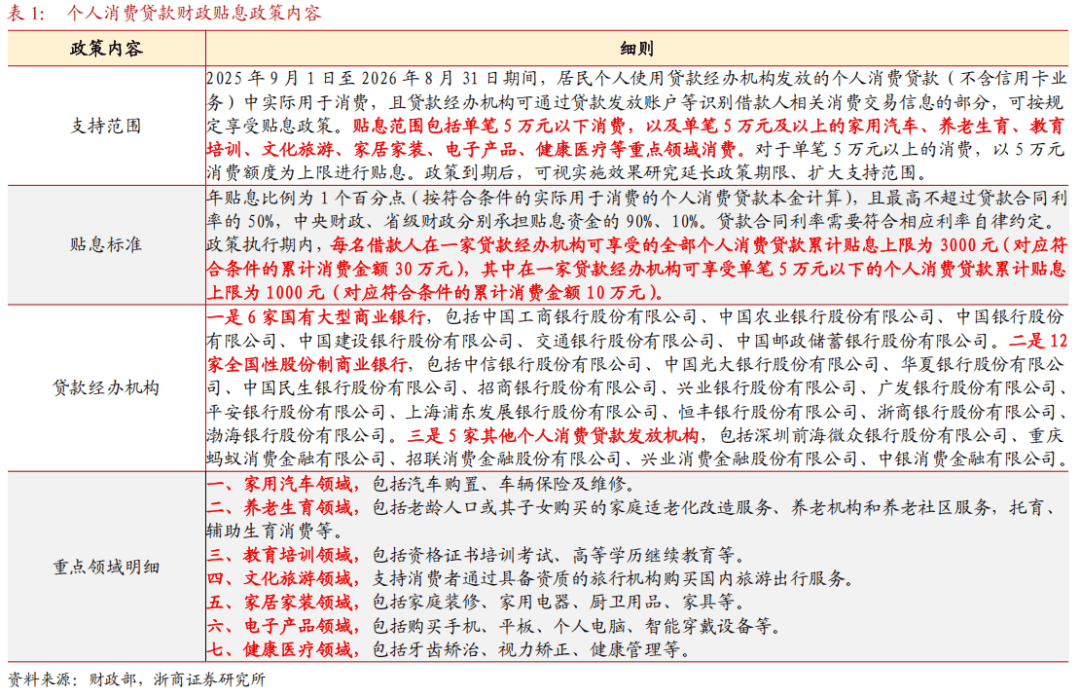
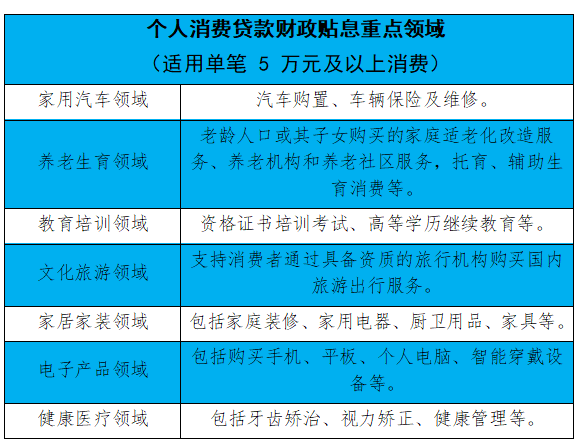
Group 1 - The policy provides interest subsidies for personal consumption loans of 50,000 yuan and above in key areas such as home automotive, elderly care, education, cultural tourism, home decoration, electronic products, and healthcare [1][3]. - The subsidy rate is set at 1% per annum, covering up to 50% of the loan contract interest rate, with the central and provincial finances bearing 90% and 10% of the subsidy costs respectively [4]. - Each borrower can receive a maximum subsidy of 3,000 yuan for total personal consumption loans of up to 300,000 yuan, with a specific cap of 1,000 yuan for loans below 50,000 yuan [4]. Group 2 - The policy aims to stimulate consumer spending in various sectors by providing financial support through interest subsidies [3]. - The implementation of the policy may be extended or expanded based on its effectiveness after the initial period [3]. - The program includes a wide range of financial institutions, including six major state-owned banks and twelve national joint-stock commercial banks, as well as other consumer loan providers [4].



促消费、惠民生 符合条件的个人消费贷款将可享财政贴息
Yang Shi Wang· 2025-08-13 03:37
Group 1 - The Ministry of Finance and other departments have released two financial subsidy policy implementation plans aimed at personal consumption loans and service industry operating entities, providing a one-year subsidy for related loans [1] - The personal consumption loan subsidy policy specifies that from September 1, 2025, to August 31, 2026, residents can enjoy a subsidy for personal consumption loans used for specific categories, with a maximum subsidy limit of 3,000 yuan per borrower [3] - The subsidy covers consumption loans under 50,000 yuan and those above for key areas such as home appliances, education, and healthcare, with a subsidy rate of 1% per year, not exceeding 50% of the loan contract interest rate [3] Group 2 - The service industry subsidy policy targets eight sectors including catering, health, and tourism, allowing eligible loans to receive a subsidy for up to 100,000 yuan per entity, with a similar 1% annual subsidy rate [4] - Experts believe these subsidy policies will stimulate consumer spending and improve living standards by reducing the cost of consumer credit and supporting service providers in enhancing infrastructure and service capabilities [4] - The implementation of these policies reflects a shift in fiscal policy towards a focus on improving people's livelihoods and integrating fiscal and monetary policies to stimulate personal consumption [4]
贴息政策协同发力,提振零售信贷修复斜率
GUOTAI HAITONG SECURITIES· 2025-08-13 03:32
Investment Rating - The report assigns an "Overweight" rating for the industry [1] Core Insights - The implementation of personal consumption loan interest subsidy policies and service industry operating entity loan interest subsidy policies is expected to stimulate consumption potential and enhance market vitality by reducing financing costs [4] - The report highlights the collaboration of two subsidy policies with other measures in the "Consumption Promotion Special Action Plan," aiming to boost consumption from both demand and supply sides [5] - The fiscal subsidies are projected to lower the financing costs for entities, benefiting retail small and micro loan demand and alleviating credit risks to some extent [5] Summary by Sections Policy Implementation - The Ministry of Finance and other departments have issued specific implementation plans for the subsidy policies, which will be effective from March 16, 2025, to December 31, 2025, for service industry loans, and from September 1, 2025, to August 31, 2026, for personal consumption loans [5] - The subsidy for service industry loans will cover 90% of the interest from central and provincial finances, with a maximum subsidy of 10,000 yuan per entity [5] - For personal consumption loans, the annual subsidy rate is set at 1 percentage point, with a maximum limit of 3,000 yuan for individuals [5] Investment Recommendations - The report suggests that state-owned and joint-stock banks will directly benefit from the policies, enhancing their competitiveness in retail products [5] - It recommends focusing on high-quality regional city commercial banks such as Hangzhou Bank, Chengdu Bank, and others, as well as joint-stock banks with recovery potential and attractive dividend yields like China Merchants Bank and Industrial Bank [5] - The report anticipates a trend of increased capital allocation in the sector, although short-term fluctuations are expected [5] Earnings Forecasts and Valuation Levels - The report provides earnings per share (EPS) and book value per share (BVPS) forecasts for various banks, indicating a generally positive outlook for the sector [6] - Specific banks such as China Merchants Bank and Ping An Bank are highlighted with their respective EPS and valuation metrics, all rated as "Overweight" [6]



A股盘前市场要闻速递(2025-08-13)
Jin Shi Shu Ju· 2025-08-13 02:47
Group 1: Government Policies - The Ministry of Finance and eight other departments announced that service industry operators can enjoy interest subsidies on loans up to 1 million yuan, with a subsidy rate of 1% for a maximum of one year [1] - The Ministry of Finance, the People's Bank of China, and the Financial Regulatory Bureau issued a plan for fiscal interest subsidies on personal consumption loans, covering various categories including household vehicles and education [1] - The Ministry of Finance and the State Taxation Administration clarified that income from express delivery services will be subject to VAT as "collection and delivery services" [1] Group 2: Industry Developments - A closed-door meeting of key dry-process lithium battery separator manufacturers reached several agreements to address issues like price competition and overcapacity, emphasizing price discipline and industry cooperation [2] - The Ministry of Commerce announced a preliminary ruling on anti-dumping investigations into imported canola seeds from Canada, confirming that dumping has caused substantial harm to the domestic canola industry [3] Group 3: Company News - Guizhou Moutai reported a net profit of 45.403 billion yuan for the first half of 2025, an increase of 8.89% year-on-year, with revenue rising by 9.10% to 89.389 billion yuan [3] - Cambrian Technology refuted rumors regarding large orders and revenue forecasts, urging investors to rely on official announcements [4] - Shangwei New Materials disclosed that its major shareholder reduced its stake to 5% by selling 1.5844 million shares [5] - China Shipbuilding announced a buyback price of 30.02 yuan per share for dissenting shareholders, with the stock closing at 38.50 yuan, indicating a premium of 28.25% [6] - Hengxin Oriental is under investigation by the China Securities Regulatory Commission for alleged information disclosure violations [7] - Quzhou Development plans to acquire 95.46% of Xian Dao Electric Science and Technology, with the stock set to resume trading [8] - ST Shengtun will change its stock name to Shengtun Mining and remove risk warnings, allowing for a 10% trading limit [9] - Grand Microelectronics acquired 100% of LUCEDA NV to expand into silicon photonics technology [10] - Sifang Precision plans to reduce its stake by up to 2.25% due to shareholder funding needs [11] - Shaanxi Huada intends to purchase 100% of Huajing Microelectronics through a share issuance [12] - Hailanxin plans to acquire 100% of Hailan Huanyu for 1.051 billion yuan, constituting a major asset restructuring [12] - Ganfeng Lithium is collaborating with LAR to develop a lithium product production line with an annual capacity of 150,000 tons [13] - Yuhua Tian clarified that a minor stake acquisition by Zhiyuan Innovation does not significantly impact its operations [14]





工商银行:正在依法依规、积极有序推进财政贴息工作
Ge Long Hui· 2025-08-13 01:45
格隆汇8月13日|中国工商银行发布关于个人消费贷款与服务业经营主体贷款贴息工作的公告,为落实 党中央、国务院决策部署,进一步支持提振和扩大消费,激发消费潜力,提升市场活力,降低居民消费 信贷成本,我行依据《关于印发个人消费贷款财政贴息政策实施方案的通知》(财金[2025]80号)和 《关于印发服务业经营主体贷款贴息政策实施方案的通知》(财金[2025]81号)精神和相关要求,正在 依法依规、积极有序推进财政贴息工作。工商银行对办理上述贷款贴息不收取任何服务费用,没有委托 官方渠道以外的任何机构、人员代为办理。 ...
个人消费贷款、服务业经营主体贷款可享财政贴息 年贴息比例为1个百分点
Ren Min Ri Bao· 2025-08-13 00:04
为充分发挥财政政策引导带动作用,推动降低服务业经营主体融资成本,助力激发消费市场活力, 以高质量供给创造有效需求,财政部等九部门近日联合印发《服务业经营主体贷款贴息政策实施方 案》,明确对符合条件的消费领域服务业经营主体贷款给予财政贴息。 根据方案,同时符合以下条件的贷款可享受贴息政策:一是由经办银行向餐饮住宿、健康、养老、 托育、家政、文化娱乐、旅游、体育8类消费领域服务业经营主体发放。二是在《提振消费专项行动方 案》公开发布之日(2025年3月16日)至2025年12月31日期间签订贷款合同且相关贷款资金发放至经营 主体。三是贷款资金合规用于改善消费基础设施和提升服务供给能力。民办非企业法人的养老服务机构 同等享受贷款贴息政策。政策到期后,可根据实施效果研究延长政策期限、扩大支持范围。 对于贴息标准,方案明确,年贴息比例为1个百分点,且最高不超过贷款合同利率的50%,中央财 政、省级财政分别承担贴息资金的90%、10%。贷款合同利率需要符合相应利率自律约定。政策执行期 内,每名借款人在一家贷款经办机构可享受的全部个人消费贷款累计贴息上限为3000元(对应符合条件 的累计消费金额30万元),其中在一家贷款经 ...
个人消费贷款、服务业经营主体贷款可享财政贴息:年贴息比例为一个百分点
Ren Min Ri Bao· 2025-08-12 23:40
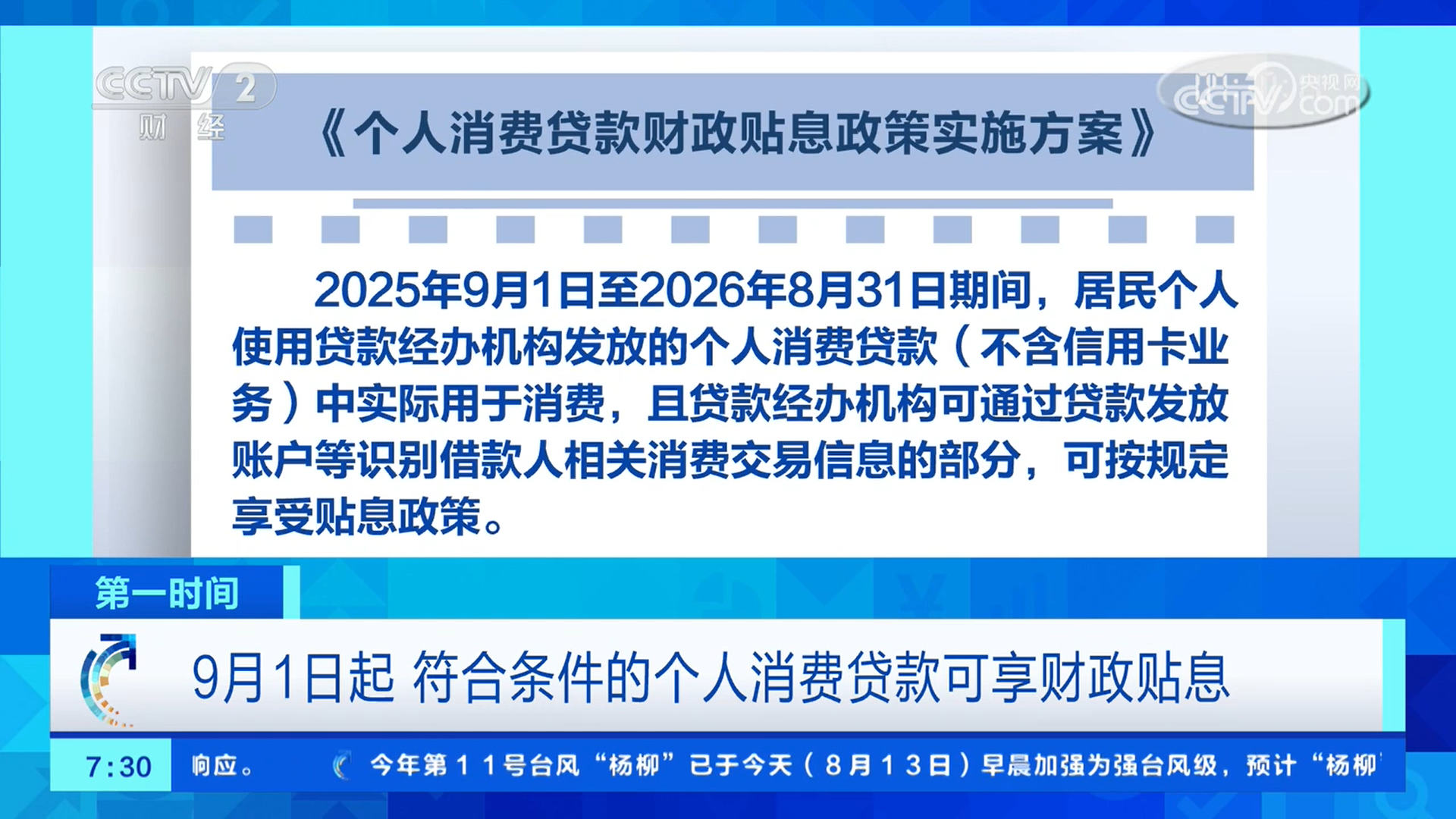
方案要求相关部门强化监督约束,确保贴息资金专款专用。经审核发现存在违法违规行为的,财政部门 将追回相关贴息资金,并依法依规严肃处理。对于贷款经办机构违法违规行为,由相关部门依法依规追 究相应责任。对于借款人违法违规套取贴息资金的情况,由贷款经办机构纳入个人征信记录。 为更好发挥财政资金对提振消费的支持引导作用,降低居民消费信贷成本,助力释放居民消费潜力,财 政部、中国人民银行、金融监管总局近日联合印发《个人消费贷款财政贴息政策实施方案》,明确对个 人消费贷款进行财政贴息。 根据方案,2025年9月1日至2026年8月31日期间,居民个人使用贷款经办机构发放的个人消费贷款(不 含信用卡业务)中实际用于消费,且贷款经办机构可通过贷款发放账户等识别借款人相关消费交易信息 的部分,可按规定享受贴息政策。贴息范围包括单笔5万元以下消费,以及单笔5万元及以上的家用汽 车、养老生育、教育培训、文化旅游、家居家装、电子产品、健康医疗等重点领域消费。对于单笔5万 元以上的消费,以5万元消费额度为上限进行贴息。政策到期后,可视实施效果研究延长政策期限、扩 大支持范围。 对于贴息标准,方案明确,年贴息比例为1个百分点,且最高不超过 ...
服务业经营主体贷个人消费贷可享贴息 银行迅速响应 年贴息比例均为1个百分点,中央财政承担贴息资金的90%
Zheng Quan Shi Bao· 2025-08-12 17:35
通过财政贴息,符合条件的服务业经营主体贷款与个人消费贷款可享受贴息政策——8月12日,《服务 业经营主体贷款贴息政策实施方案》和《个人消费贷款财政贴息政策实施方案》(以下合称"实施方 案")正式公布。两项贷款贴息政策的年贴息比例均为1个百分点,中央财政将承担贴息资金的90%, 以"真金白银"减轻服务业经营主体融资压力、激发居民消费潜力。 田利辉指出,家用汽车、教育医疗等高频消费场景受季节性影响显著,例如"金九银十"往往是汽车销售 旺季。贴息政策延迟至9月启动,不仅为金融机构预留了系统改造和风控准备的时间,也确保政策红利 能够覆盖全年消费高峰,实现"以时间换空间"的政策效果最大化。 个人消费贷款贴息政策执行期内,每名借款人在一家贷款经办机构可享受的全部个人消费贷款累计贴息 上限为3000元,其中在一家贷款经办机构可享受单笔5万元以下的个人消费贷款累计贴息上限为1000 元。 根据实施方案,个人消费贷款贴息范围包括单笔5万元以下消费,以及单笔5万元及以上的家用汽车、养 老生育、教育培训、文化旅游、家居家装、电子产品、健康医疗等重点领域,基本可覆盖普通居民各类 日常生活性消费以及相对支出规模较大的重点领域消费。对于 ...
申请消费贷财政贴息需要哪些操作?财政部,最新回应!
证券时报· 2025-08-12 15:49
Core Viewpoint - The article discusses the implementation of the "Personal Consumption Loan Financial Subsidy Policy" aimed at boosting consumer spending and expanding domestic demand, which is crucial for economic growth and improving people's livelihoods [1][2][3]. Group 1: Background and Importance - Consumption is a key driver of economic growth and is essential for enhancing people's well-being and meeting their growing needs [2]. - The central government has emphasized the importance of boosting consumption in recent economic meetings and reports, highlighting it as a vital measure for economic stability and growth [3]. Group 2: Policy Features - The policy directly benefits individual consumers by reducing the cost of personal consumption loans, contrasting with previous policies that focused on investment and supply [4]. - It addresses actual consumer needs by covering a wide range of daily expenses and significant investments in areas such as automobiles, education, and healthcare [4][6]. - The policy operates under market-oriented and legal principles, ensuring responsible lending practices and preventing misuse of funds [5]. Group 3: Key Policy Details - The subsidy applies to personal consumption loans used for actual consumption, including amounts below and above 50,000 yuan, with a subsidy interest rate set at 1% per annum [6][7]. - The policy is effective for one year, from September 1, 2025, to August 31, 2026, with potential for extension based on its effectiveness [7]. Group 4: Implementation Process - The application and approval process for the subsidy is streamlined to minimize the burden on borrowers, with financial institutions handling most of the administrative tasks [8][9]. - A comprehensive review mechanism is established to ensure that subsidy funds are used appropriately and effectively [10]. Group 5: Organizational Coordination - The Ministry of Finance will coordinate with relevant departments to ensure effective implementation of the policy, including monitoring and compliance checks [11][12].