
险资入市

Search documents
非银金融行业周报:料非银三季报业绩亮眼,关注金融街论坛期间增量政策预期-20251019
Shenwan Hongyuan Securities· 2025-10-19 08:12
Investment Rating - The report maintains a "Positive" outlook on the non-bank financial industry, highlighting the potential for growth and investment opportunities [3]. Core Views - The report emphasizes the strong performance of non-bank financial institutions in Q3 2025, with significant profit increases expected for major players like New China Life and China Pacific Insurance [4][36]. - It notes the anticipated release of new policies during the 2025 Financial Street Forum, which could further support the market [4][15]. - The report identifies three main investment themes: strong comprehensive capabilities of leading institutions, firms with high earnings elasticity, and those with robust international business competitiveness [4]. Summary by Sections Market Review - The Shanghai Composite Index closed at 4,514.23 with a decline of 2.22%, while the non-bank index closed at 1,977.98, down 1.34% [7]. - The brokerage sector saw a decline of 3.13%, while the insurance sector increased by 3.65% [7]. Non-Bank Industry Insights - In September 2025, new deposits from residents reached 2.96 trillion yuan, while non-bank institutions saw a decrease of 1.06 trillion yuan in new deposits [4]. - The report highlights the significant increase in new A-share accounts, indicating continued interest in equity markets [4]. Key Company Announcements - New China Life reported a projected net profit increase of 45% to 65% for Q3 2025, with expectations of a total profit of 299.86 billion to 341.22 billion yuan for the first three quarters [34]. - China Pacific Insurance also anticipates a net profit increase of 40% to 60% for the same period, driven by a stable economic environment and improved investment returns [36]. Investment Recommendations - The report recommends stocks of leading brokerages such as GF Securities, CITIC Securities, and Huatai Securities due to their strong market positions and growth potential [4]. - For insurance companies, it suggests focusing on undervalued stocks with high elasticity, including China Life, New China Life, and China Pacific Insurance [4].



银行股回调过后,险资继续开启买买买模式
Shang Hai Zheng Quan Bao· 2025-10-17 03:49
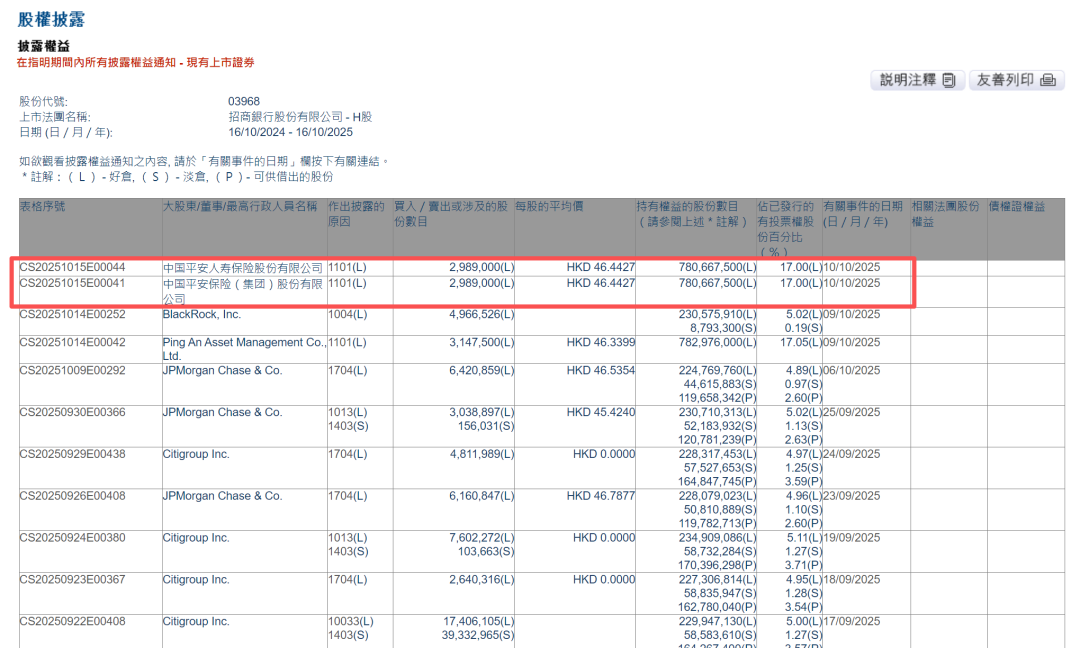
Core Viewpoint - Ping An Insurance and its subsidiary Ping An Life have invested approximately HKD 173 million in H-shares of China Merchants Bank and Postal Savings Bank since October, indicating a strategic move to capitalize on the recent market corrections in the banking sector [1][4]. Group 1: Investment Details - Ping An and its subsidiary Ping An Life have increased their holdings in China Merchants Bank H-shares by approximately 2.99 million shares, investing around HKD 139 million, resulting in a holding ratio of about 17% [3]. - Additionally, they have acquired approximately 6.42 million shares of Postal Savings Bank H-shares, investing around HKD 34.41 million, which brings their holding ratio to approximately 17.01% [3]. Group 2: Market Context - The banking sector has experienced a decline of over 10% since July, with both China Merchants Bank and Postal Savings Bank H-shares seeing significant drops [4]. - The current external uncertainties in the global market have made financial sectors, particularly banks and insurance, preferred defensive assets for investors [4]. Group 3: Future Outlook - The trend of insurance capital increasing equity asset allocation is expected to continue, with banks remaining a focal point due to their high dividend yields [5]. - Research indicates that insurance capital is likely to further increase its holdings in bank stocks, particularly favoring large banks and those with regional advantages [5].




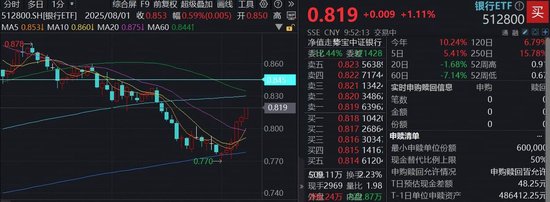
又见险资扫货银行股!银行稳步6连阳,百亿银行ETF(512800)续涨逾1%,近5日“暴力”吸金39亿元!
Xin Lang Ji Jin· 2025-10-16 02:09
Core Viewpoint - The banking sector is experiencing a resurgence, with significant gains in bank stocks and ETFs, indicating a positive market sentiment towards the industry [1][5]. Group 1: Market Performance - As of October 16, the bank sector has shown strength, with the bank ETF (512800) rising over 1% and achieving six consecutive days of gains, with a trading volume exceeding 400 million yuan in less than half a day [1]. - A total of 42 bank stocks in the A-share market mostly showed positive performance, with Shanghai Pudong Development Bank leading with an increase of over 2% [3]. Group 2: Investment Trends - Insurance capital has been actively buying bank stocks this year, driven by a low interest rate environment and policies encouraging long-term funds to enter the market [5]. - The bank ETF (512800) has seen a net inflow of 3.893 billion yuan over the past five days, reaching a new historical high in total assets of 18.496 billion yuan [5][7]. Group 3: ETF Characteristics - The bank ETF (512800) tracks the CSI Bank Index and includes 42 listed banks, making it an efficient investment tool for tracking the overall performance of the banking sector [7]. - The bank ETF remains the largest and most liquid among the 10 bank ETFs in A-shares, with an average daily trading volume exceeding 700 million yuan this year [7].
险资入市驱动投资收益大增!新华保险上涨5.34%,A股保险股全线飘红
Mei Ri Jing Ji Xin Wen· 2025-10-14 09:41
Core Viewpoint - The insurance sector in A-shares has shown strong performance, with New China Life Insurance leading the gains, reflecting a positive market sentiment and potential for valuation and earnings growth in the sector [1][2]. Group 1: Stock Performance - On October 14, the A-share insurance sector rose significantly, with New China Life Insurance's stock price increasing by 5.34% to close at 65.5 yuan per share, resulting in a market capitalization of 204.33 billion yuan [1]. - Other major insurers also saw stock price increases, with China Pacific Insurance up 3.09% and China Life Insurance up 2.07% [1]. - The positive performance in A-shares also influenced Hong Kong-listed insurance stocks, with New China Life Insurance (HK) rising by 2.75% [1]. Group 2: Earnings Forecast - New China Life Insurance projected a net profit increase of 45% to 65% for the first three quarters of 2025, estimating a profit range of 29.986 billion to 34.122 billion yuan [2]. - The company expects its net profit excluding non-recurring items to grow by 40% to 60%, with an estimated range of 28.998 billion to 33.141 billion yuan [2]. - The growth is attributed to a focus on enhancing the value and quality of insurance business, optimizing asset allocation, and responding to the call for insurance capital to enter the market [2][3]. Group 3: Investment Strategy - The insurance sector has been encouraged to increase equity investments, with policies aiming for large state-owned insurance companies to allocate 30% of new premiums to A-shares starting in 2025 [4]. - As of mid-2023, the total investment balance of insurance companies exceeded 36 trillion yuan, with a notable increase in stock investments [4]. - The shift towards equities is driven by the need to improve investment yields in a low-interest-rate environment, with a focus on balancing risk and return through diversified investment strategies [5][6].
中泰证券:险资规模稳步增长 银行板块凭借高股息更受青睐
Zhi Tong Cai Jing· 2025-10-13 23:37
Core Viewpoint - The insurance capital investment scale is steadily increasing, with a significant rise in the proportion of stock investments due to long-term interest rates declining below the preset rates of insurance products, leading to a notable increase in stock investment compared to bonds [1][2]. Group 1: Investment Scale and Structure - As of the first half of 2025, the insurance capital scale has increased by 17.4% year-on-year to 36.2 trillion yuan, with life insurance companies accounting for 90.0% of the investment balance [2]. - In terms of investment structure, the proportions of bonds and stocks are 51.1% and 8.8% respectively, both showing year-on-year increases, with stock investment growth outpacing that of bonds [2]. - The increase in stock investment is primarily driven by long-term interest rates being lower than the preset rates of insurance products, which raises the risk of interest rate spread losses for insurance companies [2]. Group 2: Focus on Banking Stocks - Among the heavy stock investments, banking stocks have consistently held the highest proportion, reaching 47.2% in the first half of 2025, significantly higher than the second-highest sector, utilities, at 7.2% [2]. - In 2025, the proportion of banking stocks in the total number of stock purchases reached 41.9%, marking a significant increase compared to 0% in 2023 and 10.0% in 2024 [2]. Group 3: Policy and Regulatory Environment - Since the Central Political Bureau meeting in July 2023, policies have been introduced to promote long-term capital market participation, with insurance capital being a key focus for stable long-term funding [3]. - Regulatory optimizations are being implemented to enhance insurance companies' willingness to invest in equities, including adjustments to investment assessments and limits on equity investment ratios [3]. Group 4: Future Investment Projections - It is projected that new insurance investment funds will amount to 4.3 trillion yuan and 4.8 trillion yuan in 2025 and 2026 respectively [4]. - The expected stock investment scale is projected to account for 9.3% and 10.9% of the total new insurance investment funds in 2025 and 2026 respectively [4]. Group 5: Investment Recommendations - Given the current policy and macroeconomic environment, the trend of increasing equity investment by insurance capital is expected to deepen, with banking stocks being particularly favored due to their high dividend yields [5]. - Two main investment lines in banking stocks are identified: regional banks with strong certainty and high dividend stability [5].

银行股的保险资金配置:有望持续提升
ZHONGTAI SECURITIES· 2025-10-12 12:46
Investment Rating - The report maintains an "Overweight" rating for the banking sector [1]. Core Insights - The scale of insurance capital investment is steadily increasing, with a significant rise in stock investment proportion, which has outpaced bond growth [3][4]. - Bank stocks have consistently held the largest share in insurance capital's heavy stock holdings, with a notable recovery in their proportion post-2023, reaching 41.9% of total stock purchases in 2025 [3][4]. - Current policies are promoting long-term capital market entry, with adjustments in insurance company assessment mechanisms to enhance equity investment ratios, a strategy validated by experiences in the US and Japan [3][4]. Summary by Sections Insurance Capital Investment: Steady Growth and Increased Stock Proportion - As of 1H25, the total insurance capital investment balance in China reached 36.2 trillion yuan, marking a year-on-year growth of 17.4%, with life insurance companies accounting for 90% of this balance [6][8]. - Stock investment growth has outpaced bond investment, with stock investment proportion rising to 8.8% in 1H25, reflecting a significant increase compared to previous years [10][12]. - The decline in long-term interest rates has been a crucial factor driving insurance companies to increase stock investments, as they seek to mitigate risks associated with interest rate spreads [24][26]. Increased Proportion of Bank Stocks in Insurance Capital Holdings - Bank stocks have maintained the highest proportion in the heavy stock holdings of insurance capital, accounting for 47.2% in 1H25, significantly higher than other sectors [29][30]. - The number of stock purchases (or "takeovers") in the banking sector surged in 2025, with bank stocks representing 41.9% of total purchases, a marked increase from previous years [29][30]. Policy Support for Increased Equity Investment by Insurance Capital - Recent policies have been implemented to facilitate the entry of long-term capital into the market, with a focus on enhancing the willingness of insurance companies to invest in equities [31][32]. - The experiences of the US and Japan demonstrate that increasing equity investment during periods of declining long-term interest rates is a viable strategy for maintaining the health of insurance companies [33][37]. Projected New Insurance Investment Funds - It is anticipated that new insurance investment funds will exceed 4 trillion yuan in both 2025 and 2026, with stock investment proportions expected to rise to 9.3% and 10.9%, respectively [41][42]. Investment Recommendations - In the current policy and macroeconomic environment, it is recommended to focus on bank stocks, particularly those with regional advantages and high dividend yields, as insurance capital is likely to increase its holdings in this sector [48].




现金流ETF(159399)连续5日净流入近2亿元,资金积极布局,机构:险资加配红利板块
Mei Ri Jing Ji Xin Wen· 2025-09-22 06:30
Core Viewpoint - The cash flow ETF (159399) has seen a net inflow of nearly 200 million yuan over the past five days, indicating strong investor interest in this fund [1] Group 1: Market Trends - Under increasing downward pressure on interest rates, listed insurance companies are accelerating their allocation to high-yield stocks to compensate for cash income gaps, with the average allocation of FVOCI stocks rising by 1.3 percentage points to 4.2% compared to the beginning of the year [1] - The balance of FVOCI stocks has increased by nearly 320 billion yuan, showing a significant shift in investment strategy among major listed insurance companies [1] - The allocation of FVTPL stocks has also increased by 0.3 percentage points to 5.5% due to a favorable stock market and policies promoting insurance capital into the market [1] Group 2: Investment Opportunities - Investors are encouraged to pay attention to the cash flow ETF (159399), which has outperformed the CSI Dividend Index and the CSI 300 Index for nine consecutive years from 2016 to 2024 [1] - The underlying index of the cash flow ETF focuses on large and mid-cap stocks, with a higher proportion of central state-owned enterprises compared to similar cash flow indices [1] - The ETF has consistently paid dividends for seven consecutive months since its listing, making it an attractive option for investors [1] - For investors without stock accounts, they may consider the GTFTSE China A-Share Free Cash Flow Focused ETF Initiated Link A (023919) and Link C (023920) [1]
险资加快入市,如何展望钢铁的红利价值?
Changjiang Securities· 2025-09-14 23:31
Investment Rating - The investment rating for the steel industry is Neutral, maintained [8] Core Views - The pace of insurance capital entering the market has accelerated, with insurance potentially adding several hundred billion yuan of long-term funds to the A-share market annually. This influx is expected to benefit low-volatility, high-dividend assets, enhancing their investment value [2][6] - The steel sector is witnessing a confirmation of profit bottoms and a slowdown in capital expenditure, highlighting the dividend attributes of quality leading companies, which are expected to attract long-term incremental capital [2][6] Summary by Sections Market Performance - The steel industry is experiencing a recovery in demand, with significant improvements in plate demand due to eased production restrictions in key manufacturing areas. However, the demand during the "Golden September" period appears slightly insufficient [5] - The average daily pig iron production has risen to 2.4055 million tons, an increase of 11.71 thousand tons per day, indicating a high level of production [5] - Total steel inventory has increased by 0.83% week-on-week and 0.49% year-on-year, reflecting a buildup in stock levels [5] Price Trends - The price of Shanghai rebar has dropped to 3,210 yuan/ton, a decrease of 50 yuan/ton, while hot-rolled steel has increased to 3,410 yuan/ton, up by 10 yuan/ton. The estimated profit for rebar is -87 yuan/ton [5] Policy and Structural Changes - The "anti-involution" policy is expected to optimize the supply-demand structure in the steel industry, potentially supporting steel prices by constraining backward production capacity [6][26] - The report anticipates that the supply of iron ore may become more relaxed, with new projects coming online, which could lead to a decrease in iron ore prices [6] Investment Opportunities - The report identifies four main investment lines: 1. Companies benefiting from cost reductions due to new capacities in iron and coke, such as Nanjing Steel and Hualing Steel [26] 2. Companies with low price-to-book ratios that may see significant performance and valuation recovery, such as New Steel and Fangda Special Steel [27] 3. Mergers and acquisitions under the state-owned enterprise reform theme, which could enhance asset quality and valuation [27] 4. Quality processing leaders and resource leaders, particularly in specialized fields, such as Jiuli Special Materials and Yongjin Co., with a focus on copper and iron resources [27]

险资借道ETF加速入市,配置规模超2800亿的幕后逻辑
Xin Lang Cai Jing· 2025-09-11 09:00
Core Insights - Insurance capital is reshaping its investment landscape, with ETFs becoming a significant outlet for this capital [1][8] Investment Trends - As of June 2025, the balance of insurance funds exceeded 36 trillion yuan, marking a year-on-year growth of 17.4% [2] - Direct investments in the stock market reached 3.07 trillion yuan, an increase of 640.6 billion yuan compared to the end of the previous year [2] - Insurance funds have allocated approximately 4.74 trillion yuan to stocks and securities investment funds, with direct stock investments amounting to 3.06 trillion yuan, a net increase of about 1 trillion yuan year-on-year [2] ETF Holdings - Insurance capital holds around 500 ETFs, with over 2.5 billion shares and a market value exceeding 280 billion yuan, showing significant growth since early 2025 [2] - By the end of Q2 2025, 1,572 insurance asset management products or institutions were among the top 10 holders of equity ETFs, collectively holding 268.8 billion yuan, an increase of over 10% from the end of 2024 [2][3] Strategic Shifts - Insurance capital is diversifying its ETF investment strategies, increasing holdings in broad-based index ETFs like the CSI 300 while also exploring niche strategies and thematic ETFs [3] - The shareholding in the CSI A500 ETF rose from 32.56 billion shares to 45.48 billion shares, while the CSI 300's shareholding decreased from 17.78 billion shares to 9.98 billion shares [3] Market Focus - Hong Kong stock ETFs have gained attention, with major insurers like China Life and Ping An Life increasing their positions in various Hong Kong ETFs [3] - The low volatility of ETFs, their ability to diversify individual stock risks, and their liquidity align well with the investment needs of insurance capital [4] Regulatory Environment - The implementation of new accounting standards has encouraged insurance companies to increase their ETF allocations, as fair value changes directly impact current profits and losses [3][4] - In April 2025, regulatory adjustments allowed for a higher equity investment ratio for insurance companies, potentially increasing the balance of equity assets to 50% of total assets [5][6] Market Confidence - The performance of high-dividend sectors, particularly banks, has bolstered confidence among insurance capital investors, with the banking sector index rising approximately 14.3% in the first half of the year [7] - The China Securities Regulatory Commission aims for large state-owned insurance companies to allocate 30% of new premiums to A-share investments starting in 2025, potentially introducing an additional 500 billion yuan into the market annually [7][8]

险资入市全拆解
2025-09-07 16:19
Summary of the Conference Call on Insurance Capital Market Participation Industry Overview - The insurance capital market is experiencing a significant increase in participation, with insurance funds increasing their holdings in A-shares by over 200 billion yuan in Q2 2024, indicating a steady upward trend in investment [2][4][12]. Key Insights and Arguments - **Investment Trends**: Insurance funds are shifting from external management to direct stock investments, with a focus on dividend-paying assets. In Q2, there was a notable increase in holdings of dividend stocks while reducing exposure to energy sectors [2][5][10]. - **Future Projections**: It is anticipated that insurance funds will contribute an additional 300 to 400 billion yuan in capital by the second half of 2025, driven by regulatory support for long-term capital market participation [2][4]. - **Stock Market Participation**: As of August 31, 2024, insurance funds had made 28 significant investments in listed companies, with 23 of these in Hong Kong stocks, reflecting a preference for higher dividend yield and cost-effective assets [2][5][6]. - **ETF Investment Strategy**: There has been a slowdown in the allocation of insurance funds to broad-based ETFs, with a notable shift towards direct investments. The proportion of ETF investments peaked in early 2024 and has since declined [7][9]. - **Sector Preferences**: In Q2, the average dividend yield for the top 20 companies held by insurance funds was 3.8%, indicating a strategic focus on high-yield dividend assets across various sectors, including telecommunications and food and beverage, while reducing stakes in less sustainable high-dividend sectors like oil and coal [8][10]. Additional Important Insights - **Growth in Stock Holdings**: The market value of stocks held by five A-share listed insurance companies increased by 28.7% year-on-year, with a total increase of over 400 billion yuan in the first half of the year [3][12]. - **OCI Account Growth**: The OCI accounts of these insurance companies saw a significant increase of 2,843 billion yuan, a 42.2% year-on-year growth, indicating a strong trend towards equity asset allocation [13]. - **Investment Characteristics**: The overall characteristics of insurance capital allocation this year include accelerated investment, a significant increase in direct investments, and a broader focus on dividend assets beyond traditional categories [14]. This summary encapsulates the key points from the conference call regarding the trends and strategies of insurance capital in the stock market, highlighting the shift towards direct investments and a focus on high-yield assets.