生成式人工智能

Search documents
合规风险分析生成式人工智能
IMF· 2025-08-12 05:14
1. Report Industry Investment Rating No relevant content provided. 2. Core Viewpoints of the Report - The report explores the application of Generative AI (GenAI) in tax and customs management for compliance risk analysis, aiming to enhance understanding of GenAI and provide guidelines for its implementation [13]. - GenAI has transformative potential for risk functions in tax and customs management, with the ability to revolutionize the relationship between analysts and technology [14]. - The future of GenAI likely involves integration into digital tools and management agent environments, with custom - tailored solutions emerging for professional fields [78]. 3. Summary by Relevant Catalogs II. Understanding Generative AI - GenAI is a type of AI that generates human - like content based on patterns learned from large amounts of data, using advanced machine - learning techniques [18]. - GenAI works by combining technologies for data processing and accessing pre - trained foundation models. It can be conceptually understood through input and parameters, foundation models, capabilities, and interactions [26]. III. Using GenAI for Compliance Risk Analysis Generalization and Understanding of Use Cases - GenAI use cases can be generalized beyond tax and customs administration, divided into four types based on subject - area expertise and autonomy: assistant AI, consultant AI, collaborative AI, and autonomous agent AI [30]. How AI Supports Compliance Risk Analysis - Deployment options for GenAI include commercial clouds, local deployments, and offline open - source options, accessible through APIs and SDKs [38]. - Analysts can access GenAI through tools like chatbots, virtual assistants, configurable agents, and it can be embedded in or replace traditional risk - analysis tools [39]. - GenAI can support risk analysis in four application scenarios: assistance, consultation, collaboration, and autonomous agent (replacement), consistent with compliance risk - management frameworks [40]. IV. Demonstration Using Managed Services - Three demonstrations are provided: natural - language research on the impact of a 25% currency devaluation on tax revenue and compliance; natural - language analysis of a large taxpayer's risk review; and natural - language analysis of distinguishing taxpayer risks [43]. V. Towards Local Applications - Most management agencies may choose local deployment configurations for GenAI to balance cost and security. An example of GenAI integration with the ASYCUDA system is presented, including interactions between AI agents [51]. VI. Operational Use Recommendation Guidelines - Understand when to use GenAI, considering its advantages and limitations, such as supporting open - ended research, using non - structured data, and enabling natural - language interaction [65]. - Clearly define human accountability for AI results, ensuring responsibility throughout the AI development and use process [69]. - Anticipate changes and prioritize employee training, including aspects like AI ethics, information security, and specific AI - tool usage [70]. - Build and protect a compliance information repository, which can enhance GenAI services through RAGs and fine - tuning [71]. - Adopt GenAI gradually and cautiously, starting with risk - assessed use cases and expanding for operational purposes while ensuring compliance with policies [77]. VII. Conclusion - GenAI can play multiple roles in compliance risk analysis, but human responsibility for its responsible use remains crucial. Its impact may be unbalanced globally, and future development will involve integration and customization [78].
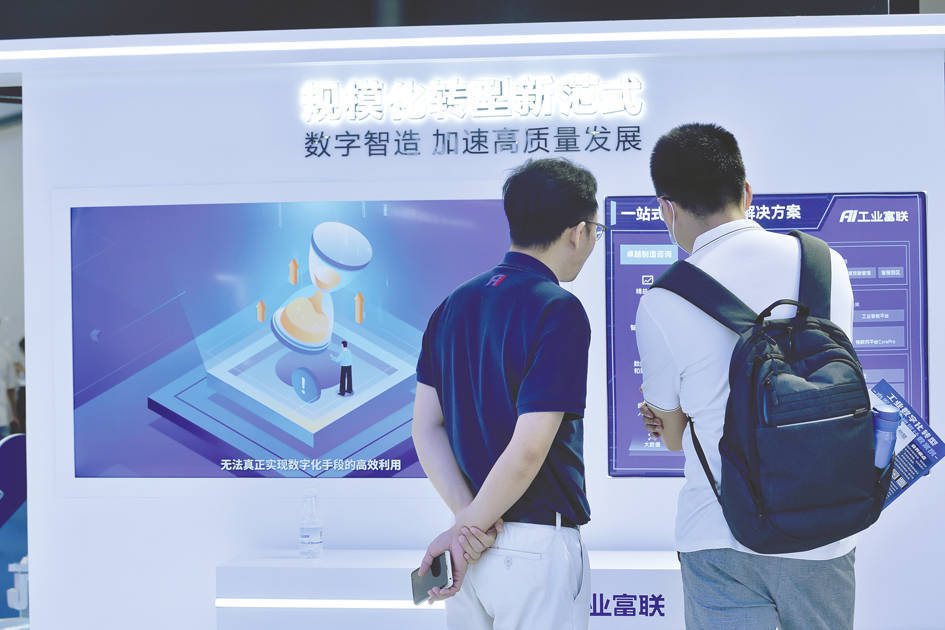
AI业务强势增长 工业富联上半年净利润超120亿元
Sou Hu Cai Jing· 2025-08-11 12:39
8月10日晚间,工业富联(SH601138,股价36.35元,市值7219亿元)披露2025年半年报。 财报显示,受益于AI(人工智能)相关业务的强势增长,2025年上半年,工业富联实现营收3607.6亿元,同比增长35.58%,归母净利 润为121.13亿元,同比增长38.61%,均创同期历史新高。其中,第二季度单季,公司营收首次超过2000亿元达到2003.45亿元,同比增 长35.9%,净利润为68.86亿元,同比增长51.13%,也均创下同期历史新高。 7月7日,工业富联曾披露2025年半年度业绩预告。彼时,工业富联预计今年上半年实现归母净利润119.58亿~121.58亿元,同比增长 36.84%~39.12%;预计第二季度实现归母净利润67.27亿~69.27亿元,同比增长47.72%~52.11%。 视觉中国图 工业富联在半年报中表示,2025年上半年,全球科技产业格局在智能革命浪潮下加速重构,以大模型与生成式AI为代表的技术突破推 动应用生态进入爆发阶段。核心驱动力方面,预计北美四大云服务商2025年合计资本开支同比实现高速增长,其中AI云基础设施投入 占比将显著提升,带动高端AI服务器需求激 ...


直线20%封板!A股这一概念板块,集体大涨
Zheng Quan Shi Bao· 2025-08-11 12:21
Market Overview - A-shares experienced a significant rally, with major indices such as the Shanghai Composite Index and Shenzhen Component Index reaching new highs for the year, while the CSI 1000 index hit a two-year high. Trading volume increased to 1.85 trillion yuan [1] - Key sectors showing strong performance included solid-state batteries, consumer electronics, robotics, and defense, while precious metals, banking, film and television, and oil services lagged behind [1] Fund Flow Analysis - Major sectors like computers, electronics, and electrical equipment saw net inflows exceeding 10 billion yuan, while the pharmaceutical and biological sector received over 8.5 billion yuan in net inflows. The machinery sector has seen net inflows for eight consecutive days, and several other sectors have also experienced consistent inflows [1] - Conversely, the banking sector faced a net outflow of over 2 billion yuan, with public utilities, oil and petrochemicals, and steel also experiencing significant outflows [1] Solid-State Battery Industry - The solid-state battery industry is accelerating, with expectations for mass production in vehicles starting from 2026. The sulfide electrolyte route has become the mainstream choice, although high costs and environmental requirements remain key bottlenecks [5] - Major Chinese companies, including CATL, have advanced their timelines for solid-state battery mass production to between 2027 and 2030 [4] Consumer Electronics Sector - The consumer electronics sector index reached a historical high, with numerous stocks experiencing significant gains, including a 20% increase for companies like Oulu Tong and Longli Technology [5] - The smartphone industry is undergoing a technological transformation driven by artificial intelligence, with global AI smartphone shipments expected to reach 827 million units by 2027, reflecting a compound annual growth rate of 100.7% [7] - In China, AI smartphone shipments are projected to grow to 150 million units by 2027, accounting for 51.9% of the overall smartphone market, with a compound annual growth rate of 96.8% [7]
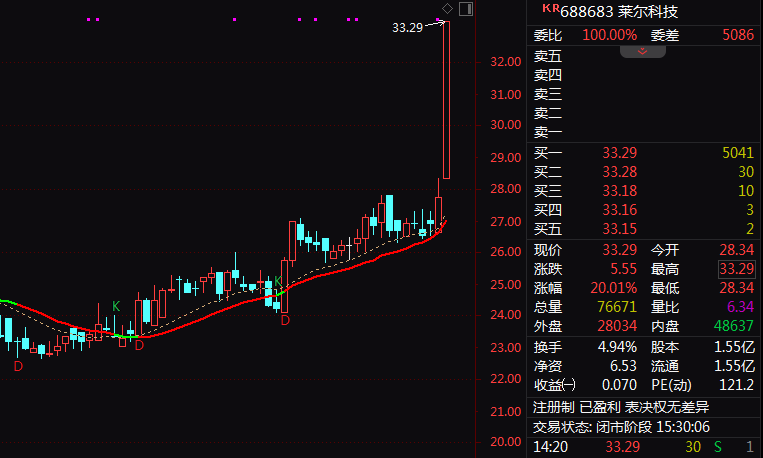
半年大赚121亿元,7000亿巨头公告:第二季度营收首破2000亿元;股价再创历史新高
Mei Ri Jing Ji Xin Wen· 2025-08-11 09:08
Core Viewpoint - Industrial Fulian (601138.SH) reported strong financial results for the first half of 2025, driven by significant growth in AI-related businesses, achieving record highs in revenue and net profit [1][2]. Financial Performance - The company achieved revenue of 360.76 billion yuan, a year-on-year increase of 35.58% [2] - Net profit attributable to shareholders reached 12.11 billion yuan, up 38.61% year-on-year [2] - In Q2 alone, revenue exceeded 200 billion yuan for the first time, reaching 200.35 billion yuan, with a year-on-year growth of 35.9% [1][2] - Q2 net profit was 6.89 billion yuan, marking a 51.13% increase year-on-year [1][2] - Operating cash flow showed a significant decline of 70.76%, totaling 1.41 billion yuan [2] Business Segments - The company reported nearly a threefold increase in revenue from 800G high-speed switches compared to the entire year of 2024 [3][4] - AI server revenue grew over 60% year-on-year, with overall server revenue increasing by more than 50% in Q2 [3][7] - The cloud computing segment saw a substantial increase, with server revenue from cloud service providers rising over 150% year-on-year [3][7] - The company is collaborating with leading global clients to develop next-generation AI servers and liquid-cooled cabinets, enhancing its competitive position in the AI infrastructure market [3][4] Market Position and Outlook - Industrial Fulian holds approximately 40% market share in the global AI server OEM market, with major clients including Microsoft, Amazon, and Google [8] - The company has resolved previous concerns regarding the GB200 product's yield issues, entering a phase of large-scale delivery, which is expected to significantly boost performance [8] - The outlook for the smartphone market remains positive, with trends towards high-end devices and generative AI expected to drive new growth [3]
日媒:日本“数字逆差”几乎抵消“旅游顺差”
Huan Qiu Shi Bao· 2025-08-10 22:56
Group 1 - Japan is facing a significant digital services trade deficit, with a recorded deficit of 3.481 trillion yen in the first half of 2025, highlighting its reliance on foreign tech giants [1] - The digital deficit is projected to triple over the next decade, indicating a growing concern for Japan's international balance of payments [1][2] - In the first half of 2025, Japan's service trade balance showed a surplus of 14.5988 trillion yen, but the digital services deficit of 1.3779 trillion yen nearly offset this surplus [1] Group 2 - The increasing reliance on major US tech companies like GAFA for advertising and cloud services is contributing to Japan's expanding digital deficit [2] - The Ministry of Economy, Trade and Industry estimates that by 2035, Japan's digital deficit could reach 18 trillion yen, which is 2.6 times the projected deficit for 2024 [2] - The Japanese government plans to implement support measures to enhance the competitiveness of domestic digital services and reduce the international balance of payments deficit [3]
第二季度营收首破2000亿元工业富联上半年净赚超120亿元,业绩、股价齐创历史新高
Xin Lang Cai Jing· 2025-08-10 21:05
Core Viewpoint - Industrial Fulian reported strong growth in AI-related business, achieving a revenue of 360.76 billion yuan in the first half of 2025, a year-on-year increase of 35% [1] Financial Performance - The company achieved a net profit attributable to shareholders of 11.958 billion to 12.158 billion yuan in the first half of 2025, representing a year-on-year growth of 36.84% to 39.12% [1] - For the second quarter, the net profit is expected to be between 6.727 billion and 6.927 billion yuan, with a year-on-year increase of 47.72% to 52.11% [1] - The final data for both the first half and the second quarter were at the upper end of the forecast range [1] Business Segments - The cloud computing business saw significant growth, with overall revenue in the second quarter increasing by over 50% year-on-year [1] - AI servers are becoming a larger part of the cloud computing business, with the product structure continuously optimizing [1] - The precision components business experienced a 17% year-on-year increase in shipment volume due to the strong sales of specific models [1] Market Position - Industrial Fulian holds approximately 40% market share in the AI server market, serving major clients such as Microsoft, Amazon, and Google [1] - The company has deep collaborations with leading global clients to develop next-generation AI servers and liquid-cooled cabinets [1] - The revenue from 800G high-speed switches nearly tripled compared to the entire year of 2024, solidifying the company's market share in high-performance computing and AI infrastructure [1]
第二季度营收首破2000亿元 工业富联上半年净赚超120亿元,业绩、股价齐创历史新高
Mei Ri Jing Ji Xin Wen· 2025-08-10 12:48
工业富联提及,公司与多家全球领先客户深度合作,共同开发新一代AI服务器、液冷机柜等关键技术, 并提供定制化解决方案。产品已广泛应用于高性能AI数据中心,为全球AI算力基础设施提供强有力支 撑。目前,公司正协同客户推进下一代产品的设计研发,在产业链覆盖广度与交付能力方面继续保持行业 领先地位。 工业富联在财报中指出,公司核心业务强势增长,实现订单规模与价值量同步跃升。云计算业务方面,工 业富联产品结构持续优化,AI服务器在云计算业务中的占比稳步扩大。第二季度公司整体服务器营收增 长超50%,云服务商服务器营收同比增长超150%,AI服务器营收同比增长超60%。GB200系列产品实现量 产爬坡,良率持续改善,出货量逐季攀升。目前,公司正协同客户推进下一代产品的设计研发,在产业链 覆盖广度与交付能力方面继续保持行业领先地位。 每经记者|蔡鼎 每经编辑|张海妮 工业富联(601138.SH,股价36.59元,市值7266.58亿元)8月10日晚间披露半年报。受益于AI(人工智 能)相关业务的强势增长,公司2025年上半年实现营收3607.6亿元,同比增长35.58%,归母净利润为 121.13亿元,同比增长38.61 ...

联想(00992)摩托罗拉手机Q2营收实现双位数增长 稳居海外市场第四
Zhi Tong Cai Jing· 2025-08-10 06:16
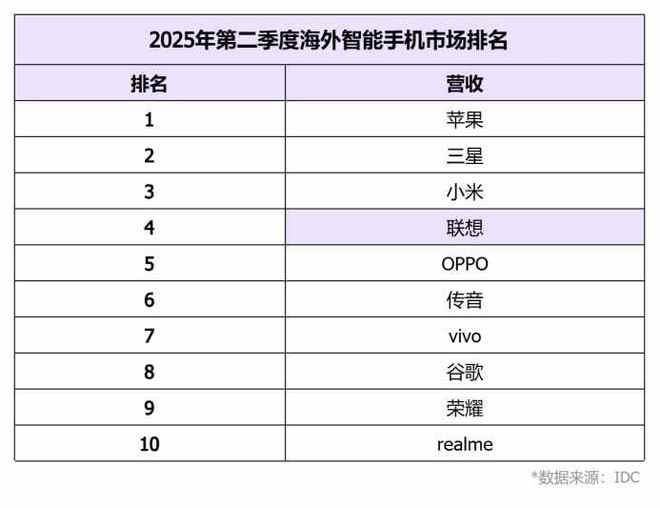
Core Insights - The international smartphone market, excluding China, generated total revenue of $91.3 billion, reflecting a year-on-year growth of 9.2%, significantly surpassing the previous growth forecast of 1.2% [1] - Lenovo Group's mobile business performed exceptionally well in overseas markets, achieving a robust revenue growth of 14.6% year-on-year, solidifying its position as the fourth largest player globally with a market share of 5.4% [1][2] - Lenovo's Motorola brand also saw its global revenue share increase to 3.0%, ranking eighth in the market [1] Revenue Growth and Market Position - Lenovo's revenue growth of 14.6% outpaced other top players in the overseas market, where Apple grew by 9.7%, Samsung by 11.3%, and Xiaomi by 3.7%, while OPPO experienced a decline of 1% [2] - The Asia-Pacific emerging markets and North America were identified as key growth drivers for Lenovo, with revenue in the Asia-Pacific region increasing by 66%, and the Indian market alone growing by 44% [2] - In North America, Lenovo's revenue reached $1.07 billion, marking an 18.2% year-on-year increase, with a market share of 5.3%, elevating its rank to third [3] Strategic Advantages - Lenovo's Motorola brand emerged as one of the fastest-growing major brands, benefiting from strong sales in India, steady expansion in the North American prepaid market, and enhanced competitiveness in the mid-range 5G product category [3] - Despite a downturn in the domestic smartphone market in China, Lenovo's Motorola experienced a significant revenue increase of 52% and a shipment growth of 32% [3] - In the fiscal year 2024-25, Motorola's revenue reached 62.6 billion yuan, a 27% increase, marking a historical high since Lenovo's acquisition, with smartphone shipments rising by 75% compared to 2020 [3][4] Future Outlook - Lenovo is expected to continue solidifying its fourth position in the global smartphone market, with double-digit revenue growth reflecting its strategic focus and execution in emerging markets [4] - The global smartphone market is anticipated to maintain a trend towards high-end products, with revenue growth expected to outpace volume growth in 2025 [4] - Lenovo's Motorola is well-positioned to capitalize on opportunities in the personal smart device sector and foldable smartphone market, driven by increasing interest in generative AI (GenAI) devices [4]

计算机行业周报:如何客观看待GPT5发布?Genie3发布验证物理AI加速!-20250809
Shenwan Hongyuan Securities· 2025-08-09 14:27
Investment Rating - The report maintains a positive outlook on the computer industry, particularly focusing on the commercialization of AI applications and the acceleration of physical AI [5][6]. Core Insights - The release of GPT-5 has generated diverse market evaluations, emphasizing its potential in productivity tools and B2B scenarios, particularly in monetization [7][10]. - Google DeepMind's introduction of the Genie 3 model marks a significant acceleration in the commercialization of physical AI, allowing for the generation of interactive 3D environments [33][36]. - Key companies such as Nengke Technology, Saiyi Information, and Daotong Technology are highlighted for their advancements in AI applications across various sectors [5][53][59]. Summary by Sections GPT-5 Release - GPT-5 is expected to validate its product in productivity tools and B2B scenarios, with significant improvements in coding capabilities and reduced hallucination rates [10][18]. - The monetization potential is underscored by its competitive pricing for API services, which is significantly lower than competitors [19][20]. - Performance metrics show GPT-5 achieving state-of-the-art results in various benchmarks, including mathematics and coding tasks [13][24]. Genie 3 Launch - Genie 3 allows users to generate interactive 3D environments at 720p resolution and 24 frames per second, significantly improving upon its predecessor [33][36]. - The model demonstrates enhanced performance in terms of duration, consistency, interactivity, and instruction adherence [34][36]. - Genie 3's capabilities are expected to facilitate advancements in various applications, including gaming and virtual training environments [39][41]. Key Company Updates - Nengke Technology is accelerating AI applications in specialized industries, leveraging partnerships with Huawei for smart manufacturing solutions [53][55]. - Saiyi Information is rapidly deploying AI agents in manufacturing, with optimistic order forecasts indicating significant growth potential [56]. - Daotong Technology is enhancing its AI inspection capabilities through collaboration with Huawei, focusing on energy and transportation sectors [59][60].



【2025WRC】大会发布|具身智能机器人十大发展趋势
机器人圈· 2025-08-09 00:47
Core Viewpoint - The article discusses the ten major trends in embodied intelligent robots as presented at the 2025 World Robot Conference, emphasizing the integration of various technologies and interdisciplinary collaboration to enhance the capabilities and applications of these robots [2]. Group 1: Trends in Embodied Intelligent Robots - Trend 1: The synergy of physical practice, physical simulators, and world models drives embodied cognition, creating realistic training environments for robots [3][26]. - Trend 2: Multi-level end-to-end embodied decision-making enhances the generalization ability of robots in unstructured environments through the integration of multimodal large models and life sciences [5][29]. - Trend 3: The integration of model predictive control, reinforcement learning, and life sciences improves the adaptability and performance of embodied intelligent robots in dynamic environments [8][33]. Group 2: Design and Development - Trend 4: Generative AI facilitates the unified optimization of robot components, enabling the automatic exploration of optimal designs in physical simulators [10][36]. - Trend 5: Consistency between software and hardware is crucial, achieved through predefined interface specifications and joint simulation [12][39]. - Trend 6: A "manufacturing" approach for embodied intelligent robots integrates various R&D efforts, allowing for rapid design and high-quality system development [14][43]. Group 3: Data and Collaboration - Trend 7: The construction of large-scale, high-quality datasets enhances the capabilities of robots in morphological optimization and training efficiency [15][46]. - Trend 8: The development of robot swarms and their collaboration with humans focuses on improving safety and empathy, facilitating their integration into society [17][49]. - Trend 9: An interdisciplinary open community is essential for the advancement of embodied intelligent robots, promoting collaboration across various scientific fields [19][53]. Group 4: Safety and Ethics - Trend 10: Establishing safety assessment frameworks and ethical norms is vital for ensuring the reliability and safety of robots in complex environments [21][56].