
宠物经济

Search documents
行业回归创新驱动,宠物药品及出海拓展成长空间
2025-08-24 14:47
Summary of Industry and Company Insights from Conference Call Industry Overview - The animal health industry is experiencing increased competition and pressure on profit margins, with gross margins declining from over 35% in 2020 to less than 31% in 2023 due to intensified price wars and a lack of innovation [1][11] - The market for veterinary pharmaceuticals is facing challenges, including a significant drop in the number of new veterinary drug certificates, with the number of first-class new drug applications decreasing from 5 in 2019 to 2 in 2023 [1][12] - The pet medical market is rapidly growing, projected to reach a market size of 84 billion yuan by 2024, accounting for approximately 30% of the entire pet market, driven by an increase in pet ownership and a younger demographic of pet owners [1][20] Key Points and Arguments - The demand for animal health products is rigid due to the significant risks posed by diseases in livestock farming, despite animal health products only accounting for slightly over 5% of the costs in pig farming [1][9] - Integrated strategy companies are better positioned to survive in a competitive environment, as there is an increasing need for comprehensive solutions and technical services in livestock farming [1][17] - The domestic animal health market is facing international competition, but a trend towards domestic substitution is emerging, with local companies gradually closing the gap with international players [3][24] Financial Insights - The investment outlook for the pig farming sector remains positive, particularly for companies like Muyuan Foods, which has shown strong performance and attractive dividend yields [2] - The revenue of the animal health industry is expected to see significant growth in the pet medical sector, with a compound annual growth rate of nearly 10% from 2018 to 2024 [20][21] Challenges and Risks - The animal health industry is facing challenges such as intensified competition, price wars, and a decline in profitability, with the top 20 pig farming companies expected to account for over 30% of the market by 2024 [10][16] - Small and medium-sized enterprises in the animal health sector are under increasing pressure, with some reporting losses due to the competitive landscape [14] Future Growth Opportunities - Future growth in the animal health industry is anticipated to come from the pet medical field, with domestic companies needing to expand into both economic animals and international markets [5][23] - The market penetration rate for pet healthcare in China remains low compared to mature markets, indicating significant growth potential [24] Noteworthy Companies - Companies such as Reap Bio, Kexin Bio, and Huaiyun Bio are highlighted as having strong competitive positions and potential for growth in the pet medical sector [26] - Reap Bio is noted for its comprehensive product matrix and has shown resilient sales growth, helping to mitigate some industry downturn risks [18] Conclusion - The animal health industry is at a crossroads, with significant challenges and opportunities ahead. Companies that can innovate and adapt to the changing landscape, particularly in the pet medical sector, are likely to thrive in the coming years [25]
依依股份(001206):优质客户稳健增长,H2改善可期
Xinda Securities· 2025-08-24 07:30
Investment Rating - The investment rating for the company is not explicitly stated in the provided documents, but the report indicates a positive outlook for the second half of the year, suggesting potential for improvement in performance [1][2]. Core Views - The company reported a revenue of 888 million yuan in H1 2025, representing a year-on-year increase of 9.3%, and a net profit attributable to the parent company of 102 million yuan, up 7.4% [1]. - In Q2 2025, the company experienced a revenue decline of 6.1% to 403 million yuan and a net profit decrease of 9.1% to 48 million yuan, attributed to tariff impacts [1][2]. - The company maintains a strong customer base with high entry barriers for suppliers, leading to strong customer retention and stable growth in the U.S. market despite tariff disruptions [2]. - The company’s production capacity has expanded significantly, with domestic pet pad capacity reaching 4.6 billion pieces and overseas capacity in Cambodia expected to improve exports to the U.S. in H2 2025 [2]. Financial Performance Summary - For H1 2025, the company's main product, pet pads, generated revenue of 764 million yuan, a year-on-year increase of 7.3% [2]. - The gross margin for Q2 2025 was 19.1%, with a net profit margin of 11.9%, indicating stable profitability despite slight declines [3]. - The company’s operating cash flow for Q2 2025 was 118 million yuan, showing strong cash flow performance [3]. - Profit forecasts for 2025-2027 estimate net profits of 240 million, 290 million, and 350 million yuan, respectively, with corresponding P/E ratios of 20.2X, 16.3X, and 13.4X [3].
新消费派丨1.87亿只“毛孩子”背后,透视宠物经济三大变化
Xin Hua Cai Jing· 2025-08-24 02:17
Core Insights - The 27th Asia Pet Expo in Shanghai highlights the booming pet economy in China, driven primarily by the younger generation, with 45.3% currently owning pets and over half having previous pet ownership experience [1][2] Market Trends - The pet market is experiencing robust growth, with a significant increase in investment across various segments such as online platforms, pet healthcare, and pet products [1][6] - The pet economy index has risen by 28.11% this year, outperforming the broader market, indicating strong investor interest [1][6] Consumer Behavior - Young pet owners are increasingly viewing pet ownership as a lifestyle choice, with a shift from basic needs to emotional, refined, and scientific consumption [3][4] - Nearly 70% of pet owners spend an average of 800 yuan per month on pet care, while higher spending brackets (801-1500 yuan and above 1500 yuan) account for 17.2% each [4] Industry Dynamics - The pet industry is evolving from a focus on quantity to value, with a notable trend towards premiumization and localization in sectors like food, healthcare, and insurance [7] - Companies are adapting their strategies to align with consumer preferences, such as collaborating with popular IPs to enhance brand visibility [3] Investment Landscape - The pet industry has seen 634 financing events, with online platforms leading at 27.3%, followed by pet healthcare and products [6] - The sector is expected to provide structural growth opportunities, with a focus on companies that demonstrate strong brand, channel penetration, and product capabilities [7]
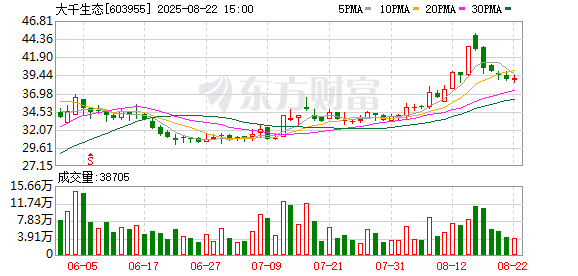
上半年净利润亏损达1590万元,大千生态押注宠物经济新赛道,销售费用暴涨超1000%
Hua Xia Shi Bao· 2025-08-23 08:54
Core Viewpoint - Daqian Ecological Environment Group Co., Ltd. reported a significant net loss of 15.90 million yuan in the first half of the year, marking a 223.94% decline year-on-year, attributed to the costs associated with its new pet service business [2][6]. Financial Performance - The company's revenue for the first half of the year was 55.15 million yuan, a year-on-year increase of 10.02% [2]. - The net cash flow from operating activities was -97.34 million yuan, a decline of 268.24% year-on-year [2]. - Sales expenses surged to 17.69 million yuan, reflecting a 1013.98% increase due to the expansion into the pet business [6]. Business Segments - The ecological construction business saw a significant revenue drop of 86.64% year-on-year, while the cultural tourism operation business experienced a revenue increase of 116.85% [4]. - The newly launched pet service and sales business generated 9.08 million yuan in revenue, accounting for 16.47% of total revenue [4]. Strategic Initiatives - Daqian Ecological established a wholly-owned subsidiary, Jiangsu Qianchongjia Technology Co., Ltd., in March to develop a comprehensive pet service brand [3]. - The company has opened 20 pet service stores in major cities like Beijing, Shanghai, Nanjing, and Hangzhou, focusing on an "experience + retail" model [3]. Market Outlook - The pet economy is viewed as a promising sector, with projections indicating that China's pet consumption market will reach 300.2 billion yuan in 2024, a 75.76% increase from 2018 [6]. - The company aims to integrate resources and explore opportunities in the pet consumption sector while maintaining its traditional business [9]. Ownership Changes - In November 2024, the "Bubugao system" acquired an 18.09% stake in Daqian Ecological, with plans to leverage the company for resource integration in emerging consumer sectors [6][9]. - The "Bubugao system" has a pet social platform named "Chongpangpang," which is expected to be integrated into Daqian Ecological [6].


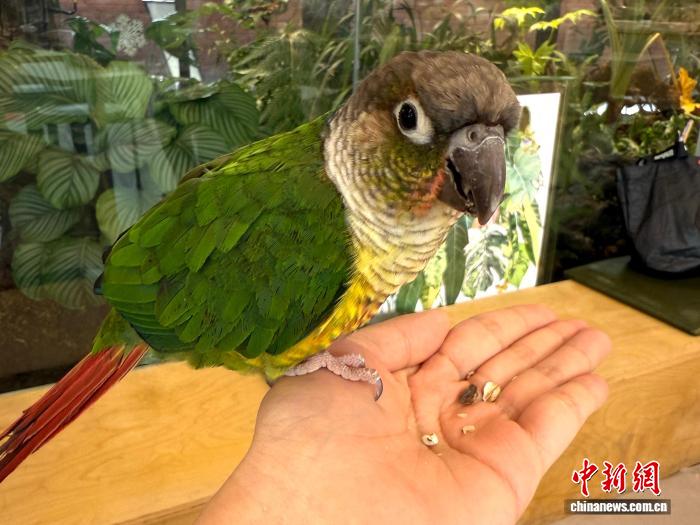
“鸟门”走热:宠物鸟为何成年轻人“新宠”
Zhong Guo Xin Wen Wang· 2025-08-23 08:39
Core Insights - The trend of raising pet birds, particularly among young people, is gaining popularity, with a significant increase in orders for pet birds on platforms like Taobao, showing over 50% year-on-year growth in the last six months [1][4] - The demographic shift indicates that the "post-95" generation is becoming the main consumer group for pet birds, with female bird owners increasing at a rate eight times that of male owners [1][4] - The market for bird-related products is expanding, with a noticeable rise in sales of bird supplies and accessories, indicating a developing "bird economy" [4] Market Dynamics - Young individuals are increasingly engaging in activities such as taking their pet birds out in public or sharing their experiences on social media, which is driving demand for related products and services [2][4] - The shift in consumer behavior reflects a broader trend where young people are seeking emotional fulfillment from pets, moving from traditional companionship to more nuanced emotional connections [4] Industry Growth - The rise in interest for pet birds is leading to a burgeoning market for bird supplies, with local entrepreneurs showing interest in opening bird cafes and related businesses [4] - The domestic market for bird-related products is gradually expanding, with a notable increase in inquiries from young consumers in China, contrasting with previous trends that focused on overseas markets [4]
宠物市场越来越大 入局淘金者越来越多
Shang Hai Zheng Quan Bao· 2025-08-23 00:34
Core Viewpoint - The Chinese pet industry is entering a new development stage, with pets transitioning from "functional companions" to "family members" [1] Industry Trends - The scale of pet ownership is increasing, leading to the growth of related sectors such as pet food, pet supplies, pet healthcare, and pet services, which are evolving towards specialization and refinement [1] - There is a rapid rise in the demand for "specialized and dedicated" products for pets [1] Market Dynamics - The booming pet economy is attracting more industrial capital into the market [1] - During the Asia Pet Expo, an increasing number of e-commerce platforms, including leading shelf e-commerce, interest e-commerce, and lifestyle platforms, have set up booths, indicating the growing appeal of the pet economy in recent years [1] - A participant who has attended the expo for five consecutive years noted that the number of e-commerce platforms and the size of their booths have both increased significantly [1]
“宠”出来的市场何止千亿级?它们带来的不仅是情绪价值!
Shang Hai Zheng Quan Bao· 2025-08-22 23:21
Industry Overview - The pet economy is rapidly growing, driven by social changes such as urbanization, smaller family structures, and an increase in single and elderly populations, leading to pets being viewed as family members and emotional companions [4][5] - The Chinese pet industry is entering a new development stage, with pets transitioning from "functional companions" to "family members," resulting in a rise in demand for specialized pet products and services [5][6] Market Size and Growth - According to the "2025 China Pet Industry White Paper," the number of pet dogs in China is projected to reach 52.58 million in 2024, a 1.6% increase from 2023, while the number of pet cats is expected to reach 71.53 million, a 2.5% increase [7] - The urban pet market in China is expected to exceed 300 billion yuan in 2024 and is projected to surpass 400 billion yuan by 2027, indicating significant growth potential compared to the U.S. pet market, which is expected to exceed 140 billion USD in 2024 [8][9] Consumer Spending Trends - Pet food constitutes a major portion of pet owners' expenses, with average monthly costs for pet care varying based on pet type and owner preferences; for example, one owner spends approximately 2,000 yuan monthly on their dog [7][8] - The rise of "self-indulgence economy" and "emotional consumption" is reshaping the pet consumption market in China, with a growing focus on high-quality pet food and services [8][9] Product and Service Innovations - Pet food brands are increasingly focusing on product quality, nutritional value, and specialized needs, with domestic brands gaining market share through insights into local consumer preferences [9][10] - The demand for diverse, intelligent, and one-stop pet services is growing, with over 30,000 businesses providing pet services on platforms like Meituan, reflecting a 24% year-on-year increase [11] Competitive Landscape - The pet industry is attracting significant investment from various sectors, with companies like Daqian Ecology and Three Squirrels entering the market to create comprehensive pet service brands [13] - The competition is intensifying, prompting companies to innovate and differentiate their offerings, such as unique pet cages and specialized pet food products [15][16]

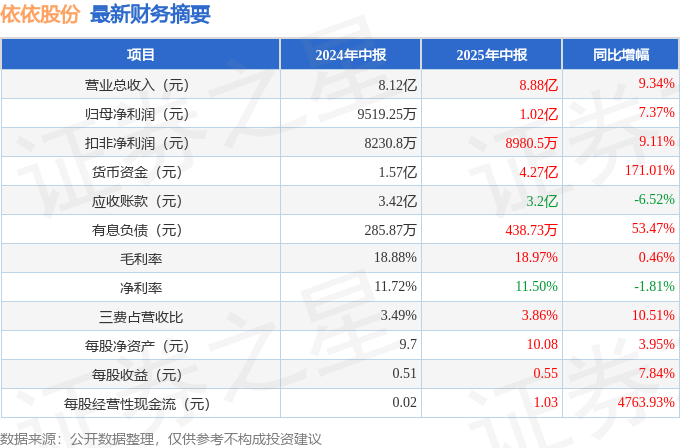
依依股份2025年中报简析:营收净利润同比双双增长,公司应收账款体量较大
Zheng Quan Zhi Xing· 2025-08-22 23:20
Financial Performance - Company reported total revenue of 888 million yuan for the first half of 2025, a year-on-year increase of 9.34% [1] - Net profit attributable to shareholders reached 102 million yuan, up 7.37% year-on-year [1] - In Q2 2025, total revenue was 403 million yuan, a decline of 6.05% compared to the same period last year [1] - Q2 net profit attributable to shareholders was 48.11 million yuan, down 9.09% year-on-year [1] - Gross margin was 18.97%, an increase of 0.46% year-on-year, while net margin was 11.5%, a decrease of 1.81% [1] - Total operating expenses were 34.30 million yuan, accounting for 3.86% of revenue, an increase of 10.51% year-on-year [1] - Earnings per share increased to 0.55 yuan, up 7.84% year-on-year [1] Cash Flow and Assets - Operating cash flow per share surged to 1.03 yuan, a dramatic increase of 4763.93% year-on-year [1] - Cash and cash equivalents increased by 186.42%, attributed to higher cash receipts from sales [4] - Accounts receivable accounted for 148.6% of net profit, indicating a significant amount of outstanding payments [1][4] Market and Industry Insights - The company is focusing on expanding its market presence in non-US regions such as Europe and Southeast Asia to mitigate risks from tariff policies [5] - The domestic market for pet hygiene products is expected to grow due to increasing pet ownership among younger generations and the aging pet population [7][8] - The company plans to enhance its self-owned brands and expand its market share through a combination of online and offline strategies [9] Future Strategy - The company aims to implement a dual-circulation strategy focusing on both domestic and overseas markets, as well as a dual-engine approach combining ODM/OEM and self-owned brands [10] - Future investments will target essential pet products, including cat litter, pet food, and medical vaccines, to capitalize on market opportunities [10]
皇家宠物食品:持续深耕中国宠物经济
Xin Hua Cai Jing· 2025-08-22 22:15
Core Insights - The Chinese pet economy is experiencing significant growth, attracting multinational companies like Royal Canin, which has been operating in China for 30 years [1][2] - Royal Canin has established a strong supply chain in China, including a factory in Shanghai and four distribution centers, achieving zero food safety incidents over 15 years [1][2] - The company has introduced over 350 nutritional combinations tailored to the needs of Chinese pets, emphasizing precise nutrition throughout the pet lifecycle [2] Company Developments - Royal Canin launched three strategic new products during its 30th anniversary event, including the world's first Corgi-specific food [2] - The company has built a "mutual benefit ecosystem," serving over 10,000 pet hospitals and nearly 20,000 pet stores in China [2] - Royal Canin's initiatives include the "PROactive Breeder Project," which has certified thousands of dog and cat breeders across the country [2] Industry Impact - Royal Canin is actively contributing to the standardization and professionalization of the Chinese pet industry, participating in the development of industry standards and providing educational resources for veterinarians [2] - The company aims to foster a harmonious human-pet society in China by collaborating with various stakeholders in the industry [3]
吃得越来越精细、用得越来越舒适 “宠”出来的市场何止千亿级?
Shang Hai Zheng Quan Bao· 2025-08-22 22:14
Group 1: Market Growth and Trends - The pet economy is experiencing significant growth driven by social changes such as urbanization, smaller family structures, and an increase in single and elderly populations, leading to pets being viewed as family members rather than just companions [1] - The pet industry in China is entering a new development stage, with a shift from "functional companions" to "family members," resulting in a rise in demand for specialized pet products and services [1] - According to the "2025 China Pet Industry White Paper," the number of pet dogs in China is projected to reach 52.58 million in 2024, a 1.6% increase from 2023, while the number of pet cats is expected to reach 71.53 million, a 2.5% increase [3] Group 2: Consumer Spending and Behavior - Pet owners are increasingly willing to spend on high-quality food, comfortable bedding, fashionable clothing, and even birthday parties for their pets, reflecting a trend towards "humanization" of pet consumption [1] - Average monthly spending on pets can vary significantly; for example, one pet owner spends around 2,000 yuan per month on food, grooming, insurance, and medical care for their dog [3] - The pet market in urban areas is expected to exceed 300 billion yuan in 2024 and is projected to surpass 400 billion yuan by 2027, indicating a robust growth trajectory [4] Group 3: Product and Service Diversification - The demand for pet food is a major component of pet owners' expenses, with a focus on safety, nutrition, and specific health needs driving purchasing decisions [5] - Companies are increasingly investing in brand image and product differentiation, with some brands collaborating with popular IPs to attract consumers [6] - The rise of young consumers is leading to a demand for diverse, intelligent, and one-stop pet services, with over 30,000 businesses offering pet services on platforms like Meituan, reflecting a 24% year-on-year growth [7] Group 4: Industry Competition and Innovation - The pet economy is attracting more capital and new entrants, with companies like Daqian Ecology and Three Squirrels entering the market to provide comprehensive pet services and products [9] - The number of pet-related merchants on Tencent's platform has increased 2.5 times since early 2024, indicating a growing interest in the pet sector [10] - Despite increasing competition, the future of the pet industry remains promising, with specialized needs for different pet types and age groups presenting numerous opportunities for brands [11]