
数字化

Search documents
华创证券:维持途虎-W“推荐”评级 目标价23.62港元
Zhi Tong Cai Jing· 2025-09-25 09:17
Group 1 - The core viewpoint of the report maintains a "recommend" rating for Tuhu-W (09690), with adjusted net profit estimates for 2025-2027 at 8.09 billion, 9.92 billion, and 12.03 billion respectively, and a target price of 23.62 HKD [1] - The company achieved a revenue of 78.77 billion in the first half of 2025, representing a year-on-year growth of 10.5%, with a gross profit of 19.82 billion and a gross margin of 25.2% [1] - The revenue growth is attributed to the expansion of the store network and the contribution from high-growth businesses such as new energy and quick repair services, with core businesses like tires and automotive maintenance also showing approximately 11% year-on-year growth [1] Group 2 - The company's new energy service ecosystem is rapidly expanding, with platform users reaching 3.4 million, a year-on-year increase of 83.5%, and a penetration rate exceeding 12% [2] - The total number of stores has reached 7,205, covering 70% of counties with more than 20,000 passenger vehicles, indicating a strong presence in lower-tier markets [2] - User operations are being strengthened, with 26.5 million transaction users and a repurchase rate of 64%, showcasing significant ecological synergy [2] Group 3 - The company is enhancing efficiency through supply chain intelligence upgrades and AI technology, with automation warehouse efficiency in Guangzhou increasing by 2.5 times and the introduction of unmanned delivery vehicles [3] - The intelligent customer service system, based on the DeepSeek model, has improved pre-sale conversion rates by 2 percentage points while reducing labor costs by 18% [3] - The company is actively leveraging the "old-for-new" policy benefits, achieving a single-day sales record of over 1.5 billion during the 618 shopping festival [3]
华创证券:维持途虎-W(09690)“推荐”评级 目标价23.62港元
智通财经网· 2025-09-25 09:15
Group 1 - The company maintains a "recommended" rating with projected adjusted net profits of 8.09 billion, 9.92 billion, and 12.03 billion for 2025-2027, and a target price of 23.62 HKD [1] - In the first half of 2025, the company achieved revenue of 78.77 billion, a year-on-year increase of 10.5%, with a gross profit of 19.82 billion and a gross margin of 25.2% [1] - The revenue growth is attributed to the expansion of the store network and contributions from high-growth sectors such as new energy and quick repair services [1] Group 2 - The company's new energy service ecosystem is rapidly expanding, with platform users reaching 3.4 million, a year-on-year increase of 83.5%, and a penetration rate exceeding 12% [2] - The total number of stores has reached 7,205, covering 70% of counties with more than 20,000 passenger vehicles [2] - User operations are being strengthened, with 26.5 million transaction users and a repurchase rate of 64% [2] Group 3 - The company is enhancing efficiency through supply chain intelligence upgrades and AI technology, significantly improving overall operational efficiency [3] - The automation warehouse efficiency in Guangzhou has increased by 2.5 times, and the introduction of unmanned delivery vehicles is underway [3] - The intelligent customer service system, based on the DeepSeek model, has improved pre-sale conversion rates by 2 percentage points while reducing labor costs by 18% [3]
正安康健梁冬:一部分人进不了人工智能和数字化领域,黄金就成了他们的心锚
Feng Huang Wang Cai Jing· 2025-09-25 05:46
Group 1 - The "Phoenix Bay Area Finance Forum 2025" was held in Guangzhou, focusing on the theme "New Pattern, New Path" and gathering global political, business, and academic elites to explore development trends [1] Group 2 - Liang Dong, founder of Zheng'an Health and the Zheng'an Traditional Chinese Medicine Education Foundation, discussed the relationship between the surge in gold prices and the rise of digital currencies, suggesting that both phenomena are driven by parallel forces of accelerationism and decelerationism [3] - Liang Dong explained that as some individuals rapidly engage in artificial intelligence and digitalization, others who feel left behind seek a "mental anchor," which manifests in investments in gold and aesthetic values, as well as geopolitical conflicts [3] - In the current complex environment, many investors are uncertain about future directions, leading them to diversify their investments between digital currencies and gold, potentially resulting in a new hybrid product, such as gold-backed digital currencies [3] - An example provided is Laopu Gold, which combines traditional Chinese cultural design elements with contemporary design art, presenting gold as a modern luxury lifestyle product, reflecting a shift in perception of gold from a traditional asset to a contemporary lifestyle choice [3]


南航援藏干部3年交出的“数字化”答卷
Nan Jing Ri Bao· 2025-09-24 23:37
Core Insights - The article highlights the successful digital transformation efforts in Tibet, particularly focusing on the implementation of cloud services and data sharing among local government units [1][2][4] - The initiative led to the creation of a traceable certification system for Tibetan yak meat, enhancing consumer trust and boosting sales [3][4] - Significant financial outcomes were achieved, including over 90 billion yuan in data-related investments and projects [3][4] Group 1: Digital Transformation Efforts - A total of 137 units were transitioned to cloud platforms within four months, marking a significant achievement in digital infrastructure development [2] - The local government had minimal prior experience with data sharing and cloud services, necessitating extensive training and support from the team [2][3] - The establishment of a comprehensive data policy framework and the creation of over 260 data products were key outcomes of the digital initiative [3][4] Group 2: Yak Meat Certification - The "Digital Yak" initiative was launched to address the issue of counterfeit yak meat, providing a reliable traceability system for consumers [3] - The implementation of an information system at farms allowed for detailed tracking of yak meat from breeding to processing, significantly increasing sales and consumer confidence [3] Group 3: Financial Impact and Future Prospects - The digital transformation efforts resulted in a tenfold increase in cloud services, data sharing, and computing power within the local government [4] - Future projects include a data investment signing worth over 10 billion yuan in Shenzhen and a planned computing power investment conference in Nanjing [3][4]
施耐德电气亮相工博会:中国已成全球产业格局核心力量
Xin Hua Cai Jing· 2025-09-24 14:27
Core Insights - Schneider Electric showcased its innovative practices aimed at accelerating the digital and green transformation of industries at the China International Industry Fair, emphasizing the theme of "Remarkable Future Industry" [1][2] - The company presented a comprehensive display of industrial automation products, solutions, and services powered by cutting-edge technologies such as open automation, AI, and digitalization across various industry applications [1] Group 1: Industry Applications - Schneider Electric highlighted seven thematic exhibition areas that demonstrate its innovative practices across different industry application scenarios, including oil extraction and refining, fine chemicals and new materials, consumer goods manufacturing, packaging and logistics, water treatment and environmental protection, waste/heat power generation, and public engineering and construction [1] - The company introduced a new generation of machine motion control solutions tailored to local enterprise needs, which includes the "Golden Four Set" comprising Harmony ET5 human-machine interface, Altivar 305 general-purpose inverter, Modicon M310M motion controller, and Lexium18ME servo drive with BEH18 servo motor, adaptable to logistics, packaging, and lithium battery industries [1] Group 2: Strategic Partnerships - At the fair, Schneider Electric signed cooperation agreements with clients and partners such as Hangzhou Jinjiang Group, Shandong Jingbo Holdings Group, and Shenzhen Ailing Network Co., Ltd., further deepening its collaborative layout across various industries and projects [1] Group 3: Market Positioning - Schneider Electric's Executive Vice President and President for China and East Asia, Yin Zheng, stated that China has become a core force in the global industrial landscape due to its vast market size, complete industrial support, resilient supply chain system, and the rapid development and widespread application of advanced technologies like AI [2] - The company aims to support industrial transformation and upgrading by focusing on the core needs of various industries, leveraging its digital capabilities to enhance quality and efficiency in "Made in China" initiatives, and creating a sustainable industrial future in collaboration with partners [2]
六部门印发《建材行业稳增长工作方案(2025—2026年)》推动行业从“重规模”向“高技术、高附加值”转型
Xin Hua She· 2025-09-24 12:35
Core Insights - The Ministry of Industry and Information Technology, along with other governmental departments, has issued a work plan for the building materials industry for 2025-2026, aiming for recovery and improved profitability in the sector [1] Group 1: Industry Development - The plan emphasizes the enhancement of technological innovation capabilities within the building materials industry, focusing on advanced ceramics and superhard materials [1] - The industry is encouraged to shift from a "scale-heavy" approach to one that prioritizes "high technology and high added value" [1] Group 2: Production Transformation - There is a push for the digital and green integration of enterprises, promoting the establishment of green smart factories [1] - The initiative aims to not only improve production efficiency but also strengthen environmental protection capabilities [1]
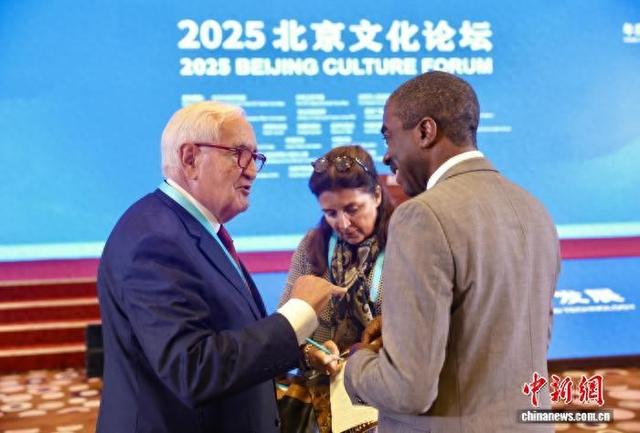
搭建文明之桥 2025北京文化论坛促国际交流合作
Zhong Guo Xin Wen Wang· 2025-09-24 11:52
Group 1 - The 2025 Beijing Cultural Forum was held from September 23 to 24, focusing on the theme of "Cultural and Technological Integration" with over 800 participants from 58 countries and regions [1][3] - International cooperation is emphasized as essential for cultural preservation, with institutions like the Asian Civilizations Museum collaborating globally [3] - The Dunhuang Academy's "Digital Dunhuang" resource has facilitated global sharing of high-definition images of cave murals, hosting over 50 digital exhibitions to promote Dunhuang culture [3][6] Group 2 - The forum featured six parallel sessions and over 20 professional salons, along with a special event for significant results, releasing the "2024 Sino-Foreign Cultural Exchange Report" [3] - The report highlights 2024 as a year for high-quality development in Sino-foreign cultural exchanges, promoting deep interactions between Chinese and world cultures [3] - The forum included a special series of activities titled "Cinematic Dialogue between China and France," celebrating the anniversaries of world and Chinese cinema [4] Group 3 - A creative display area showcased over 600 cultural and creative products, merging traditional and modern elements, reflecting the new trend of "Culture + Technology" [6] - In the first half of the year, Beijing's cultural and related industries achieved revenues of 12,429.5 billion RMB, a year-on-year increase of 13.2% [6] - New cultural business models in Beijing showed remarkable performance with revenues of 8,808.8 billion RMB, growing by 15.9% year-on-year [6]

周鸿祎:朱华荣开车吓得我胆战心惊,车子都快竖起来了
Xin Lang Ke Ji· 2025-09-24 08:21
责任编辑:李昂 "像前一阵我再去重庆,就去参观他们最大的汽车研究风洞。跟长安汽车的董事长(朱华荣),他开一 辆跑车,拉着我跑220公里/小时,车子都快要竖起来了,吓得我胆战心惊的。"周鸿祎说。 9月24日下午消息,今日,罗永浩与周鸿祎深度对谈。周鸿祎分享到,曾和俞敏洪一起去山西,俞敏洪 替山西应县古塔做了宣传,山西应县就卖了很多陶瓷出去。 "地方领导见了俞老师,都恨不得俞老师到他们这来做一些宣传。所以当时就给了我一个启发,你有流 量,就可以帮助地方做一些正向的事情。"所以,周鸿祎表示,自己现在到各地去,更愿意多介绍一些 各地的数字化、智能化发展。 ...
六部门印发《建材行业稳增长工作方案(2025—2026年)》
Zheng Quan Shi Bao Wang· 2025-09-24 07:08
人民财讯9月24日电,工信部等六部门印发《建材行业稳增长工作方案(2025—2026年)》,2025—2026 年,建材行业恢复向好,盈利水平有效提升,产业科技创新能力不断增强,绿色建材、先进无机非金属 材料产业规模持续增长,其中2026年绿色建材营业收入超过3000亿元,绿色低碳和数字化发展水平明显 提高。 ...
麦当劳中国宣布未来三年投资4亿元用于人才培训和发展
Zheng Quan Ri Bao Wang· 2025-09-24 06:43
Core Insights - McDonald's China celebrated the 15th anniversary of its Hamburger University, which has trained nearly 10,000 students annually, focusing on talent development and empowerment [1][2] - The company plans to invest over 400 million yuan in talent training and development over the next three years, aiming to upgrade Hamburger University to meet the demands of the digital age [1][3] Company Overview - Since its establishment in 1955, McDonald's has adhered to its core values of quality, service, cleanliness, and value for money [2] - Hamburger University was founded in 1961 to ensure consistent and high-quality burger production across all McDonald's restaurants [2] - McDonald's China Hamburger University was established in Shanghai in 2010, becoming the seventh Hamburger University globally, and has modernized its curriculum to align with both global experiences and local market needs [2] Training and Development - The university focuses on both hard skills, such as restaurant operations, and soft skills, including leadership and human-centered care, making it a unique institution in the restaurant service industry [2] - Currently, there are 16 leadership academies across China, with approximately 100 experts, and nearly 200,000 employees utilize the "McDonald's e-learning" platform annually [2] Future Directions - Hamburger University will continue to evolve by integrating AI technology and personalized learning, expanding industry collaboration, and fostering a supportive growth environment for restaurant management talent [3] - The focus will be on three main directions: becoming smarter, more open, and more attentive to comprehensive growth [3]
