高端化

Search documents
45亿元单季净利破纪录!长城汽车靠高端化打赢二季度
2 1 Shi Ji Jing Ji Bao Dao· 2025-07-24 12:54
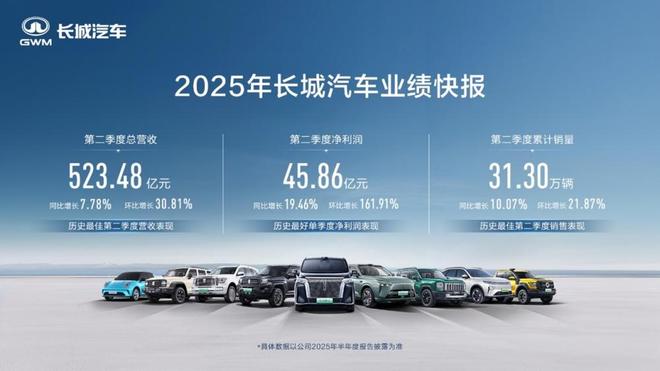
Core Viewpoint - Great Wall Motors has reported its best-ever second-quarter financial results, driven by a new product cycle and strong performance in high-end and new energy vehicles [1][3][9] Financial Performance - In Q2 2025, Great Wall Motors achieved revenue of 52.348 billion yuan, a year-on-year increase of 7.78% and a quarter-on-quarter increase of 30.81% [1] - The net profit for the same period was 4.586 billion yuan, reflecting a year-on-year growth of 19.46% and a quarter-on-quarter growth of 161.91% [1] - Vehicle deliveries reached 313,000 units, marking a year-on-year increase of 10.07% and a quarter-on-quarter increase of 21.87% [1] Product Strategy - The company is focusing on high-end models to enhance brand value and pricing power, with the WEY brand showing significant growth [3][4] - The WEY brand's sales exceeded 10,000 units in June, a year-on-year increase of 246.95% [3] - The Tank brand has also seen substantial growth, with a quarter-on-quarter increase of 46.9% in Q2 [4] New Energy Vehicles (NEVs) - Great Wall Motors' NEV sales reached 97,900 units in Q2, a year-on-year increase of 33.7% and a quarter-on-quarter increase of 56.4% [9] - The NEV penetration rate reached 31.3%, up 5.5 percentage points year-on-year [9] - The company is committed to accelerating its transition to NEVs, with the WEY brand leading this effort [10][12] International Expansion - In H1 2025, Great Wall Motors' overseas sales approached 200,000 units, with Q2 sales reaching 106,800 units, a 50% increase in non-Russian markets [14][16] - The company has established a localized production strategy, with factories in Thailand and Brazil, enhancing its global competitiveness [15][16] - Great Wall Motors aims to build a comprehensive overseas sales network, having over 1,400 sales channels globally [16]


海尔泰国白电逆增26%创最快增速
Quan Jing Wang· 2025-07-24 09:24
Core Insights - The Thai white goods market is experiencing a downturn, with an overall decline of 8.3% from January to May 2025, while Haier's white goods segment has achieved a remarkable growth of 26%, outperforming the industry and competitors [1] - Haier's success in Thailand is attributed to its localized innovation, high-end product offerings, and collaborative supply chain strategies, which have allowed it to capture significant market share [2][3] Market Performance - The overall Thai white goods market is down by 8.3% in early 2025, while Haier's white goods have grown by 26% [1] - In the refrigerator segment, Haier achieved a 40% increase despite a 4.2% decline in the overall market [1] - Haier's washing machines saw a 72% growth, significantly outpacing the market's 5.8% increase [1] - The air conditioning market declined by 21.1%, yet Haier's air conditioning segment maintained a stable performance [1] Product Innovation - Haier has introduced a 520-liter T-door ice water refrigerator in Thailand, featuring Smart Ice technology, which caters to local preferences for ice [2] - The air conditioning units have been optimized for health, energy efficiency, and ease of installation, enhancing market competitiveness [2] High-End Market Strategy - Haier launched three high-end washing machine models in Bangkok, targeting the premium segment traditionally dominated by Japanese and Korean brands [3] - The company is actively engaging with local culture through events like international marathons and badminton championships to strengthen brand recognition [3] Supply Chain Development - Haier's Spring Valley air conditioning industrial park has begun trial production, with a planned capacity of 6 million units, covering a wide range of air conditioning products [3] - This facility is positioned as Haier's largest overseas air conditioning manufacturing base and the first 5G-connected factory in Southeast Asia, enhancing efficiency and supply chain reliability [3] Future Outlook - As Chinese brands continue to gain influence in Southeast Asia, the dominance of Japanese and Korean brands is expected to diminish, providing Haier with further growth opportunities [3]


沈阳制造攀“高”向“新”逐“绿”(奋勇争先,决战决胜“十四五”)
Ren Min Ri Bao· 2025-07-22 21:51
Group 1: Industrial Achievements - Shenyang has made significant advancements in various industrial sectors, including the creation of the "Fengjin" hard rock tunnel boring machine, which achieved a record single-machine excavation of 26,521 meters [1] - The world's first 0.235-second "supersonic" wide-body CT developed by Neusoft Medical Systems was showcased at the Arab International Medical Equipment Exhibition [1] - The RX4M, China's first four-seat electric hybrid aircraft, successfully completed its maiden flight in Shenyang [1] Group 2: Advanced Manufacturing Development - Shenyang has over 700 industrial enterprises in the robotics and intelligent manufacturing cluster, contributing more than 20% to the city's total industrial output [2] - The city aims for its ten key industrial clusters to exceed 1 trillion yuan in scale by 2024, with five clusters reaching 100 billion yuan [2] - The Shenyang Industrial Mother Machine Cluster and Shenyang Aviation Cluster have been recognized as national advanced manufacturing clusters [2] Group 3: Smart Transformation of Industries - The application of industrial internet at Shenyang Guo Group has saved over 1.9 million drawings annually, with key component processing efficiency improving by 28.2% [3] - Shenyang is implementing 105 smart upgrade projects in 2024, aiming for a digital design tool usage rate of 82.8% and a CNC rate of 71.5% for key processes [3] - The city has been designated as a pilot city for new technology transformation in manufacturing and for the integration of 5G and industrial internet [3] Group 4: Green Manufacturing Initiatives - The Northeast Pharmaceutical Group has implemented a fully enclosed production environment, significantly reducing waste gas emissions [4] - Shenyang has cultivated 74 national-level and 275 provincial-level green manufacturing units, with energy consumption per unit of industrial added value decreasing by over 15% in four years [4] - The city's high-tech manufacturing industry is projected to grow by 17.6% year-on-year in 2024, with the number of technology-based enterprises surpassing 25,000 [4]

习近平总书记关切事|一根甘蔗“两头甜”——把地方特色产业做优做强之一
Xin Hua She· 2025-07-22 10:55
Core Insights - The article highlights the advancements in the sugarcane industry in Guangxi, emphasizing the integration of modern technology and mechanization to enhance productivity and efficiency [2][3][4] Industry Overview - Guangxi is recognized as China's primary sugarcane production area, with a planting area exceeding 2 million acres and supporting around 500,000 farmers [2] - The sugarcane planting area for the 2024/2025 season is projected to be 11.35 million acres, reflecting an increase of 110,000 acres year-on-year, with sugar production expected to reach 6.465 million tons, up by 283,600 tons [3] Technological Integration - The use of modern technologies such as IoT, satellite remote sensing, and artificial intelligence is significantly improving operational efficiency in sugarcane production [3] - The introduction of mechanized operations has transformed traditional farming practices, allowing for the spraying of pesticides over hundreds of acres in a fraction of the time previously required [1][2] Economic Impact - The sugar industry in Guangxi plays a crucial role in ensuring national sugar supply security and enhancing the income of sugarcane farmers [2][3] - The comprehensive value of the sugarcane industry in Yunnan has surpassed 10 billion yuan, driven by innovative uses of by-products like bagasse [5] Sustainability and Innovation - The industry is moving towards a circular economy, with a 100% utilization rate of by-products such as bagasse, sugar molasses, and filter mud expected in the 2024/2025 season [6] - New products, such as sugarcane plant water, are being developed to extend the value chain and meet market demands [6] Government Support - The Chinese government is actively promoting the modernization and mechanization of agriculture, with a focus on high-quality development and technological innovation in the sugar industry [4][5]
浙江工业经济向高向新向智发展成效显著
Ke Ji Ri Bao· 2025-07-22 00:48
Economic Overview - Zhejiang's GDP for the first half of 2025 reached 45,004 billion yuan, showing a year-on-year growth of 5.8% at constant prices [1][2] Industrial Development - The industrial economy in Zhejiang is improving in quality and efficiency, focusing on high-end, new, and intelligent development [1] - High-tech manufacturing, core digital economy industries, equipment manufacturing, and strategic emerging industries saw value-added growth of 12.7%, 12.0%, 11.1%, and 9.8% respectively, contributing to an overall increase in industrial value-added by 2.2%, 2.1%, 5.5%, and 3.5% [1] Innovation and R&D - From January to May, R&D expenses for large-scale enterprises in Zhejiang increased by 7.0%, outpacing revenue growth by 2.1%, with R&D expenses accounting for 3.08% of revenue, up by 0.06% year-on-year [1] - In key innovation corridors, the ratio of R&D expenses to revenue reached 3.84% [1] Intelligent Transformation - The revenue growth rate of core artificial intelligence enterprises in Zhejiang significantly outpaced that of large-scale enterprises, with strong sales in smart home appliances, wearable devices, and smartphones [2] Future Outlook - Zhejiang aims to enhance internal growth momentum and optimize industrial structure to contribute to national economic stability and growth [2]
《Brand Finance 2025年全球酒精饮料品牌价值榜》发布
Jing Ji Guan Cha Wang· 2025-07-21 13:29
Core Insights - The report from Brand Finance reveals that Chinese alcoholic beverage brands continue to dominate the global market, with the industry valued at $123.38 billion, reflecting a 5.2% increase from 2024 [1] Beer Segment - Snow Beer is recognized as the most valuable beer brand in China, with a brand value of $4.66 billion, marking an 8.6% year-on-year growth and ranking sixth globally [1] - Tsingtao Beer saw a significant brand value increase of 42.3%, reaching $3.63 billion, and rose three positions to ninth in the global beer brand ranking [2] - Yanjing Beer experienced a 21.5% growth in brand value, reaching $640 million, and improved its ranking by seven places to 38th [2] Spirits Segment - Six Chinese liquor brands made it to the top ten in the global spirits brand value ranking, with Moutai, Wuliangye, Luzhou Laojiao, and Fenjiu maintaining the top four positions [3] Wine Segment - Zhangyu is the only Chinese wine brand listed, with a brand value increase of 16.1% to $820 million, solidifying its position among the top five global wine brands [4] Global Brand Leaders - Corona Extra retained its title as the most valuable beer brand globally, valued at $13.36 billion [5] - Jack Daniel's remains the most valuable whiskey brand with a value of $4.44 billion [5] - Crown Vodka's brand value grew by 33.3% to $2.93 billion, maintaining its leading position in the vodka category [5] Industry Trends - The Chinese alcoholic beverage industry is experiencing four key development trends: accelerated premiumization, deepened internationalization, innovation-driven competition, and cultural empowerment reshaping brand value [5]





荆门制造业转型升级提速 以“三化”引擎驱动产业能级跃升
Zhong Guo Fa Zhan Wang· 2025-07-21 09:20
Core Viewpoint - Jingmen City is focusing on high-end, intelligent, and green transformation in its manufacturing sector, supported by national and provincial pilot demonstrations, leading to a modern industrial system characterized by high-quality development [1] Group 1: High-end Development - Jingmen has established a clear industrial cluster matrix, with 2 national-level and 15 provincial-level key growth industrial clusters, leading the province [2] - The city has 504 provincial-level innovative SMEs, 367 specialized and innovative SMEs, and 29 national-level "little giant" enterprises, providing a solid foundation for industrial upgrading [2] Group 2: Intelligent Transformation - The integration of 5G technology and industrial internet in manufacturing processes has led to fully automated operations, marking a significant breakthrough for Jingmen [3] - Jingmen has added 17 advanced intelligent factories, ranking first in the province, bringing the total to 93 [3] - The city has established 7 provincial-level industrial internet platforms and 28 national-level DCMM standard enterprises, enhancing the digital capabilities of its manufacturing sector [3] Group 3: Green Development - Jingmen has implemented a green manufacturing system with 19 national-level green factories and 2 green industrial parks, showcasing its commitment to sustainable practices [4] - The city has achieved an 8.6% year-on-year reduction in energy consumption for industrial units above a designated size, emphasizing its focus on low-carbon development [4] - New industries such as hydrogen energy and low-altitude manufacturing are rapidly developing, with significant projects like a 10 billion yuan hydrogen fuel cell project and the deployment of 300 hydrogen-powered heavy trucks [4]
华菱钢铁(000932) - 2025年7月16日投资者关系活动记录表
2025-07-21 00:42
Industry Overview - The steel industry is currently in a downward cycle that began in mid-2022, with a loss ratio of 26.14% among large and medium-sized steel enterprises, although this has narrowed year-on-year [2][3] - Demand for steel is expected to decline slowly in the long term, but there are structural opportunities in manufacturing, shipbuilding, wind power, silicon steel, and new energy vehicles [2][3] - The cost of raw materials like coking coal has decreased by 32% in the first half of the year, improving the supply-demand balance and leading to a downward shift in price levels [2][3] Government Policies - The government has emphasized the need to regulate the steel industry to combat "involution" and has proposed continuous control of crude steel production [3] - The new 2025 version of the "Steel Industry Normative Conditions" aims to promote high-quality development through optimization and elimination of outdated capacity [3] VAMA's Market Position - VAMA focuses on the high-end automotive steel market, having developed 137 steel grades since its inception in 2014, including advanced high-strength steel (AHSS) and ultra-high-strength steel (UHSS) [5][6] - VAMA's sales to new energy vehicle manufacturers have been increasing, with both Phase I and II of production nearly at full capacity [5][6] Future Developments - VAMA plans to introduce 24 advanced steel grades, including Ductibor®1500 and Fortiform® series, to enhance its competitive edge [8][9] - The third phase of VAMA's project is progressing, with plans to incorporate advanced vacuum coating technology (JVD technology) to improve production capabilities [10][11] Financial Performance - The company has maintained a leading profitability level in the industry, despite fluctuations due to transitional factors and maintenance schedules [12][13] - The cash dividend for 2024 is set at 1.00 yuan per 10 shares, with a payout ratio of 34%, which is an increase of 2.7 percentage points from the previous year [19] R&D Investment - The company has significantly increased R&D investment to support the development of new products and maintain competitiveness in high-end steel markets [16][17] - R&D expenses typically exceed 3% of revenue for large and medium-sized steel enterprises, reflecting the industry's commitment to innovation [17]

瑞银前瞻中国汽车业 Q2 盈利:新势力控本增效,传统车企出口发力
Zhi Tong Cai Jing· 2025-07-18 14:21
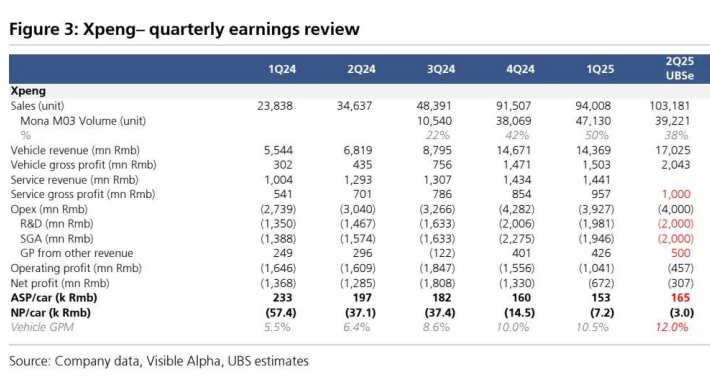
Core Viewpoint - UBS reviews the sales and product mix of major Chinese automakers, previewing second-quarter profits and comparing them with buyer expectations, suggesting that despite concerns over pricing pressures, corporate earnings should remain stable [1] Group 1: New Energy Vehicle Manufacturers - New energy vehicle manufacturers, including Li Auto, NIO, and Xpeng, have shown a quarter-on-quarter increase in sales and moderate improvement in product mix, with UBS expecting Li Auto's profits to grow quarter-on-quarter and NIO and Xpeng's losses to narrow [2] - NIO and Xpeng aim to achieve breakeven net profit by the fourth quarter, with UBS anticipating improved gross margins as cost controls take effect [2] - Li Auto's reduction in computing power leasing costs is expected to aid in controlling R&D expenses, with UBS believing that sales of new models are more critical than profits for these companies [2] Group 2: Traditional Automakers - UBS notes limited high-quality data on quarterly forecasts for traditional automakers but believes investor concerns about price competition are present, leading to moderate overall expectations [3] - BYD's record-high export volume, accounting for 21% of second-quarter sales, is expected to help achieve a net profit of 8,800 yuan per vehicle [3] - Great Wall Motors' high-end brands, Wei and Tank, contribute to 26% of sales, aiding in profit recovery, while Geely's complex structure complicates profit forecasts, though UBS expects earnings to be close to first-quarter levels [3] Group 3: Stock Impact - Since late May, investor sentiment has cooled due to concerns over price competition and signs of unfair competition, leading UBS to adopt a slightly more positive view on the industry [4] - UBS is optimistic about Li Auto's i8 debut at the end of July, BYD's overseas performance, and Great Wall Motors' high-end strategy, while expressing concerns about Xpeng's G7 performance amid fierce competition [4] Group 4: Li Auto (LI.0) - Li Auto delivered 111,000 vehicles in the second quarter, with the L6 model accounting for 52,000 units, representing a 20% quarter-on-quarter increase and a 5% year-on-year increase [5] - UBS predicts a gross margin of 19.5% for Li Auto in the second quarter, slightly lower than the first quarter due to increased pricing pressure [6] - R&D expenses are estimated at 2.6 billion yuan, with sales and management expenses at 2.9 billion yuan, leading to total operating expenses of 5.5 billion yuan, which is stricter than market consensus [6] Group 5: NIO (NIO.N) - NIO delivered 72,000 vehicles in the second quarter, with the Onvo L60 model accounting for 17,000 units, resulting in a 72% quarter-on-quarter increase and a 26% year-on-year increase [7] - UBS estimates a gross margin of 12.5% for NIO, reflecting operational leverage from increased sales [8] - R&D expenses are projected at 3 billion yuan, with sales and management expenses at 4 billion yuan, leading to total operating expenses of 7 billion yuan, slightly below market consensus [8] Group 6: Xpeng (XPEV.N) - Xpeng delivered 103,000 vehicles in the second quarter, with the Mona M03 model accounting for 39,000 units, resulting in a 10% quarter-on-quarter increase and approximately 200% year-on-year increase [9] - UBS expects a gross margin of 12.0% for Xpeng, benefiting from improved product mix and a 45% quarter-on-quarter increase in export volume [9] - R&D expenses are estimated at 2 billion yuan, with sales and management expenses at 2 billion yuan, leading to total operating expenses of 4 billion yuan, aligning with market consensus [9]

头号烈酒集团首任女CEO闪电离职
21世纪经济报道· 2025-07-18 11:02
Core Viewpoint - Diageo's first female CEO, Debra Crew, has resigned after only two years in the role, prompting a search for her successor amid declining performance and market challenges [1][3][4]. Group 1: Leadership Changes - Debra Crew joined Diageo in 2019 and became CEO in June 2023, succeeding Ivan Menezes, who had led the company for a decade and passed away shortly before her appointment [1][6]. - Crew was initially seen as a promising leader due to her extensive experience in the consumer industry and previous success in North America, where she achieved a 14% organic net sales growth [6][7]. Group 2: Performance Decline - Since Crew's appointment, Diageo's stock price has dropped over 43%, with significant declines in key markets such as Latin America and the Caribbean, where organic net sales fell by 23% [3][7]. - The company has faced a broader downturn in demand post-pandemic, with a 3.5% year-on-year decline in sales volume and a need to manage excess inventory [8][9]. Group 3: Cost-Cutting Initiatives - In May 2023, Crew announced a cost-saving plan aimed at achieving $500 million in savings through the sale of several brands [4][11]. - Following her resignation, the future of this "acceleration plan" remains uncertain, as Diageo has already begun selling assets, including its Italian subsidiary and stakes in various brands [12][13]. Group 4: Market Strategy in China - Diageo continues to invest in the Chinese market, including plans for a new whiskey distillery in Yunnan with an investment of 800 million yuan [14]. - The company has a long-standing partnership with Chinese liquor brand Shui Jing Fang, indicating a strategic focus on the Chinese market despite recent leadership changes [15].