
借壳上市

Search documents
追觅科技创始人拟23亿入主嘉美包装,股权受让+要约成科技新贵竞逐A股新路?
Di Yi Cai Jing· 2025-12-18 11:20
Core Viewpoint - The acquisition of Jia Mei Packaging by Zhu Yue Hong Zhi through a combination of share transfer and tender offer has raised speculation about potential reverse mergers in the robotics sector, as it marks the third instance this year of a primary market robotics company gaining control of a secondary market listed company [2][3][6]. Group 1: Acquisition Details - On December 16, Jia Mei Packaging announced that its controlling shareholder plans to transfer 29.9% of its shares to Zhu Yue Hong Zhi, which will also make a tender offer for an additional 25% of shares [2][3]. - The share transfer price is set at 4.45 yuan per share, totaling approximately 1.243 billion yuan, which is slightly below the closing price before the suspension [3]. - After the completion of the transactions, Zhu Yue Hong Zhi will hold 54.9% of Jia Mei Packaging, becoming the new controlling shareholder [3]. Group 2: Financial Performance and Commitments - Jia Mei Packaging has committed to maintaining a net profit of no less than 120 million yuan annually from 2026 to 2030, with cash compensation required if this target is not met [4]. - The company's net profits for the past three years were 17 million yuan, 154 million yuan, and 183 million yuan, indicating rapid growth, but there are concerns about a significant decline in performance in 2025 [4]. - In the first three quarters of 2025, Jia Mei Packaging reported revenues of approximately 2.039 billion yuan, a year-on-year decrease of 1.94%, and a net profit of about 39.16 million yuan, down 47.25% year-on-year [4]. Group 3: Market Implications and Trends - The acquisition has sparked speculation about potential reverse listings for Zhu Yue Hong Zhi's parent company, Duying Technology, which is a leading player in the domestic robotic vacuum market [5]. - Duying Technology holds a 12.4% share of the global market for robotic vacuums as of the first three quarters of 2025, ranking third [5]. - The trend of primary market technology companies acquiring control of secondary market listed companies is becoming more common, with similar cases observed in other robotics firms [6][7].
摸着智元过河,追觅先掏超22亿
3 6 Ke· 2025-12-18 08:19
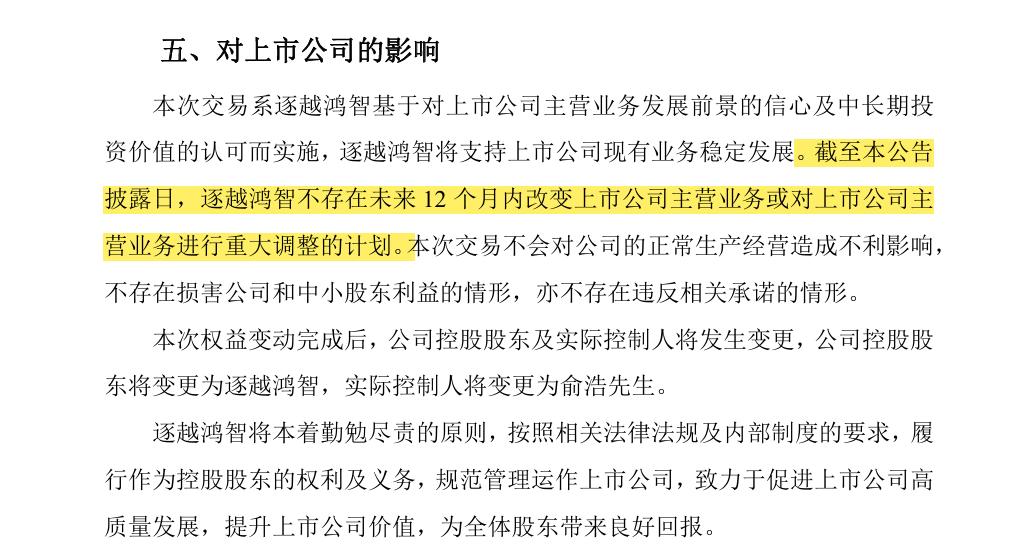
美国同行iRobot刚刚宣布破产,追觅就计划斥资超22亿元买下一家上市公司。按照杉川以近25亿接盘iRobot计算,追觅这笔钱放在对其扫地机等 家电清洁赛道产品的赋能来看,可能并不划算。 12月16日晚间,A股上市企业嘉美包装发布公告,追觅科技创始人俞浩,通过旗下持股平台苏州逐越鸿智,以"协议转让+主动要 约"的组合拳,斥资逾22.82亿元拿下嘉美包装公司控制权。 在这笔收购前,追觅对外的投资出手并不多。 业务边界的扩张,主要内部孵化事业群的模式进行。截至到今年上半年,追觅系有智能清洁事业群、个护事业群、科技机器人事业群、汽车事 业群、大家电事业群等。已布局的产品赛道包括但不限于:家电清洁、运动相机、人形机器人、具身大模型、新能源汽车、3D打印、火锅咖 啡、商业航空等。 不过根据披露的交易公告显示,目前不存在未来12个月内改变上市公司主营业务或对上市公司主营业务进行重大调整的计划。尽管尚未构成实 质性的借壳上市,但是控股股东变更,依然在资本市场受到热捧。 不过,这些公司都是追觅系的孵化业务。嘉美包装这笔交易,可以算是俞浩在原有追觅体系之外的大手笔花销。同时因为嘉美包装是上市公 司,因此这笔交易也被外界猜测为追 ...

追觅借壳上市?俞浩22亿入主嘉美包装
Sou Hu Cai Jing· 2025-12-17 14:02
Group 1 - The core point of the article is that Chasing Technology may be planning a reverse merger with Jiamei Packaging, which has recently undergone a significant share transfer, making Suzhou Zhuyue Hongzhi the new controlling shareholder [2][3] - The transaction involves Suzhou Zhuyue Hongzhi acquiring 54.90% of Jiamei Packaging's shares, with the original controlling shareholder, Zhongbao Hong Kong, selling 29.90% of its shares at a price of 4.45 yuan per share, totaling approximately 1.243 billion yuan [4][5] - Jiamei Packaging is the largest metal can manufacturer in China, with major clients including Yangyuan Beverage, Wanglaoji, and Dali Group, and reported a revenue of 2.04 billion yuan and a net profit of 390 million yuan in the first three quarters of this year [7][8] Group 2 - The total cost of the acquisition is approximately 2.282 billion yuan, which includes 1.243 billion yuan for the share transfer and an estimated 1.039 billion yuan for a tender offer for an additional 25% of shares [8] - The funding for the acquisition will primarily come from the acquirer's own or self-raised funds, with some funds potentially sourced through bank loans, which are currently under negotiation [8][11] - Chasing Technology, a leading robot vacuum company, has reported significant revenue growth, with expectations to exceed 15 billion yuan in total revenue for 2024, indicating a strong market position compared to competitors [12][13] Group 3 - Chasing Technology's founder, Yu Hao, is under some financial pressure due to the company's ambitious expansion plans, including entering the automotive and drone industries, which require substantial capital investment [17][19] - The company has a wide range of business units and product lines, including but not limited to vacuum cleaners, air purifiers, and electric vehicles, indicating a diverse portfolio [21] - Recent rumors about potential bankruptcy have been publicly addressed by Yu Hao, who stated that the company has sufficient cash flow and has repurchased approximately 5 billion yuan of shares to increase his ownership stake [22][23] Group 4 - Influences on Yu Hao and Chasing Technology's expansion include figures like Lei Jun, who has shaped the company's strategic direction, and Chang Jing, who has pursued similar business ventures after separating from Xiaomi's ecosystem [25][28] - The acquisition strategy employed by Zhuyue Hongzhi mirrors that of other companies in the industry, such as Zhiyuan Robotics, which also utilized a similar approach to gain control of a listed company [29]
A股易拉罐生产巨头嘉美包装易主,买家系追觅科技创始人
Nan Fang Du Shi Bao· 2025-12-17 12:53
Core Viewpoint - The acquisition of control over Jia Mei Packaging by Zhu Yue Hong Zhi, associated with Chasing Technology's founder Yu Hao, has sparked speculation about a potential reverse listing for Chasing Technology, despite the differing business focuses of the two companies [2][5]. Group 1: Acquisition Details - Jia Mei Packaging announced on December 16 that it is undergoing a change in control, with its major shareholder, China Food Packaging Co., planning to transfer 279 million shares (29.90% of total shares) to Zhu Yue Hong Zhi [3][4]. - The transaction involves a two-step process: first, the transfer of shares from China Food Packaging to Zhu Yue Hong Zhi, followed by a partial tender offer to acquire an additional 233 million shares (25.00% of total shares) [4][5]. - The total price for the shares in both steps is set at 4.45 yuan per share, amounting to approximately 2.282 billion yuan [4]. Group 2: Company Background - Jia Mei Packaging specializes in the production and sales of three-piece cans, two-piece cans, aseptic paper packaging, and PET bottles, primarily serving the beverage industry [5]. - Zhu Yue Hong Zhi was established in September 2023 and is controlled by Yu Hao, who also founded Chasing Technology, a company focused on high-speed digital motors and intelligent algorithms [3][5]. - The acquisition is positioned as a long-term investment, with Zhu Yue Hong Zhi expressing confidence in Jia Mei Packaging's business prospects and committing to support its existing operations without immediate plans for significant changes [5].
四川一服务员,买下了港股上市公司
Sou Hu Cai Jing· 2025-12-17 12:36
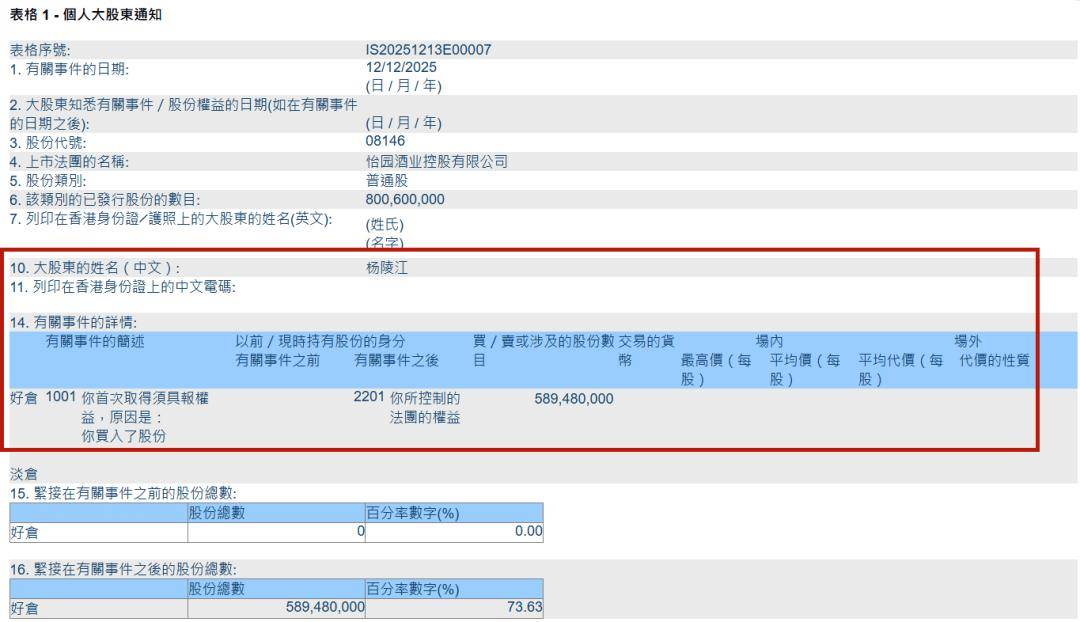
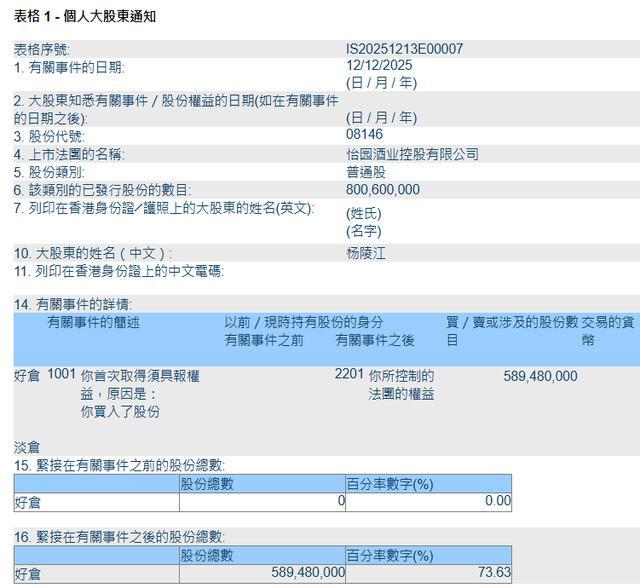
1919创始人、壹玖壹玖集团董事长杨陵江近日收购了港股上市公司怡园酒业(08146.HK) 73.63%的股份,成为其实际控制人。 此次交易不仅是杨陵江对酒业长期价值的看好,也为其雄心勃勃的资本布局增添了新的篇章。 01 从服务员到企业家 杨陵江的创业故事,可谓是白手起家的典范。 1973年出生于四川省凉山彝族自治州甘洛县的他,家境普通。 1995年,杨陵江从四川旅游学校酒店管理专业毕业。 毕业后,为了能留在成都,他选择进入赫赫有名的锦江宾馆工作,干起了服务员。 凭借热情与好学,入职没几个月,他就成了领班,当上了小领导。 然而,月薪800元的收入并未能满足他对赚钱的渴望。 期间通过酒吧兼职,他对酒水市场的运作方式有了一定的认识。 再三考虑后,他于1998年从锦江宾馆离职,转行成为酒水经销商。 据悉,杨陵江首笔40万元创业资金几乎全部来自他在锦江宾馆服务过的客人。 接下来的几年中,杨陵江通过不断扩展销售渠道,成功积累了财富与经验。 2006年,他在成都创立"1919酒类直供"品牌,从中间商转型为直接面向消费者的终端商,并开设了第一家门店。 在当时,零售终端模式在酒类行业尚属新兴,杨陵江凭借敏锐的市场嗅觉迅速抓住 ...
胜通能源(001331.SZ):收购方不存在未来36个月内通过上市公司借壳上市的计划或安排
Ge Long Hui A P P· 2025-12-17 09:46
格隆汇12月17日丨胜通能源(001331.SZ)公布,截至目前,收购方不存在未来十二个月内的资产重组计 划。截至目前,公司主营业务仍为液化天然气采购、运输及销售,未发生重大变化。收购方截至目前不 存在未来12个月内对上市公司及其子公司的资产和业务进行出售、合并、与他人合资或合作的计划,或 上市公司拟购买或置换资产的重组计划。截至目前,收购方不存在未来36个月内通过上市公司借壳上市 的计划或安排。 ...
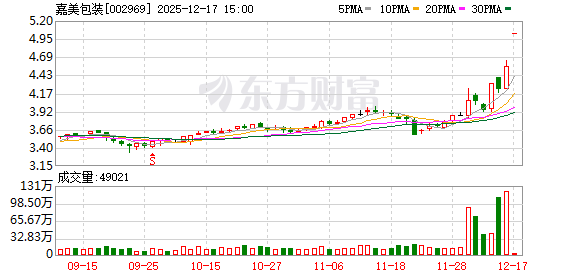
嘉美包装22.82亿元易主股票涨停 追觅科技创始人接盘引发借壳猜想
Chang Jiang Shang Bao· 2025-12-17 09:07
Core Viewpoint - The founder of ZhiMi Technology, Yu Hao, is set to invest approximately 2.282 billion yuan to acquire control of JiaMei Packaging (002969.SZ) through a two-step process involving a share transfer and a tender offer [1][2]. Group 1: Acquisition Details - The first step involves a share transfer agreement where JiaMei Packaging's controlling shareholder, ZhongBao HongKong, will transfer 279 million shares (29.9% of total shares) to Suzhou ZhuYue HongZhi Technology Development Partnership at a price of 4.45 yuan per share, totaling 1.243 billion yuan [1]. - The second step will see ZhuYue HongZhi issue a tender offer to acquire approximately 233 million shares (25% of total shares) from other shareholders at the same price of 4.45 yuan per share, with ZhongBao HongKong committing to accept the offer for its 11.02% stake [1][2]. Group 2: Ownership and Market Impact - If the share transfer and tender offer are completed, ZhuYue HongZhi will hold a total of 54.9% of JiaMei Packaging, with the total transaction value around 2.282 billion yuan, resulting in a change of control from Chen Min and Li CuiLing to Yu Hao [2]. - Following the announcement, JiaMei Packaging's stock hit the daily limit, reflecting market speculation about ZhiMi Technology potentially seeking a reverse merger for listing [3]. Group 3: Company Background and Commitments - JiaMei Packaging is one of the largest metal can manufacturers in China, holding a significant market share in three-piece cans and related printing iron business, with major clients including well-known brands like Yangyuan Beverage, Wanglaoji, and Nongfu Spring [3]. - To ensure a smooth transition, ZhongBao HongKong and JiaMei Packaging's current controlling shareholders have committed to maintaining a minimum annual net profit of 120 million yuan for the next five fiscal years (2026-2030), with cash compensation required if this target is not met [3].
杨陵江控股怡园酒业,壹玖壹玖“借壳上市”猜想升温
Huan Qiu Wang Zi Xun· 2025-12-17 04:23
Core Viewpoint - The acquisition of a controlling stake in Yiyuan Wine Industry by Yang Lingjiang, founder of the new retail giant Yijiujiu, is seen as a strategic move to restart the company's capital process after a year-long hiatus from the capital market [1]. Group 1: Acquisition Details - Yang Lingjiang acquired a 73.63% stake in Yiyuan Wine Industry (08146.HK), becoming its controlling shareholder and actual controller [1][2]. - The acquisition is interpreted as a "backdoor listing" for Yijiujiu, which has been rumored to be planning an IPO since its delisting from the New Third Board in mid-2023 [1][4]. Group 2: Financial Context - Yijiujiu has recently faced rumors of a tight cash flow, but Yang Lingjiang stated that the company has repaid over 6 billion yuan in debt, reducing its debt ratio from 92% to below 20% by the end of the year [1]. - Despite a 42.5% year-on-year revenue growth in the first half of 2025, Yiyuan Wine Industry reported a net loss of 2.745 million yuan [3][4]. Group 3: Strategic Implications - Yang Lingjiang's acquisition is expected to bring new business models and operational strategies to Yiyuan Wine Industry, potentially revitalizing its operations amid industry-wide declines [4]. - The acquisition provides a platform for Yang to integrate overseas wine and whiskey businesses into Yiyuan, enhancing its asset value and capital operations [4][5]. - The move is seen as a combination of "bottom-fishing" and strategic positioning, allowing for the consolidation of undervalued assets during a market downturn [5].
杨陵江控股港股酒企怡园酒业 1919有望“重新”上市
2 1 Shi Ji Jing Ji Bao Dao· 2025-12-16 01:00
Core Viewpoint - 1919, a prominent player in China's liquor retail market, is set to re-enter the capital market through a significant acquisition of 73.63% of Yiyuan Wine Industry by its founder Yang Lingjiang, positioning it as a key platform for future growth and expansion in the wine sector [1][2]. Group 1: Company Overview - 1919 is recognized as one of the earliest instant retail brands for liquor in China, boasting over 3,000 stores and a strong online presence [2]. - Yiyuan Wine Industry, known for its premium wine production, was the first boutique winery to go public in Hong Kong in 2018, transitioning from family control to a publicly traded company [2]. Group 2: Financial Performance - Yiyuan Wine Industry has faced declining performance, recording losses of approximately 600,000 yuan in 2022 and around 4.1 million yuan in 2024, with a loss of 274,500 yuan in the first half of 2025 [3]. - The company's market capitalization fell to about 200 million HKD before its recent suspension, categorizing its stock as a "penny stock" [3]. Group 3: Strategic Implications - The acquisition provides Yang Lingjiang an opportunity to capitalize on Yiyuan's low market valuation, with the company's net assets estimated at around 226 million yuan by the end of 2024 [4]. - Yang Lingjiang aims to build a comprehensive liquor platform by integrating 1919 and other brands into Yiyuan, aligning with his long-term goal of achieving a market valuation of 100 billion yuan within the next 5-10 years [4][5]. - The trend of mainland companies seeking listings in Hong Kong due to stringent A-share regulations highlights the strategic importance of this acquisition for expanding market access [4].
胜通能源近17亿易主七腾机器人 借壳上市预期刺激股票两涨停
Chang Jiang Shang Bao· 2025-12-16 00:05
Core Viewpoint - The A-share market is expected to see the emergence of a new company similar to "Shangwei New Materials," with the focus on the acquisition of Victory Energy (001331.SZ) by Qiteng Robotics, which is anticipated to lead to a shell listing [1][9]. Group 1: Acquisition Details - Victory Energy's controlling shareholder and actual controller, Wei Jisheng, Zhang Wei, and others, plan to transfer 29.99% of their shares to Qiteng Robotics and its concerted parties [2][8]. - The acquisition price is set at 13.28 yuan per share, with a total transaction value of approximately 1.686 billion yuan [3][8]. - Following the transfer, Qiteng Robotics will launch a partial tender offer for an additional 15% of Victory Energy's shares, bringing its total ownership to 44.99% [2][8]. Group 2: Market Reaction - Victory Energy's stock experienced two consecutive trading halts and subsequently surged to 17.85 yuan per share following the announcement of the acquisition [6][9]. - The market perceives this acquisition as a strategic move for Qiteng Robotics to facilitate its own industry deployment or capital operations, effectively serving as a shell listing [9]. Group 3: Qiteng Robotics Background - Qiteng Robotics has established itself as a high-tech enterprise specializing in the design, research, development, production, sales, and service of special robots, having served over a thousand enterprises globally [12]. - The company has developed a complete AI technology chain with 8 core technologies and 468 algorithms, and has received investments from several A-share listed companies [12]. - In 2024, Qiteng Robotics reported a revenue of 930 million yuan, a year-on-year increase of 50.2%, and a net profit of 117 million yuan, up 35.4% [13]. Group 4: Victory Energy's Performance - Victory Energy primarily engages in LNG business in both domestic and international markets, achieving a revenue of 4.513 billion yuan and a net profit of 44.39 million yuan in the first three quarters of 2025, representing year-on-year growth of 21.34% and 83.58%, respectively [13]. - The actual controller of Victory Energy has committed to maintaining profitability in existing operations over the next three years [5].