
期权交易

Search documents
Aramark: Better Upside In Alternatives, But A 'Buy' (Rating Upgrade) (NYSE:ARMK)
Seeking Alpha· 2025-11-17 15:07
Core Viewpoint - The article discusses the expertise of a senior analyst and private portfolio manager with over 10 years of experience in generating value ideas in European and North American markets [1]. Group 1: Analyst Background - The analyst is a contributing author and analyst for the investing group iREIT®+HOYA Capital and Wide Moat Research LLC, covering various European markets including Scandinavia, Germany, France, UK, Italy, Spain, Portugal, and Eastern Europe [1]. - The focus is on identifying reasonably valued stock ideas within these markets [1]. Group 2: Investment Position - The analyst holds a beneficial long position in the shares of SDXAY through stock ownership, options, or other derivatives [1].



Aramark: Better Upside In Alternatives, But A 'Buy' (Rating Upgrade)
Seeking Alpha· 2025-11-17 15:07
Core Insights - The article discusses the expertise of a senior analyst and private portfolio manager with over 10 years of experience in generating value ideas in European and North American markets [1] Group 1: Analyst Background - The analyst is a contributing author and analyst for the investing group iREIT®+HOYA Capital and Wide Moat Research LLC, covering various European markets including Scandinavia, Germany, France, UK, Italy, Spain, Portugal, and Eastern Europe [1] Group 2: Investment Focus - The analyst focuses on identifying reasonably valued stock ideas within the mentioned markets, indicating a strategic approach to investment opportunities [1]

海纳百川有容乃大——第十九届全国期货(期权)实盘交易大赛总结报告
Qi Huo Ri Bao Wang· 2025-11-17 00:52
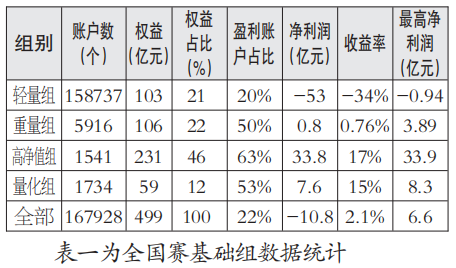
Core Insights - The 19th National Futures (Options) Trading Competition saw a total of 167,928 participating accounts, with total equity reaching 49.9 billion yuan, marking an increase of 11.22% compared to the previous competition [4][5][6] - Professional traders demonstrated a significant advantage, with over half of the profits coming from them, while smaller traders faced increased losses [1][11] - The competition highlighted a shift towards institutionalization in the trading landscape, with high-net-worth and quantitative groups showing substantial profitability [35][36] Participation and Equity - The total number of participating accounts increased by 3.91% compared to the last competition, with the high-net-worth group seeing a growth of 5.84% [4][5] - Total equity peaked at 52.2 billion yuan during the competition, with 499 billion yuan recorded at the end [4][6] - The average equity per account in the high-net-worth group rose to 15.01 million yuan, an increase of 206,000 yuan from the previous year [6] Profitability Analysis - The overall loss for the competition was 2.1%, a significant improvement from the previous year's loss of 5.2% [11][12] - The high-net-worth group achieved a profit of 33.8 million yuan, while the quantitative group made 7.6 million yuan, both marking their third consecutive year of profitability [9][11] - The lightweight group, however, recorded a loss of 53 million yuan, the highest in five years [9][11] Trading Volume and Performance - A total of 80 futures varieties were traded, with a transaction volume of 450 million contracts, and the top five by volume included glass, soda ash, and焦煤 [29][30] - The trading volume for the lightweight group accounted for 53% of total transactions, despite having a lower equity share [30] - The competition saw a notable increase in the number of accounts trading options, with 66,354 accounts participating, representing 39.51% of total accounts [28][33] Market Trends and Insights - The competition's profitability was closely tied to market trends, with participants capitalizing on bullish trends in precious metals and stock index futures [19][31] - The high-net-worth and quantitative groups displayed superior market handling, effectively mitigating the impact of market volatility on profits [21][36] - The competition served as a platform for talent development, with many successful participants being recruited by private equity and risk management firms post-competition [35][36]
Applied Materials Stock on Track for Worst Week Since August
Schaeffers Investment Research· 2025-11-14 15:37
Group 1 - Applied Materials Inc (NASDAQ:AMAT) shares are down 2.3% to $218.16 despite better-than-expected fiscal fourth-quarter results, primarily due to a lackluster full-year revenue outlook and predictions of lower spending in China amid U.S. restrictions [1] - Eight analysts have raised their price targets, with B. Riley increasing its target to $270 from $265, indicating a generally bullish sentiment among analysts, as 21 out of 35 brokerages have a "buy" or better rating, and the 12-month consensus target price is $233.62, representing a 7.1% premium to current levels [2] - The stock is on track for its largest weekly drop since August, pulling back from its 52-week high of $242.50, but a support level around $200 is expected to contain losses, with the stock still showing a 34% lead for 2025 [3] Group 2 - Today's options activity shows 19,000 calls and 20,000 puts traded, which is six times the typical volume, with the most active contract being the weekly 11/14 200-strike put, indicating new positions being opened [4] - The security typically outperforms options traders' volatility expectations, as indicated by a Schaeffer's Volatility Scorecard (SVS) score of 94 out of 100 [4]


实盘大赛颁奖大会15日将在西安举行
Qi Huo Ri Bao Wang· 2025-11-11 01:27
Core Insights - The "2025 Global Futures Traders Conference and the 19th National Futures (Options) Live Trading Competition Award Ceremony" will take place on November 15 in Xi'an, emphasizing the theme "Embracing Diversity" to highlight the inclusive and multifaceted nature of the futures market [1] - The event has attracted over 1,500 participants, including traders, futures companies, spot enterprises, private equity funds, banks, brokerages, fintech service providers, and individual investors [1] - The theme "Embracing Diversity" reflects the core spirit of futures trading, encouraging effective, compliant, and stable strategies regardless of the approach, whether based on fundamental insights, quantitative models, or short-term trading [1] Event Highlights - The award ceremony will feature speeches from notable participants, including the ninth place winner of the global competition, Gu Mingzhe, and the national competition champions, Zhang Shenxiang and Xie Libo, who will share their insights and investment philosophies [2] - Two high-profile parallel forums will be held: the Professional Traders Forum and the Institutional Investors Forum, focusing on practical trading strategies and the application of derivatives from institutional and industrial perspectives [3] - The event will conclude with a follow-up activity titled "Options Winners Circle: Champion Strategy Integration Private Sharing Session," aimed at providing in-depth learning opportunities for participants interested in options trading [4]
化工品月均价期货合约上市,这些交易时间您得记牢了
Sou Hu Cai Jing· 2025-11-04 11:14
Group 1 - The futures market has listed a total of 148 futures and options products, with trading times organized for over a hundred products [3][5][12] - Specific trading times for various futures and options products are provided, including day and night sessions [6][7][8] - Certain products, marked as special varieties, require separate trading permissions to participate, such as soybean oil, PTA, and stock index futures [12] Group 2 - The introduction of foreign traders to palm oil options occurred on June 18, 2021, and to soybean options on December 26, 2022 [5] - Trading hours for different exchanges are detailed, including the Shanghai Futures Exchange and the Zhengzhou Commodity Exchange [6][7] - The document emphasizes the need for traders to understand the specific requirements for trading special products [11][12]

棉花、棉纱日报-20251103
Yin He Qi Huo· 2025-11-03 11:39
Report Industry Investment Rating - Not provided in the report Core Viewpoints - The report predicts that Zhengzhou cotton (Zhengmian) is likely to fluctuate, with limited upward and downward space. The supply side features a large number of new flowers on the market, with a significant increase in production this year but the increase may be less than expected. The demand side enters a relatively off - season after the peak season, and previous negative factors have been mostly reflected in the market. Meanwhile, future Sino - US trade policies may have a significant impact on the market [7]. - It is expected that the future trend of US cotton will mostly be in a fluctuating state, while Zhengzhou cotton is expected to show a slightly stronger fluctuating trend. For trading strategies, it is recommended to wait and see for arbitrage and options [8][9][10]. Summary by Relevant Catalogs First Part: Market Information - **Futures Market**: The closing prices of CF01, CF05, and CF09 contracts of cotton futures are 13,600, 13,615, and 13,780 respectively, with corresponding increases of 5, 10, and 25. The closing prices of CY01, CY05, and CY09 contracts of cotton yarn futures are 19,920, 0, and 0 respectively, with corresponding increases of 45, - 19,920, and - 20,085. There are also data on trading volume, open interest, and their changes [2]. - **Spot Market**: The price of CCIndex3128B is 14,859 yuan/ton, up 16 yuan/ton; the price of Cot A is 76.45 cents/pound, up 77.40 cents/pound; the price of (FC Index):M: to - port price is 75.60 cents/pound, down 0.80 cents/pound. There are also prices and price changes of other spot products [2]. - **Spread**: In cotton inter - period spreads, the spread between January and May is - 15, down 5; between May and September is - 165, down 15; between September and January is 180, up 20. In cotton yarn inter - period spreads, the spread between January and May is 19,920, up 19,965; between May and September is 0, up 165; between September and January is - 19,920, down - 20,130. There are also cross - variety spreads and internal - external spreads [2]. Second Part: Market News and Views Cotton Market News - On November 3, 2025, the price of China Cotton Price Index 3128B was 14,859 yuan/ton, down 1 yuan/ton from last Friday; the price of 2129B was 15,137 yuan/ton, up 7 yuan/ton. The delivery price of machine - picked cotton in Xinjiang was 14,530 yuan/ton for 3128B, down 10 yuan/ton; 14,820 yuan/ton for 2129B, unchanged from last Friday. The main contract of Zhengzhou cotton opened higher and then fluctuated downward on Friday, with the basis quote basically stable and the spot transaction price relatively stable [4]. - On November 2, 2025, the acquisition index of machine - picked cotton in Xinjiang was 6.30 yuan/kg, down 0.01 yuan/kg from the previous day; the acquisition index of hand - picked cotton was 7.04 yuan/kg, unchanged from the previous day. In Aksu, the lint percentage of seed cotton purchased by some ginneries was 0.5% - 1.0% lower than last year, and the purchase price of high - lint - percentage seed cotton remained at about 6.4 - 6.5 yuan/kg [5]. - In September 2025, Japan's clothing imports entered the peak season, with both the import volume and value increasing significantly compared to the previous month. The import value was 372.276 billion yen (equivalent to 2.524 billion US dollars), a year - on - year increase of 7.52% and a month - on - month increase of 13.12%. The import volume was 110,000 tons, a year - on - year increase of 5.13% and a month - on - month increase of 21.91%. From January to September, Japan's cumulative clothing import value was 2,685.447 billion yen (equivalent to 18.103 billion US dollars), a year - on - year increase of 5.1%, and the cumulative import volume was 713,200 tons, a year - on - year increase of 6.69% [5]. - As of October 27, 2025, the total cotton inventory in Zhangjiagang Free Trade Zone was 33,100 tons, a year - on - year decrease of 0.42%. Among them, bonded cotton was 3.07 tons, a year - on - year decrease of 0.43%; non - bonded cotton was 2,200 tons, a year - on - year decrease of 0.26%. In terms of the origin of imported cotton, in the cotton inventory of Zhangjiagang Free Trade Zone, US cotton accounted for 26.64%, a year - on - year decrease of 20.87 percentage points; Brazilian cotton accounted for 23.38%, a year - on - year increase of 4.37 percentage points; Australian cotton accounted for 45.94%, a year - on - year increase of 14.29 percentage points; other countries and regions accounted for 4.05%, a year - on - year increase of 2.21 percentage points. The net inbound volume was - 807.15 tons, with 1,154.15 tons out of storage and 347 tons into storage. The inventory in Zhangjiagang decreased slightly, and cotton imports continued to recover in September and October, with an increase in US and Brazilian cotton arriving in Hong Kong, but the outbound speed accelerated, leading to a decline in storage capacity [6]. Trading Logic - In terms of fundamentals, with a large number of new flowers on the market in November, there may be some selling and hedging pressure in the market. Although this year's cotton production is a bumper harvest, the expected increase may be less than previously thought. On the demand side, after the peak season, the market enters a relatively off - season. Overall, with a large number of new flowers on the market on the supply side and a significant increase in production this year but the increase may be less than expected, and with average recent orders on the demand side but previous negative factors already reflected in the market, Zhengzhou cotton is expected to fluctuate, with limited upward and downward space. In addition, there may be trade negotiations between China and the US, and the Sino - US tariff agreement expires in November, so future Sino - US trade policies may have a significant impact on the market [7]. Trading Strategies - **Unilateral**: It is expected that the future trend of US cotton will mostly be in a fluctuating state, while Zhengzhou cotton is expected to show a slightly stronger fluctuating trend [8]. - **Arbitrage**: Wait and see [9]. - **Options**: Wait and see [10]. Cotton Yarn Industry News - Although the macro - atmosphere improved slightly last week and market confidence recovered to some extent, the actual downstream demand did not improve significantly, and there was still significant hedging pressure on cotton. After some quotes of pure cotton yarn were tentatively raised, the market returned to calm, and most actual transaction prices changed little. Due to the lack of order support, only a few varieties had good sales, such as C40, high - count export varieties, and low - count compact - spun yarn. Most air - jet spun and combed yarns had relatively slow sales, and the market mainly consisted of small, urgent, and necessary orders. In the future, it is necessary to continue to pay attention to the recovery of downstream demand and the trend of Zhengzhou cotton. The current tax - included cash price of high - compact C32S produced in Jiangsu is 21,300 - 21,500 yuan/ton, subject to negotiation for actual orders [10]. - The spot market for all - cotton grey cloth remained weak, with insufficient trading atmosphere. The quantity and price of pure - cotton cloth in the spot market were weak, so fabric mills mostly purchased raw materials as needed. Downstream customers mainly placed necessary orders. With weak terminal demand, the operation space was reduced, and most customers adopted a wait - and - see attitude towards the fabric mills' dumping information. Even if the price was discounted, they were reluctant to stock up without orders [10]. Third Part: Options - **Option Contract Data**: On November 3, 2025, for the option contract CF601C13400.CZC, the underlying contract price was 13,600, the closing price was 260, and the decline was 10.0%. For CF601P13000.CZC, the closing price was 25, and the decline was 34.2%. For CF601P12400.CZC, the closing price was 8, and the decline was 60.0%. There are also data on implied volatility, Delta, Gamma, Vega, Theta, theoretical leverage, and actual leverage [12]. - **Volatility and Trading Suggestion**: The 120 - day historical volatility (HV) of cotton decreased slightly compared to the previous day. The implied volatility of CF601 - C - 13400 was 7.5%, that of CF601 - P - 13000 was 10.8%, and that of CF601 - P - 12400 was 14.7%. The PCR of the main contract of Zhengzhou cotton was 0.7135, and the PCR of the trading volume of the main contract was 0.7629. The trading volumes of both call and put options decreased today. It is recommended to wait and see for options [13][14]. Fourth Part: Relevant Attachments - The report provides multiple charts, including the chart of the internal - external market cotton price difference under 1% tariff, the charts of cotton basis for January, May, and September, the charts of the spread between CY05 and CF05, CY01 and CF01, CF9 - 1, and CF5 - 9 [15][19][20].
先锋期货期权日报-20251103
Xian Feng Qi Huo· 2025-11-03 09:19
1. Report Summary - Report Date: November 3, 2025 [1] - Report Name: Pioneer Futures Options Daily Report 2. Options Underlying Volatility Ranking - The report presents a ranking of options underlying based on three volatility metrics: implied volatility of at - the - money options, 30 - day historical volatility of the underlying, and the underlying's true range on the day. For example, ps2512 ranks first in implied volatility of at - the - money options with 3.1%, while rm601 ranks first in the underlying's true range on the day with 4.8% [3][4]. - The implied volatility of at - the - money options reflects the market's expectation of future fluctuations of the variety, the 30 - day historical volatility reflects the past actual market size, and the true range on the day reflects the intraday market size [5]. 3. Exchange - Specific Options Analysis 3.1 Shanghai Stock Exchange Options 3.1.1 Shanghai 50ETF - **Basic Information**: The trading volume of the main options of Shanghai 50ETF on the day is 632,460 lots, the open interest is 897,163 lots, the trading volume ratio of call options to put options is 1.45, and the weighted average implied volatility is 15.93% [19][21]. - **Volatility Trading**: Volatility trading suggestions include selling the month with the curve on top and buying the month with the curve below for different months, and selling the option with the point above the curve and buying the option with the point below the curve for the same month [26]. - **Risk - Free Arbitrage**: The minimum annualized return of the optimal arbitrage portfolio held to maturity is 4.67% when trading at the settlement price and 1.16% when trading at the counter - party price [28][30]. 3.1.2 Huatai - Berry SSE 300ETF - **Basic Information**: The trading volume of the main options of Huatai - Berry SSE 300ETF on the day is 670,871 lots, the open interest is 740,234 lots, the trading volume ratio of call options to put options is 1.23, and the weighted average implied volatility is 16.61% [31][33]. - **Volatility Trading**: Similar to Shanghai 50ETF, sell the month with the curve on top and buy the month with the curve below for different months, and sell the option with the point above the curve and buy the option with the point below the curve for the same month [37]. - **Risk - Free Arbitrage**: The minimum annualized return of the optimal arbitrage portfolio held to maturity is 4.45% when trading at the settlement price and 0.18% when trading at the counter - party price [40][42]. 3.1.3 Southern CSI 500ETF - **Basic Information**: The trading volume of the main options of Southern CSI 500ETF on the day is 1,244,691 lots, the open interest is 790,230 lots, the trading volume ratio of call options to put options is 0.9, and the weighted average implied volatility is 20.66% [43][45]. - **Volatility Trading**: Follow the same volatility trading suggestions as above [49]. - **Risk - Free Arbitrage**: The minimum annualized return of the optimal arbitrage portfolio held to maturity is 25.3% when trading at the settlement price and 5.60% when trading at the counter - party price [52][54]. 3.1.4 Huaxia SSE STAR 50ETF - **Basic Information**: The trading volume of the main options of Huaxia SSE STAR 50ETF on the day is 995,460 lots, the open interest is 1,173,825 lots, the trading volume ratio of call options to put options is 1.15, and the weighted average implied volatility is 37.4% [55][57]. - **Volatility Trading**: Adopt the same volatility trading strategies [62]. - **Risk - Free Arbitrage**: The minimum annualized return of the optimal arbitrage portfolio held to maturity is 12.3% when trading at the settlement price and 0.66% when trading at the counter - party price [64][66]. 3.1.5 E Fund SSE STAR 50ETF - **Basic Information**: The trading volume of the main options of E Fund SSE STAR 50ETF on the day is 194,205 lots, the open interest is 286,584 lots, the trading volume ratio of call options to put options is 1.34, and the weighted average implied volatility is 38.24% [67][68]. - **Volatility Trading**: Use the same volatility trading methods [72]. - **Risk - Free Arbitrage**: The minimum annualized return of the optimal arbitrage portfolio held to maturity is 14.6% when trading at the settlement price and 2.75% when trading at the counter - party price [76][78]. 3.2 Shenzhen Stock Exchange Options 3.2.1 Harvest SSE 300ETF - **Basic Information**: The trading volume of the main options of Harvest SSE 300ETF on the day is 126,768 lots, the open interest is 151,843 lots, the trading volume ratio of call options to put options is 0.96, and the weighted average implied volatility is 17.72% [79][81]. - **Volatility Trading**: Apply the same volatility trading suggestions [87]. - **Risk - Free Arbitrage**: The minimum annualized return of the optimal arbitrage portfolio held to maturity is 19.4% when trading at the settlement price and 1.52% when trading at the counter - party price [89][91].
Here's How To Capitalize On Palantir's Volatility With This Options Strategy
Investors· 2025-10-31 15:46
Core Insights - Palantir (PLTR) is set to report earnings, with the options market anticipating a 10.5% price movement in either direction, indicating high implied volatility of 88% compared to its usual 60% [1][3] - The strategy of selling cash-secured puts is highlighted as a way to capitalize on this volatility, allowing traders to either keep the premium or acquire the stock at a lower price [1][6] Cash-Secured Put Strategy - A trader selling the Nov. 7 put with a strike price of 182.50 can generate approximately $335 in premium per contract, with a 79% chance of the option expiring worthless [3][4] - The break-even price for this trade is calculated at 179.15, which is 11% below the current trading price of around 201.20, offering a potential return of 1.87% in a few days, equating to an annualized return of 85% [4][6] Company Performance and Ratings - Palantir holds a Composite Rating of 99, an Earnings Per Share Rating of 98, and a Relative Strength Rating of 97, ranking first in its group according to Investor's Business Daily [7] - The company specializes in data integration and analytics platforms, serving government agencies and commercial enterprises, and is known for its work with the U.S. Department of Defense [7][8] Market Context - Palantir stock has reached a new record high ahead of its Q3 earnings report, although concerns exist regarding potential impacts from a U.S. government shutdown on Q4 guidance [10][12]
