
经济增长预期

Search documents
欧元区通胀维持温和 拉加德表态谨慎压制欧元
Jin Tou Wang· 2025-08-26 03:01
Group 1 - The euro against the US dollar rose to around 1.16, with a current quote of 1.1632, reflecting a 0.15% increase from the previous close of 1.1615 [1] - Eurozone's July CPI data remained consistent with initial estimates, showing an overall inflation rate of 2.0% year-on-year, meeting expectations [1] - Core inflation decreased by 0.2% month-on-month, with a year-on-year increase of 2.3%, indicating no significant acceleration in inflation, alleviating market concerns about rising inflation [1] Group 2 - ECB President Lagarde expressed a cautious outlook on economic growth for Q4, suggesting potential downward pressure on the Eurozone economy despite its resilience amid multiple shocks [1] - Lagarde's statements did not provide clear hawkish or dovish signals, maintaining a neutral stance in light of inflation not exceeding expectations and ongoing economic uncertainties [1] - The market is awaiting further data and policy signals to clarify direction, as the euro did not gain significant upward momentum from Lagarde's remarks [1]
韩国政府下调今年经济增长预期至0.9%
Xin Hua Cai Jing· 2025-08-22 08:02
Group 1 - The South Korean government has revised its GDP growth forecast for this year down to 0.9% [1] - The government anticipates that the economic growth rate will double next year to 1.8% [1] - Economic growth was weak in the first quarter (0%) and second quarter (0.5%), but a recovery is expected in the second half of the year due to policy measures such as supplementary budgets [1] Group 2 - The growth forecast takes into account various negative factors, including emergency measures, impeachment issues, and new U.S. tariff policies [1] - The forecast does not reflect the recent U.S. announcement of separate tariffs on semiconductors [1]
新加坡7月出口同比下降4.6%,跌幅远超预期
Sou Hu Cai Jing· 2025-08-18 00:54
Core Insights - Singapore's non-oil domestic exports in July fell by 4.6% year-on-year, exceeding analyst expectations of a 1.8% decline, primarily due to a drop in pharmaceutical exports [1][1][1] - The Singapore government raised its economic growth forecast for 2025 from a range of 0.0%-2.0% to 1.5%-2.5% following better-than-expected performance in the first half of the year [1][1][1] - Despite a free trade agreement with the U.S. and a trade deficit with the U.S., Singapore is still subject to a 10% tariff, which may impact future economic growth [1][1][1] Export Performance - Non-oil exports to the U.S., China, and Indonesia decreased in July, while exports to the EU, Taiwan, South Korea, and Hong Kong increased [1][1][1] - The Singapore Economic Development Board maintained its forecast for non-oil export growth at 1%-3% for the year, anticipating some weakness in the second half of 2025 [1][1][1] Trade Policy Concerns - Singapore's Prime Minister expressed uncertainty regarding potential increases in U.S. tariffs on specific industries such as pharmaceuticals and semiconductors, highlighting the pressure on small open economies due to rising trade barriers [1][1][1]
【环球财经】日本二季度实际GDP环比微增0.3%
Xin Hua Cai Jing· 2025-08-15 05:53
Group 1 - Japan's real GDP grew by 0.3% quarter-on-quarter in Q2, translating to an annualized growth rate of 1.0% [1] - Personal consumption, which accounts for over half of Japan's economy, increased by 0.2% quarter-on-quarter, while business investment in equipment rose by 1.3% and residential investment grew by 0.8% [1] - Public demand, including government consumption and public investment, decreased by 0.3%, contributing negatively to domestic demand growth [1] Group 2 - The Japanese Cabinet Office revised its economic growth forecast for the fiscal year 2025 from 1.2% to 0.7%, citing the impact of U.S. tariff policies on Japan's exports [2] - The decline in exports to the U.S. is expected to have a direct effect, while reduced exports from other countries to the U.S. will indirectly affect Japan's exports of intermediate goods [2]
韩国智库维持2025年增长预期 但出口疲软仍压经济
Xin Hua Cai Jing· 2025-08-12 05:52
Core Viewpoint - The Korea Development Institute (KDI) maintains its economic growth forecast for South Korea at 0.8% for this year, despite the last-minute trade agreement with the U.S. that mitigated the impact of punitive tariff increases [1] Economic Growth Forecast - KDI's forecast for South Korea's economic growth remains unchanged at 0.8% for this year, consistent with its May prediction [1] - The positive impact of government stimulus plans on consumer confidence is being offset by declining construction investment and ongoing weak exports due to U.S. tariff increases [1] Trade Agreement Impact - The recent trade agreement reduced the proposed U.S. tariff cap on South Korean exports from 25% to 15%, helping South Korea avoid more severe economic repercussions [1] - However, the new terms are less favorable than the Korea-U.S. Free Trade Agreement, and KDI warns that current tariff levels and uncertainties remain high compared to previous years [1] Export Growth Outlook - KDI projects only moderate growth in goods exports over the next two years, as the negative effects of tariff increases are expected to become apparent starting in the second half of this year [1]
利好突袭,韩国股市大涨
Zheng Quan Shi Bao· 2025-08-05 02:15
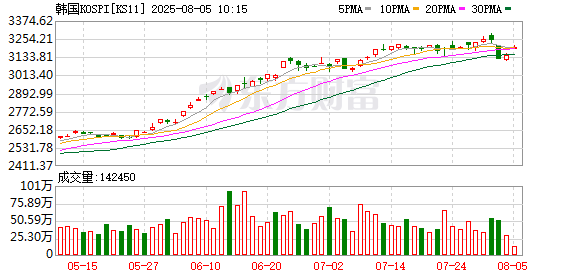
Market Performance - The South Korean stock market experienced a significant rebound, with the KOSPI index rising over 2% during intraday trading, driven by strong performances in the information technology, healthcare, and financial sectors [1][3] - As of the latest report, the KOSPI index maintained a gain of approximately 1.9%, with notable increases in individual stocks such as Sk Biopharma (up over 16%) and Samsung SDI (up over 12%) [3] Economic Outlook - The South Korean government plans to utilize all policy tools, including fiscal, tax, and regulatory reforms, to achieve an economic growth forecast of 1% for the year, which is higher than the predictions from the Bank of Korea and the International Monetary Fund [3] - The Consumer Price Index (CPI) for July showed a year-on-year increase of 2.1%, marking the second consecutive month of inflation exceeding 2% [3][4] Price Trends - The prices of agricultural products, particularly fruits and vegetables, have surged due to extreme heat, with the average retail price of watermelon reaching 33,337 KRW (approximately 173 RMB), reflecting a 33.7% increase from the previous month and a 17.6% increase from the same period last year [5][7] - Other notable price increases include tomatoes, which saw a nearly 70% rise month-on-month, and cabbages, which increased by 68% [7] Weather Impact - South Korea is experiencing one of the most severe heatwaves on record, with July temperatures reaching 33 degrees Celsius or higher on 15 days, significantly impacting agricultural production and prices [8]
利好突袭!韩国股市大涨!蔬果价格暴涨 西瓜平均零售价高达173元人民币
Zheng Quan Shi Bao Wang· 2025-08-05 02:14
Market Performance - The South Korean stock market experienced a significant rebound, with the KOSPI index rising over 2% during intraday trading [2][3] - Key sectors such as information technology, healthcare, and finance showed strong performance, with IT and healthcare sectors increasing by over 3% [3] - Notable individual stock performances included SK Biopharma rising over 16% and Samsung SDI increasing over 12% [3] Economic Outlook - The South Korean government plans to utilize all policy tools, including fiscal, tax, and regulatory reforms, to achieve an economic growth forecast of 1% for the year, which is higher than the predictions from the Bank of Korea and the IMF [3] - The Consumer Price Index (CPI) for July showed a year-on-year increase of 2.1%, marking the second consecutive month of inflation above 2% [3][4] Price Trends - The prices of agricultural products, particularly fruits and vegetables, have surged due to extreme heat, with watermelon prices reaching an average of 33,337 KRW (approximately 173 RMB), a 33.7% increase from the previous month [6][7] - Other notable price increases include tomatoes, which saw a nearly 70% rise in average price compared to the previous month, and cabbage prices exceeding 6,000 KRW [6][7] Foreign Exchange Reserves - As of the end of July, South Korea's foreign exchange reserves increased by $1.13 billion to $411.33 billion, following a decline to a five-year low in May [5] - The increase in reserves was attributed to the issuance of new foreign exchange stabilization fund bonds and improved returns on foreign assets [5]

刚刚,利好突袭!韩国股市大涨!
券商中国· 2025-08-05 01:56
Group 1 - The South Korean stock market experienced a significant rebound, with the KOSPI index rising over 2% during intraday trading, driven by strong performances in the information technology, healthcare, and financial sectors [1][2] - The South Korean government plans to utilize all policy tools, including fiscal, tax, and regulatory reforms, to achieve its economic growth forecast of 1% for the year, which is higher than the predictions from the Bank of Korea and the International Monetary Fund [2][3] - The Consumer Price Index (CPI) for July showed a year-on-year increase of 2.1%, with processed food prices rising by 4.1% and seafood prices increasing by 7.3%, while agricultural product prices saw a slight decline of 0.1% [2][3] Group 2 - The average retail price of watermelon reached 33,337 KRW (approximately 173 RMB), marking a 33.7% increase from the previous month and a 20.7% rise compared to the same period last year, attributed to extreme heat and increased demand [5][6] - Other agricultural products, such as tomatoes and cabbages, also saw significant price increases, with tomatoes rising nearly 70% month-on-month and cabbages exceeding 6,000 KRW (32 RMB) per head, reflecting the impact of severe weather conditions [5][6] - The Bank of Korea reported an increase in foreign exchange reserves, which rose by 1.13 billion USD to 411.33 billion USD by the end of July, following a decline to a five-year low in May [4][3]

IMF提高2025—2026年拉美增长预期
Shang Wu Bu Wang Zhan· 2025-08-01 15:42
Core Viewpoint - The International Monetary Fund (IMF) has revised its economic growth forecasts for Latin America, projecting a growth of 2.2% in 2025 and 2.4% in 2026, indicating a slight improvement compared to previous estimates [1] Summary by Relevant Categories Economic Growth Projections - Latin America's economic growth is expected to reach 2.2% in 2025, an increase of 0.2 percentage points from April's forecast, and 2.4% in 2026 [1] - Brazil's growth is projected at 2.3% for 2025, up by 0.3 percentage points, and 2.1% for 2026, an increase of 0.1 percentage points [1] - Mexico is expected to grow by 0.2% in 2025, an increase of 0.5 percentage points, and maintain a growth of 1.4% in 2026 [1] - Argentina's growth forecast remains at 5.5% for 2025 and 4.5% for 2026, unchanged from April [1] Comparative Performance - Despite the upward revision, Latin America's growth continues to lag behind other emerging markets and developing countries, which are projected to grow by 4.1% in 2025 and 4% in 2026 [1]
IMF预计2025年中东北非地区经济增速超预期
Shang Wu Bu Wang Zhan· 2025-08-01 15:42
Core Insights - The International Monetary Fund (IMF) has raised its economic growth forecast for the Middle East and North Africa (MENA) region, expecting a growth of 3.2% this year, primarily due to better-than-expected output from Saudi Arabia and Egypt [2] - The IMF predicts Saudi Arabia's economic growth will reach 3.6% this year and has adjusted Egypt's GDP growth forecast for 2025 from 3.8% to 4.0% [2] - The improvement in the economic outlook is attributed to more supportive financial conditions in the region, with a decrease in main debt spreads and an increase in international bond issuances [2] Economic Forecasts - The MENA region's economic growth is expected to remain at 3.4% in 2026 [2] - Egypt's economic growth forecast for 2026 has been downgraded by 0.2 percentage points to 4.1%, mainly due to delays in implementing structural reform agendas [2] - The IMF anticipates a decline in inflation rates in the coming months and years, despite currently high regional inflation [2] Sector Performance - Non-oil manufacturing, tourism, and telecommunications sectors in Egypt have shown better-than-expected output, contributing to the upward revision of its economic growth forecast [2]