
资本市场投融资综合改革

Search documents
持续深化资本市场投融资综合改革,中央经济工作会议释放了哪些信号将指引投资?
Xin Lang Cai Jing· 2025-12-12 14:01
智通财经记者 | 陈靖 中央经济工作会议12月10日至11日在北京举行。 作为"十五五"规划开局之年的关键部署会议,此次会议不仅明确了更加积极的宏观政策取向,更以"持 续深化资本市场投融资综合改革"的核心表述,勾勒出金融赋能实体经济的核心路径。这也是中央经济 工作会议连续两年部署"资本市场投融资综合改革"。 "中央经济工作会议连续两年聚焦相关部署,其核心逻辑在于以制度创新为突破口,持续强化资本市场 作为服务实体经济核心枢纽的关键作用,推动金融资源更精准、高效地对接实体产业发展需求。"苏商 银行特约研究员薛洪言在接受智通财经采访时表示。 薛洪言表示,当前中国经济转型已进入攻坚突破的关键阶段,新质生产力的培育壮大亟需资本提供精准 滴灌与长效支撑,而投融资改革的协同推进,正是打通"科技—产业—资本"良性循环、激活创新生态的 核心抓手。 资本市场改革被置于"改革攻坚"任务的突出位置,成为本次会议连接金融与实体的关键纽带。证监会主 席吴清此前在2025金融街论坛年会上的阐述已提前释放信号。 彼时吴清指出,"在全球格局和科技创新趋势深刻变化的今天,无论是融资端,还是投资端,都对资本 市场发展和功能发挥提出了新要求、新期待 ...
中央经济工作会议丨八项重点任务这样干!
Xin Hua She· 2025-12-12 13:07
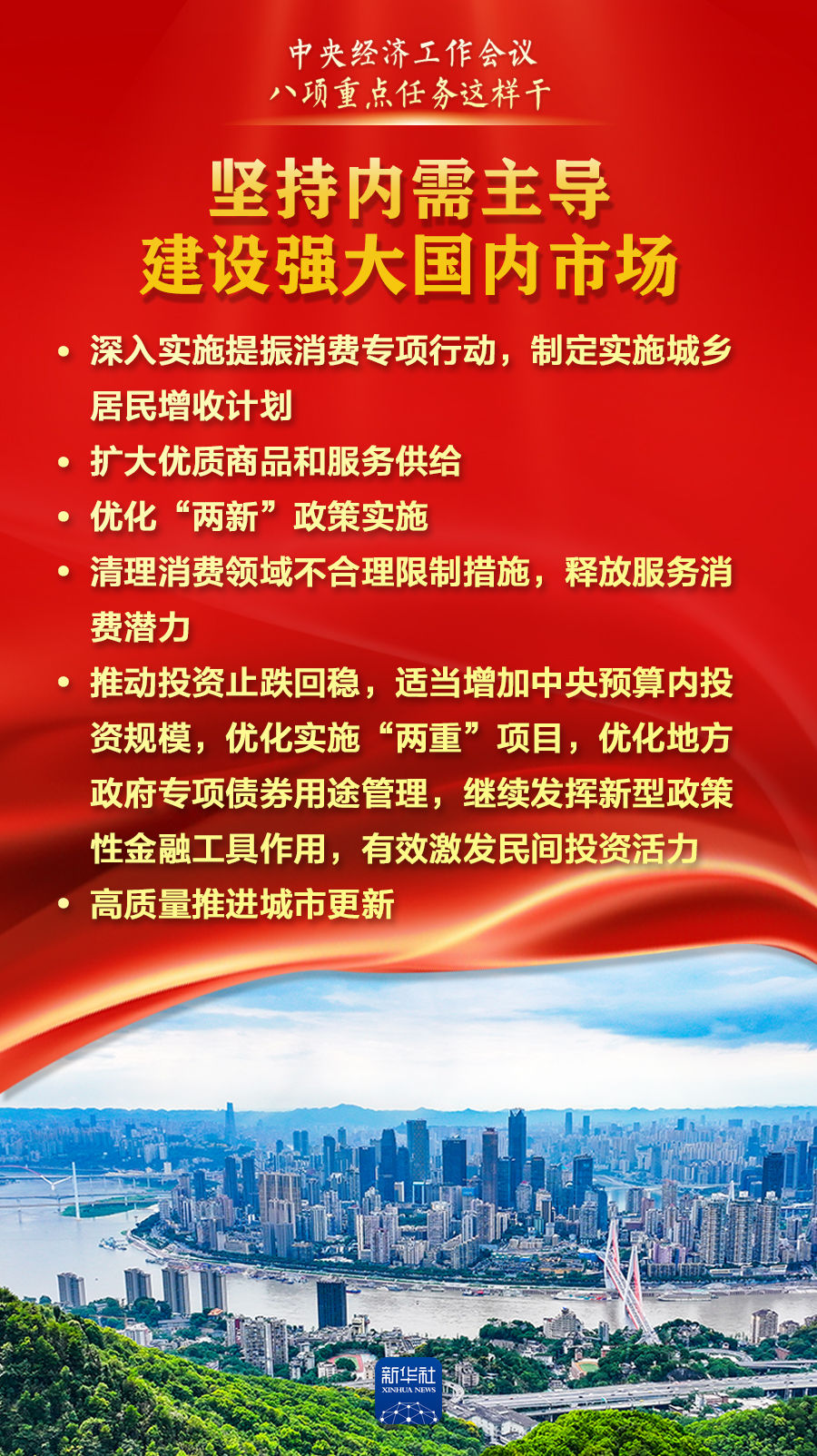
Core Viewpoint - The Central Economic Work Conference held on December 10-11 in Beijing outlined eight key tasks for economic work in the coming year, focusing on fostering new growth drivers, enhancing high-quality development, and promoting coordinated and sustainable growth. Group 1: New Growth Drivers - Accelerate the cultivation and expansion of new driving forces for economic growth, including the development of a comprehensive plan for education, technology, and talent [4] - Establish international technology innovation centers in Beijing (Jing-Jin-Ji), Shanghai (Yangtze River Delta), and the Guangdong-Hong Kong-Macao Greater Bay Area [4] - Strengthen the role of enterprises in innovation and improve the intellectual property protection system in emerging fields [4] Group 2: Reform and High-Quality Development - Formulate a national unified market construction regulation and address "involution" competition [7] - Implement further reforms for state-owned enterprises and improve supporting regulations for the private economy [7] - Expedite the clearance of overdue payments owed to enterprises [7] Group 3: Open Cooperation - Promote multi-field cooperation and win-win outcomes, including expanding pilot reforms for market-oriented factors [10] - Gradually advance institutional openness and expand the scope of autonomous service sector openings [12] - Encourage the development of digital and green trade, and deepen reforms in foreign investment promotion mechanisms [12] Group 4: Coordinated Development - Promote urban-rural integration and regional collaboration, focusing on urbanization centered around county towns and comprehensive rural revitalization [14] - Ensure food production and maintain reasonable prices for essential agricultural products [14] - Strengthen coordination among key urban agglomerations and enhance cross-administrative cooperation [14] Group 5: Green Transformation - Advance energy-saving and carbon reduction transformations in key industries [16] - Develop a national energy strategy and accelerate the construction of a new energy system [16] - Implement comprehensive solid waste management actions and enhance environmental protection efforts [16] Group 6: People-Centric Approach - Implement actions to stabilize and expand employment for key groups, including college graduates and migrant workers [18] - Adjust the layout of educational resources to increase the supply of high school and quality college admissions [18] - Optimize centralized drug procurement and deepen reforms in medical insurance payment methods [18] Group 7: Risk Management - Focus on stabilizing the real estate market with city-specific policies to control growth and reduce excess [20] - Promote long-term care insurance systems and enhance support for vulnerable groups [20] - Ensure safety in production, disaster prevention, and food and drug safety [20]

中航证券首席经济学家董忠云:实现融资端精准赋能与投资端价值回报的动态平衡
Zheng Quan Ri Bao Wang· 2025-12-12 12:27
Core Viewpoint - The Central Economic Work Conference emphasizes the need to deepen comprehensive reforms in capital market financing and investment, aiming for a dynamic balance between financing capabilities and investment returns [1]. Group 1: Capital Market Reform Goals - The goal of comprehensive capital market reform is to build a more resilient, efficient, and vibrant modern capital market system, focusing on three balances: functional balance (shifting from "financing-led" to "equal emphasis on financing and investment"), structural balance (optimizing market participant structure), and developmental balance (coordinating innovation with risk prevention) [1][2]. Group 2: Future Focus Areas for Reform - Future efforts in comprehensive reform include improving the market-oriented pricing mechanism for IPOs and secondary market valuations, establishing a new interconnected multi-tier capital market structure, and enhancing regulatory effectiveness to create a fair and transparent market environment [2]. Group 3: Enhancing Issuance System Inclusivity - To activate innovation, the issuance system should be more inclusive, allowing more high-quality unprofitable tech companies to go public by optimizing listing standards and introducing a multi-dimensional evaluation system [3]. - The refinancing process should be streamlined, especially for projects focused on fundamental research and core technology, while simplifying administrative approvals for mergers and acquisitions [3]. Group 4: Improving Investment Value of Listed Companies - Strengthening corporate governance and information disclosure, linking cash dividend policies to refinancing qualifications, and encouraging share buybacks to stabilize stock prices are essential for enhancing the investment value of listed companies [4]. - A regularized delisting system should be established to eliminate poor-quality companies, with improved investor relief mechanisms during the delisting process [4]. Group 5: Building a Long-term Investment Ecosystem - The investment side of the capital market is crucial for its stability and long-term health, with significant progress already made in enhancing the role of long-term funds and diversifying investment products [5]. - The core of investment reform is to create a "long money, long investment" ecosystem by addressing systemic barriers and optimizing the market environment to facilitate long-term capital inflow [5]. Group 6: Measures to Facilitate Long-term Capital Inflow - Suggestions for improving long-term capital inflow include optimizing assessment mechanisms for insurance funds, developing products that meet long-term capital needs, and expanding the public REITs market to provide stable cash flow assets [6][7]. - Risk management tools should be diversified to allow long-term investors to hedge against systemic and individual risks, encouraging them to adopt long-term positions [7].
解读2025中央经济工作会议:真抓实干“十五五”|宏观经济
清华金融评论· 2025-12-12 08:30
Core Viewpoint - The article emphasizes the importance of a systematic and practical approach to economic policy in China, focusing on targeted and effective measures to address existing challenges while maintaining long-term growth potential [4][5]. Group 1: Economic Policy Direction - The Central Economic Work Conference has shifted from general principles to a more systematic and practical approach, emphasizing "targeted precision" and "solid implementation" in economic policies [5]. - The conference acknowledges the intertwining of long-term positive economic trends with new challenges, advocating for integrated effects of existing and new policies rather than a scattered use of policy tools [5][7]. Group 2: Key Focus Areas - The conference identifies three main focus areas: expanding domestic demand, fostering innovation and reform, and addressing risk in key sectors such as real estate and local government debt [10]. - It highlights the need to tackle demand shortfalls, enhance innovation-driven growth, and manage risks effectively, particularly in the real estate market and local government debt [10][19]. Group 3: Practical Implementation - The article outlines specific actions to boost domestic demand, including initiatives to enhance consumer spending and increase investment through government support and private sector engagement [13][14]. - It stresses the importance of aligning consumption and investment strategies to create a robust foundation for domestic demand growth [14][15]. Group 4: Innovation and Reform - The conference sets a clear agenda for innovation, including the establishment of international technology innovation centers and the promotion of a collaborative ecosystem for technology and industry integration [16]. - It emphasizes the need for reforms that dismantle barriers and release institutional dividends, with specific regulations and action plans to support private enterprises and improve the business environment [17]. Group 5: Social Welfare and Risk Management - The article discusses measures to enhance social welfare, focusing on employment stability, education, healthcare, and support for vulnerable groups, ensuring a safety net for the population [18]. - It outlines a structured approach to risk management, particularly in the real estate sector and local government debt, advocating for precise and gradual measures to mitigate systemic risks [19][20]. Group 6: Capital Market Development - The article highlights the importance of deepening capital market reforms to enhance attractiveness and inclusivity, aiming to create a multi-layered and differentiated market system [22][23]. - It calls for optimizing return mechanisms for investors and improving the regulatory framework to support long-term investments and facilitate market access for various stakeholders [22][23].

中小金融机构“减量提质”意味着什么? | 解读中央经济工作会议
Xin Lang Cai Jing· 2025-12-12 05:18
智通财经记者 | 张一诺 中央经济工作会议在部署2026年经济工作重点任务时提到"深入推进中小金融机构减量提质",这和去年 会议提出的"稳妥处置地方中小金融机构风险"的表述相比有明显变化。 分析人士对智通财经表示,"减量提质"的提法,意味着金融体系改革正从扩大规模转向优化结构和提升 质量,以增强服务实体经济的能力和风险抵御水平。 万博新经济研究院院长滕泰对智通财经表示,深入推进中小金融机构减量提质,是当前我国金融体系结 构性改革的重要内容,旨在增强金融机构稳健性、提升存续机构的可持续经营能力,筑牢金融安全底 线、提升服务实体经济质效。 "结合本次会议要求货币政策'引导金融机构加力支持扩大内需、科技创新、中小微企业等重点领域', 也更加明确了金融机构和实体经济到底'谁服务谁'的问题,不能牺牲宏观经济保个别金融行业盈利,而 是商业银行等金融机构必须服务实体经济,尤其支持扩大内需等目标。"滕泰说。 中信证券首席经济学家明明补充道,从金融改革层面看,中小金融机构"减量提质"与资本市场投融资综 合改革呼应,实质上是在通过风险出清与制度优化提升金融体系配置效率,使金融能够更有效地服务科 技创新和实体经济。 他进一步指出, ...
田轩解读2025中央经济工作会议:真抓实干“十五五”
Xin Lang Cai Jing· 2025-12-12 02:43
Core Viewpoint - The Central Economic Work Conference has established a clear policy blueprint for the beginning of the 14th Five-Year Plan, emphasizing a systematic and practical approach to economic policy, focusing on targeted and effective measures to address existing challenges and stimulate economic growth [1][17][18]. Group 1: Economic Policy Focus - The conference highlighted the need for a shift from broad policy coverage to targeted and practical measures, integrating existing and new policies to enhance effectiveness [1][18]. - It emphasized the importance of addressing long-standing issues while recognizing new challenges, aiming to stabilize expectations and release internal economic momentum [2][20]. Group 2: Key Economic Strategies - The conference identified five essential strategies for economic governance: maximizing economic potential, balancing policy support with reform innovation, ensuring effective regulation, combining investments in physical and human capital, and strengthening internal capabilities to face external challenges [3][21]. - It focused on three main areas: expanding domestic demand, fostering innovation and reform, and managing risks in key sectors such as real estate and local government debt [4][22]. Group 3: Policy Implementation - The conference called for a combination of proactive fiscal policies and moderately loose monetary policies, ensuring policy continuity while optimizing implementation methods [6][23]. - It stressed the importance of coherent policy evaluation and management mechanisms to enhance market confidence and ensure effective execution [6][23]. Group 4: Domestic Demand and Investment - The conference proposed dual strategies to boost domestic demand through consumption and investment, including specific actions to increase central budget investments and stimulate private investment [7][24]. - It emphasized the need for a policy framework that supports consumer spending and investment in infrastructure, education, and healthcare to solidify the foundation for domestic demand growth [8][26]. Group 5: Innovation and Reform - The conference outlined plans to establish major international technology innovation centers and enhance intellectual property protection to drive innovation [9][27]. - It called for comprehensive reforms in various sectors, including the establishment of a unified national market and the promotion of private sector rights [10][28]. Group 6: Social Welfare and Risk Management - The conference highlighted the importance of social welfare measures, focusing on employment stability and improving living standards for vulnerable groups [11][29]. - It proposed targeted risk management strategies for the real estate market and local government debt, emphasizing a structured approach to prevent systemic risks [12][30].
经济观察|中央连续两年部署“资本市场投融资综合改革”有何深意?
Zhong Guo Xin Wen Wang· 2025-12-12 01:52
南开大学金融发展研究院院长田利辉认为,中央经济工作会议的这一安排是顶层设计对资本市场功 能定位的战略性升级,其核心考量有三层。一是服务新质生产力的迫切要求。二是破解当前经济核心矛 盾的现实需要。三是夯实金融强国建设的制度基础。"连续两年聚焦,表明这不是短期刺激,而是构建 安全、规范、透明、开放、有活力、有韧性的现代资本市场体系的'持久战',关乎国家金融竞争力的全 局。" 回顾过去一年中国资本市场投融资综合改革,薛洪言认为,改革在多方面取得扎实进展。一方面, 投资端呈现积极变化,中长期资金入市步伐加快,公募基金规模创下历史新高,保险资金权益投资比例 稳步上升。另一方面,融资端的制度包容性持续增强,科创板"1+6"改革允许未盈利硬科技企业上市, 并购重组"绿色通道"有效促进了产业整合,推动A股"含科量"显著提升。 中新社北京12月11日电 (记者 陈康亮)中央经济工作会议12月10日至11日在北京举行。会议提出, 持续深化资本市场投融资综合改革。这是中央经济工作会议连续两年部署"资本市场投融资综合改革"。 田利辉认为,过去一年的改革突出体现了"融资端激活"与"投资端筑基"的双向发力。但不足之处依 然明显,如投资端 ...
【CGS-NDI热点洞察】2026年资本市场划重点——中央经济工作会议解读
Xin Lang Cai Jing· 2025-12-12 01:37
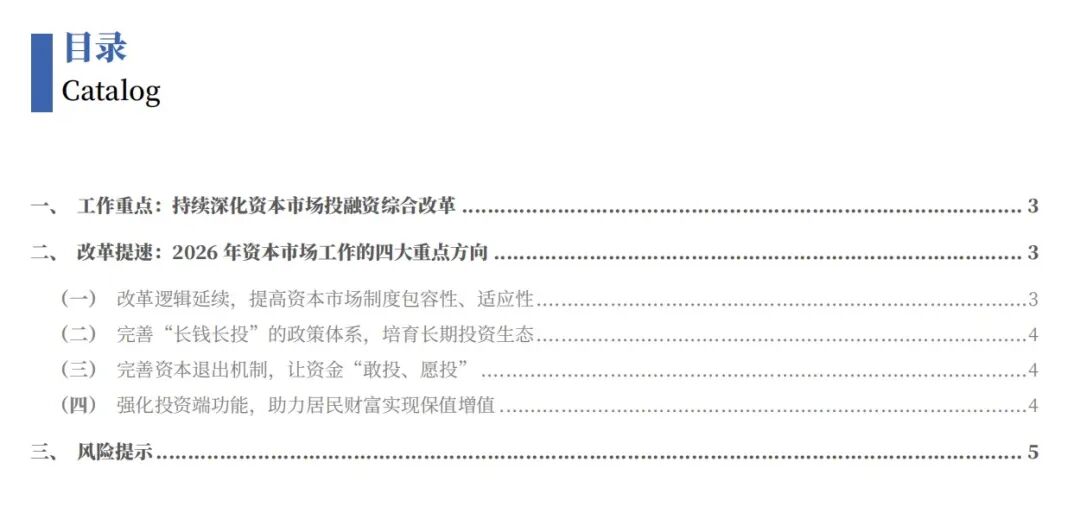
Core Viewpoint - The Central Economic Work Conference held on December 10-11 in Beijing emphasized that the continuous deepening of comprehensive reforms in capital market investment and financing will be a key focus for the capital market in 2026, which marks the beginning of the "14th Five-Year Plan" [1][5]. Group 1: Key Focus Areas for 2026 Capital Market Work - Continuous deepening of comprehensive reforms in capital market investment and financing is highlighted as a priority [1][5]. - The new quality productivity is recognized as a strong driving force for high-quality economic development, necessitating enhanced capital market reforms to better empower this productivity [1][5]. - The emphasis on "sustained deepening" in the conference indicates the importance of investment and financing reforms in the capital market for 2026 [1][5]. Group 2: Four Major Directions for Capital Market Reform - First, improve the inclusiveness and adaptability of capital market systems, actively promote equity and debt financing, and guide financial resources towards technological innovation [7][28]. - Second, continuously improve the policy system for "long money and long investment," creating an attractive environment for medium- and long-term funds to enter the market [9][30]. - Third, enhance capital exit mechanisms to encourage investment, allowing funds to "dare to invest and be willing to invest" [11][31]. - Fourth, strengthen investment functions to help residents preserve and increase their wealth, improving mechanisms for dividends and stock buybacks [13][33]. Group 3: Specific Measures for Reform - Continuous deepening of reforms in the Sci-Tech Innovation Board, Growth Enterprise Market, and Beijing Stock Exchange to optimize differentiated arrangements across various sectors [7][28]. - Promotion of a "technology board" in the bond market to institutionalize and normalize the issuance of technology bonds, enhancing financing accessibility for tech enterprises [8][29]. - Introduction of a refinancing framework to optimize the financing mechanism for mergers and acquisitions, improving market efficiency and flexibility for enterprises [8][29]. Group 4: Enhancing Investor Experience - Continuous improvement of the dividend and stock buyback mechanisms of listed companies to enhance residents' sense of gain in the capital market [13][33]. - Strengthening responsibilities for information disclosure, cash dividends, and stock buybacks among listed companies to form stable investment return expectations [13][33]. - Enhancing investor protection and education, increasing the costs of illegal activities in the securities field, and improving compensation and relief mechanisms for investors [13][33].
定调2026 中央经济工作会议最新解读!对市场影响几何?
Qi Huo Ri Bao· 2025-12-12 00:17
Group 1 - The central economic work conference held on December 10-11, 2025, summarized economic work and analyzed the current economic situation, deploying tasks for 2026 [1] - The conference emphasized the integration of existing and new policies to enhance macroeconomic governance and policy effectiveness [6] - The focus for 2026 includes maintaining a stable GDP growth target of around 5% to allow for quality improvement in the later years of the 14th Five-Year Plan [6] Group 2 - The conference proposed a more proactive fiscal policy, maintaining necessary fiscal deficits and optimizing fiscal expenditure structure [8] - Monetary policy will remain moderately loose, with a focus on stabilizing economic growth and ensuring reasonable price recovery [8] - The fiscal support for consumption is expected to increase from 300 billion to 500 billion yuan, with a focus on service consumption [12] Group 3 - The conference highlighted the importance of domestic demand and the construction of a strong domestic market as a priority task [10] - Measures to stimulate consumption include implementing a plan for increasing urban and rural residents' income and optimizing the supply of quality goods and services [11] - Investment support is expected to increase, with special bonds for major projects rising from 800 billion to 1 trillion yuan [12] Group 4 - The conference emphasized innovation-driven development and the establishment of international technology innovation centers in key regions [14] - The focus on "Artificial Intelligence+" aims to enhance technological financial services and support the development of new industries [14][15] - The integration of technology and finance is expected to create a comprehensive service system for technological innovation [15] Group 5 - The conference addressed the need for coordinated development, promoting urban-rural integration and regional collaboration [16] - Emphasis was placed on high-quality development of county economies and maintaining reasonable prices for important agricultural products [17] - The strategy aims to prevent large-scale poverty and ensure the sustainability of poverty alleviation efforts [17] Group 6 - The conference aims to stabilize the real estate market through targeted policies to control supply and encourage the purchase of existing homes for affordable housing [19] - There is an expectation for continued support for real estate financing and potential easing of purchase restrictions [20] - The focus on stabilizing the real estate market is seen as crucial for maintaining economic confidence [20] Group 7 - The conference called for deepening capital market reforms to enhance financing support for technological innovation and the real economy [21] - The establishment of a unified national market and the elimination of "involution" competition are key reform objectives [21] - The goal is to create a more attractive environment for long-term investments and improve the capital market ecosystem [22]
资本市场投融资改革向纵深推进
Zhong Guo Zheng Quan Bao· 2025-12-11 20:16
Group 1 - The core focus of the Central Economic Work Conference is to deepen the comprehensive reform of capital market investment and financing, aiming to enhance market attractiveness and inclusivity while attracting more long-term capital [1][4] - The current financing structure is heavily reliant on indirect financing, with direct financing only accounting for 31.1% as of June 2025, indicating significant room for improvement [1][2] - The shift from a "financing-heavy" to a "balanced investment and financing" approach is crucial for optimizing the capital market's role in guiding social capital allocation and promoting residents' income growth [2][3] Group 2 - Recent reforms have led to significant improvements in both investment and financing sides, with a notable increase in A-share refinancing totaling over 800 billion yuan, a 258% year-on-year growth [3][5] - The establishment of a "capital market investment and financing integration" ecosystem is a key focus, with reforms on both ends expected to work synergistically to enhance investor confidence and market resilience [2][3] - Future reforms will include the introduction of a refinancing shelf issuance system and improvements to the ChiNext board, aimed at better accommodating the financing needs of emerging industries [5][6]