
数字孪生

Search documents
智能工厂梯度培育见成效,中国制造重塑生产范式
Zheng Quan Shi Bao· 2025-08-29 00:27
Core Insights - The integration of AI, big data, and IoT with China's manufacturing sector is transforming production paradigms and driving industrial upgrades [1][3] - The Ministry of Industry and Information Technology reports over 30,000 basic intelligent factories, 1,200 advanced intelligent factories, and 230 excellent intelligent factories across China, indicating initial success in the cultivation of intelligent factories [1][3] Industry Transformation - Intelligent factories are becoming pivotal in shifting China's manufacturing from "scale dividends" to "value dividends," serving as a critical window for observing the transformation and upgrading of Chinese manufacturing [3][4] - The intelligent factory model is exemplified by companies like Zhongji HuanKe, which utilizes digital twin technology to optimize production efficiency, achieving a 30% reduction in delivery time and a 10% increase in first-pass yield [3][7] Application and Policy Support - The transformation of companies like Yawen Co. showcases a model of industrial change, with a focus on digitalization and transparency in manufacturing processes, leading to significant improvements in operational efficiency [4][6] - Government policies and local support for intelligent manufacturing provide a robust institutional framework for these transformations, as highlighted by the Ministry of Industry and Information Technology [6][10] Value Creation and Challenges - Intelligent manufacturing is not just about efficiency; it also involves a shift in business models, as seen with Yawen Co., which has evolved to offer comprehensive solutions beyond just machinery sales [9] - The industry faces challenges in transitioning from quantity to quality and from price competition to value competition, necessitating a restructuring of the talent system to include skilled digital craftsmen [9][10] Global Standards and Future Directions - China has published 469 national standards and 50 international standards for intelligent manufacturing, indicating a focus on application while recognizing the need for improvement in standard-setting and international influence [10] - The future of Chinese manufacturing lies in leveraging its application advantages to lead in international standard formulation and enhance its position in the global value chain [10]

智能工厂梯度培育见成效,中国制造重塑生产范式
证券时报· 2025-08-28 23:59
Core Viewpoint - The article emphasizes the rapid transformation of China's manufacturing industry through the integration of new technologies such as AI, big data, and IoT, leading to the establishment of smart factories that enhance production efficiency and drive industrial upgrades [1][3]. Group 1: Smart Factory Development - As of now, over 30,000 basic smart factories, more than 1,200 advanced smart factories, and over 230 excellent smart factories have been established across China, indicating initial success in the smart factory cultivation initiative [1][7]. - The distribution of excellent smart factories spans 31 provinces, covering over 80% of major manufacturing sectors, with nearly 2,000 exemplary scenarios implemented [7]. Group 2: Technological Integration and Efficiency - In the case of Zhongji HuanKe, the integration of digital technologies has led to a 30% reduction in delivery times, a 10% increase in first-time assembly pass rates, and a 50% improvement in inspection efficiency [3]. - The digital transformation of Yawey Co. has progressed through four stages, resulting in a 40% improvement in drawing management efficiency, a 36% increase in inventory turnover efficiency, a 22% reduction in product defect rates, and the launch of an industrial internet platform that connects 1,500 enterprises [4]. Group 3: Policy Support and Industry Trends - The transformation of these enterprises is supported by a series of policies aimed at upgrading the manufacturing sector, with the Ministry of Industry and Information Technology advocating for the development of innovative, secure, and collaborative solutions [6]. - The current trend indicates a shift from "scale dividends" to "value dividends" in manufacturing, with smart factories serving as a critical observation point for this transition [3][4]. Group 4: Challenges and Future Directions - The article highlights the need for a talent system restructuring to support smart manufacturing, emphasizing the demand for both high-end R&D talent and skilled application personnel [9]. - There is a call for breakthroughs in core technologies, as digital transformation is described as a long-term, systematic process that requires continuous iteration and innovation [9]. Group 5: Global Standards and Competitive Positioning - China has released 469 national standards and 50 international standards for smart manufacturing, with over 6,500 solution providers covering all manufacturing sectors [10]. - The article suggests that China should leverage its application advantages to accelerate the establishment of international standards and enhance its voice in the global value chain [11].

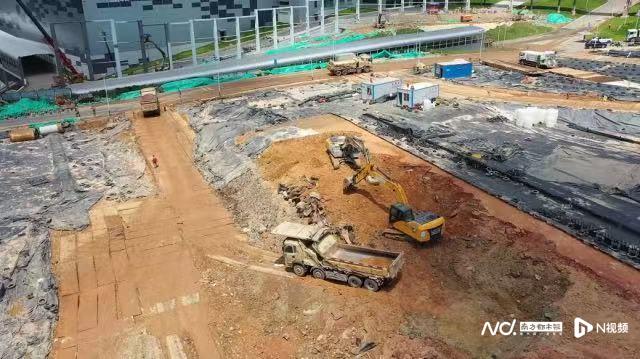
明年底完工!深圳最大的垃圾填埋场将打造数字产业智创高地
Nan Fang Du Shi Bao· 2025-08-28 20:50
Core Insights - The article discusses the significant environmental restoration project at the Yulong landfill site in Luohu, Shenzhen, which is the largest of its kind in China, aiming to transform a historical waste site into a digital innovation hub [1][9][10] - The project involves advanced technologies and methodologies to ensure minimal impact on surrounding residents and ecosystems while achieving effective waste management and environmental recovery [6][8][9] Group 1: Project Overview - The Yulong landfill, operational since 1983 and closed in 1997, has a total waste management volume of 2.55 million cubic meters, making it the largest environmental restoration project in the country [5][10] - The project is set to complete over 4.1 million tons of waste treatment, equivalent to filling 1,000 Olympic-sized swimming pools, and aims to restore the site by the end of next year [1][10] - The total investment for the environmental restoration project is 2.17 billion yuan, with a planned completion date of 2026 [7][10] Group 2: Technological Implementation - The project employs a "digital twin" system for comprehensive smart management, covering environmental monitoring, slope stability, and safety control [8] - Advanced techniques such as rapid aerobic pretreatment, canopy excavation, and multi-dimensional deodorization are utilized to enhance waste processing efficiency and minimize odors [7][8] - The project features a large canopy system, the largest in the country, spanning 280 meters and covering 116,900 square meters to ensure safe and efficient excavation operations [4][6] Group 3: Future Development Plans - Upon completion, the site will provide approximately 30 hectares of contiguous land for development, becoming the largest government-held industrial land in Shenzhen [10] - The area is planned to be developed into a digital industry cluster, with an estimated fixed asset investment exceeding 15 billion yuan, focusing on R&D, pilot testing, and digital services [10] - The project aligns with Shenzhen's "20+8" industrial cluster strategy, positioning the area as a hub for innovation and ecological integration [10]
智能工厂梯度培育见成效中国制造重塑生产范式
Zheng Quan Shi Bao· 2025-08-28 17:58
Core Insights - The article highlights the rapid transformation of China's manufacturing industry through the integration of advanced technologies such as AI, big data, and IoT, leading to the establishment of smart factories as a key driver for industrial upgrading and new productivity cultivation [1][2]. Industry Overview - As of now, China has built over 30,000 basic smart factories, more than 1,200 advanced smart factories, and over 230 excellent smart factories, indicating initial success in the smart factory cultivation initiative [1]. - The distribution of excellent smart factories spans across 31 provinces, covering over 80% of major manufacturing sectors, showcasing the extensive reach of this transformation [1][5]. Technological Advancements - The integration of technologies such as AI, 5G, and digital twin systems in smart factories has led to significant improvements, including a 30% reduction in delivery times, a 10% increase in first-time assembly success rates, and a 50% enhancement in inspection efficiency [2]. - The digital transformation journey of companies like Yawen Co. illustrates a phased approach, achieving a 40% improvement in drawing management efficiency and a 36% increase in inventory turnover efficiency through the implementation of PLM and ERP systems [3]. Policy Support - The transformation of these enterprises is supported by a series of policies aimed at upgrading the manufacturing sector, with local governments providing necessary support for smart manufacturing initiatives [4]. - The Ministry of Industry and Information Technology emphasizes the need for a solution system that is innovative, secure, and collaborative, focusing on the integration of technologies to promote comprehensive smart transformation in enterprises [4]. Performance Metrics - The implementation of smart factories has resulted in an average reduction of product development cycles by 28.4%, a 22.3% increase in production efficiency, a 50.2% decrease in defect rates, and a 20.4% reduction in carbon emissions, demonstrating significant improvements in quality, efficiency, and sustainability [5]. Business Model Innovation - Companies like Yawen Co. have evolved their business models from merely selling machinery to offering comprehensive solutions that include hardware, software, cloud services, and consulting, enhancing their industry influence [6]. - The shift towards value competition necessitates a restructuring of the talent system, focusing on both high-end R&D and skilled application talents to drive deeper transformation [6]. Global Standards and Competitiveness - China has published 469 national standards and 50 international standards for smart manufacturing, with over 6,500 solution providers covering all manufacturing sectors, indicating a strong foundation for global competitiveness [7]. - There is a recognized need for China to enhance its influence in standard-setting and international patents to secure a stronger position in the global value chain [7].
又见“股神”!600410,靠“炒股”大举扭亏!股价暴涨260%
Zhong Guo Ji Jin Bao· 2025-08-28 16:11
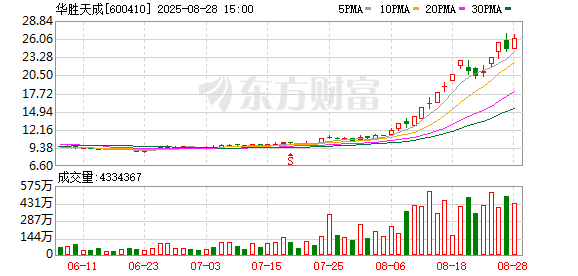
Core Viewpoint - In the first half of 2025, Huasheng Tiancai achieved a turnaround with a net profit of 140 million yuan, driven by substantial investment returns from companies like Tailin Micro and Haibo Sichuang, despite ongoing losses in its core digital services business [2][10]. Financial Performance - Huasheng Tiancai reported a revenue of 2.262 billion yuan, marking a year-on-year increase of 5.11% [2]. - The company realized an investment income of 238 million yuan, significantly exceeding its net profit [2][10]. - The core business continued to incur losses, with a non-recurring net profit of -83.31 million yuan [10]. Investment Highlights - The investment income primarily stemmed from Tailin Micro, which saw a stock price increase of approximately 45% in the first half of 2025 [4][7]. - Huasheng Tiancai holds 17.8619 million shares of Tailin Micro, representing 7.42% of its total share capital, making it the largest shareholder [3][4]. - The company also benefited from investments in Haibo Sichuang and Youyou Green Energy, both of which successfully completed IPOs in 2025 [7][8]. Strategic Focus - Huasheng Tiancai is focusing on high-value areas such as generative AI, cloud-native technology, and digital twins, targeting sectors like government, finance, and energy [10]. - The company aims to leverage its investment strategy to support the growth of its core business and achieve synergy with its investment portfolio [10][11]. Market Position - As of August 28, 2025, Huasheng Tiancai's stock price was 26.10 yuan per share, with a total market capitalization of 28.6 billion yuan, reflecting a year-to-date increase of 260% [11].


唐源电气战略转型初见成效 智慧交通业务显著增长
Zheng Quan Shi Bao Wang· 2025-08-28 14:52
Core Insights - Tangyuan Electric reported a revenue of 290 million yuan and a net profit of 33.6 million yuan for the first half of 2025, reflecting a strategic shift in its operations [1] Business Performance - The revenue from the vanadium-titanium resource development and utilization business decreased by 64.40% year-on-year [2] - The core business in smart transportation generated a revenue of 242 million yuan, marking a year-on-year growth of 21.97% [2] - Revenue from railway bus integration and smart station projects reached 15.2 million yuan, with a year-on-year increase of 43.66% [2] Technological Advancements - The company achieved significant breakthroughs in the smart rail transit sector, including the development of a new generation drone inspection system with dual-mode data processing capabilities [3] - Major advancements were made in high-altitude tunnel detection technology, successfully passing expert review after high-speed data collection tests [3] - Standardized application of ultrasonic rail flaw detection technology was established, laying a solid technical foundation for smart maintenance robots [4] Market Expansion and Future Outlook - The company is enhancing market promotion and project implementation in the railway bus integration and smart station sectors, with new systems already operational [4] - In the smart emergency and intelligent manufacturing sectors, various products and platforms are accelerating deployment [4] - Looking ahead, the company aims to leverage its core technologies to develop new products and explore new business segments aligned with emerging production capabilities [4] Fundraising and Investment Plans - The company announced a plan to raise up to 864 million yuan through a private placement, with proceeds aimed at developing smart operation robots and AI models for rail transit [5] - The fundraising is expected to enhance the company's capital strength and support product development and industrialization [5]
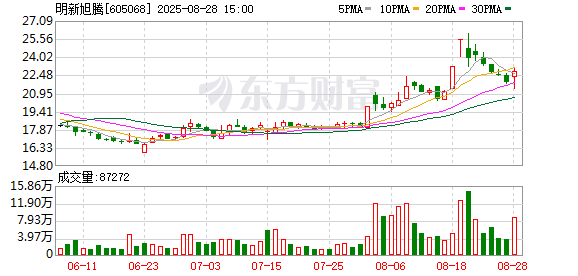
明新旭腾上半年营收同比增长29.26% 新能源汽车市场渗透率持续提升
Zheng Quan Ri Bao· 2025-08-28 08:13
Core Insights - Mingxin Xuteng New Materials Co., Ltd. reported a revenue of 603 million yuan for the first half of 2025, representing a year-on-year growth of 29.26% [2] - The company has deepened partnerships with major automotive manufacturers, including FAW-Volkswagen, SAIC-GM, BYD, NIO, and others, enhancing its supply relationships [2] - Mingxin Xuteng has established a "dual-drive" business expansion strategy focusing on high-end interior materials and innovative products to capture trends in new energy, lightweight, and smart technologies [2][3] Business Development - The company has set up a wholly-owned subsidiary, Mingxin Zhiyuan (Zhejiang) New Materials Technology Co., Ltd., to support the development of intelligent responsive materials for various applications [3] - Mingxin Xuteng has made significant investments in R&D, participating in the formulation of 34 national and industry standards and holding 289 valid patents as of June 2025 [3] - The company achieved successful upgrades in water-based PU leather technology, which has received infant-grade certification and is now in mass production for certain new energy vehicle models [3] Sustainability and ESG - Mingxin Xuteng has integrated ESG principles into its development strategy, achieving an upgrade in its Wind ESG Rating from A to AA, with a score of 8.2, reflecting its commitment to sustainable development [4] - The company is implementing "lighthouse factory" standards, utilizing technologies like cloud computing and industrial IoT to enhance production efficiency and reduce costs [4] - To foster a shared vision for growth, Mingxin Xuteng has introduced an employee stock ownership plan and reported a share increase by its controlling shareholder, demonstrating confidence in the company's future [4]

宁德时代与印度尼西亚合作项目正式动工
鑫椤储能· 2025-08-28 07:33
Core Viewpoint - A joint investment project in Indonesia's nickel resources and battery industry chain has been launched, involving Ningde Times' subsidiary, CBL, Indonesian state-owned mining company ANTAM, and Indonesian battery company IBC, with a total investment of nearly $6 billion [1] Group 1: Project Overview - The project aims to produce batteries capable of supporting 200,000 to 300,000 electric vehicles annually and will expand into the energy storage sector [1] - The total planned area for the project exceeds 2,000 hectares, including nickel mining and smelting in East Halmahera, battery material manufacturing, and battery recycling [1] - The battery manufacturing facility in Karawang, West Java, has a planned initial capacity of 6.9 GWh and will utilize advanced technologies such as AI, 5G, and digital twins [1] Group 2: Technological and Strategic Aspects - The Karawang battery factory will be built according to Ningde Times' lighthouse factory standards, focusing on high-quality battery production [1] - The project is expected to accelerate the transition to electric mobility and energy transformation in Indonesia and globally [1]


我国已建成5G基站459.8万个 实现
Yang Shi Xin Wen· 2025-08-28 02:45
Group 1 - As of now, China has deployed 64,000 5G industry virtual private networks, with over 100 types of 5G industrial gateways and routers, and holds a 42% global share of essential 5G standard patents [1][2] - By the end of July this year, China has built 4.598 million 5G base stations and over 30.53 million gigabit network capability ports, achieving "gigabit access in every county and 5G access in every township" [1][2] - The national integrated computing power network system is accelerating its construction, with 10.85 million standard racks in use and an intelligent computing power scale of 788 EFLOPS (FP16 half precision) as of the end of June [1] Group 2 - The information and communication technology industry in China is continuously enhancing its strength, achieving breakthroughs in key technology areas, and expanding the scale of operating entities, with 186,500 telecom business licenses issued, a 10% year-on-year increase [2] - New technologies such as 5G, industrial internet, artificial intelligence, and digital twins are widely applied in research and development, significantly shortening the manufacturing cycle of key sectors like large aircraft and new energy vehicles by nearly 30% [2] - 5G applications have been integrated into 86 out of 97 categories of the national economy, with over 138,000 cases accelerating into core production processes, resulting in an average capacity increase of 19.6% and a 14.5% reduction in operating costs for 5G factories [2] Group 3 - The Ministry of Industry and Information Technology will promote the "construction, use, and research" of the information and communication industry, accelerating the deployment of 5G-A product systems and high-quality networks, and advancing 6G technology research [3]
“湾区之眼”内部试运行
Shen Zhen Shang Bao· 2025-08-27 23:35
Core Insights - "Bay Area Eye" officially opened on September 26, 2023, as the world's largest physical bookstore and a new cultural complex in the Guangdong-Hong Kong-Macao Greater Bay Area [1][2] - The complex features three themed spaces: Art Garden, Humanistic Wonders, and Joyful META, housing nearly 100,000 types and over 300,000 selected books [1] - The facility integrates various business formats to create a unique experience for visitors, including personalized printing services and dedicated areas for children [1] Group 1 - "Bay Area Eye" aims to be a leader in digital technology applications within cultural complexes, featuring innovative smart operations and digital services [2] - The complex utilizes an IoT management cloud platform that integrates cutting-edge technologies such as digital twins and artificial intelligence [2] - An AI digital assistant is introduced to provide navigation, inquiries, and personalized interactions with readers, enhancing user engagement [2] Group 2 - The trial operation phase will continue to refine and improve the facility before its official public opening [2]