
黄金投资

Search documents
2026年1月15日,国内黄金9995价格多少钱一克?
Sou Hu Cai Jing· 2026-01-15 01:39
据交易所数据显示,截至8点30分,国内黄金(99.95%)最新报价为1039.72元/克,上涨0.46%。 据《纽约时报》报道,美国联邦检察官已对美联储主席鲍威尔启动刑事调查,市场担忧政治因素干预美 联储独立性,美元信用受损吸引力下降。同时美国仍处于降息周期,劳动力市场降温、通胀反弹可控推 动降息预期延续,降低黄金持有机会成本,ETF投资需求持续增长,两者共振推高金价。 3. 全球结构性与周期性买盘持续共振 全球央行黄金配置意愿依旧强烈,持续增持黄金对冲美元贬值与地缘风险。2026年伴随美联储降息进程 推进,ETF等周期性投资需求持续释放,与央行结构性买盘形成共振支撑金价。摩根大通预计2026年第 四季度金价有望升至5055美元/盎司,进一步强化市场看涨情绪。 国际黄金价格报4620.5美元/盎司,下跌0.33%。 以下是今日对黄金价格走势影响较大的3个主要资讯: 1. 美洲地缘风险扩散强化避险需求 美国对委内瑞拉军事介入后,正将影响力向墨西哥、哥伦比亚等美洲国家渗透,甚至计划吞并格陵兰岛 引发与欧盟潜在摩擦。叠加中东地区局势持续扰动,全球地缘政治风险居高不下,市场避险情绪显著升 温,资金持续流向黄金这类传统 ...
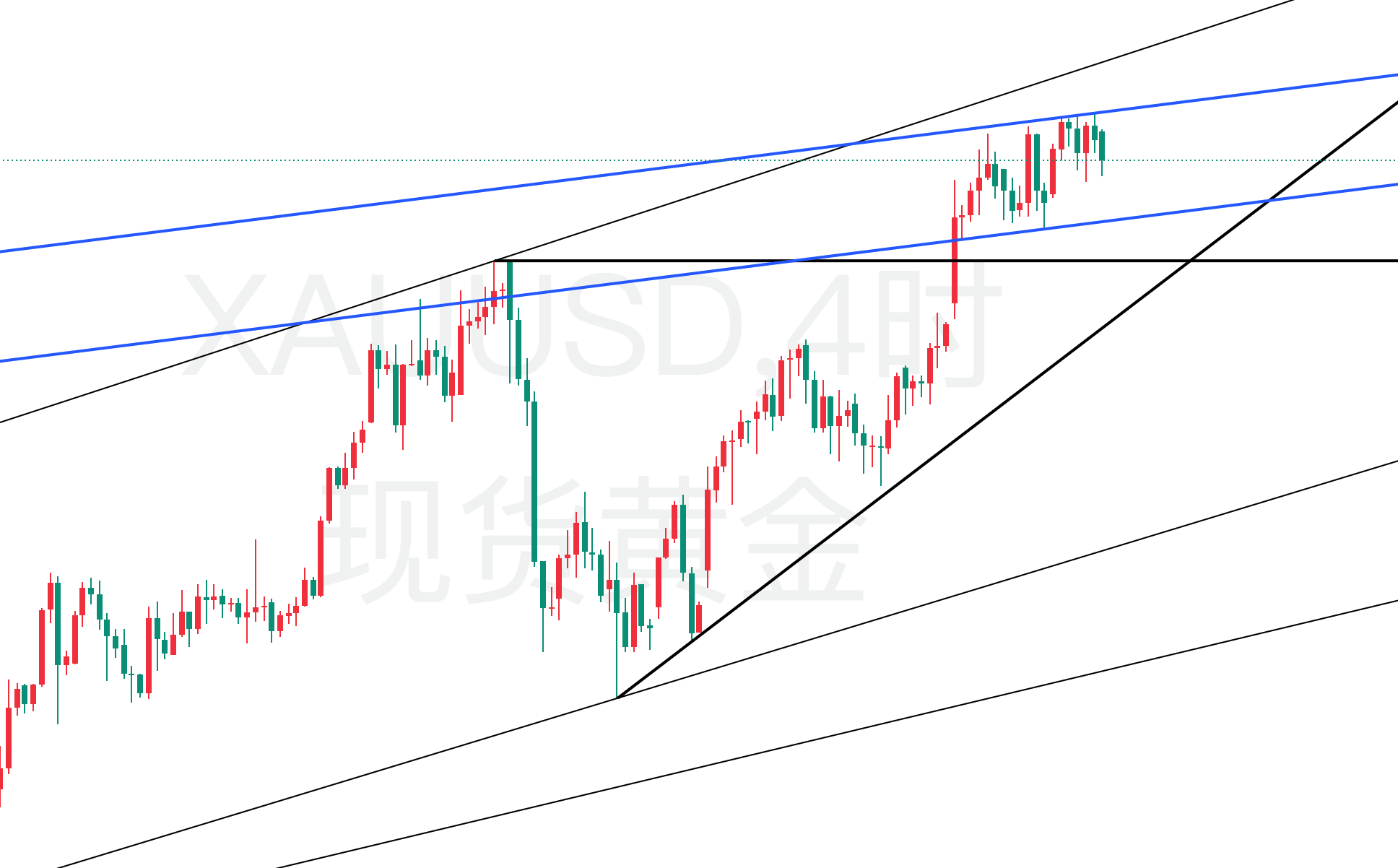
财经随笔记:黄金反复冲高回落,紧盯关键位置布局
Sou Hu Cai Jing· 2026-01-15 01:01
Group 1: Core Insights - The gold market is experiencing a shift from a fringe asset to a mainstream investment, with increased volatility and a historical high of 65% institutional ownership in physical gold ETFs [3] - Geopolitical tensions, particularly involving Iran and the U.S., are driving investors towards safe-haven assets like gold [2] - Economic uncertainty, highlighted by mixed U.S. economic indicators, is leading to expectations of at least two interest rate cuts by the Federal Reserve this year, enhancing gold's attractiveness [2] Group 2: Technical Analysis - On the daily chart, gold prices are maintaining an upward trend, with key support at the 5-day moving average around 4580; a sustained position above this level could indicate a continued bullish outlook [4] - The four-hour chart indicates a strong upward movement since the 4274 point, but caution is advised due to potential pullback risks; key support levels to watch include 4600, 4580/4570, and 4560 [6] - Resistance levels are identified at 4640/4645 and 4673, with the former being a significant high point from recent trading sessions [6]

金价飙升后,银行里的“一尺铁柜”成了抢手货
Xin Lang Cai Jing· 2026-01-15 00:02
Core Insights - The rising gold prices have sparked a surge in demand for bank safe deposit boxes, leading to a situation where they are in high demand but low supply [1][4][12] - Many banks in Beijing report that all safe deposit boxes are currently rented out, with waiting lists exceeding 100 customers at some locations [2][10] - The demand for safe deposit boxes is driven by increased interest in gold investments, as geopolitical risks continue to elevate the appeal of gold as a safe-haven asset [4][12] Demand and Supply Dynamics - The demand for safe deposit boxes has significantly increased, with banks reporting a notable rise in inquiries since last year [4][12] - Banks are struggling to keep up with the demand, as the supply of safe deposit boxes has not increased in tandem, leading to a shortage [6][15] - Some banks have ceased offering safe deposit box services altogether due to high maintenance costs and low profitability [15][16] Pricing and Features - Different banks offer various sizes and pricing structures for safe deposit boxes, with significant variations in rental fees [3][11] - For example, at China Merchants Bank, the smallest box has a monthly rental fee of 50 yuan, while larger boxes can cost up to 42,000 yuan annually [11] - Postal Savings Bank offers a fully automated safe deposit box with advanced security features, including 24-hour monitoring and multiple verification methods for access [5][13] Market Trends - The ongoing geopolitical tensions and expectations of continued low interest rates are expected to sustain the demand for gold and, consequently, safe deposit boxes [4][12] - Investors are increasingly looking for secure storage options for their gold investments, as concerns about home security grow [4][12] - Some banks are innovating their services, such as offering promotional deals for customers purchasing gold products, to attract more clients [16]





金价飙升后 银行里的“一尺铁柜”成了抢手货
Zhong Guo Zheng Quan Bao· 2026-01-14 21:10
Core Viewpoint - The surge in gold prices has led to a significant increase in demand for bank safe deposit boxes, resulting in a shortage of available boxes in Beijing banks [1][4]. Group 1: Demand for Safe Deposit Boxes - There is a booming demand for safe deposit boxes as residents are increasingly investing in gold, with reports indicating that many banks are fully booked and customers are facing long waiting lists [1][2]. - Some banks have reported waiting lists exceeding 100 people, with estimates suggesting that new customers may not be able to rent boxes until 2026 [2][4]. Group 2: Supply Constraints - The supply of safe deposit boxes has not kept pace with the rising demand, as only larger bank branches typically offer this service, and many smaller branches do not have safe deposit box facilities [1][6]. - Factors such as space limitations and high maintenance costs have prevented banks from expanding their safe deposit box offerings, leading to a decline in the availability of this service [6]. Group 3: Pricing and Variability - Different banks offer various sizes and pricing structures for safe deposit boxes, with significant differences in rental fees based on box dimensions [3][4]. - For example, at China Merchants Bank, the smallest box has a monthly rental fee of 50 yuan, while larger boxes can cost up to 42,000 yuan annually [3]. Group 4: Investor Sentiment and Alternatives - Investors express concerns about the safety of storing physical gold at home, leading many to prefer bank safe deposit boxes for their perceived security [5]. - Some investors are considering alternatives such as home safes due to the high rental costs and long wait times associated with bank safe deposit boxes [7]. Group 5: Innovations and Promotions - To address the supply-demand imbalance, some banks are exploring smart upgrades and promotional offers to attract customers, such as free rental periods for new clients purchasing gold products [7]. - For instance, Qingdao Rural Commercial Bank has offered promotional incentives for customers purchasing gold products, including free usage of safe deposit boxes for a limited time [7].
金价飙升后银行里的“一尺铁柜”成了抢手货
Zhong Guo Zheng Quan Bao· 2026-01-14 20:51
Core Insights - The rising gold prices have led to increased demand for bank safe deposit boxes, resulting in a shortage of available boxes in Beijing [1][3] - Many banks are experiencing a significant influx of customers seeking to rent safe deposit boxes, with some reporting waiting lists of over 100 people [1][3] - The supply of safe deposit boxes has not kept pace with the growing demand, leading to a situation where many banks are fully booked [1][4] Summary by Category Demand for Safe Deposit Boxes - Residents are increasingly interested in gold investments, prompting a surge in demand for safe deposit boxes for secure storage [3][4] - Bank staff have noted a marked increase in inquiries about safe deposit box rentals since last year [3][4] - Customers express concerns about storing physical gold at home due to security risks, further driving the demand for bank storage solutions [3][4] Supply Constraints - Many banks, particularly smaller branches, do not have safe deposit boxes available, and customers are often directed to larger branches where they may face long wait times [1][4] - The limited availability of safe deposit boxes is exacerbated by banks' reluctance to expand their facilities due to high costs and space constraints [4][5] - Some banks have ceased offering safe deposit box services altogether, citing low profitability and high maintenance costs [5] Pricing and Features - Rental prices for safe deposit boxes vary significantly across banks, with some offering lower-cost traditional boxes and others providing more expensive automated options [2][4] - For example, Beijing Bank charges 800 yuan per month for a specific automated box, while other banks have a wide range of pricing based on box size and features [2] - Banks are exploring innovative solutions, such as smart upgrades and promotional offers, to attract customers and alleviate supply issues [6]
挂钩黄金结构性存款走俏 投资者还能“上车”吗?
Guo Ji Jin Rong Bao· 2026-01-14 16:52
Core Viewpoint - The recent surge in gold prices has led to increased interest in structured deposits linked to gold, with various banks offering competitive products that appeal to conservative investors seeking stable returns [1][4]. Group 1: Structured Deposits Overview - Structured deposits are floating-rate deposits that are protected by deposit insurance, where the interest earned is invested in financial derivatives like gold, indices, or stocks to pursue higher returns [2]. - For example, China Merchants Bank has launched gold-linked structured deposits with investment terms ranging from 7 to 181 days, offering annualized rates up to 1.78% [2]. - Historical performance indicates that most structured deposits yield mid-range returns, with an 80% probability of achieving such outcomes [2]. Group 2: Market Dynamics - Banks are increasingly offering gold-linked structured deposits to attract risk-averse investors amid market volatility and declining interest rates [4]. - These products help banks capture attention during periods of high gold price fluctuations, enhancing retail asset management and mitigating net interest margin pressures [4]. - The demand for stable investment options has surged, particularly as traditional fixed-term deposit rates have fallen to around 1.30% for longer terms and even lower for shorter durations [4]. Group 3: Investor Considerations - Despite the promise of capital protection, structured deposits are still investment products with inherent risks, including uncertain returns and liquidity constraints [5]. - Investors are advised to undergo risk assessments before purchasing these products and to be cautious of the advertised maximum returns [5]. - It is essential for investors to understand the complex terms and conditions associated with these products, including the potential for locked funds during the investment period [5].

黄金抗通胀成笑话,8年亏20%的真相,买金饰的人全踩了坑
Sou Hu Cai Jing· 2026-01-14 15:57
Core Viewpoint - The recent surge in gold jewelry prices is driven by consumer perception of gold as a hedge against inflation, but this belief may lead to significant financial pitfalls for buyers [1][4]. Group 1: Gold Price Trends - Over the past thirty years, gold has experienced two major bull markets, rising from $252 per ounce in 2001 to $1,920 in 2011, with projections suggesting it could exceed $4,500 by 2026, representing a cumulative increase of over 16 times [1]. - However, during the period from 2011 to 2019, those who bought gold at its peak had to wait eight years to break even, while the average annual CPI in China increased by 2.1%, leading to an 18% reduction in purchasing power [4]. Group 2: Consumer Behavior and Market Dynamics - Most consumers enter the market at high prices, with a notable example being a gold necklace that increased in price from 121,000 yuan to 136,000 yuan overnight, reflecting a 15,000 yuan increase driven by market psychology rather than actual gold price changes [9][11]. - The actual cost of the necklace, based on current gold prices, was approximately 54,700 yuan, indicating that over 70,000 yuan of the price was attributed to craftsmanship, design, and brand premiums [9][11]. Group 3: Investment vs. Consumption - There is a critical distinction between gold as an investment and gold jewelry as a consumer product; gold jewelry incurs immediate depreciation upon purchase, while gold as an investment can fluctuate in value [6][15]. - Consumers are advised to consider gold bars or gold ETFs for investment purposes, as these options are more aligned with the intrinsic value of gold without additional costs associated with jewelry [17]. Group 4: Recommendations for Consumers - It is essential for consumers to differentiate between consumption and investment, avoiding the misconception that gold jewelry is a reliable store of value [19]. - Rational planning is encouraged, suggesting that consumers should buy gold jewelry based on personal preference rather than investment expectations, and consider diversifying investments across core A-shares and quality real estate to effectively preserve wealth [19].
2026年小白想了解黄金ETF,从哪儿开始看比较好?
Sou Hu Cai Jing· 2026-01-14 11:47
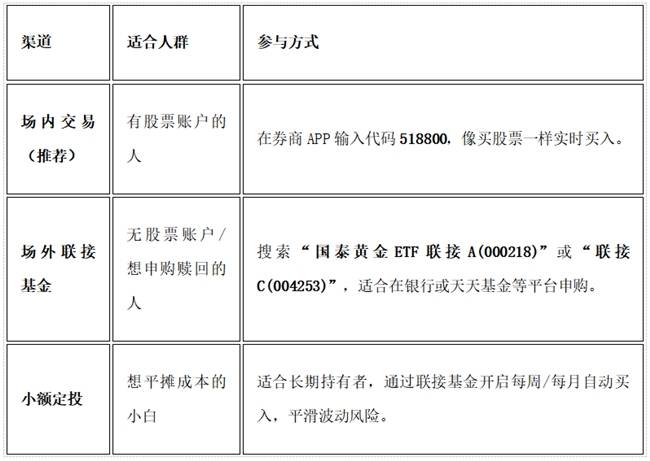
Group 1 - The core viewpoint emphasizes that the Gold ETF (518800) is the best entry point for beginners in gold investment due to its low entry barrier, convenience, and transparent costs [1] - The Gold ETF (518800) is recognized for its significant advantages summarized as "large, fast, and economical," with a large scale providing strong risk resistance and high liquidity for easy buying and selling [3] - The fund closely tracks the spot gold price, ensuring zero delay in price tracking, which allows for real-time market capture without the hassles of physical gold [3] Group 2 - Three investment methods for the Gold ETF (518800) are outlined: trading through a stock account, connecting through banks or platforms for those without a stock account, and small regular investments for long-term holders [3] - A cautionary guide for new investors highlights the importance of phased entry, monitoring premium rates, and focusing on long-term value rather than short-term speculation [5]
李迅雷专栏 | 央行将抛售还是增持黄金:我最想贴的一张图
中泰证券资管· 2026-01-14 11:33
Core Viewpoint - The article emphasizes the increasing importance of gold as a hedge against inflation and geopolitical risks, highlighting its dual attributes of value preservation and risk aversion, especially in the context of ongoing financial, trade, and technological conflicts among major nations [1][11]. Group 1: Historical Context of Gold Holdings - Global central banks held 12.25 billion ounces of gold in 1964, which decreased to 11.66 billion ounces by 2024, despite significant monetary expansion over the same period [3]. - The price of gold has increased dramatically from $35 per ounce in 1964 to approximately $2,639 per ounce by the end of 2024, representing a nearly 75-fold increase [3]. - The broad money supply (M2) grew from $0.98 trillion in 1964 to $156.67 trillion in 2024, a growth of 159 times, indicating a much faster expansion compared to gold prices [3]. Group 2: Current Gold Reserves and Market Value - By the end of 2024, the market value of central bank gold reserves exceeded $3 trillion, yet this value remains low relative to the total global broad money supply [5]. - The proportion of gold reserves in relation to global broad money has only increased from 4.3% in 1964 to 1.9% in 2024, indicating a significant decline over the decades [5][8]. - The share of foreign exchange reserves in total central bank reserves rose from 31% in 1960 to 90% during 2006-2008, before declining to 77% by 2024, reflecting a shift away from gold [8]. Group 3: Implications for Future Gold Holdings - Since 2022, central banks have been increasing their gold reserves due to concerns over U.S. debt and the weakening dollar, which has been a significant factor driving up gold prices [11]. - The global gold stock has increased by approximately 1.5 times over the past 60 years, yet central banks currently hold only about 17.5% of the total gold stock, suggesting a potential for increased gold accumulation [11]. - China's gold holdings are relatively low, projected to be around 0.74 billion ounces by the end of 2025, which is only 6.3% of global central bank holdings [11]. Group 4: Economic and Geopolitical Considerations - The article notes that the post-World War II era has seen a significant accumulation of debt, with few countries successfully implementing reforms, leading to a reliance on monetary expansion, which supports the rising prices of non-yielding assets like gold [14]. - Despite the decoupling of the dollar from gold post-Bretton Woods, the dollar's international status remains strong, influenced by the U.S. economic position [14]. - The article suggests that to enhance the international status of the renminbi and optimize central bank reserves, China should consider reducing its holdings in U.S. and Japanese government bonds while increasing its gold reserves [14].

金价大涨,你想跟风?先弄明白这些“黄金”不是一回事!
Xin Lang Cai Jing· 2026-01-14 10:20
Group 1 - The article addresses the confusion among investors regarding the differences between gold ETFs and physical gold accumulation, highlighting the importance of understanding what one is investing in [1] - Physical gold accumulation allows investors to buy gold in grams, with profits directly tied to the market price at the time of sale, providing transparent and straightforward returns [2] - Gold ETFs are financial instruments traded on stock exchanges, representing shares rather than physical gold, with their value linked to the underlying gold assets and market price fluctuations [3] Group 2 - The fees associated with physical gold accumulation differ from those of gold ETFs, impacting net returns; physical gold has a buy-sell spread, while gold ETFs incur trading commissions and management fees [4] - Gold ETFs track gold prices closely, while gold stock ETFs invest in mining companies, leading to different risk and return profiles; gold ETFs focus solely on gold price movements [5][6] - The performance of gold stock ETFs is influenced by multiple factors, including gold prices, company profitability, and market sentiment, making them more complex to analyze compared to gold ETFs [6]