
美联储独立性危机

Search documents
黄金白银价格剧烈波动,投资者情绪降温银行金条库存充足
Jin Shi Shu Ju· 2026-02-03 01:36
Core Viewpoint - The recent volatility in gold and silver prices has led to a cooling of investor enthusiasm for physical gold, with some banks reporting sufficient inventory levels for gold bars [2][3]. Price Movement - As of February 2, gold prices fell by 6.80% to $4,562 per ounce, while silver prices dropped by 11.46% to $75.49 per ounce [2]. - In January, gold and silver experienced unprecedented price increases, with COMEX gold futures peaking at over $5,600 per ounce, marking a monthly increase of over 29%, and COMEX silver futures reaching over $120 per ounce, with a peak increase of 72% [2]. Investor Sentiment - Following the price drop, investor sentiment shifted, with some choosing to wait rather than invest in physical gold, as evidenced by increased availability of gold bars in banks [3]. - There is a divide in investor attitudes, with some believing prices will continue to decline and opting to hold off on purchases, while others are taking advantage of lower prices to buy more [6]. Market Analysis - The recent price fluctuations are attributed to concerns over the independence of the Federal Reserve following President Trump's nomination of Kevin Warsh as the new chairman, which has led to a rebound in the dollar [3]. - Analysts suggest that while short-term trading risks are present, the long-term outlook for gold remains positive, with expectations of a return to upward trends later in the year [7][8]. Inventory Levels - Various banks have reported changes in inventory levels for gold products, with some previously sold-out items now available for purchase, indicating a shift in demand [5][6]. - The World Gold Council reported that global gold demand is expected to exceed 5,000 tons by 2025, driven primarily by strong physical gold investment demand [6]. Future Outlook - Analysts predict that gold prices may enter a period of weak consolidation after the recent surge, with long-term demand from central banks expected to support prices [8][9]. - The current market dynamics are influenced more by financial attributes and speculative factors rather than traditional fundamentals, making price predictions challenging [9].

矿业ETF(561330)大涨超4.5%,近20日资金净流入超13亿元,资金积极布局
Sou Hu Cai Jing· 2026-01-26 03:21
Group 1 - The core viewpoint of the articles highlights the ongoing bullish trend in precious metals driven by factors such as interest rate cut expectations, the crisis of Federal Reserve independence, rising geopolitical tensions, and potential sell-offs of U.S. Treasuries [1] - Central bank demand for gold continues to provide strong support for gold prices, with the People's Bank of China having increased its gold holdings for 14 consecutive months [1] - The demand for gold as a safe haven and investment is expected to persist long-term, leading to a potential upward trend in prices [1] Group 2 - The outlook for industrial metals remains positive, particularly for electrolytic aluminum, which is expected to maintain high profit levels due to low future capital expenditure intensity in the industry [1] - Companies in the sector are increasingly capable and willing to enhance shareholder returns, highlighting the dividend asset attributes of the industry [1] - The supply of aluminum is expected to remain rigid, with ongoing production cuts from existing projects and slow releases from new projects, while the global aluminum inventory remains low, providing strong support for aluminum prices [1] Group 3 - The mining ETF (561330) tracks the non-ferrous mining index (931892), which selects securities from companies involved in the development of copper, aluminum, lead, zinc, and rare metals to reflect the overall performance of the non-ferrous metal mining industry [1] - According to Wind data, the mining ETF (561330) is projected to have a year-to-date increase of 106.11% in 2025, ranking first among ten ETFs in the non-ferrous sector [1] - The ETF has a higher concentration of assets in "gold + copper + rare earths," indicating a strong market position [1]
有色金属行业周报(20260119-20260123):避险升温&美联储独立性危机,金银价格再创新高-20260125
Huachuang Securities· 2026-01-25 12:45
Investment Rating - The report maintains a recommendation for precious metals, particularly gold and silver, due to rising geopolitical risks and expectations of interest rate cuts by the Federal Reserve [1][2]. Core Viewpoints - The report highlights that the recent geopolitical tensions and the crisis of independence of the Federal Reserve have led to a surge in gold and silver prices, with gold surpassing $4900 per ounce and silver exceeding $100 per ounce [1][2]. - It is anticipated that the demand for gold from central banks will continue to support prices, as China has increased its gold reserves for 14 consecutive months, and other countries are also planning to increase their gold holdings [2]. - The aluminum market is expected to experience fluctuations due to seasonal demand and macroeconomic disturbances, but the long-term fundamentals remain strong, with supply constraints and new demand emerging in various sectors [3][4]. Summary by Sections Industrial Metals - The report indicates that geopolitical tensions and the Federal Reserve's independence crisis are driving precious metal prices to new highs, with significant increases in gold and silver prices [1][2]. - The aluminum market is entering a consumption off-season, but the long-term outlook remains positive due to rigid supply and new demand in energy storage and other sectors [3][4]. Company Insights - Zijin Mining's second phase of the Julong Copper Mine has commenced production, increasing its copper production capacity to 350,000 tons per day, which will enhance its position as a major global copper producer [4][9]. - The report expresses optimism about the profitability of the electrolytic aluminum industry, projecting average profits around 7600 RMB per ton, with companies showing a strong willingness to return value to shareholders through dividends [4][10]. Stock Recommendations - The report recommends investing in precious metals and copper-aluminum sectors, highlighting specific companies such as Zijin Mining, China Hongqiao, and others as potential investment opportunities [10][11].

史诗级联动!波兰购金叠加丹麦弃美债,金价14天涨554美元,未来上看5400美元?
Hua Xia Shi Bao· 2026-01-21 17:13
Core Viewpoint - The international gold price has surged to a historic high of $4,883 per ounce, driven by multiple factors including geopolitical tensions and trade conflicts, particularly related to the Greenland dispute and U.S. tariffs on European goods [1][3]. Geopolitical Factors - The escalation of geopolitical risks, particularly the U.S. imposing tariffs on eight European countries, has heightened market concerns about a potential trade war, leading to increased demand for gold as a safe-haven asset [3][4]. - The situation surrounding Greenland has intensified, with Denmark's firm stance against U.S. acquisition plans and military simulations by Canada regarding a potential U.S. invasion, further straining U.S.-European relations [3][4]. Economic Indicators - The U.S. economic landscape shows signs of resilience, with stable employment and strong GDP growth, but concerns over the Federal Reserve's independence and rising inflation expectations are influencing market dynamics [7][8]. - Recent inflation data indicates a year-on-year CPI of 2.7%, with core CPI at 2.6%, both slightly below market expectations, suggesting a potential easing of inflationary pressures [7][8]. Central Bank Actions - Central banks globally continue to purchase gold, with Poland's central bank planning to increase its gold reserves significantly, reflecting a broader trend of diversifying away from the U.S. dollar [12]. - The World Gold Council projects that global central bank gold purchases will remain robust, with an estimated total of 800-850 tons in 2025, despite a decline from 2024 levels [12]. Market Sentiment and Predictions - Analysts predict that gold prices may continue to rise, with some estimates suggesting a target of $5,000 per ounce by 2026, driven by ongoing geopolitical tensions and economic uncertainties [12][13]. - The volatility in the market, particularly in response to U.S. stock market fluctuations, may impact gold and silver prices, necessitating cautious investment strategies [14].
财经随笔记:黄金反复冲高回落,紧盯关键位置布局
Sou Hu Cai Jing· 2026-01-15 01:01
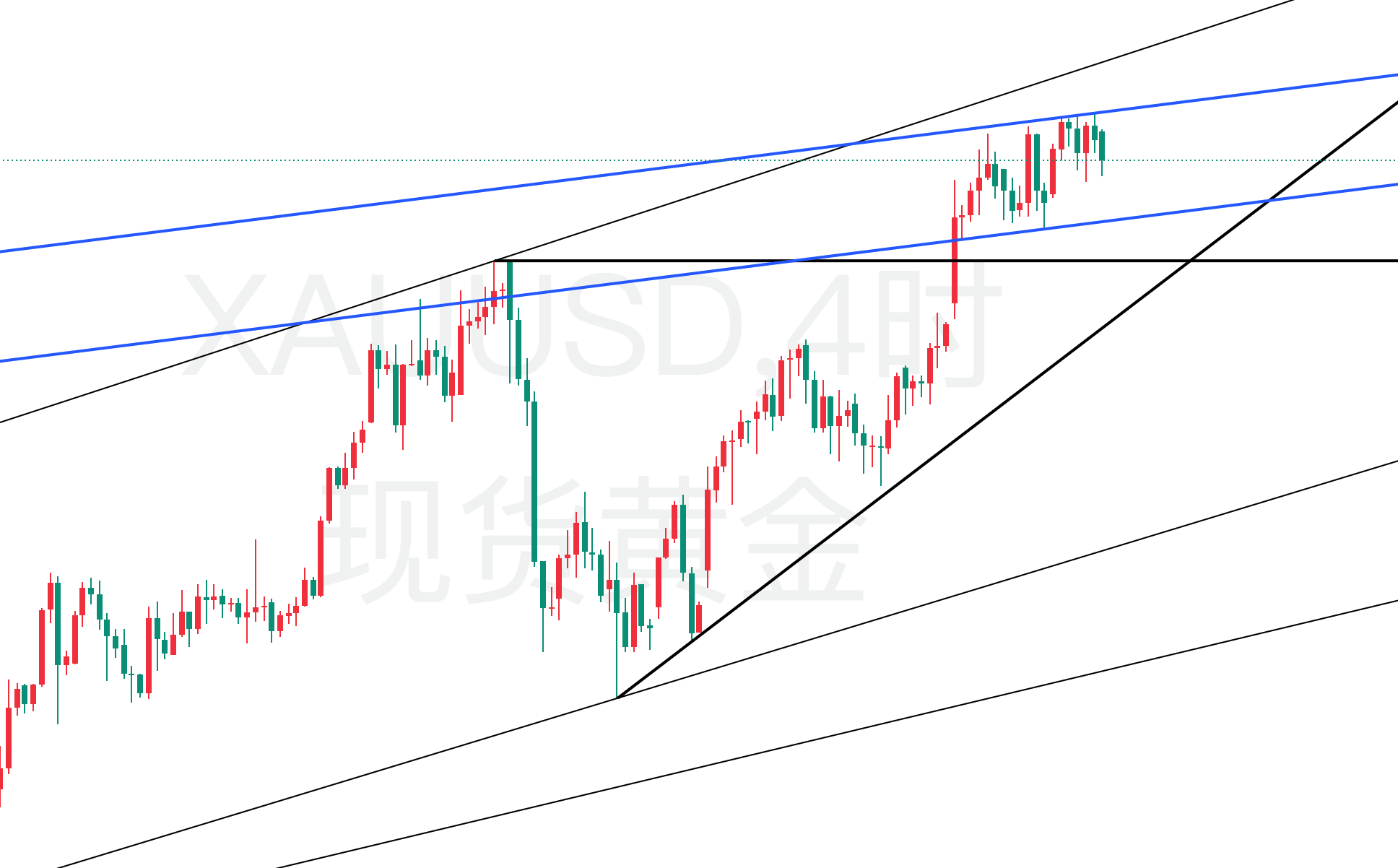
Group 1: Core Insights - The gold market is experiencing a shift from a fringe asset to a mainstream investment, with increased volatility and a historical high of 65% institutional ownership in physical gold ETFs [3] - Geopolitical tensions, particularly involving Iran and the U.S., are driving investors towards safe-haven assets like gold [2] - Economic uncertainty, highlighted by mixed U.S. economic indicators, is leading to expectations of at least two interest rate cuts by the Federal Reserve this year, enhancing gold's attractiveness [2] Group 2: Technical Analysis - On the daily chart, gold prices are maintaining an upward trend, with key support at the 5-day moving average around 4580; a sustained position above this level could indicate a continued bullish outlook [4] - The four-hour chart indicates a strong upward movement since the 4274 point, but caution is advised due to potential pullback risks; key support levels to watch include 4600, 4580/4570, and 4560 [6] - Resistance levels are identified at 4640/4645 and 4673, with the former being a significant high point from recent trading sessions [6]
新华财经:避险情绪支撑,黄金白银均创历史新高
Xin Hua Cai Jing· 2026-01-12 06:30
Group 1 - The core viewpoint of the articles highlights the rising demand for gold and silver as safe-haven assets due to geopolitical uncertainties and concerns over the independence of the Federal Reserve [1][2][3] - Gold prices reached a historical high of $4600.79 per ounce, while silver prices approached $84 per ounce, marking significant increases driven by global conflicts and the weakening of the U.S. dollar's credibility [1][2] - Analysts suggest that the ongoing disputes between President Trump and the Federal Reserve are undermining the credibility of the dollar, contributing to a trend of de-dollarization and increasing the appeal of precious metals [2][3] Group 2 - The current environment of frequent geopolitical conflicts is creating substantial uncertainty in the market, which is enhancing the safe-haven properties of precious metals [2] - Factors such as rising debt risks, geopolitical tensions, and the ongoing trend of de-dollarization are expected to sustain the upward trajectory of gold prices in the long term [3] - The supply shortage of silver, coupled with rising industrial demand and tight inventory conditions, is likely to drive silver prices further upward [2][3]
贵金属 大震荡!后市怎么走?
Zhong Guo Zheng Quan Bao· 2025-12-29 06:35
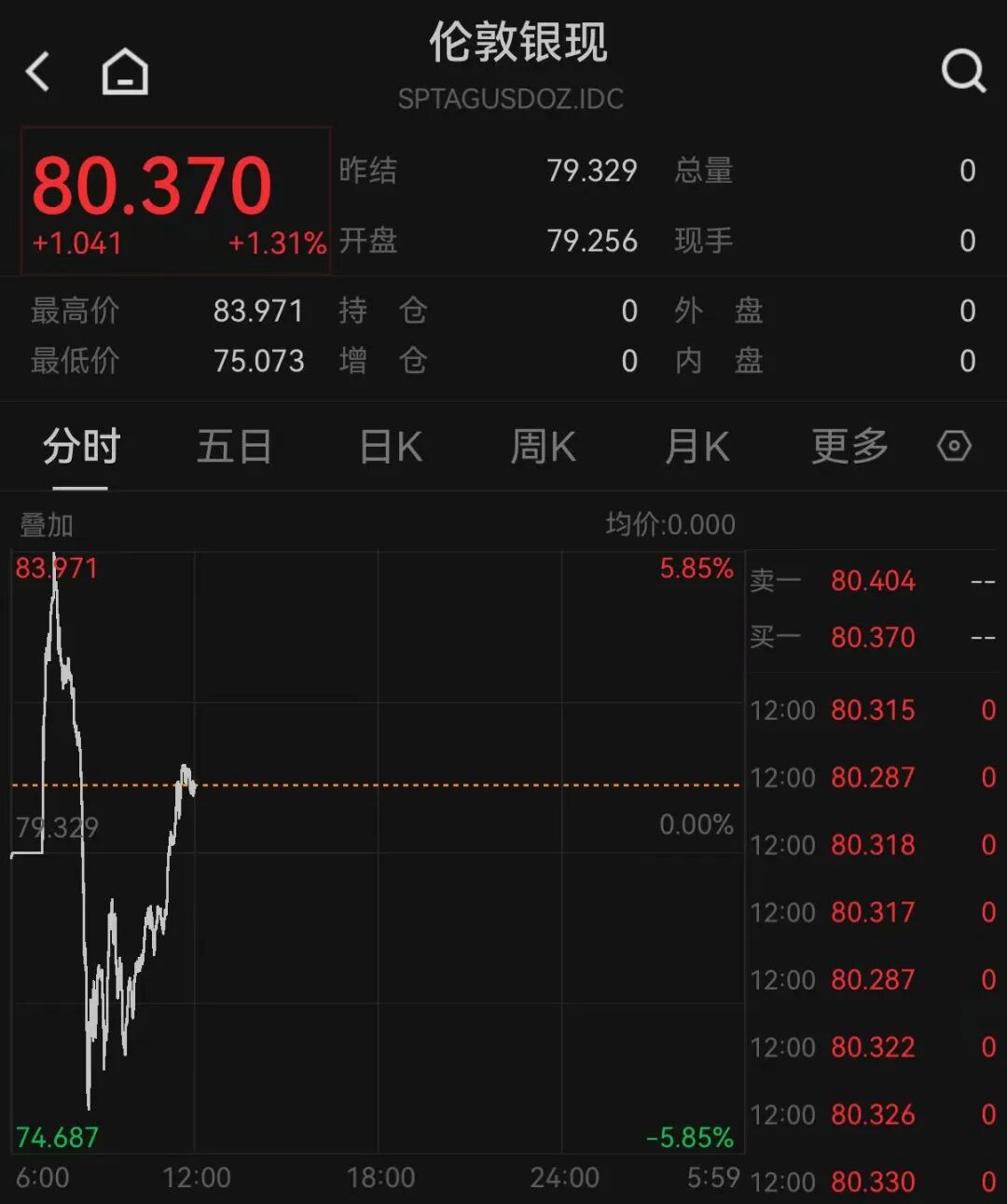
Market Volatility - The precious metals market experienced significant volatility, with silver initially rising over 5% before dropping more than 3%, and gold seeing a maximum decline of nearly $80 per ounce [1][2][4] - As of December 29, 2023, silver was priced at $80.37 per ounce, reflecting a 1.31% increase, while gold was at $4516.06 per ounce, down 0.36% [2][4] Market Dynamics - Analysts attribute the increased volatility to the upcoming New Year holiday and potential adjustments in the Bloomberg Commodity Index, which may lead to heightened market fluctuations [6][8] - The trading heat in the silver market is driven by a perceived shortage, with increased trading volume and delivery amounts, although there are concerns about profit-taking and market cooling as the delivery month ends [8] Future Outlook - Despite short-term price corrections, industry experts remain optimistic about the long-term outlook for precious metals, predicting a challenging environment for prices to decline significantly [8][9] - The precious metals market is expected to be influenced by factors such as the Federal Reserve's independence crisis, the weakening of the dollar, and a potential silver supply crisis, which could support higher prices in the future [9][10] - Analysts suggest that gold prices may rise due to increased demand for safe-haven assets and central bank purchases, while silver could outperform gold due to industrial demand and supply constraints [9][10]
贵金属,大震荡!后市怎么走?
Xin Lang Cai Jing· 2025-12-29 04:48
Market Volatility - The precious metals market experienced significant volatility, with silver initially rising over 5% to nearly $84 per ounce before dropping over 3%, and then recovering slightly to $80.37 per ounce, a 1.31% increase [1] - Gold reached a peak of $4550.52 per ounce before falling to a low of $4471.25 per ounce, marking a decline of nearly $80 per ounce, and was reported at $4516.06 per ounce, down 0.36% [3] - Platinum prices saw a sharp decline of nearly 8% during the trading session, but the drop was later mitigated, with the price reported at $2434.30 per ounce, down 0.09% [5] Market Drivers and Predictions - Analysts suggest that the recent surge in trading activity for precious metals is influenced by the upcoming New Year holiday and potential adjustments in the Bloomberg Commodity Index, which may lead to increased market volatility [6] - The silver market is experiencing speculative trading due to a perceived shortage, with increased delivery volumes in the futures market. However, the end of the delivery month and the holiday break may lead to profit-taking and increased price volatility [7] - Looking ahead to 2026, analysts remain optimistic about precious metals, citing factors such as the Federal Reserve's independence crisis, declining dollar credibility, and a potential silver supply crisis as key drivers for price increases [8] Supply and Demand Dynamics - The supply-demand imbalance for silver is intensifying, with global deliverable inventories at historical lows. The London Bullion Market Association (LBMA) inventory, excluding ETFs, offers little buffer [8] - Potential tariffs on silver imports by the U.S. could exacerbate resource competition and disrupt trade flows, worsening the current supply shortage [8] - Industrial demand from sectors such as photovoltaics, AI data centers, and electric vehicles is expected to provide rigid support for silver prices, while low mining output makes prices sensitive to demand shocks [8] Investment Strategies - Analysts recommend a cautious approach to trading, suggesting that investors consider reducing long positions in the short term due to potential profit-taking and market cooling [7] - The overall outlook for precious metals remains bullish, with expectations of price increases driven by macroeconomic factors and geopolitical risks. Strategies should focus on low-cost positioning while being mindful of market volatility [9]
百利天恒:12月26日召开董事会会议
Mei Ri Jing Ji Xin Wen· 2025-12-28 07:48
Company Overview - Baili Tianheng (SH 688506) announced that its fifth board meeting will be held on December 26, 2025, to discuss the proposal for the 2026 first extraordinary shareholders' meeting [1] - As of the report, Baili Tianheng has a market capitalization of 139.8 billion yuan [1] Revenue Composition - For the year 2024, Baili Tianheng's revenue composition is as follows: 99.97% from the pharmaceutical manufacturing industry and 0.03% from other businesses [1]

繁荣之下的“定时炸弹”!盘点2026年还需小心的十大风险
Jin Shi Shu Ju· 2025-12-26 07:06
Group 1: AI Bubble and Market Valuation - The current valuation levels of US stocks, particularly in the AI sector, are approaching those seen during the 2000 dot-com bubble, raising concerns about sustainability [2] - Analysts predict a 10-13% earnings growth for the S&P 500 in 2025, with a 15% growth expected in 2026, but there are doubts whether this growth can support current valuations [2] - If major tech companies fail to deliver expected returns from AI investments, market confidence could collapse, leading to significant economic repercussions [2][3] Group 2: Consumer Spending and Economic Resilience - The top 20% of wealthy households in the US hold 70% of financial assets, and their spending accounts for nearly half of total US consumption [3] - A collapse of the AI bubble could lead to a rapid decrease in wealth for these households, resulting in a sharp contraction in consumer spending and a potential recession [3] Group 3: Labor Market and Inflation Risks - The construction of AI infrastructure has created numerous jobs, but a sudden halt in AI investment could lead to widespread job losses and a rise in unemployment [4] - Stricter immigration policies are exacerbating labor shortages, which could lead to increased wage inflation and further economic instability [5] Group 4: Fiscal and Trade Risks - The US federal budget deficit reached $1.8 trillion in the 2025 fiscal year, raising concerns about fiscal sustainability [6][7] - Proposed "tariff rebates" by the Trump administration could exacerbate the deficit, especially if they are not supported by corresponding revenue [6][7] Group 5: Federal Reserve Independence - The potential political influence over the Federal Reserve could undermine its independence, leading to uncontrolled inflation and rising long-term interest rates [10][11] - A loss of credibility for the Federal Reserve could result in a significant decline in the value of the US dollar and increased capital flight [12] Group 6: Bond Market Trust Crisis - The US federal deficit is expected to remain high, and any loss of investor confidence could trigger a sell-off in the bond market, affecting global financial stability [13] - European countries are also facing similar challenges, with rising defense spending and increasing public debt levels [14][15] Group 7: Japanese Policy and Global Impact - Japan's recent interest rate hikes could disrupt global financial markets, particularly affecting yen carry trades that have significant implications for liquidity [16][17] - A potential "rate hike-recession" cycle in Japan could further complicate global economic conditions [17] Group 8: Gold Valuation Risks - The significant disparity between the market value and the official valuation of US gold reserves poses risks if the government decides to revalue these assets [18][19] - A revaluation could lead to inflationary pressures and undermine the independence of the Federal Reserve [19][20] Group 9: Geopolitical Risks - The shift in US foreign policy could lead to increased volatility in global markets, particularly concerning energy prices and supply chains [21][22] - Ongoing conflicts in regions like the Middle East and Africa could disrupt critical trade routes, impacting global economic stability [23][25] Group 10: European Political Fragmentation - The rise of far-right parties in Europe and the erosion of EU unity could lead to increased political instability and economic challenges [26][27] - The potential for member states to act independently could weaken the EU's collective decision-making power and exacerbate existing tensions [28] Group 11: Private Credit Market Risks - The private credit market has grown significantly, but rising default rates and financial instability could lead to a broader financial crisis [29][30] - A collapse in this market could trigger a chain reaction affecting traditional financial systems and investor confidence [30]