创新药

Search documents
安科姚建平:创新引领企业高质量发展
Zhong Guo Jing Ying Bao· 2025-12-12 06:41
Core Viewpoint - Anke Biopharma aims for high-quality development through innovation, focusing on a strategic layout that includes biopharmaceuticals, traditional Chinese medicine, and precision medicine, while actively exploring mRNA technology, ADC, oncolytic viruses, cell therapy, and gene therapy [2][4]. Financial Performance - In the first three quarters of 2025, Anke Biopharma reported a revenue of 1.963 billion yuan, representing a year-on-year increase of 2.15%. The net profit attributable to shareholders was 551 million yuan, a decrease of 6.48%. R&D expenses amounted to 145 million yuan, reflecting a year-on-year growth of approximately 12.4% [3]. Strategic Development - Anke Biopharma's strategic goal is to achieve a valuation, revenue, and profit of 10 billion yuan each, encapsulated in the phrase "100 billion Anke, 100-year Anke" [2]. - The company has a history of innovation since its establishment, transitioning from a state-owned enterprise to a publicly listed company, with significant reforms occurring in 1995, 1996, and 2000 [3]. R&D Focus - Anke Biopharma invests nearly 10% of its annual revenue into R&D, emphasizing innovation in product development, talent acquisition, and research investment [4]. - The company’s product portfolio includes biopharmaceuticals, traditional Chinese medicine, small molecule drugs, peptide drugs, and cell immunotherapy [4]. AI Integration - The integration of AI in drug development is highlighted, with potential to significantly reduce the time for drug discovery and clinical research, from five years to one year for large molecules and from five to eight years to three to five years for clinical studies [5]. - The establishment of the Anke Biopharma (Shanghai) Innovation Research Institute aims to enhance R&D capabilities and attract high-end talent, addressing current R&D bottlenecks and fostering innovation in drug development [5].


重磅官宣,康方生物大涨6.8%!创新药龙头集体提振,高弹性港股通创新药ETF(520880)转涨拉升逾1%
Xin Lang Cai Jing· 2025-12-12 06:40
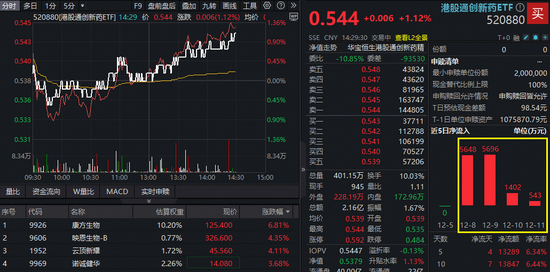
Core Viewpoint - The Hong Kong Stock Connect innovative drug sector is experiencing a rebound, with the high-volatility Hong Kong Stock Connect Innovative Drug ETF (520880) rising over 1%, potentially ending a four-day losing streak. Notably, this week has seen a net subscription of over 130 million yuan, indicating increased buying interest [1][6]. Group 1: ETF Performance - The Hong Kong Stock Connect Innovative Drug ETF (520880) has seen a cumulative net subscription of over 130 million yuan this week [1][6]. - As of November 30, the ETF's scale reached 2.142 billion yuan, with an average daily trading volume of 458 million yuan since its listing, making it the largest and most liquid among its peers [10]. Group 2: Sector Dynamics - The leading stock, Kangfang Biologics, surged over 6.8%, while other notable stocks like Innovent Biologics and BeiGene also saw gains of over 2% and 1%, respectively [8]. - Kangfang Biologics has received FDA approval to conduct a Phase III clinical trial for its PD-1/CTLA-4 dual-specific antibody, indicating significant advancements in innovative drug development [3][8]. Group 3: Investment Insights - A report from Ping An Securities suggests that the rise of innovative drugs is sustainable, recommending attention to companies with rich pipelines, high-potential single products, and leading technology platforms [3][8]. - The Hong Kong innovative drug sector has been in a correction phase since early September, enhancing the cost-effectiveness of investments in this area [3][8]. Group 4: Index Characteristics - The underlying index for the ETF, the Hang Seng Stock Connect Innovative Drug Select Index, has a significant concentration of leading stocks, with the top ten holdings accounting for over 72% of the index weight [4][9]. - The index is designed to exclude CXO companies, focusing solely on innovative drug developers, which enhances its purity and comprehensiveness [9].

科创板反弹,科创板50ETF(588080)本周前四个交易日“吸金”超10亿元
Mei Ri Jing Ji Xin Wen· 2025-12-12 06:14
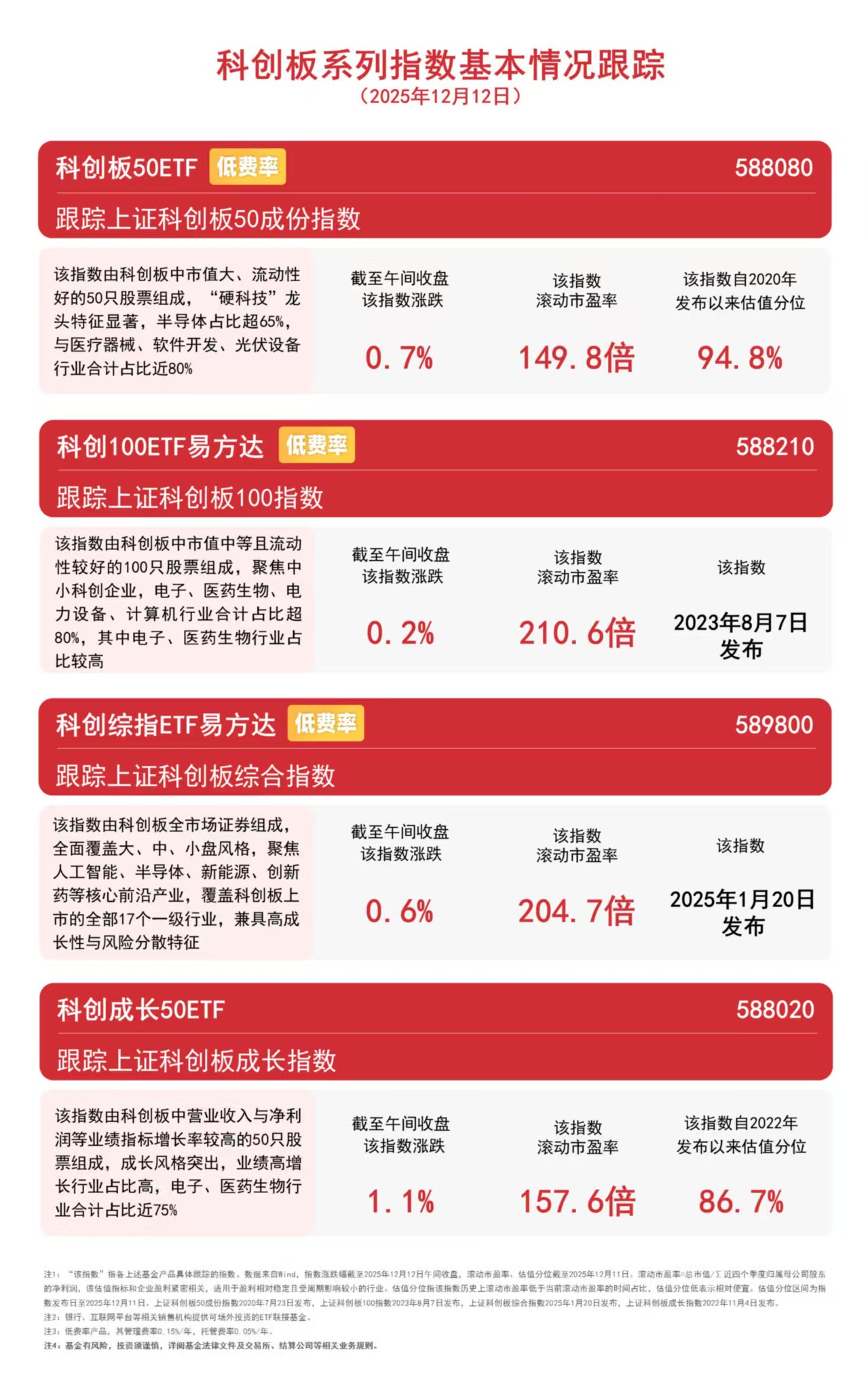
Group 1 - The article discusses various ETFs tracking the Sci-Tech Innovation Board indices, highlighting their low fee rates and focus on high-quality stocks in the technology sector [2] - The Sci-Tech Innovation Board 50 ETF tracks the top 50 stocks with significant market capitalization and liquidity, predominantly in the semiconductor sector, which accounts for over 65% of the index [2] - The rolling price-to-earnings (P/E) ratio for the Sci-Tech Innovation Board 50 ETF is reported at 149.8 times, indicating a high valuation relative to earnings [2] Group 2 - The Sci-Tech Innovation Board 100 ETF focuses on 100 medium-cap stocks with good liquidity, primarily in the electronics, biopharmaceuticals, and electrical equipment sectors, which together represent over 80% of the index [2] - The rolling P/E ratio for the Sci-Tech Innovation Board 100 ETF is noted at 210.6 times, reflecting a premium valuation in the market [2] - The Sci-Tech Comprehensive Index ETF covers all market securities on the Sci-Tech Innovation Board, focusing on key industries such as artificial intelligence, semiconductors, and new energy, with a rolling P/E ratio of 204.7 times [2]
港股异动 基石药业-B(02616)涨超5% 普拉替尼获纳入国家医保目录 公司2.0管线矩阵持续扩大
Jin Rong Jie· 2025-12-12 04:02
Core Viewpoint - The stock of Basilea Pharmaceutica (02616) has risen over 5%, currently at 6.07 HKD, following the announcement that its RET inhibitor, Pralsetinib (100 mg), has been included in the latest National Medical Insurance Drug List in China, effective January 1, 2026 [1] Company Developments - Basilea has successfully advanced four innovative drugs to market approval, with three of these products having completed clinical trials and registration in China, now included in the national medical insurance list [1] - The inclusion of Pralsetinib in the insurance list is expected to accelerate its market penetration, as noted in a report by Tianfeng Securities published in August [1] Pipeline and Technology - The company's preclinical pipeline includes over nine potential candidates, focusing on FIC/BIC research across oncology, autoimmune, and inflammatory diseases [1] - Basilea's innovative internal ADC technology platform features proprietary linkers designed to enhance the selective release of effective payloads in tumors, supporting multiple ADC products in its pipeline 2.0, which is expected to provide ongoing momentum for the company's future growth [1]
基石药业-B涨超5% 普拉替尼获纳入国家医保目录 公司2.0管线矩阵持续扩大
Zhi Tong Cai Jing· 2025-12-12 03:07
Group 1 - Company shares of 基石药业-B (02616) increased by over 5%, reaching a price of 6.07 HKD with a trading volume of 22.7042 million HKD [1] - The company announced that its RET inhibitor, 普吉华 (普拉替尼胶囊, 100mg), has been successfully included in the latest National Medical Insurance Catalog, effective from January 1, 2026 [1] - To date, 基石药业 has successfully advanced four innovative drugs to market approval, with three of them having completed clinical trials and registration in China, now included in the national insurance catalog [1] Group 2 - Tianfeng Securities published a report in August, predicting that the inclusion of 普拉替尼 in the insurance catalog is expected to accelerate its market penetration [1] - The company's preclinical pipeline includes over nine potential candidates, focusing on FIC/BIC research across oncology, autoimmune, and inflammatory diseases [1] - The innovative internal ADC technology platform of the company features optimized proprietary linkers to improve the selective release of effective payloads in tumors, supporting multiple ADC products in its pipeline 2.0, which is expected to provide ongoing momentum for future development [1]
港股异动 | 基石药业-B(02616)涨超5% 普拉替尼获纳入国家医保目录 公司2.0管线矩阵持续扩大
智通财经网· 2025-12-12 03:03
Core Viewpoint - 基石药业's RET inhibitor, Pralsetinib (普吉华®), has been included in the latest National Medical Insurance Drug List in China, effective January 1, 2026, which is expected to enhance its market penetration and sales growth [1] Group 1: Company Developments - 基石药业's stock rose by 5.57% to HKD 6.07, with a trading volume of HKD 22.7042 million [1] - The company has successfully advanced four innovative drugs to market approval, with three of them having completed clinical trials and registration in China, now included in the national medical insurance list [1] Group 2: Market Expectations - Tianfeng Securities reported in August that the inclusion of Pralsetinib in the insurance list is anticipated to accelerate its market uptake [1] - The company's preclinical pipeline includes over nine potential candidates, focusing on FIC/BIC research across oncology, autoimmune, and inflammatory diseases [1] Group 3: Technological Advancements - 基石药业 has developed an innovative internal ADC technology platform, characterized by optimized proprietary linkers to improve tumor-selective payload release [1] - The platform supports multiple ADC products in its pipeline 2.0, which is expected to provide ongoing momentum for the company's future growth [1]
柳药集团(603368):Q3批发业务逐步恢复,来年稳健增长可期
China Post Securities· 2025-12-12 02:49
Investment Rating - The report maintains a "Buy" rating for the company, indicating an expected relative increase in stock price of over 20% compared to the benchmark index within the next six months [7][9]. Core Insights - The company's wholesale business is gradually recovering in Q3, with a projected stable growth outlook for the coming year. The total revenue for the first three quarters of 2025 was 15.758 billion yuan, a decrease of 1.47% year-on-year, while the net profit attributable to shareholders was 646 million yuan, down 9.81% [3][4]. - The decline in revenue and profit is primarily attributed to the impact of centralized procurement policies and hospital drug sales control, which have led to a temporary decrease in sales volume and profit margins in the wholesale segment. However, improvements in product structure and cost reduction efforts are expected to support a gradual recovery in performance [4][5]. - The retail and industrial segments showed steady growth, with retail revenue increasing by 8.17% to 2.591 billion yuan and industrial revenue rising by 6.44% to 860 million yuan in the first three quarters of 2025 [5]. Financial Performance Summary - For Q1-Q3 2025, the gross margin was 10.88%, a decrease of 0.88 percentage points, while the net profit margin was 4.10%, down 0.38 percentage points. The company’s operating cash flow net amount was 135 million yuan, an increase of 10.09% [4]. - The company’s revenue projections for 2025-2027 are 21.133 billion yuan, 22.221 billion yuan, and 23.383 billion yuan, respectively, with net profits expected to be 828 million yuan, 873 million yuan, and 922 million yuan [9][11]. Strategic Initiatives - The company has implemented an employee stock ownership plan and stock option incentive plan to enhance talent retention and core team cohesion. The first transfer of shares under the employee stock ownership plan has been completed, involving 52 employees [6]. - To diversify its product offerings and enhance competitiveness, the company has established a wholly-owned subsidiary and signed an investment agreement with Suninflam Ltd. for the development of an innovative monoclonal antibody drug targeting inflammation-related factors in epilepsy [8].

从杭州走向世界 一颗创新药的“远征”
Hang Zhou Ri Bao· 2025-12-12 02:27
Core Insights - The article highlights the successful development and approval of the innovative drug "Taretnib" by Baoyuan Pharmaceutical, marking a significant milestone for Chinese pharmaceutical innovation on the global stage [2][6] Group 1: Drug Development and Approval - Taretnib is the first Class 1 innovative drug to emerge from the Hangzhou Medical Port, recently receiving approval from Japan's Ministry of Health, Labor and Welfare, following its approval in the United States [2] - The drug targets a specific genetic mutation in non-small cell lung cancer, which affects only 1% to 3.4% of patients, yet represents a breakthrough opportunity for Chinese innovation in pharmaceuticals [3] Group 2: Company Strategy and Collaboration - Baoyuan Pharmaceutical adopts a "global rights, global development" strategy, collaborating with partners in China, South Korea, and Japan to enhance clinical development and commercialization efforts [4] - The company has successfully navigated the drug approval process, benefiting from China's accelerated drug approval system, particularly under the "14th Five-Year Plan" which emphasizes support for the biopharmaceutical industry [6] Group 3: Industry Growth and Impact - The biopharmaceutical industry in Hangzhou has seen significant growth, with the number of pharmaceutical production companies increasing from 94 to 133 and wholesale companies from 167 to 318 over the past five years, reflecting an average growth rate of 83% [7] - The successful acquisition of Baoyuan Pharmaceutical by a U.S. biopharmaceutical company underscores the global recognition of Chinese innovative drugs, completing a cycle of internationalization from development to market acceptance [7]
创新药持续调整,恒生医药触及60日新低,资金跑步进场
Mei Ri Jing Ji Xin Wen· 2025-12-12 02:24
恒生医药ETF(159892)聚焦创新药、CXO及相关产业,在港交所18A制度优势下覆盖众多创新标的 (百济神州、信达生物等),在创新药出海+商保目录等催化下有望延续估值修复行情。 随着创新药持续调整,前期的泡沫化担忧逐步淡化,资金已连续11日申购恒生医药ETF,该ETF在跟踪 恒生生物科技指数的ETF中规模最大,日均成交额排名第一,流动性良好。 港股市场创新药板块延续震荡调整走势,恒生医药ETF(159892)已连续4日收跌,其二级市场交易价 格自9月高位调整幅度超18%,今日一度触及60日新低,先声药业、药明合联、三生制药等盘中领跌。 ...
9款创新药首入2025国家医保目录
Jin Rong Shi Bao· 2025-12-12 02:11
Core Insights - The 2025 National Medical Insurance Drug List has successfully added 114 new drugs, including 50 innovative drugs, achieving an overall success rate of 88%, significantly higher than the 76% in 2024 [1] - The first version of the Commercial Health Insurance Innovative Drug List has been released, marking a substantial breakthrough in the multi-tiered medical security system [1] - Nine innovative drugs from the Sci-Tech Innovation Board have been included in the new lists, showcasing the strength of these companies [1] Group 1: National Medical Insurance and Commercial Insurance - The new drug lists aim to establish a multi-tiered medical security system, with the basic insurance list covering essential drugs and the commercial insurance list focusing on high-value drugs not covered by basic insurance [4] - Since 2018, 149 innovative drugs have been included in the medical insurance list, accounting for 17% of the new drugs, supported by various policies to facilitate the entry of innovative drugs [2] - The successful inclusion of innovative drugs in the insurance lists reflects the government's recognition of their clinical value and the importance of supporting local innovation [6] Group 2: Sci-Tech Innovation Board Companies - Nearly 90% of the Sci-Tech Innovation Board's biopharmaceutical companies have received medical insurance support for their approved new drugs [2] - Notable products such as Junshi Biosciences' innovative drug, which is the only domestic PCSK9-targeted drug for statin-intolerant patients, have been included in the insurance list [2] - The successful renewal of contracts for drugs like Baiyue's Bai Ze An and Junshi's Tuoyi further expands the insurance coverage, benefiting a wider patient population [6] Group 3: Research and Development Investment - The R&D investment of Sci-Tech Innovation Board companies reached a new high in the first three quarters of 2025, with a year-on-year increase of over 10% and an R&D intensity of 42%, significantly surpassing the overall level of A-shares [6] - Companies like Baiyue have invested over 10 billion yuan in R&D, demonstrating a strong commitment to innovation [6] - The cycle of R&D investment leading to innovative outcomes, insurance support, market returns, and reinvestment in R&D has been established and is continuously strengthening [7]