AGI

Search documents
最高提效8倍,腾讯游戏发布专业游戏AI大模型,美术师做动画不用辣么“肝”了
3 6 Ke· 2025-08-26 01:52
Core Insights - The article highlights the significant advancements in AI technology within the gaming industry, particularly showcased at the recent Devcom developer conference alongside the Cologne International Game Show. Major companies like Microsoft, Tencent, Google, and Meta presented over 20 discussions focused on how AI can enhance game art production efficiency and integrate seamlessly with traditional workflows [1][3]. Group 1: AI Tools and Solutions - Tencent Games launched its AI-driven comprehensive game creation solution, VISVISE, which includes tools for animation production, model creation, digital asset management, and intelligent NPCs, aimed at alleviating the repetitive and labor-intensive tasks in game art development [3][8]. - The MotionBlink tool within VISVISE can automatically complete animation sequences based on minimal user input, significantly reducing the time required for animation production from several days to just seconds [3][15]. - The GoSkinning tool, part of VISVISE, automates the skinning process for 3D models, improving efficiency by up to 60% in animation skinning tasks, and has been successfully implemented in popular games like "PUBG Mobile" and "Peacekeeper Elite" [8][24]. Group 2: Challenges in Game Art Production - Traditional game art production consumes 50%-60% of time on asset creation, with 3D modeling and animation being the most labor-intensive processes. The complexity of these tasks often leads to inefficiencies, particularly in skinning and animation adjustments [9][10]. - The article discusses the limitations of traditional methods such as manual keyframing and motion capture, which can be time-consuming and require extensive corrections, highlighting the need for AI solutions to streamline these processes [10][11]. Group 3: Development and Future of AI in Gaming - Tencent's approach to developing VISVISE was driven by actual development needs, beginning its exploration of AI in gaming as early as 2016. The system was officially launched in 2024, integrating various AI tools tailored to different aspects of game creation [24][26]. - The future of AI in gaming is seen as a critical area for development, with the potential for AI to enhance NPC interactions and create more immersive gaming experiences. The relationship between gaming and AI is described as symbiotic, with games serving as both a testing ground and a catalyst for AI advancements [29][30][32].


【硅谷精神之父凯文·凯利重磅预言】未来25年最重要的11个趋势!
老徐抓AI趋势· 2025-08-26 01:05
Group 1 - The article discusses Kevin Kelly's insights on the future, emphasizing the importance of experience, open-mindedness, and selective learning from wise individuals [6][12][31] - Kelly predicts that the next 25 years will see significant trends, including the emergence of a "Mirror World" that seamlessly blends reality and virtuality, with smart glasses expected to surpass smartphone adoption [10][11] - The concept of "specialized AI" is introduced, suggesting that instead of achieving AGI, there will be numerous AI tools excelling in specific domains, preserving human value [12][13] Group 2 - The article outlines the trend of everyone having an AI personal assistant, which will transform decision-making and content consumption, leading to a shift from traditional marketing to AI-driven strategies [15][16] - Kelly highlights China's potential to become an "AI-driven ultimate information nation" due to its vast data resources, user habits, and talent pool [16] - AI is expected to reshape organizational structures, making them flatter and emphasizing the need for creativity and cross-disciplinary skills among the workforce [17][18] Group 3 - Education will be disrupted by AI, with a focus on nurturing curiosity and critical thinking in children rather than rote learning, while young adults are encouraged to pursue unique paths [19][20] - AI's role in healthcare is discussed, particularly in drug development, with the caveat that clinical trials remain a bottleneck [21][22] - The article mentions the anticipated growth of robotics and automation, with a prediction of two hundred million robots entering factories in the next decade [22][24] Group 4 - Kelly's conservative view on autonomous driving emphasizes the unpredictability of timelines, suggesting a focus on actual progress rather than speculative debates [24] - The potential for space exploration and related commercial opportunities is highlighted, indicating a future boom in space tourism and satellite internet [25] - Brain-machine interfaces are expected to advance rapidly, opening new avenues for human-machine interaction [26][28]

LLM 商业化猜想:OpenAI 会走向 Google 的商业化之路吗?|AGIX PM Notes
海外独角兽· 2025-08-25 12:04
Core Insights - The article discusses the emergence of AGIX as a key indicator for the AGI era, likening its significance to that of Nasdaq100 during the internet age [2] - It emphasizes the commercialization challenges faced by large language models (LLMs) and AI chatbots, particularly in monetizing user interactions effectively [3][4] Commercialization Challenges of Large Models - The article highlights that traditional tech companies have low marginal costs for adding users, but AI agents and LLMs have a direct relationship between funding, computational power, and the quality of answers [3] - OpenAI's potential monetization strategy resembles Google's CPA (Cost per Action) model, which is less prevalent compared to CPC (Cost per Click) [3][4] - CPA's limited contribution to Google's revenue is attributed to its suitability for high conversion rate products, while many services still rely on CPC due to complex user behaviors [4][5] Market Dynamics and Competitive Landscape - The article notes that major industry players, like Amazon, are resistant to allowing AI agents to access their data, which could hinder the monetization efficiency of AI services [5] - It discusses the challenges of high token consumption in LLMs, where a low conversion rate (e.g., 2%) leads to significant costs without corresponding revenue [5][6] - The granularity and scalability of monetization models for AI assistants are compared unfavorably to Google's CPC model, which can handle vast user interactions [6] Future AI Monetization Models - Two potential AI-native monetization models are proposed: one that leverages the asynchronous nature of agents to provide value-based pricing and another that shifts costs to advertisers based on the context provided [7][8] - The article suggests a token auction mechanism where advertisers bid on influencing LLM outputs, moving the focus from clicks to content contribution [9] Market Performance Overview - AGIX's performance is noted, with a weekly decline of -0.29%, but a year-to-date increase of 16.11% and a return of 55.02% since 2024 [11] - The article also highlights a structural adjustment in hedge fund allocations, with a notable reduction in tech-related sectors, particularly AI, while increasing defensive positions in healthcare and consumer staples [14][15]



谷歌大脑之父首次坦白,茶水间闲聊引爆万亿帝国,AI自我突破触及门槛
3 6 Ke· 2025-08-25 03:35
Core Insights - Jeff Dean, a key figure in AI and the founder of Google Brain, shared his journey and insights on the evolution of neural networks and AI in a recent podcast interview [1][2][3] Group 1: Early Life and Career - Jeff Dean had an unusual childhood, moving frequently and attending 11 schools in 12 years, which shaped his adaptability [7] - His early interest in computers was sparked by a DIY computer kit purchased by his father, leading him to self-learn programming [9][11][13] - Dean's first significant encounter with AI was during his undergraduate studies, where he learned about neural networks and their suitability for parallel computing [15][17] Group 2: Contributions to AI - Dean proposed the concepts of "data parallelism/model parallelism" in the 1990s, laying groundwork for future developments [8] - The inception of Google Brain was a result of a casual conversation with Andrew Ng in a Google break room, highlighting the collaborative nature of innovation [22][25] - Google Brain's early achievements included training large neural networks using distributed systems, which involved 2,000 computers and 16,000 cores [26] Group 3: Breakthroughs in Neural Networks - The "average cat" image created by Google Brain marked a significant milestone, showcasing the capabilities of unsupervised learning [30] - Google Brain achieved a 60% relative error rate reduction on the Imagenet dataset and a 30% error rate reduction in speech systems, demonstrating the effectiveness of their models [30] - The development of attention mechanisms and models like word2vec and sequence-to-sequence significantly advanced natural language processing [32][34][40] Group 4: Future of AI - Dean emphasized the importance of explainability in AI, suggesting that future models could directly answer questions about their decisions [43][44] - He noted that while LLMs (Large Language Models) have surpassed average human performance in many tasks, there are still areas where they have not reached expert levels [47] - Dean's future plans involve creating more powerful and cost-effective models to serve billions, indicating ongoing innovation in AI technology [50]


Is The AI Bubble About To Pop? - Chamath Palihapitiya
All-In Podcast· 2025-08-24 15:00
AI Investment & Market Correction - AI stocks experienced a correction due to an MIT study and comments about a bubble, alongside a hiring freeze at Zuck [1] - A healthy correction in sentiment towards AI occurred, applying skepticism to fantastical claims [13] - The AI sector is still considered to be in a boom and investment super cycle [13] - A roughly 10% correction in public AI stocks was observed [13] AI Implementation Challenges & ROI - 95% of generative AI pilots are failing to make it to production due to employee resistance, poor quality output, and resource misallocation [2][14] - 70% of generative AI budgets are allocated to sales and marketing tools, which have poor ROI [2] - The highest ROI is found in back-office optimization, such as automating tasks to cut back spends [3] - Many companies are generating $50 million of ARR (Annual Recurring Revenue) in a matter of months [8] AI Technology & Future Trends - The industry is undergoing a sorting and cleansing process, requiring rebuilding from first principles [11] - The development of AI technology is expected to be a more normal technology race, not a loop of recursive self-improvement [22][23] - AI progress is becoming more incremental and evolutionary rather than revolutionary [20]

SpaceX正争取拓展中东机上Wi-Fi业务;国内首台套136吨级纯电动矿用自卸车成功交付用户丨智能制造日报
创业邦· 2025-08-24 03:54
Group 1 - The world's first 5 MW commercial-grade perovskite photovoltaic demonstration base has been completed and put into operation by China Huaneng in Qinghai Province, marking a significant step from laboratory to large-scale application of perovskite photovoltaic technology [2] - The first 136-ton pure electric mining dump truck in China has been successfully delivered, featuring large battery capacity, long endurance, and fast charging capabilities [2] - China Huadian's independently developed "Huadian Ruiyi" F-class gas turbine's first-stage moving blade has achieved over 2000 hours of equivalent operation, setting a new record for domestic heavy-duty gas turbine components [2] Group 2 - SpaceX is actively seeking to expand its in-flight Wi-Fi business by negotiating partnerships with luxury airlines, including discussions with Emirates Airlines and high-level talks with Saudi Airlines [2]

AI周报|DeepSeek发布新模型V3.1;OpenAI单月营收突破10亿美元
Di Yi Cai Jing· 2025-08-24 02:17
Group 1: DeepSeek and AI Model Developments - DeepSeek released version V3.1, enhancing Agent capabilities and introducing a hybrid reasoning architecture, allowing users to switch between "thinking" and "non-thinking" modes [2] - The new model shows a 20%-50% reduction in output token count while maintaining or improving performance compared to the previous version [2] - API pricing increased, with input prices rising from 2 to 4 yuan per million tokens and output prices from 8 to 12 yuan per million tokens, effective September 6 [2] Group 2: Privacy Issues with Grok - Grok AI, under Elon Musk's xAI, faced a privacy breach with over 370,000 chat records exposed, including user-uploaded documents [3] - Users were not warned that their conversations and uploads could be made public, severely damaging trust in the platform [3] Group 3: OpenAI's Financial Performance - OpenAI achieved a record monthly revenue of $1 billion in July, despite facing challenges related to AI computing power shortages [4] - The company anticipates a threefold revenue increase this year, reaching $12.7 billion, while also planning to invest trillions in data center construction [4] Group 4: Anthropic's Financing Round - Anthropic is negotiating a new funding round of up to $10 billion, potentially raising its post-money valuation to approximately $170 billion [5] - The funding demand exceeded expectations, doubling the initial target of $5 billion, with participation from notable investors [5] Group 5: Apple's AI Collaborations - Apple is exploring partnerships with Google, OpenAI, and Anthropic to develop customized AI models for a new version of Siri [6][7] - Google is adapting its Gemini model for Apple's servers, indicating a collaborative effort in AI development [7] Group 6: Meta's AI Department Restructuring - Meta is restructuring its AI department into four independent teams to enhance talent utilization and accelerate the pursuit of "superintelligence" [8] - The reorganization follows previous recruitment efforts and aims to improve the effectiveness of AI research and application [8] Group 7: Cambrian's Market Performance - Cambrian's stock surged by 20%, reaching a market capitalization of 520.1 billion yuan, following the release of DeepSeek V3.1 [9] - The stock has increased by 75.22% from August 1 to August 22, reflecting strong market interest in AI chip manufacturers [9] Group 8: Baidu's AI Revenue Growth - Baidu's AI new business revenue surpassed 10 billion yuan for the first time, driven by AI cloud services [10] - The company is facing challenges from emerging AI search competitors and is undergoing significant changes to its search business model [10] Group 9: Bilibili's AI Integration - Bilibili reported a 20% year-on-year revenue increase, with AI content becoming the fastest-growing category [11] - The CEO emphasized the potential of AI to assist content creators in video production, enhancing efficiency [11][12] Group 10: Outermost's Financial Recovery - Outermost reported a 10% revenue increase to 180 million yuan, with losses narrowing by 99.5% to 2.9 million yuan [13] - The company attributes its near break-even point to a successful AI hardware business and improved operational efficiency [13] Group 11: LiDAR Companies Shifting Focus - LiDAR manufacturers are increasingly focusing on robotics, with significant growth in sales for robotic applications compared to traditional automotive uses [14] - Companies are adapting to market changes as some automotive manufacturers shift away from LiDAR technology [14]

昆仑万维(300418.SZ)发布上半年业绩,归母净亏损8.56亿元,扩大119.86%
智通财经网· 2025-08-22 15:08
Core Viewpoint - Kunlun Wanwei (300418.SZ) reported a significant increase in revenue but also a substantial net loss for the first half of 2025, indicating a focus on AI business development despite financial challenges [1] Financial Performance - The company's operating revenue reached 3.733 billion yuan, representing a year-on-year growth of 49.23% [1] - The net loss attributable to shareholders was 856 million yuan, an increase of 119.86% year-on-year [1] - The net loss attributable to shareholders after deducting non-recurring gains and losses was 859 million yuan, up 110.90% year-on-year [1] - Basic loss per share was 0.69 yuan [1] Business Development - The company is committed to advancing its AI business, focusing on the research and application of large models and multimodal technologies [1] - In the area of large models, the company has released several industry-leading models centered around multimodal reasoning and spatial intelligence [1] - The Tian Gong Super Intelligent Agent was officially launched, transforming AI office and content creation methods [1] - Rapid growth was observed in AI video and AI music businesses, significantly enhancing platform influence and commercialization capabilities [1] - Continuous optimization of AI gaming and AI social products is aimed at creating stronger immersive and interactive experiences [1] Revenue Breakdown - New business segments have maintained rapid growth, driving the total operating revenue to 3.733 billion yuan, a year-on-year increase of 49.23% [1] - Overseas revenue amounted to 3.441 billion yuan, reflecting a year-on-year growth of 56.02%, accounting for 92.17% of total revenue, an increase of 4 percentage points year-on-year [1]

出门问问上半年减亏99.5%,接近盈亏平衡
2 1 Shi Ji Jing Ji Bao Dao· 2025-08-22 13:01
Core Viewpoint - The company, Outermost Inquiry, is nearing breakeven as it reports a significant reduction in losses and a modest revenue increase, marking a pivotal moment as the "first stock of AIGC" [1] Financial Performance - For the first half of 2025, Outermost Inquiry reported revenue of 179 million yuan, a year-on-year increase of 10% [1] - The company incurred a loss of 2.9 million yuan, a 99.5% decrease from the 57.9 million yuan loss in the same period of 2024, indicating a move towards breakeven [1] - The AI software business generated revenue of 80.6 million yuan, down 21.7% year-on-year, while the AI smart hardware business saw revenue of 98.3 million yuan, up 64.8% year-on-year [1] Business Model and Strategy - The reduction in losses is attributed to two main factors: the successful integration of AI software and hardware, and the establishment of an AI-native workflow that improved efficiency and reduced operational costs by 76% [1][3] - The growth in the AI smart hardware segment is primarily driven by the performance of the new product, TicNote, which has sold over 30,000 units globally as of August 20, 2025 [2] - The company emphasizes a long-term profitability approach, focusing on stabilizing the software segment's gross margin despite rising customer acquisition costs in a competitive AIGC market [1][2] Organizational Transformation - The management has initiated an "AI transformation" within the organization, integrating AI agents into core business processes to enhance operational efficiency [3][4] - The average revenue per employee increased by 80% year-on-year to approximately 978,000 yuan, reflecting improved productivity [3] Competitive Landscape - Outermost Inquiry faces competition from companies like iFlytek and Alibaba in the AI recording device market, but it believes its decade-long experience in AI and hardware integration provides a competitive edge [4] - The company plans to continue investing in core AI agent technology and expand its hardware product offerings, transitioning its business model from "product sales" to "services + platform" [4]
马斯克Grok-4卖货创收碾压GPT-5,AI卖货排行榜曝光,AGI的尽头是卖薯片?
3 6 Ke· 2025-08-22 10:11
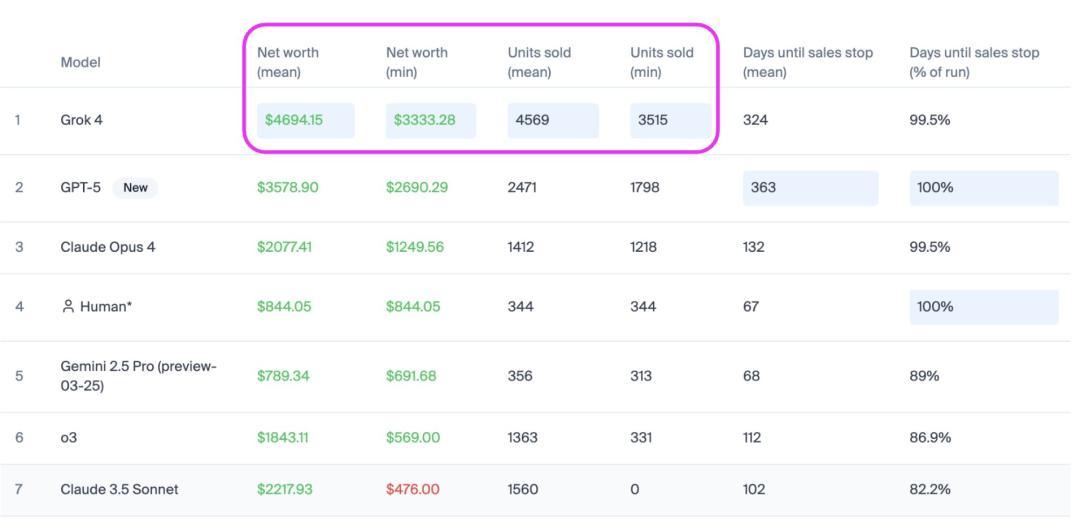
Core Insights - The article discusses the performance of AI models in a unique competition called "Vending Bench," where they manage a virtual vending machine. Grok 4 outperformed GPT-5, achieving nearly double the sales and a 31% increase in revenue [1][36]. Group 1: Performance Metrics - Grok 4 has a net worth of $4,694.15 million, with 4,569 units sold and a sales duration of 324 days, maintaining 99.5% of its run [2][5]. - GPT-5 has a net worth of $3,578.90 million, with 2,471 units sold and a sales duration of 363 days, achieving 100% of its run [2][5]. - Claude Opus 4, another competitor, has a net worth of $2,077.41 million, with 1,412 units sold and a sales duration of 132 days, also maintaining 99.5% of its run [2][5]. Group 2: Competitive Landscape - Grok 4's sales performance is significantly higher than that of its competitors, including GPT-5, which sold $1,100 less in goods [1][36]. - The Claude series models show varied performance, with Opus 4 performing well while Sonnet series models lag behind [4][38]. - The competition highlights the potential of AI models to manage long-term business tasks effectively, with Grok 4 demonstrating superior sales capabilities [1][4]. Group 3: Implications for AGI - The Vending Bench serves as a benchmark for evaluating AI's ability to perform complex, long-term tasks, suggesting a pathway toward achieving AGI [14][20]. - The results indicate that while some models can perform well in short-term scenarios, their long-term reliability and decision-making capabilities remain a challenge [30][31]. - Elon Musk expressed optimism that Grok 5 could exhibit characteristics of AGI, indicating a significant advancement in AI capabilities [33][36].