
食品安全

Search documents
我国餐饮业食品安全态势持续向好
Zhong Guo Xin Wen Wang· 2025-07-19 05:12
Core Insights - The Chinese catering industry is experiencing a positive trend in food safety, supported by government policies and increased awareness among enterprises regarding their responsibilities [1][2] - The catering sector is projected to achieve a revenue of 55,718 billion yuan in 2024, reflecting a year-on-year growth of 5.3%, driven by expanding market size and evolving consumer demands for personalized, diverse, and high-quality dining experiences [1] - The shift towards nutritional transformation in the catering industry is gaining attention, with a focus on healthy cooking methods and balanced nutrition, which is changing consumer eating habits and presenting challenges for the industry [1] Industry Developments - The widespread application of digital and intelligent technologies is enhancing collaboration across the supply chain, leading to increased standardization and reduced food safety risks in the catering industry [2] - The recognition of the importance of standardization in food safety has grown, with a more robust regulatory framework being established, although the complexity of the industry presents ongoing challenges for comprehensive management [2] - Emerging food categories that align with health trends, such as low-calorie and high-fiber options, are gaining popularity, particularly among younger consumers, indicating a shift in consumer preferences towards healthier dining choices [2]
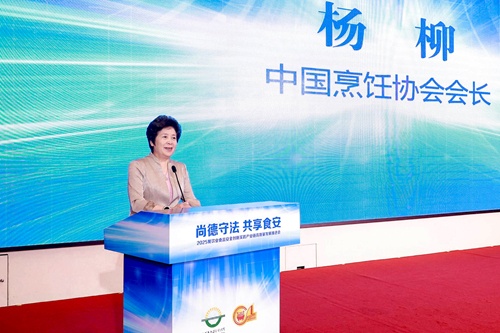
中国烹饪协会会长杨柳:以责任与创新推动餐饮业高质量发展
Zhong Guo Jing Ji Wang· 2025-07-18 13:36
Core Viewpoint - Food safety is emphasized as the cornerstone of the restaurant industry's development, with a focus on innovation and resilience in a complex economic environment [1] Industry Overview - The restaurant market is steadily expanding, supported by government policies and regulations aimed at enhancing food safety, such as the "Opinions on Further Strengthening Food Safety Full-Chain Supervision" and "Measures for Promoting and Managing the Restaurant Industry" [1] - The food safety situation in China's restaurant industry is improving, with increased corporate responsibility and innovative practices emerging [1] Challenges and Responses - The complexity of the restaurant industry, along with the long food safety chain and high control requirements, poses challenges for refined management [1] - The China Cuisine Association is actively cooperating with the government to promote policy awareness, deepen industry collaboration, and strengthen the responsibilities of online food service platforms [1] Future Outlook - The restaurant industry has a broad market prospect, but it requires collective responsibility, innovation, and governance to solidify the foundation of food safety, achieve nutritional health goals, promote a culture of conservation, and enhance food quality [1]

市场监管总局召开2025年直播带货食品安全行政指导会
news flash· 2025-07-18 12:04
Core Viewpoint - The State Administration for Market Regulation (SAMR) emphasizes the importance of food safety in the rapidly growing live-streaming e-commerce sector, highlighting issues such as false advertising and counterfeit products [1][2]. Group 1: Meeting Outcomes - The SAMR held a meeting on July 18, 2023, to address food safety in live-streaming e-commerce, urging platforms and influencers to prioritize food safety [1]. - A recent special inspection revealed that some food products and agricultural products exceeded permissible limits for food additives and pesticide residues, necessitating immediate attention [1]. - The meeting called for strict implementation of food safety responsibilities and risk control measures in response to inspection findings [1]. Group 2: Recommendations for Industry - Companies in the live-streaming e-commerce sector must establish a strong food safety awareness and treat it as a critical aspect of their business development [1]. - The SAMR encourages platforms to enhance the internal motivation and market vitality of their operators, optimizing resource allocation to support businesses that ensure product quality and food safety [1]. - The SAMR plans to strengthen policy guidance and institutional development to promote accountability among platforms and operators, aiming for improved quality safety awareness and management practices [2].
“字节跳动上百名员工食物中毒”,有新进展
财联社· 2025-07-18 08:41
Core Viewpoint - The article discusses the final ruling regarding the food poisoning incident involving ByteDance employees in Singapore, where the restaurant Yun Hai Yao was fined for food safety violations [1][3]. Summary by Sections Incident Overview - On July 18, it was reported that Yun Hai Yao was fined 7,000 Singapore dollars (approximately 39,000 RMB) due to a collective food poisoning incident at ByteDance's Singapore office [1]. - The incident involved a significant number of affected individuals, some of whom required hospitalization [3]. Legal Proceedings - The judge highlighted the high potential harm caused by the food contamination, which was due to excessive levels of Staphylococcus aureus found in the food served [3]. - Yun Hai Yao's CEO, Lu Zhitang, represented the company in court and acknowledged the legal responsibility for the incident [5]. Food Safety Violations - The food served to ByteDance employees contained over 200,000 Staphylococcus aureus colonies per gram, which is 2000 times the permissible limit [4]. - Inspections revealed multiple food safety breaches, including unclean utensils and the presence of live cockroaches in the restaurant [5]. Company Response - Following the ruling, Yun Hai Yao publicly apologized to the affected employees and announced the permanent closure of its corporate meal service [3]. - The company committed to retraining all relevant staff on food safety and overhauling its food safety management system, including third-party risk assessments [3].

字节跳动上百名员工食物中毒,最新进展→
第一财经· 2025-07-18 08:20
Core Viewpoint - Yun Hai Yao, a restaurant company, was fined 7,000 Singapore dollars (approximately 39,000 RMB) due to a food poisoning incident involving ByteDance employees, highlighting serious food safety management failures within the company [1][2]. Group 1: Incident Details - The food poisoning incident affected a significant number of individuals, with some requiring hospitalization, and was caused by food contaminated with Staphylococcus aureus at levels exceeding safety limits [1][2]. - The Singapore court emphasized the lack of food safety awareness from Yun Hai Yao, noting that the company had not issued an apology or compensation by the time of sentencing [1][3]. - The court's fine was higher than the prosecution's request of 5,500 Singapore dollars, reflecting the severity of the case [1]. Group 2: Company Response - Following the incident, Yun Hai Yao publicly apologized to affected employees and announced the permanent closure of its "company meal" service and the Nafu City branch [1][2]. - The company committed to retraining all relevant staff in food safety and overhauling its food safety management system, including third-party risk assessments and enhanced controls over key processes [2]. - The incident was attributed to severe management negligence, including inadequate risk assessment for new business operations and failure to maintain proper hygiene standards [2]. Group 3: Legal Proceedings - On July 2, the CEO of Yun Hai Yao, Lu Zhitang, pleaded guilty in court, accepting legal responsibility for the food poisoning incident [3]. - The company faced two charges for violating the Environmental Public Health (Food Sale) Act and the Environmental Public Health (Food Hygiene) Regulations [3].

新加坡云海肴因中毒案被罚近4万元,货架检出10多只活蟑螂
Nan Fang Du Shi Bao· 2025-07-18 07:45
Core Points - ByteDance's Singapore employees experienced food poisoning after consuming meals from Yunhaiyao, leading to a significant legal and operational fallout for the restaurant [1][5][6] - Yunhaiyao was fined 7,000 Singapore dollars (approximately 39,000 RMB) for violating food safety regulations and has permanently closed the implicated store and its new corporate catering business [1][3][4] Group 1: Legal and Regulatory Actions - On July 17, Yunhaiyao was penalized for food safety violations under the Food Sale Act and the Environmental Public Health (Food Hygiene) Regulations [3][4] - The incident involved 171 reported cases of gastroenteritis, with 60 individuals requiring hospitalization [3][5] - The court found that the restaurant's food safety practices were severely lacking, including pest infestations and unsanitary conditions [3][6] Group 2: Internal Management Failures - The root cause of the incident was identified as serious management failures, particularly in risk assessment for the new corporate catering service [3][4] - The restaurant failed to control the volume of food prepared, exceeding its processing capacity, which contributed to the outbreak [4][6] - Subsequent investigations revealed that the food samples collected did not pass safety inspections, highlighting deficiencies in hygiene and temperature control during food preparation and storage [4][5] Group 3: Remedial Actions - In response to the incident, Yunhaiyao has implemented corrective measures, including the permanent closure of the implicated store and the corporate catering service [4][6] - The company is conducting comprehensive food safety training for all relevant staff, requiring them to obtain official certification before returning to work [4][6] - A third-party audit will be conducted to strengthen the food safety management system across all operational aspects, including sourcing, hygiene, processing, and pest control [4][6]
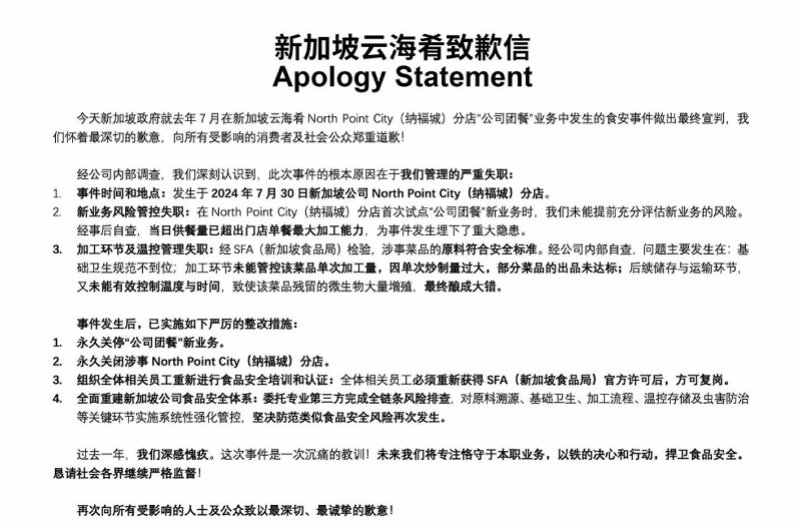
字节跳动海外上百名员工食物中毒,云海肴被判最高罚款,已永久停止公司团餐服务
新华网财经· 2025-07-18 05:50
Core Viewpoint - The article discusses the recent food poisoning incident involving ByteDance employees in Singapore, highlighting the legal consequences faced by the catering supplier Yunhaiyao and the measures taken in response to the incident. Group 1: Incident Overview - On July 30, 2024, a food poisoning incident affected 171 ByteDance employees, with 60 requiring medical treatment and 22 hospitalized, marking it as one of the more severe food poisoning cases in recent years [10] - The food sample from Yunhaiyao served to ByteDance contained over 200,000 colony-forming units of Staphylococcus aureus per gram, exceeding safety standards by 2,000 times [10] Group 2: Legal and Regulatory Actions - Yunhaiyao was fined a maximum of 7,000 Singapore dollars for violating food sales laws and public health regulations [2][4] - The CEO of Yunhaiyao, Lu Zhitang, pleaded guilty in court, accepting legal responsibility for the incident [3] Group 3: Company Response and Measures - Following the incident, Yunhaiyao permanently ceased its "company meal" service and closed the affected outlet [2] - The company acknowledged severe management failures, including inadequate risk assessment for new business operations and poor hygiene practices [6][7] - Yunhaiyao committed to retraining all relevant staff on food safety and overhauling its food safety system, including third-party risk assessments and improved control measures [5]

云海肴CEO当庭认罪后续:被判最高罚款 公司称永久停止“公司团餐”服务
Huan Qiu Wang Zi Xun· 2025-07-18 01:33
Core Viewpoint - The food poisoning incident involving ByteDance employees in Singapore has led to significant legal consequences for the catering supplier Yunhaiyao, which has been fined and has ceased its corporate meal services [1][3]. Group 1: Incident Details - The food poisoning incident occurred on July 30, 2024, affecting 171 ByteDance employees, with 60 requiring medical treatment and 22 hospitalized [5]. - The investigation revealed that the food sample provided by Yunhaiyao contained over 200,000 colony-forming units of Staphylococcus aureus per gram, exceeding safety standards by 2,000 times [5]. - During inspections, authorities found multiple food safety violations, including the presence of live cockroaches and unclean kitchen equipment [5]. Group 2: Legal and Corporate Response - Yunhaiyao's CEO, Lu Zhitang, pleaded guilty in court, leading to a maximum fine of 7,000 SGD for violations of food sales laws and public health regulations [1][3]. - Following the court ruling, Yunhaiyao issued a public apology and announced the permanent cessation of its corporate meal services, along with the closure of the affected outlet [1][3]. - The company has committed to retraining all relevant staff in food safety and has initiated a comprehensive overhaul of its food safety management system [3].
广东省珠海市市场监管局关于2025年食品监督抽检信息的通告(第5期)
Zhong Guo Zhi Liang Xin Wen Wang· 2025-07-17 09:35
Core Viewpoint - The Zhuhai Market Supervision Administration has conducted a food safety inspection in 2025, revealing that out of 734 samples tested, 715 were qualified while 19 were found to be non-compliant, primarily in the categories of catering food, vegetable products, and edible agricultural products [3]. Summary by Categories Inspection Results - A total of 734 samples were tested, with 715 passing and 19 failing the safety standards [3]. - The inspection covered 26 categories of food products, including agricultural products, catering food, condiments, beverages, and various processed foods [3]. Non-compliance Issues - The main contaminants detected in non-compliant samples included anionic synthetic detergents, pesticides like Leverage and Thiamethoxam, and preservatives such as dehydroacetic acid and sodium salt [3][4][5][6][7][8][9][10]. - Specific maximum residue limits were exceeded for various substances, such as: - Thiamethoxam in ginger with a limit of 0.2 mg/kg [5]. - Dehydroacetic acid in food products, potentially due to excessive use by manufacturers [6]. - Sodium saccharin in pickled vegetables, with a limit of 0.15 g/kg [6]. Regulatory Actions - The Zhuhai Market Supervision Administration has mandated local regulatory bodies to investigate non-compliant food products and their producers, ensuring that they fulfill legal obligations, trace product distribution, and recall or remove non-compliant items from the market [3]. - The administration will document the findings in the safety credit files of food producers and publicly disclose the enforcement results for public access [3]. Consumer Guidance - Consumers are advised to purchase food from legitimate channels, check product labels for essential information, and avoid products without proper identification or those that are past their expiration dates [4][12].
“剩菜盲盒”要盛满安全
Jing Ji Ri Bao· 2025-07-17 00:08
Core Viewpoint - The "leftover blind box" concept is gaining popularity among consumers due to its affordability, substantial portions, and the surprise element, combining fun with environmental consciousness [1] Group 1: Consumer Appeal - The "leftover blind box" offers a unique shopping experience by packaging near-expiry or unsold food items randomly, making it attractive to young consumers [1] - This approach not only reduces food waste but also promotes the values of saving food and opposing wastefulness, showcasing innovation and positive societal impact [1] Group 2: Food Safety Concerns - Despite its benefits, the potential food safety risks associated with "leftover blind boxes" cannot be overlooked, as consumers cannot know specific details like production dates and storage conditions beforehand [1] - There is a risk of merchants engaging in unethical practices such as selling expired products or substandard items due to the inherent nature of blind boxes [1] Group 3: Industry Recommendations - Merchants must prioritize food safety and quality by adhering to food safety standards and clearly labeling essential information on the blind boxes, including food types, ingredients, and expiration dates [2] - Industry associations should encourage self-regulation among merchants and impose stricter penalties for violations to create a deterrent effect [2] - Regulatory bodies need to establish clear food safety standards and monitor the supply chain effectively to ensure the safety and compliance of leftover food sources [2] - Consumer education through awareness campaigns is crucial to enhance understanding of potential risks associated with "leftover blind boxes" and to promote rational consumption [2]