
人形机器人

Search documents
江苏宏微科技股份有限公司关于变更签字注册会计师和项目质量复核人的公告
Xin Lang Cai Jing· 2026-01-30 21:51
Group 1 - The company has changed its auditing firm to Tianjian Accounting Firm for the 2025 fiscal year, with the decision approved during the board meeting on July 25, 2025, and the first extraordinary shareholders' meeting on August 12, 2025 [1][2][3] - The new signing auditors are Chen Zhenwei and Weng Jincheng, while the new project quality reviewer is Li Zongwei, replacing the previous personnel due to internal adjustments at Tianjian [1][2][3][6] Group 2 - The company forecasts a net profit attributable to shareholders of the parent company for 2025 to be between 14 million and 21 million yuan, marking a turnaround from a loss in the previous year, with an increase of 28.47 million to 35.47 million yuan, representing a year-on-year growth of 196.77% to 245.15% [11][13] - The expected net profit after deducting non-recurring gains and losses is projected to be between 8 million and 12 million yuan, an increase of 41.99 million to 45.99 million yuan compared to the previous year, reflecting a year-on-year increase of 123.54% to 135.30% [11][13] - The improvement in performance is attributed to the recovery in the power semiconductor industry, increased demand for new power electronic devices, and the company's strategic adjustments in product offerings [15][16]

特斯拉转向机器人业务,资本支出激增
Xin Lang Cai Jing· 2026-01-30 15:40
Group 1 - Tesla (TSLA) shares rose by 4.1% on Friday morning [1][2] - The company anticipates a 46% decline in profits for 2025 and plans to halt production of Model S/X to retool the Fremont production line for humanoid robot manufacturing [1][2] - Capital expenditures for 2026 are expected to more than double to approximately $20 billion, aimed at funding autonomous driving technology and the Optimus robot [1][2]


中国车企和特斯拉的下一战,战场已定
虎嗅APP· 2026-01-30 13:58
Core Viewpoint - Tesla is shifting its focus towards humanoid robots, with CEO Elon Musk stating that the production of Model S and Model X will be phased out to prioritize the development of the Optimus robot, which Musk believes will underpin 80% of Tesla's future market value [2][3]. Group 1: Tesla's Strategic Shift - Tesla plans to cease production of Model S and Model X, transitioning the Fremont factory to produce Optimus robots [3]. - The introduction of humanoid robots is seen as a critical component of Tesla's new mission, which aims to create a "prosperous and extraordinary world" [2]. - Musk acknowledges that Tesla's main competition in the humanoid robot sector will come from Chinese companies, which are rapidly advancing in AI and robotics [3]. Group 2: Chinese Automakers' Robotics Initiatives - Chinese automakers are actively investing in humanoid robotics, with companies like Li Auto and BYD announcing plans to develop their own humanoid robots [5][6]. - The competitive landscape is intensifying, with various Chinese companies, including Chery and Xpeng, setting timelines for humanoid robot production by 2026 and 2028 [12][13]. - The overlap in technology between electric vehicles and humanoid robots is significant, with around 70% of automotive technology being applicable to robotics [8]. Group 3: Market Potential and Investment Outlook - The global market for humanoid robots is projected to reach $25 trillion by 2050, indicating a massive growth opportunity compared to the automotive sector [9]. - The high degree of technological overlap allows automakers to pivot towards robotics without substantial additional investment, making it a low-cost, high-reward opportunity [9]. - Morgan Stanley reports that China holds a dominant position in the humanoid robot supply chain, accounting for 63% of the market, which could drive down manufacturing costs [14]. Group 4: Competitive Landscape and Challenges - The competition between Tesla and Chinese automakers in the humanoid robot space is expected to intensify by 2027, with both sides having distinct advantages [12][14]. - Tesla's strength lies in its advanced AI algorithms and extensive real-world data, while Chinese companies have demonstrated rapid iteration and cost control capabilities [14]. - Talent acquisition is crucial for success in the humanoid robot sector, with both Tesla and Chinese firms vying for top talent amidst a competitive automotive landscape [17].


这家机器人概念公司市值涨9倍!现欲港股IPO!
IPO日报· 2026-01-30 13:21
Core Viewpoint - Zhejiang Rongtai Electric Equipment Co., Ltd. is experiencing significant growth, with a market capitalization increase of over 9 times since its A-share listing, driven by its expansion into the robotics sector and strong performance in the new energy materials market [1][5][6]. Group 1: Company Overview - Zhejiang Rongtai, established in 1998, is a leading supplier of high-performance mica composite materials and has expanded its business into key precision components for robotics [4][6]. - The company ranks first globally in the mica products market for new energy applications, holding a market share of 22.6%, and also leads in the Chinese market with a 14.1% share [4][6]. Group 2: Financial Performance - From 2020 to 2022, Zhejiang Rongtai's revenue grew from 3.65 billion to 6.67 billion, with net profits increasing from 32.6 million to 134 million [7]. - In 2023, the company achieved revenue of over 800 million, with a projected growth of 41.8% to 1.135 billion in 2024, resulting in a compound annual growth rate of approximately 32.8% from 2020 to 2024 [7]. - The net profit for 2023 and 2024 is expected to be 172 million and 230 million respectively, reflecting growth rates of 28.43% and 34.02% [7]. Group 3: Strategic Investments and Future Plans - In 2025, Zhejiang Rongtai identified the potential in the humanoid robotics market and made strategic investments, including acquiring a 51% stake in Diz Precision and a 15% stake in Jinli Transmission [8]. - The company plans to use funds from its upcoming IPO to expand global production capacity, invest in strategic acquisitions, and enhance its research and development capabilities in both the robotics and new energy sectors [9][10].

2026年首月,A股17家公司股价翻番,AI、贵金属成大赢家?
Sou Hu Cai Jing· 2026-01-30 13:11
Market Overview - The A-share market has shown a strong upward trend in 2023, with major indices rising across the board, including a 3.76% increase in the Shanghai Composite Index and a 5.03% increase in the Shenzhen Component Index [1] - Key sectors attracting significant capital inflows include AI applications, commercial aerospace, robotics, and precious metals, which have driven market sentiment and index performance [1] Notable Stock Performances - A total of 17 companies in the A-share market saw their stock prices double in January 2023, with Zhite New Materials leading with a 234.08% increase [3][4] - Other notable performers include Fenglong Co. with a 213.97% increase and Hunan Silver with a 175.14% increase [3][4] Sector Analysis - The electronic and non-ferrous metal sectors were the most prominent among the 17 companies that doubled their stock prices, each contributing four companies to the list [9] - The media and power equipment sectors followed, each with two companies represented [9] Company-Specific Insights - Zhite New Materials focuses on the research, production, and sales of aluminum molds and prefabricated components, and has recently engaged in AI and quantum technology initiatives, although it has not yet generated revenue from these areas [5] - Fenglong Co. specializes in garden machinery and automotive parts, and its stock surged following a strategic acquisition by UBTECH Robotics, which aims to enhance its competitive edge in the humanoid robotics sector [6] - Hunan Silver's stock performance is closely tied to the overall precious metals market, which has seen increased interest due to geopolitical tensions and a weakening US dollar [7] Future Outlook - Industry experts suggest that technology stocks will remain a key investment theme through 2026, with potential for rotation into other sectors such as military and non-ferrous metals [1] - The AI wave is expected to significantly boost demand across various sectors, including servers, AI chips, and storage solutions, indicating a robust growth trajectory for companies involved in these areas [10][11]



洗牌前夜,机器人豪赌春晚背后,各藏续命突围算盘
3 6 Ke· 2026-01-30 13:08
Core Insights - The 2026 CCTV Spring Festival Gala has become a battleground for five robot companies, each investing heavily to secure a partnership, with costs for a single seat reportedly reaching up to 1 billion yuan [1][2] - The event represents a strategic positioning for these companies, aiming to leverage the gala's national credibility for various objectives, including market expansion, IPO preparation, and brand recognition [1][4] Group 1: Investment and Market Dynamics - The cost of a partnership seat at the Spring Festival Gala ranges from 60 million to 1 billion yuan, with exclusive rights potentially reaching 500 million yuan, effectively excluding most companies from participation [2] - The robot industry is at a critical juncture, with signs of both excitement from order acquisitions and IPO accelerations, as well as concerns over capital cooling and public skepticism regarding the practicality of robots [1][5] - The Spring Festival Gala serves as a unique economic engine, with previous participants like Wuliangye and Yushutech experiencing explosive growth in sales and brand visibility [4] Group 2: Strategic Objectives of Participating Companies - **Chasing Technology**: Chasing Technology aims to transform from a niche brand to a national-level technology brand, leveraging the gala for credibility and trust [7][9] - **Magic Atom**: Magic Atom, a startup focused on general-purpose robots, sees the gala as a platform to enhance market credibility and attract investment ahead of its IPO [13][15] - **Galaxy General**: Galaxy General seeks to bridge the gap between its industry expertise and public recognition, using the gala to elevate its profile and highlight its technological advancements [16][18] - **Yushutech**: Yushutech, already a recognized leader, aims to defend its market position and address public skepticism through its presence at the gala [20][25] - **Songyan Power**: Songyan Power focuses on showcasing its humanoid robot technology and expanding its market presence, particularly in North America and the Middle East [27][29] Group 3: Industry Challenges and Future Outlook - The robot industry faces significant challenges, including technological bottlenecks, unclear commercialization paths, and a fragile market confidence, leading to a complex environment of opportunities and risks [5][33] - The high costs associated with the gala have sparked debates about the sustainability of such marketing strategies versus practical R&D investments [32][34] - The industry is at a crossroads, with a clear divide emerging between companies focused on short-term visibility through performances and those committed to developing practical, intelligent solutions [36][37]
本周A股市场涨跌榜:沪指站稳4100点,贵金属、农业等板块接力拉升
3 6 Ke· 2026-01-30 12:51
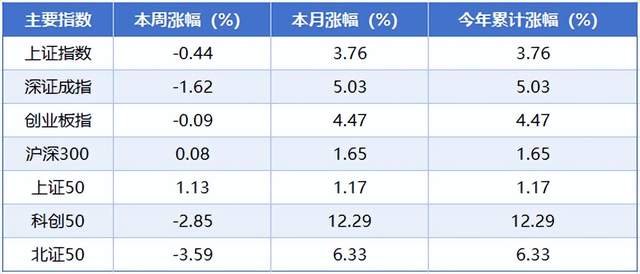
Market Overview - The A-share market indices all closed lower during the week from January 26 to January 30, with the Shanghai Composite Index down by 0.44%, the Shenzhen Component down by 1.62%, and the ChiNext Index down by 0.09% [1] - The average daily trading volume in the Shanghai and Shenzhen markets reached 30,348 billion yuan, showing an increase compared to the previous week, indicating a high level of market activity [4] Index Performance - The Shanghai 50 index showed relative strength with a weekly increase of 1.13%, while the CSI 300 index had a slight gain of 0.08%. In contrast, the North Star 50 and Sci-Tech 50 indices experienced notable declines of 3.59% and 2.85%, respectively [2][3] - For the month, the Sci-Tech 50 index led with a cumulative increase of 12.29%, followed by the North Star 50 and Shenzhen Component indices with increases of 6.33% and 5.03% [2] Sector Performance - The leading sectors for the week included genetically modified organisms, soybeans, combustible ice, corn, and gold concepts, with cumulative increases of 9.01%, 6.47%, 6.04%, 5.92%, and 5.87%, respectively [6][7] - Conversely, the sectors with the largest declines included military information technology, reducers, DRG/DIP, military-civilian integration, and commercial aerospace, with cumulative declines of 7.4%, 7.35%, 7.1%, 6.75%, and 6.75% [8] Individual Stock Highlights - The top five performing stocks for the week were Tongyuan Petroleum, Hunan Gold, Sidik, China Gold, and Xiaocheng Technology, with cumulative increases of 63.04%, 61.08%, 60.03%, 59.22%, and 53.13%, respectively [9][10] - The stocks with the largest declines included Huawai Design, *ST Yunchuang, Guosheng Technology, Tiangong Co., and Zhenstone Co., with cumulative declines of 33.91%, 30.87%, 30.70%, 28.94%, and 27.73% [14][15] Company Business Focus - Tongyuan Petroleum provides comprehensive oilfield services including enhanced oil recovery, drilling and completion technology services, and integrated project services [11] - Hunan Gold is engaged in the mining and processing of gold, antimony, tungsten, and other non-ferrous metals, as well as the import and export of related products [12] - Sidik specializes in precision coating materials and technical solutions [13]





金银河(300619):公司业绩反转确认 成长弹性进入全面提升新阶段
Xin Lang Cai Jing· 2026-01-30 12:37
Core Viewpoint - The company is expected to achieve a significant turnaround in its financial performance for the year 2025, with projected net profit ranging from 22 million to 32 million yuan, compared to a loss of 80.71 million yuan in the previous year [1] Group 1: Financial Performance - The company anticipates a net profit of 14 million to 21 million yuan for the non-recurring profit and loss, a substantial improvement from a loss of 91.83 million yuan in the previous year [1] - The fourth quarter of 2025 is projected to show a net profit of 10 million to 20 million yuan, reversing a loss of 71.99 million yuan from the same period last year [1] - The turnaround in performance is considered certain due to factors such as fixed asset depreciation and accounts receivable provisions [1] Group 2: Factors Affecting Q4 Performance - The increase in fixed asset depreciation is linked to the completion of the rubidium and cesium factory project, which will impact Q4 earnings due to the transition of construction in progress to fixed assets [2] - The estimated depreciation expense for 2025 is projected to be between 23 million and 45 million yuan, significantly affecting profitability in Q4 [2] - The company is also expected to increase its bad debt provisions in Q4, influenced by a rise in accounts receivable and the aging of receivables [3] Group 3: Business Segments - The lithium battery equipment segment is benefiting from increased demand driven by the expansion of the lithium battery industry and the development of solid-state batteries, leading to a significant increase in operating cash flow and profitability [4] - The organic silicon equipment and products segment is characterized by strong stability in profitability, with ongoing innovations and a solid market position [4] - The rubidium and cesium salt project is expected to contribute to structural growth in revenue, with the company entering a high-growth phase in 2026 [5] Group 4: Competitive Advantages - The company has established significant technological barriers in the rubidium and cesium industry, making it difficult for new entrants to compete [6] - Strategic partnerships with companies like Tianen Lithium Industry enhance the stability of the supply chain for high-purity rubidium and cesium salts, indicating potential for continued sales growth [6] - The company's proprietary low-temperature lithium extraction technology provides a competitive edge in production efficiency and cost [6] Group 5: Revenue and Profit Forecast - The company is projected to achieve revenues of 2.037 billion, 4.250 billion, and 6.040 billion yuan for the years 2025, 2026, and 2027, respectively [7] - Corresponding net profits are expected to be 32 million, 748 million, and 1.403 billion yuan, with significant growth in earnings per share anticipated [7] - The company maintains a "recommended" rating based on its growth potential and performance elasticity [7]

豪森智能:已与北京奔驰开展人形机器人合作项目
Zheng Quan Ri Bao Wang· 2026-01-30 12:23
Group 1 - The core viewpoint of the article is that Haosen Intelligent has initiated a collaboration project with Beijing Benz involving humanoid robots, which is characterized as a normal business cooperation with a small order scale [1] - The company stated that this collaboration will not have a significant impact on its operating performance [1]

杨德龙:坚定不移推广价值投资理念 做理性投资者和长期投资者
Xin Lang Cai Jing· 2026-01-30 12:15
Group 1: Value Investment Philosophy - The value investment philosophy advocated by Buffett is applicable to both US and A-share markets, but it requires adaptation to the specific conditions of the A-share market, termed "Chinese-style value investment" [2][12] - Key aspects of "Chinese-style value investment" include considering the predominance of retail investors in the A-share market, which leads to frequent mispricing opportunities and significant volatility, necessitating proper position management rather than simple long-term holding [2][12] - Understanding national policies is crucial; sectors supported by government policies, such as new energy and humanoid robots, should be prioritized, while sectors facing restrictions, like education and real estate, should be avoided [2][12] Group 2: Market Trends and Sector Performance - Traditional sectors, referred to as "old stocks," have faced stagnation, leading to skepticism about the effectiveness of value investing; however, true value investing focuses on investing in companies with future growth potential rather than past performance [3][13] - The technology innovation sector is thriving, supported by government policies and the backdrop of the AI revolution, indicating significant future growth potential and substantial stock price increases [3][13] - The semiconductor industry is characterized by intense competition, with many leading companies vying for dominance, highlighting the inherent risks in technology investments [6][16] Group 3: Valuation Metrics and Investment Strategies - Valuing technology stocks cannot rely solely on traditional metrics like price-to-earnings (P/E) ratios, as their worth is determined by future breakthroughs and market leadership potential [4][14] - Many technology companies require substantial R&D investments and may initially operate at a loss, which does not preclude significant stock price appreciation post-IPO [4][14] - The investment landscape is shifting, with a focus on future performance indicators rather than historical metrics, emphasizing the importance of industry research and analysis [5][15] Group 4: Sector-Specific Insights - The new energy sector, particularly solar energy, has faced challenges due to overcapacity and price wars, but is expected to rebound as the industry undergoes consolidation and innovation [8][18] - The solid-state battery sector is gaining attention, with many leading companies transitioning from lithium battery development, indicating substantial growth potential [8][17] - The electric power sector is highlighted as a critical area for future competition, with China's generation capacity being three times that of the US, positioning it favorably in the global energy landscape [10][19]