
量子科技

Search documents
薛鹤翔:新动能驱动 转型显韧性
Sou Hu Cai Jing· 2025-11-16 06:06
Group 1: Industrial Production - Industrial production in October continued to show steady growth, with the industrial added value of large-scale enterprises increasing by 4.9% year-on-year, and a cumulative growth of 6.1% from January to October, highlighting the characteristics of "new quality productivity leading and structural optimization upgrading" [1][6][18] - The equipment manufacturing and high-tech manufacturing sectors led the growth with rates exceeding 8% and 7% respectively, while new products like 3D printing equipment and electric vehicles maintained double-digit growth, becoming the core engines of industrial growth [1][6][18] - The industrial economy is accelerating its transition from scale expansion to quality and efficiency, but attention is needed on the insufficient vitality of small and medium-sized private enterprises, which requires targeted financing support and policy measures to unlock growth potential across the entire industrial chain [1][7][18] Group 2: Consumer Market - The consumer market in October continued to expand in scale and improve in quality, characterized by "service-led growth and structural optimization upgrading," with total retail sales increasing by 2.9% year-on-year and a cumulative growth of 4.3% from January to October [2][8][23] - The growth rate of service retail accelerated to 5.3%, with significant increases in experiential service consumption such as cultural, sports, and transportation services, indicating a shift in consumer demand from goods to services [2][8][23] - The rural market showed a notable growth rate higher than urban areas, supported by the improvement of the county commercial system and rural revitalization strategies, reflecting the continuous release of rural consumption potential [2][8][23] Group 3: Investment Structure - From January to October, fixed asset investment decreased by 1.7%, with the core characteristic of "real estate dragging down significantly while new momentum breaks through," indicating a structural change in investment dynamics [3][11][25] - Manufacturing investment continued to grow by 2.7%, becoming a key pillar for stabilizing investment, particularly in high-tech industries such as information services and aerospace equipment [3][11][25] - The residential market remains in deep adjustment, with both sales area and sales volume declining, but structural changes are noteworthy, such as the increasing proportion of existing home sales and the stabilization of housing prices in core urban areas [3][11][25] Group 4: Employment Market - The employment situation in 2025 is characterized by "overall stability with progress, prominent structural differentiation, and urgent quality improvement," with the urban survey unemployment rate averaging 5.2% from January to October [13] - Employment policies have effectively stabilized the job market, with significant reductions in costs for enterprises, but structural mismatches and low employment quality remain concerns [13] - The average weekly working hours for employees reached 48.4 hours, indicating hidden employment pressures as companies prefer to extend existing employees' hours rather than create new positions [13]


科大国创(300520):聚焦大模型落地实践 前瞻卡位量子赛道
Xin Lang Cai Jing· 2025-11-16 04:40
Core Insights - The company focuses on the practical application of large models in specific industries or verticals, leveraging its accumulated knowledge and core technology advantages in sectors such as telecommunications, energy, and transportation [1][2]. Group 1: Industry Focus and Model Application - The company is dedicated to enhancing knowledge to solve industry-specific challenges, developing the "Kechuang Xingyun" large model, which has been successfully implemented in various scenarios including customer service, network operations, and AI programming [2]. - The company addresses issues related to large models, such as insufficient reasoning depth and data quality, by utilizing a knowledge-enhanced technology approach, creating knowledge graphs from over 20 years of digital transformation experience [2]. Group 2: Business Structure Optimization - In the first three quarters of 2025, the company's revenue from digital applications, products, and operations was 348 million, 324 million, and 114 million yuan respectively, showing a year-on-year change of -43.63%, +58.50%, and -47.06% [3]. - The digital application business continues to focus on telecommunications and energy sectors, successfully launching key projects and promoting AI application revenue growth [3]. - The digital product business saw significant revenue growth, primarily due to the recovery of automotive BMS-related business, although it did not contribute to profits this period [3]. - The digital operation business faced revenue decline due to structural optimization and bad debt provisions, leading to a transfer of control to the management team to alleviate operational pressure [3]. Group 3: Quantum Technology Investment - The company has invested in quality quantum technology firms, such as Guoyi Quantum and Jiuzhang Quantum, and is promoting collaboration in quantum software development [4]. - The company aims to leverage its academic and research advantages to explore the integration of quantum and classical computing software technologies [4]. - The quantum technology sector is at a critical stage of development, with the company poised to capitalize on opportunities in various fields including government, energy, and finance [4]. Group 4: Financial Forecast - The company is expected to generate revenues of 1.906 billion, 2.196 billion, and 2.519 billion yuan from 2025 to 2027, with corresponding net profits of -0.05 billion, 0.47 billion, and 0.69 billion yuan [4]. - The projected earnings per share (EPS) for 2025 to 2027 are -0.02, 0.16, and 0.24 yuan, with a price-to-book (PB) ratio of 6 for each year [4].

国家统计局答每经问:10月份全国城镇调查失业率为5.1%,连续两个月下降
Mei Ri Jing Ji Xin Wen· 2025-11-14 16:53
Economic Overview - In October, the national economy continued to show a stable and progressive development trend, with notable characteristics including growth in production supply and market sales [2][5]. Employment Situation - The urban surveyed unemployment rate decreased to 5.1% in October, down by 0.1 percentage points from the previous month, marking two consecutive months of decline [1]. Production and Supply - Agricultural production remained strong, with an increase in autumn grain area and yield, indicating a promising harvest [2]. - The industrial production maintained stability, with the industrial added value of large-scale enterprises growing by 4.9% year-on-year in October [2]. - The service sector also showed steady growth, with a production index increase of 4.6% year-on-year [2]. Market Sales - Social retail sales of consumer goods increased by 2.9% year-on-year in October, driven by holiday consumption and the promotion of consumption [5]. - Specific categories such as communication equipment and cultural office supplies saw significant retail growth of 23.2% and 13.5%, respectively [5]. Price Trends - The consumer price index (CPI) turned positive in October, rising by 0.2% year-on-year, while the core CPI increased by 1.2%, marking a continuous expansion in growth for six months [7]. - The producer price index (PPI) saw a narrowing decline of 2.1% year-on-year, indicating a positive trend in industrial pricing [7]. Investment Trends - Investment in high-tech manufacturing showed robust growth, with a year-on-year increase of 7.2% in October [10]. - Investment in sectors such as aerospace and information services grew significantly, with increases of 19.7% and 32.7%, respectively [11]. Emerging Industries - The digital economy and green transformation are gaining momentum, with significant growth in sectors like smart manufacturing and artificial intelligence [12]. - New energy vehicles and lithium-ion batteries saw production increases of 19.3% and 30.4%, respectively, highlighting the growth potential in these areas [10].
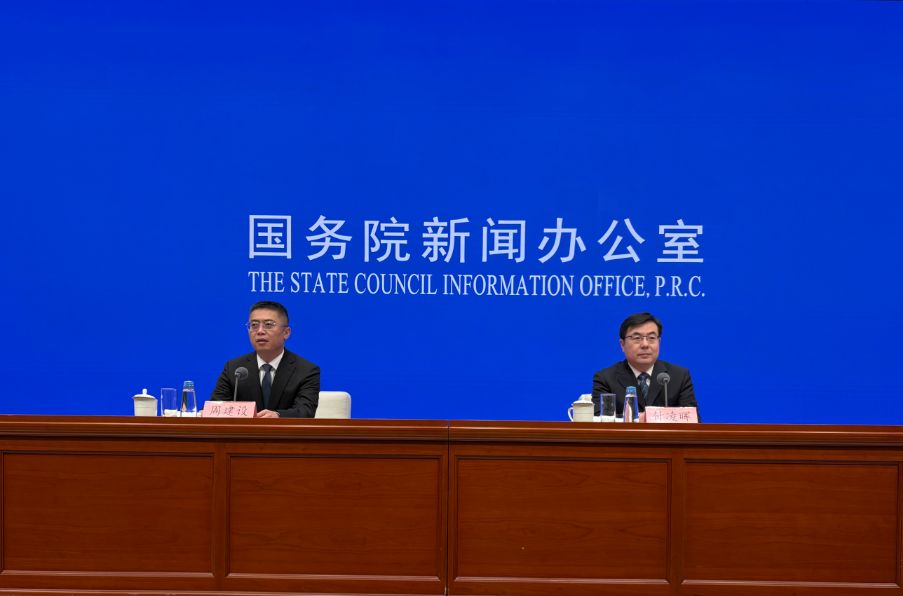
科技成长延续偏弱调整
Tebon Securities· 2025-11-14 13:28
Market Analysis - The A-share market experienced a weak adjustment, with the Shanghai Composite Index falling below the 4000-point mark, closing at 3990.49, down 0.97% [4][7] - The market saw a decrease in trading volume, with total market turnover dropping to 1.98 trillion, a 4.1% decline from the previous day [7][9] - Defensive sectors outperformed, while technology growth sectors faced significant declines, with electronic, communication, and computer sectors down by 2.88%, 2.45%, and 2.32% respectively [7][9] Bond Market - The bond market remained stable, with the 30-year main contract rising by 0.03% to 116.160, while the 10-year and 5-year contracts held steady [10] - The People's Bank of China conducted a 212.8 billion yuan reverse repurchase operation, indicating a net liquidity injection of 71.1 billion yuan [10] Commodity Market - Agricultural product prices increased, with notable rises in soybean and apple prices, up 2.26% and 2.25% respectively [10] - Precious metals experienced slight declines, with gold and silver futures down by 0.29% and 0.04%, respectively, amid changing expectations regarding Federal Reserve interest rate cuts [10] Investment Strategy - The report suggests maintaining a balanced allocation strategy focusing on dividend stocks, micro-cap stocks, and technology sectors, while closely monitoring external environmental changes [9][13] - The bond market is expected to remain loose in the short term, presenting potential allocation opportunities as the stock-bond dynamic adjusts [13] Key Investment Themes - The report highlights several key investment themes, including artificial intelligence, nuclear fusion, domestic chip production, and quantum technology, emphasizing the importance of technological breakthroughs and policy support [15] - The report also notes the potential for gold and silver investments to gain value following further interest rate cuts by the Federal Reserve, alongside the impact of geopolitical risks [15]

彩讯股份:公司对中科酷原的投资是公司面向未来的前沿战略布局
Zheng Quan Ri Bao· 2025-11-14 12:13
Core Viewpoint - The company is strategically investing in quantum technology, recognizing its potential despite the long development and commercialization cycles involved in this cutting-edge field [2] Group 1: Investment Strategy - The company has made an investment in Zhongke Kuyuan as part of its forward-looking strategic layout in quantum technology [2] - Zhongke Kuyuan has launched China's first atomic quantum computer, "Hanyuan No. 1" [2] Group 2: Future Outlook - The company will continue to monitor the technological advancements and commercialization progress of Zhongke Kuyuan [2] - Specific returns from this investment will be determined according to accounting standards, with relevant information to be disclosed in company announcements [2]
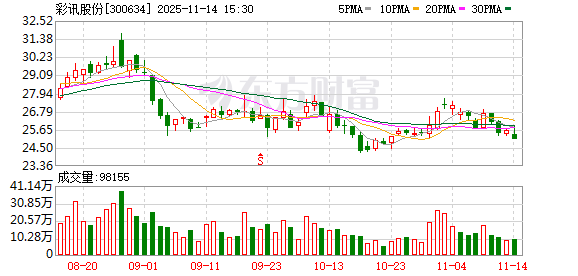
彩讯股份:中科酷原已推出国内首台原子量子计算机“汉原1号”
Mei Ri Jing Ji Xin Wen· 2025-11-14 08:00
Group 1 - The core viewpoint of the article is that quantum technology requires a long development cycle for both research and industrialization, and the company is strategically investing in this frontier area [2] - The company has invested in Zhongke Kuyuan, which has launched China's first atomic quantum computer, "Hanyuan No. 1" [2] - The company will continue to monitor the technological progress and industrialization of quantum technology, with specific revenue recognition to be determined according to accounting standards [2]
当汽车遇见量子:产业新变量的“叩门”
Zhong Guo Qi Che Bao Wang· 2025-11-14 03:23
Core Insights - Quantum technology is recognized as a transformative force in the automotive industry, with applications in enhancing vehicle information security, accelerating new materials and battery research, and optimizing autonomous driving algorithms [2][3][5]. Group 1: Quantum Technology Overview - Quantum technology integrates principles of quantum mechanics with various scientific fields, offering new paradigms for information acquisition, processing, and transmission [3][4]. - The advantages of quantum technology include extraordinary computing power, nearly absolute information security, and extreme precision in sensing capabilities [4][5]. Group 2: Applications in Automotive Industry - Quantum technology is poised to revolutionize the automotive sector by improving data security for smart vehicles through quantum encryption and enhancing precision in environmental sensing for autonomous driving [5][6]. - The introduction of "quantum eyes" technology allows vehicles to identify objects in low visibility conditions, significantly improving the performance of autonomous systems [6]. Group 3: Enhancements in Vehicle Performance - Major automotive companies are leveraging quantum computing to simulate molecular interactions, leading to the development of batteries with higher energy density and longer range [7]. - Quantum sensors can provide millimeter-level positioning support for autonomous vehicles, enhancing their ability to perceive the environment and make timely decisions [6][7]. Group 4: Future Prospects and Challenges - The integration of quantum technology is expected to redefine the automotive landscape, with predictions that by 2027, high-end smart vehicles equipped with quantum communication modules will achieve zero-latency vehicle-to-infrastructure communication [9]. - Despite the promising outlook, the large-scale application of quantum technology faces challenges, including the need for reliable engineering, a shortage of interdisciplinary talent, and the establishment of unified technical standards [10][11].

围绕创新遴选“高精尖”,促进交易力求“新实效”—— 第二十七届高交会聚焦未来科技发展
Jing Ji Ri Bao· 2025-11-13 22:18
Group 1 - The 27th China International High-tech Achievements Fair will be held in Shenzhen, covering an exhibition area of 400,000 square meters with 22 specialized exhibition areas, expecting over 450,000 professional visitors [1] - The event serves as a showcase of past five years' technological innovations and a platform for future technological development, emphasizing the importance of high-level technological self-reliance [1] - Nearly 5,000 enterprises are expected to exhibit their latest technologies and products, with over 90% of the exhibits being physical items, and more than 60 events for product launches and roadshows planned [1] Group 2 - The Futian exhibition area will host a technology innovation achievement release conference, featuring over 150 innovative exhibits from more than 50 tech companies, highlighting breakthroughs in AI, quantum technology, and biomedicine [2] - Bao'an District will select over 100 quality benchmark enterprises to showcase their core technological advantages in intelligent manufacturing, including an "AI production circle" and "AI city vitality circle" [2] - Bao'an District has implemented detailed measures to ensure the fair's success, including a "conference + cultural tourism" integrated work plan [2] Group 3 - The fair will focus on promoting transactions and creating new practical effects, aiming to convert high-tech projects into productive forces through the Shenzhen Innovation Service System [3] - Numerous industry procurement conferences will be organized, with over 1,000 professional procurement teams and dedicated international procurement matching zones for new energy and AI sectors [3] - Shenzhen aims to leverage the fair to enhance international and domestic market connections, promote high-quality development of high-tech industries, and attract foreign investment [3]
我国专精特新“小巨人”企业超1.76万家
Sou Hu Cai Jing· 2025-11-13 13:00
Core Insights - The development conference for specialized, refined, and innovative small and medium-sized enterprises (SMEs) was held in Chongqing, highlighting the growth and support for these businesses in China [1] Group 1: Growth of Specialized SMEs - China has cultivated over 17,600 "little giant" enterprises and more than 140,000 specialized, refined, and innovative SMEs, with over 600,000 quality SMEs being progressively nurtured [1][3] - During the 14th Five-Year Plan period, the number of specialized SMEs increased from less than 40,000 to over 140,000, while "little giant" enterprises grew from over 5,000 to 17,600 [3] Group 2: Contribution of SMEs to the Economy - SMEs account for 99.9% of all enterprises in China, 84.3% of employment, and 78% of total assets [3] - In 2024, 75.3% of effective invention patents were independently developed by SMEs, with "little giant" enterprises averaging 26.6 invention patents each and over 30 million yuan in R&D investment [5] Group 3: Industry Distribution and Innovation - Over 60% of "little giant" enterprises focus on industrial foundational sectors, with nearly 80% located in key industrial chain segments [7] - 90% of these enterprises directly support at least three well-known domestic or international companies, with around 6,000 "little giant" enterprises involved in future industries such as quantum technology, artificial intelligence, and low-altitude economy [7]
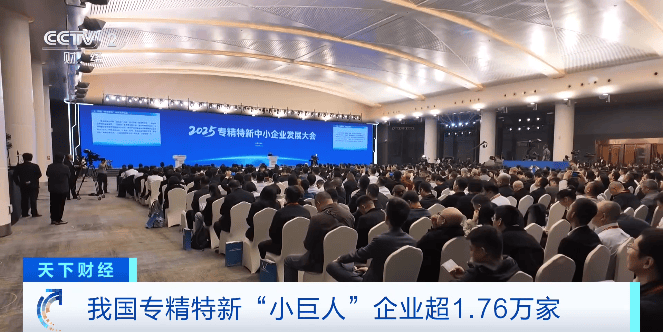
“十四五”期间我国专精特新“小巨人”企业数量增长超两倍
Yang Shi Wang· 2025-11-13 12:01
Core Insights - The number of specialized and innovative small and medium-sized enterprises (SMEs) in China has increased from less than 40,000 to over 140,000 during the 14th Five-Year Plan period [1] - The number of "little giant" enterprises has grown from over 5,000 to 17,600 [1] - Currently, there are more than 60 million SMEs in China [1] Innovation Capability - In 2024, 75.3% of effective invention patents from SMEs will be independently developed [1] - On average, "little giant" enterprises possess 26.6 invention patents each, with average R&D investment exceeding 30 million yuan [1] Industry Distribution - Over 60% of "little giant" enterprises focus on industrial foundational sectors [1] - Nearly 80% of these enterprises are distributed across key industrial chain links [1] - 90% of these enterprises directly support at least three well-known domestic and international companies [1] - There are nearly 6,000 "little giant" enterprises in future industries such as quantum technology, artificial intelligence, and low-altitude economy, playing a crucial role in strengthening and stabilizing supply chains [1]