黄金投资

Search documents
金价银价破纪录!普通人的钱包,真要“金”光闪闪了?
Sou Hu Cai Jing· 2026-01-12 13:09
Group 1 - The core point of the article highlights the significant rise in gold and silver prices, with gold surpassing $2500 per ounce and silver reaching $35 per ounce, marking historical highs that directly impact consumers [1][3]. - The surge in gold prices is attributed to global uncertainties, including tensions in the Middle East, weak economic data from Europe and the U.S., and a declining U.S. dollar, leading to increased demand for gold as a safe-haven asset [3][4]. - Central banks, particularly in China, India, and Turkey, have been increasing their gold reserves, with global central bank purchases in 2025 rising by 30% compared to the previous year, indicating a trend of seeking stability in gold amidst economic volatility [3][4]. Group 2 - The impact of rising gold prices is felt most acutely by ordinary consumers, who experience a decrease in purchasing power as prices for gold jewelry and other goods increase [4][6]. - Jewelry stores are experiencing a divide in customer behavior, with existing customers eager to buy gold for its value retention, while new customers are hesitant due to high prices, leading to a 20% increase in sales for some stores but a 30% decrease in new customer purchases [6]. - The rising costs of gold are also affecting the prices of industrial materials, with the cost of silver jewelry increasing by 8 yuan over the past six months, reflecting broader inflationary pressures [6].

Gold price today, Friday, January 16: Gold remains above $4,600 after an improved jobs report
Yahoo Finance· 2026-01-12 12:53
Gold (GC=F) futures opened at $4,621.60 per troy ounce on Friday, nearly even with Thursday’s closing price of $4,623.70. The price of gold declined slightly in early trading. Despite the pullback, the gold price remains near its record high of $4,635, recorded on Wednesday. Gold’s price softened after the release of an improved weekly jobless claims report. In the week of Jan. 10, initial unemployment claims totaled 198,000, down 9,000 from the prior week. The median forecast was 215,000. The Departmen ...
1429元/克!金价狂飙引发全国抢金潮,回收门店排队到街上!
Sou Hu Cai Jing· 2026-01-12 12:35
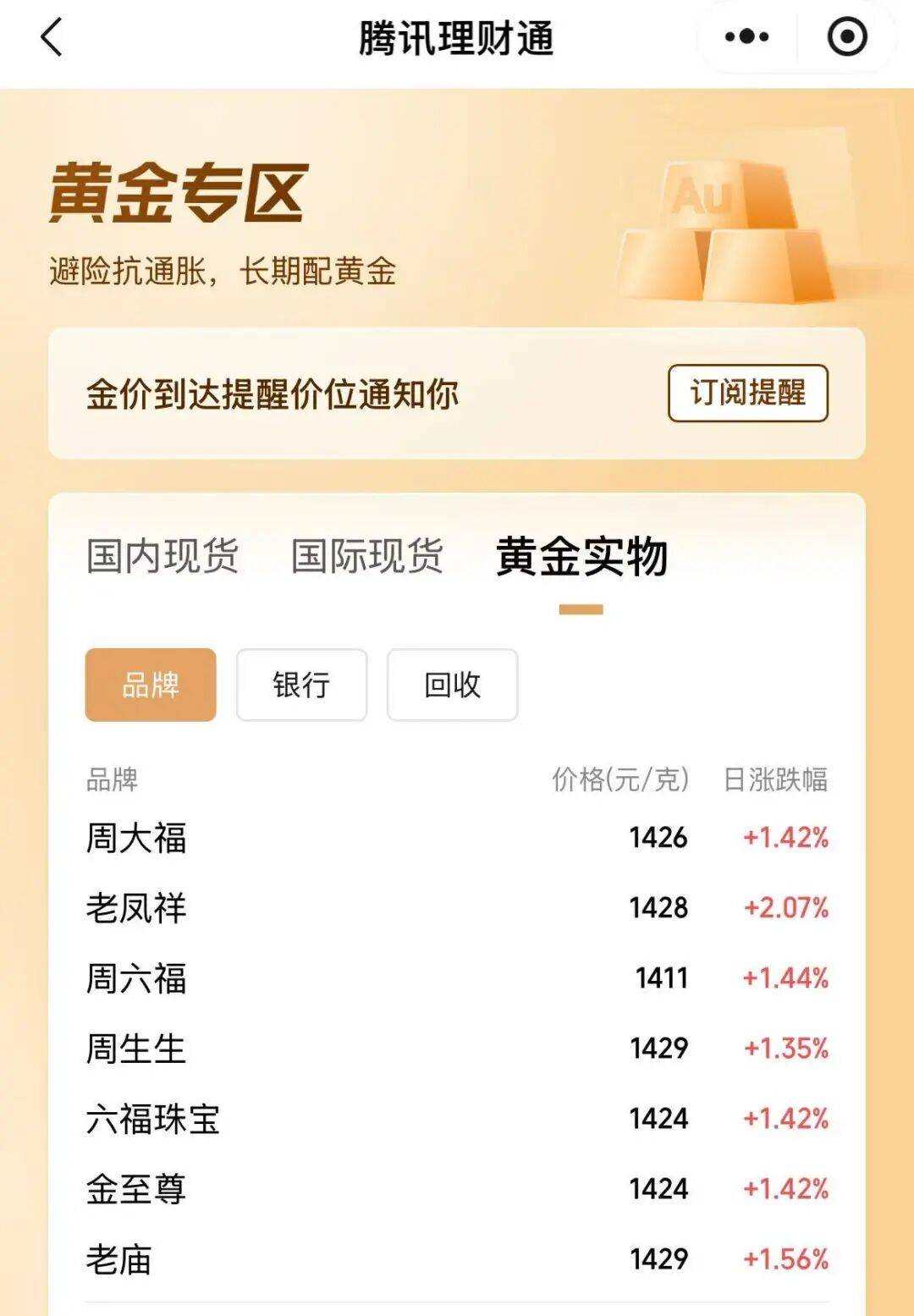
1月12日早盘,国际金价直接冲上4600美元/盎司,国内金店也跟着"蹭蹭"往上调。周生生、老庙黄金这些大牌足金饰品,一下涨到1429元/克,比前一天贵了 29元。有些一口价金饰更夸张,一夜之间贵了1.5万,看得人心脏一紧。 回收店那边更是热闹,排队的人比奶茶店还多,老板忙到手软:"今天回收量是平时三倍。" 金店里,新人们一边喊贵,一边又不敢不买:"婚期等不起,再涨就更买不起了。" "金价又涨了?我金饰还没到手,价格先飞了!" 金价为什么这么猛? 最近黄金市场的热闹程度,完全可以拍成一部抢金风云! 其实原因挺现实:全球央行都在买金、国际局势不稳、利率又在往下走。 简单说,就是大家都想找点"安全感",黄金就成了首选。 但这波涨价也把人群分得很清楚:新人硬着头皮买。投资客趁机卖。普通人默默绕道金店。 金价涨得这么快,大家的焦虑也跟着飙升。有人说黄金是硬通货,也有人感叹:"安全感越来越贵了。" 未来会不会继续涨?没人敢打包票。但有一点很稳:黄金不是暴富神器,它只是时代情绪的晴雨表。 ...
金价持续飙涨!多家银行紧急提醒
Sou Hu Cai Jing· 2026-01-12 12:13
截至1月12日9点13分,黄金价格再续涨势,现货黄金首次站上4600美元大关,日内涨超2%,新年首月累计上涨280美元。 黄金价格呈现持续上涨态势,同时交易风险陡增。中国银行、工商银行两家国有大行,接连发布相关黄金交易提示或规则调整,提醒投资者注意风险。 | 腾讯理财通 | | | 0 | | --- | --- | --- | --- | | 直金专区 | | | | | 避险抗通胀,长期配黄金 | | | | | 金价到达提醒价位通知你 | | | 订阅提醒 | | 国内现货 国际现货 | | 黄金实物 | | | 品牌 银行 | 回收 | | | | 品牌 | | 价格(元/克) 日涨跌幅 | | | 周大福 | | 1426 | +1.42% | | 老凤祥 | | 1428 | +2.07% | | 周六福 | | 1411 | +1.44% | | 周生生 | | 1429 | +1.35% | | 六福珠宝 | | 1424 | +1.42% | | 我支撑 | | 1424 | +1.42% | | 老庙 | | 1429 | +1.56% | 截图时间:2026年1月12日 银行积存金业务因 ...

格隆汇2026“全球视野”十大核心资产之黄金信托ETF-Ishares(IAU)
Sou Hu Cai Jing· 2026-01-12 09:38
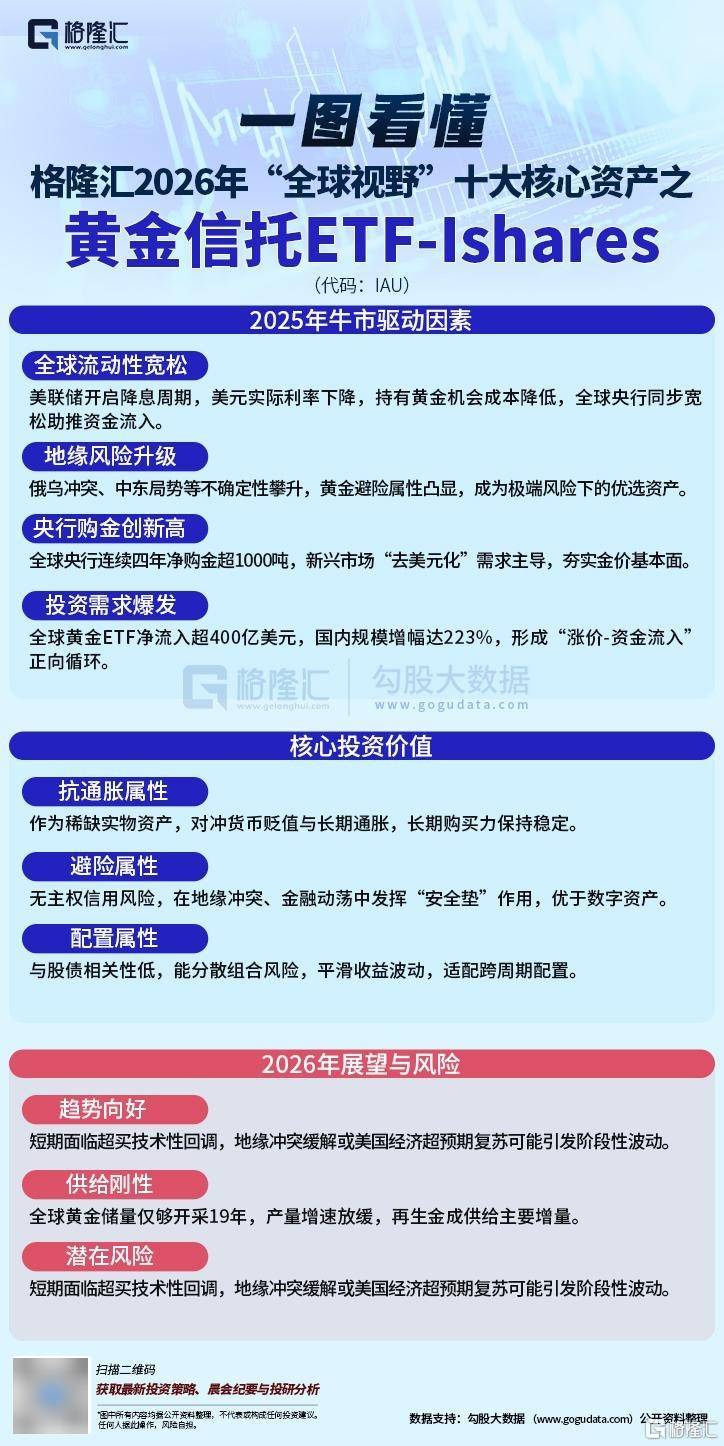
2026年度格隆汇"全球视野"十大核心资产已正式发布,黄金信托ETF-Ishares(IAU.US)历经多轮筛选 与角逐,最终入选成为核心资产中全球实物资产领域的标杆标的。 以下是关于IAU的入选逻辑与深度解析: 2025年全球金融市场波动加剧,黄金迎来史诗级牛市,伦敦现货黄金年内涨幅超67%突破4400美元/盎 司,创历史新高,成为全球表现最优大类资产。 在全球货币体系重构、美元信用弱化与全球投资者财富保值需求升级的背景下,黄金作为"信用对冲工 具"的抗通胀、避险、资产配置三重属性愈发凸显。 黄金信托ETF-Ishares(IAU)凭借"全球低费率+跨市场高流动性+全球实物背书"的独特优势,成为全球 投资者参与黄金市场的核心渠道。 作为全球规模领先的黄金ETF,IAU 2025年资产管理规模从550亿美元飙升至1780亿美元,增幅达 224%,完美承接了全球避险与配置需求。 在2026年美联储降息周期延续、地缘风险未消的背景下,IAU已构建起兼具"抗周期韧性+收益确定 性"的配置价值,成为"全球视野"资产组合中不可或缺的"安全垫"。 01 核心竞争壁垒:四大维度构筑不可替代优势 IAU的核心价值源于其标的资 ...
黄金首次突破4600美元关口,中国银行深圳分行紧急提示:警惕黄金预定价陷阱
Sou Hu Cai Jing· 2026-01-12 07:32
Core Viewpoint - The international gold market has achieved a significant breakthrough in early 2026, with spot gold prices surpassing $4600 per ounce for the first time, driven by continuous purchases from central banks and high investment interest in gold [1][2]. Group 1: Historical Price Records - As of January 12, 2026, the London spot gold price reached a peak of $4601.38 per ounce, marking a daily increase of over 2% [2]. - In 2025, international gold prices saw a cumulative increase of over 60%, the largest annual gain in nearly 46 years, setting the stage for the new high [2]. - Domestic gold prices also surged, with Shenzhen's real-time gold sales reaching 1018.27 yuan, reflecting a strong correlation with international price movements [2]. Group 2: Risk Warnings from Major Banks - Major state-owned banks, including Bank of China and Industrial and Commercial Bank of China, have issued risk warnings and adjusted trading rules to guide investors towards more rational participation in gold investments [3][7]. - Bank of China has specifically warned against "gold pre-pricing" investment traps, highlighting the risks of illegal trading platforms that lure investors with promises of low thresholds and high returns [7]. - Industrial and Commercial Bank has raised the minimum investment threshold for its gold accumulation products from 1000 yuan to 1100 yuan, indicating a proactive approach to risk management [7]. Group 3: Central Bank's Role - The strong performance of gold prices is closely linked to the People's Bank of China's ongoing accumulation of gold, with reserves reaching 74.15 million ounces as of December 2025, an increase of 30,000 ounces from the previous month [9]. - The central bank has been increasing its gold holdings for 14 consecutive months, reinforcing gold's significance in reserve asset allocation [9]. Group 4: Divergent Market Outlook - Market institutions have differing views on the future trajectory of gold prices, with a consensus on short-term high volatility [11]. - The World Gold Council suggests that current gold prices reflect expectations of stable global economic growth and a potential interest rate cut cycle, predicting a short-term fluctuation within a ±5% range [11]. - Various macroeconomic scenarios indicate potential price movements: a 5% increase if economic growth slows, a 15%-30% rise in case of a deep recession, and a 5%-20% decline if a strong economic recovery strengthens the dollar [11]. - Analysts from Everbright Securities express an optimistic outlook, predicting a target price of $4950 per ounce for gold in 2026, emphasizing its role as a crucial asset in investment portfolios amid rising geopolitical risks and inflation pressures [11].


和讯投顾裴瑞:黄金又增值了 这对大家意味着什么?
Sou Hu Cai Jing· 2026-01-12 07:20
1月12日,和讯投顾裴瑞表示,恭喜各位手中持有黄金的朋友,今天你们的黄金又增值了!下面我从四 个角度为大家详细分析:其一,黄金目前的现状。今日国际金价疯狂上扬,一举冲破4600美元每盎司, 国内金价也全面突破1400元每克。市场反馈很有意思,不少人一边抱怨金价太贵,一边却仍在持续购 买,还有人拿旧金去置换套现。其二,这对大家意味着什么?要是你之前买过黄金饰品,那现在它们可 更值钱啦;要是你正打算结婚,送礼成本可就提高了20%;要是你在犹豫要不要投资黄金,得记住,历 史新高并不意味着马上就会反转下跌,但波动肯定会加剧。其三,技术观察层面。从月线级别来看,黄 金一直处于长期的大牛市当中,在没有出现明确的大阴线之前,金价没有最高,只有更高。从基本面 看,有三个关键要点:一是全球央行持续购金,去年购买量超过1000吨,今年还在继续加码;二是地缘 冲突不断,欧美通胀反复,资金将黄金视为避风港;三是美元波动且阶段走弱,凸显了黄金的计价优 势。其四,普通人该如何应对?不建议普通人在此时追高买入黄金。如果持有旧金,可以分批兑换,锁 定利润;要是想长期配置黄金,不妨等回调时分步布局;要是打算购买黄金首饰,尽量按需购买,别盲 目 ...
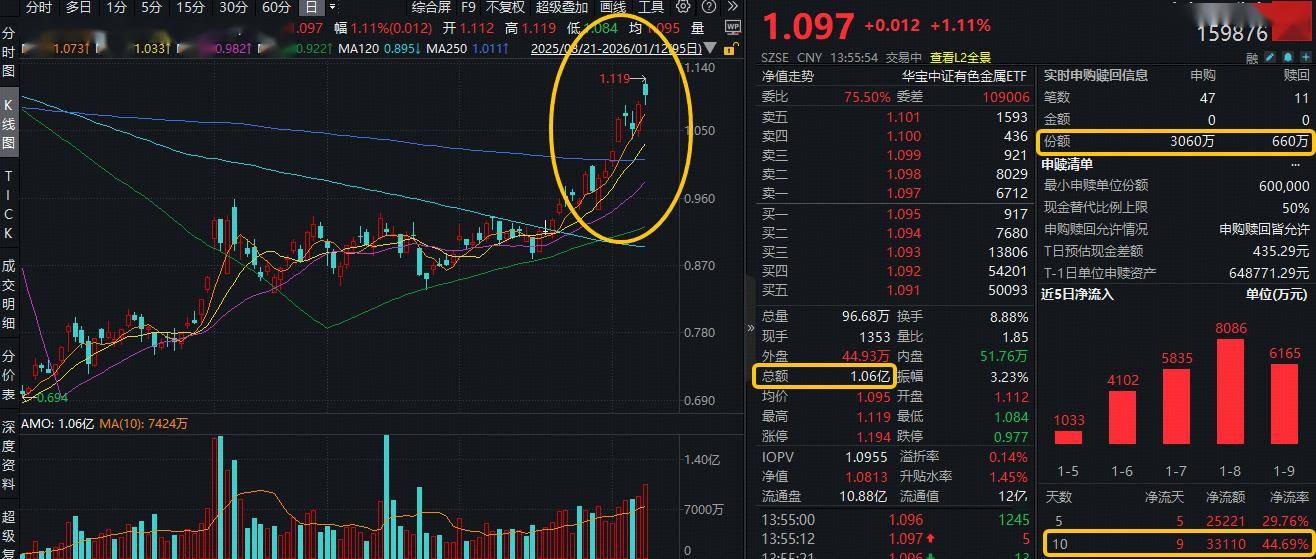
ETF盘中资讯|黄金,历史新纪录!有色ETF华宝(159876)量价齐升,续刷上市新高!近10日狂揽3.31亿元!
Sou Hu Cai Jing· 2026-01-12 06:22
Group 1 - The core viewpoint of the news highlights the strong performance of the Huabao Nonferrous ETF (159876), which reached a historical high with a trading volume of 1.06 billion yuan, indicating a bullish market sentiment [1] - The Huabao Nonferrous ETF has seen a net subscription of 24 million units, accumulating 331 million yuan over the past 10 days, suggesting significant investor interest [1] - Key constituent stocks such as Zhong Rare Earth and Western Superconducting have shown substantial gains, with Zhong Rare Earth hitting the daily limit, indicating strong sector performance [1] Group 2 - On January 12, spot gold prices surged, breaking the historical record set on December 29, 2025, reaching 4601.38 USD/oz, reflecting heightened demand for safe-haven assets amid geopolitical tensions [3] - Global geopolitical risks are escalating, particularly between Iran and the U.S., contributing to increased market uncertainty and driving demand for precious metals like gold [3] - The World Gold Council anticipates that ongoing geopolitical uncertainties will continue to influence the gold market, with potential for moderate price increases or strong rallies depending on economic conditions [3] Group 3 - Xiangcai Securities notes that the U.S. faces recession pressures, with high sovereign debt and trade deficits undermining the dollar's credibility, leading to a renewed focus on gold as a universal asset [4] - As gold prices rise, the supply-demand dynamics for commodities like copper may tighten, suggesting a potential revaluation of these assets [4] Group 4 - The Huabao Nonferrous ETF and its linked funds cover a wide range of sectors including copper, aluminum, gold, rare earths, and lithium, positioning them to capitalize on various market cycles [5] - The ETF's comprehensive coverage allows for better exposure to the overall sector's beta performance, indicating a favorable investment environment for nonferrous metals [5]
再创新高!国际现货金价首次突破4600美元/盎司,金ETF(518680)盘中涨超2%!
Mei Ri Jing Ji Xin Wen· 2026-01-12 04:58
Core Viewpoint - The precious metals market has experienced a significant surge, with gold prices reaching historical highs due to escalating geopolitical tensions and heightened investor risk aversion [1] Group 1: Market Performance - London spot gold prices peaked at $4,601.38 per ounce, while Comex futures reached $4,612.70 per ounce, both marking all-time highs [1] - The Shanghai gold market also saw a substantial increase, with prices hitting a record of 1,021.18 yuan per gram [1] - Gold ETFs (518680) rose over 2% during trading, with the latest increase reported at 1.99% [1] Group 2: Future Outlook - The World Gold Council's 2026 outlook suggests that gold prices could rise by 15% to 30% from current levels due to declining U.S. Treasury yields, escalating geopolitical tensions, and increased risk aversion [1] - Conversely, if "re-inflation returns," gold prices may face a potential correction of 5% to 20% [1] - Research institutions indicate a strong probability of a long-term bullish trend for gold, viewing short-term adjustments as potential buying opportunities [1] Group 3: Investment Opportunities - The gold ETF (518680) is backed by the Shanghai gold concentrated pricing contract (SHAU), representing domestic gold spot [1] - Investors optimistic about future gold opportunities may consider using linked funds (Class A 009504/Class C 009505) associated with the gold ETF for positioning [1]
黄金站上4600美元,有外资最高看至6000美元
Di Yi Cai Jing Zi Xun· 2026-01-12 04:47
Group 1 - COMEX gold futures prices surged to a new historical high of $4612 per ounce, with silver prices also rising significantly to $83.9 per ounce, reflecting a daily increase of 5.7% [2] - Domestic precious metal futures in China also saw gains, with Shanghai gold futures rising approximately 3% to 1031 yuan per gram and Shanghai silver futures increasing by 12% to 20614 yuan per kilogram [2] - The rise in precious metal prices is attributed to escalating geopolitical tensions and increased market expectations for further interest rate cuts by the Federal Reserve following the release of U.S. employment data [2] Group 2 - Goldman Sachs predicts that gold prices will reach $4900 per ounce by December 2026, supported by the Chinese central bank's gold purchasing behavior [3] - Several foreign institutions have raised their gold price forecasts, with JPMorgan predicting gold prices will reach $5000 per ounce by Q4 2026 and UBS increasing their target price for gold in 2026 from $4500 to $5000 per ounce [4] - The World Gold Council reports that gold is expected to perform well in 2025, with potential price increases of 15% to 30% in 2026 based on current price levels [4] Group 3 - JPMorgan maintains its forecast for silver prices at an average of $40.1 per ounce by 2026, while Bank of America has a more optimistic outlook, suggesting silver prices could peak between $135 and $309 per ounce [5]