一带一路

Search documents
首超45万亿元,中国外贸名场面有哪些|全球财经连线
2 1 Shi Ji Jing Ji Bao Dao· 2026-01-14 16:33
Core Insights - In 2025, China's foreign trade achieved a remarkable performance with a total import and export value exceeding 45 trillion RMB, marking a 3.8% year-on-year growth and maintaining positive growth for nine consecutive years [1] - The strong competitiveness of Chinese enterprises and their adaptability in exploring new markets, particularly in developing countries, contributed significantly to this growth [1][2] - The diversification of export markets and the upgrading of product structures are key characteristics of China's foreign trade in 2025 [2][3] Market Diversification - China has established trade relations with over 240 countries and regions, with more than 190 experiencing growth in imports and exports [2] - Trade with countries involved in the Belt and Road Initiative reached 23.6 trillion RMB, a 6.3% increase, accounting for 51.9% of total trade [2] - Emerging markets such as ASEAN, Latin America, and Africa showed significant growth, with import and export values of 7.55 trillion RMB, 3.93 trillion RMB, and 2.49 trillion RMB, growing at rates of 8%, 6.5%, and 18.4% respectively [2] Product Structure Upgrade - High-value products such as new energy vehicles, lithium batteries, and photovoltaic products are leading the export growth, indicating a shift from quantity to quality in exports [3] - China's manufacturing efficiency remains high, but low-profit, low-tech products are gradually moving abroad, while innovative, high-value products will drive export growth in the next 10 to 20 years [3] - The collaborative development of multiple industrial chains has reduced the sensitivity of foreign trade to external demand fluctuations and enhanced international recognition of Chinese brands [3] Future Outlook - Predictions indicate that export growth will be approximately 2.5% in 2026 and increase to 5.5% in 2027, driven by confidence in the global competitiveness of Chinese enterprises [3] - The ongoing "going out" strategy will continue to boost overseas investments, reinforcing China's role as a key player in global manufacturing and trade [3][4]
2025年我国外贸规模再创新高 “中国好物”在全球广受欢迎
Zheng Quan Ri Bao· 2026-01-14 16:18
Core Viewpoint - In 2025, China's foreign trade achieved a total import and export value of 45.47 trillion yuan, marking a growth of 3.8%, with exports at 26.99 trillion yuan (up 6.1%) and imports at 18.48 trillion yuan (up 0.5%) [1] Group 1: Trade Performance - The scale of foreign trade reached a new high, with a significant increase in the share of private enterprises in total foreign trade value, rising by 1.8 percentage points to 57.3% [1] - Foreign-funded enterprises recorded an import and export value of 13.27 trillion yuan, growing by 3.7%, maintaining growth for seven consecutive quarters [1] - State-owned enterprises had an import and export value of 6.06 trillion yuan, accounting for 13.3% of total foreign trade, with an average import and export value of 9.4 billion yuan per enterprise, the highest among all types of enterprises [1] Group 2: Regional Contributions - Various regions in China leveraged their geographical advantages and resource endowments to contribute to steady growth in imports and exports, with notable performances from foreign trade provinces, border areas, and key regions [2] Group 3: Growth Drivers - The growth in exports was driven by reasonable volume growth and effective quality improvement, particularly through innovation, green initiatives, and cooperation [2] - High-tech product exports contributed 2.4 percentage points to overall export growth, with specialized equipment, high-end machine tools, and industrial robots seeing export increases of 20.6%, 21.5%, and 48.7% respectively [2] - In the green energy sector, exports of lithium batteries and wind turbine generators grew by 26.2% and 48.7%, respectively, while electric motorcycles and railway electric locomotives saw growth rates of 18.1% and 27.1% [2] Group 4: Market Diversification - China's export markets became more diversified, with exports to countries involved in the Belt and Road Initiative increasing by 11.2%, contributing 5.4 percentage points to overall export growth [3] - ASEAN has remained China's largest export market for three consecutive years, with emerging markets in Latin America, the Middle East, Central Asia, and Africa showing faster growth rates than the overall average [3] Group 5: Technological Advancements - The export of artificial intelligence-related products showed significant growth, with exports of optical transceiver modules for high-end graphics cards increasing by nearly 60% [3] - Exports of large transformers and energy storage batteries grew by 18.8%, while both handling robots and welding robots saw export growth rates exceeding 60% [3] - Smartwatches and smart toys from China were sold in over 170 countries and regions, indicating strong global demand [3] Group 6: Hainan Free Trade Port - The Hainan Free Trade Port officially started its full island closure on December 18, 2025, with policies effectively implemented, leading to smooth and efficient operations [4] - The number of people participating in duty-free shopping in Hainan reached 585,000, with total spending of 3.89 billion yuan, reflecting year-on-year increases of 32.4% and 49.6%, respectively [4] - The categories of duty-free goods expanded from 45 to 47, including new electronic products, enhancing the attractiveness of the shopping experience [4]
【开局“十五五” 奋斗正当时·一线报道】今年滨州首批出口非洲蜡布起运
Xin Lang Cai Jing· 2026-01-14 15:33
Core Viewpoint - The textile industry in Binzhou is experiencing a strong start to the year with significant export activities, particularly to Africa, showcasing the region's integration into the global market and the success of "Binzhou manufacturing" [1][5]. Group 1: Export Performance - The first batch of textile products worth over 5 million USD has been shipped to Africa, marking the beginning of Binzhou's export trade for the year [1]. - The textile industry continues to hold a significant share of the city's total foreign trade, with overseas orders already scheduled until July [2]. - The company, Yuyue Home Textile, has reported an impressive annual sales figure of 1.7 billion RMB from wax fabric alone, reflecting its strong market position [2]. Group 2: Innovation and Competitiveness - Continuous technological innovation and craftsmanship improvements have been crucial for the company's success in the African market, overcoming initial challenges related to cultural adaptation [3]. - The company invested 50 million RMB to upgrade its wax dyeing technology, addressing issues such as fabric hardness and color fading [3]. - The development of a unique wax pattern formula, tailored to African consumer preferences, has significantly enhanced product appeal [3]. Group 3: Government Support and Infrastructure - Local government and customs authorities have played a vital role in supporting the textile industry's export efforts through proactive services and regulatory support [4]. - The Binzhou Customs has improved the efficiency of cotton import inspections by over 30% through smart inspection systems [4]. - The establishment of AEO certification for leading companies has facilitated smoother international trade processes [4]. Group 4: Future Outlook - Binzhou's textile enterprises are transitioning from merely exporting products to establishing their brands and standards internationally, aligning with the "Belt and Road" initiative [5]. - The companies are poised to leverage their strong industrial foundation and innovative capabilities to secure more overseas contracts in the coming year [5]. - The ongoing enhancement of product quality, technology, and brand influence is expected to elevate Binzhou's presence on the global stage [6].
2025年我国进出口总值超过45万亿元,创历史新高
Zhong Guo Jing Ji Wang· 2026-01-14 14:06
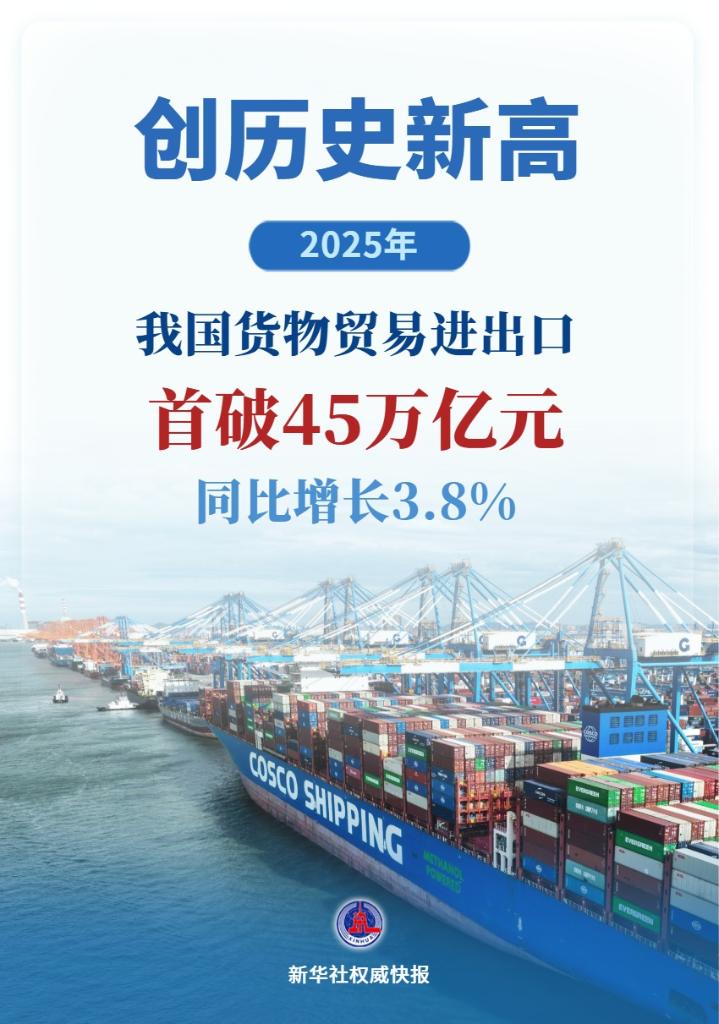
Core Insights - In 2025, China's foreign trade reached a record high of 45.47 trillion yuan, growing by 3.8%, with exports at 26.99 trillion yuan (up 6.1%) and imports at 18.48 trillion yuan (up 0.5%) [1][2] - The resilience and vitality of China's goods trade were highlighted, with a more diversified market and increased export quality [1][4] Trade Performance - China maintained its position as the world's largest goods trader, with trade relations established with over 240 countries and regions, and growth in trade with more than 190 countries [1][4] - Trade with Belt and Road Initiative countries reached 23.6 trillion yuan, growing by 6.3%, accounting for 51.9% of total trade [1] - Exports of high-tech products reached 5.25 trillion yuan, growing by 13.2%, with significant increases in green products like "new three items" and wind turbine generators [1] Import Trends - China's imports reached 18.48 trillion yuan, marking the 17th consecutive year as the world's second-largest import market, with a notable increase in import growth since June [2] - December 2025 saw a monthly import growth rate of 4.4%, contributing to a record monthly trade volume of 4.26 trillion yuan [2] Economic Environment - The domestic economy showed continuous recovery, effectively releasing production and consumption demand, providing vast market opportunities for global cooperation [3] - China accounted for approximately 10% of global imports, with a complete industrial system capable of adapting to international market demands [3] Trade Development - Over the past five years, China's foreign trade has withstood external challenges, with cumulative trade exceeding 200 trillion yuan, a 40% increase compared to the previous five-year period [4] - Private enterprises played a crucial role in stabilizing foreign trade, contributing around 80% of the foreign trade growth during the 14th Five-Year Plan period [4] - The advantages of China's system, market, industrial structure, and talent resources have become more pronounced, enhancing its resilience against risks [4]
12月进出口数据点评:外贸力撑“三驾马车”
Guoxin Securities· 2026-01-14 14:04
Trade Performance - December exports increased by 6.6% year-on-year, while imports grew by 5.7%, resulting in a trade surplus of $114.14 billion[2] - For the entire year, exports rose by 5.5%, and imports recorded no growth, leading to a total trade surplus of $1,189.99 billion, marking a historic high[4] Structural Changes - High-end manufacturing and key resource products drove export growth, with significant increases in automotive exports (up 71.7%), integrated circuits (up 47.7%), and rare earths (up 53.3%)[13] - Exports to emerging markets, particularly countries along the Belt and Road Initiative, accounted for 53% of total exports in December, mitigating weak demand from traditional markets like the U.S.[6] Import Dynamics - December imports reached $223.69 billion, reflecting a 5.7% year-on-year increase, driven by seasonal procurement of energy and raw materials[15] - Resource-based imports, including rare earths (up 102.0%) and copper ore (up 33.2%), indicated robust industrial production demand[16] Future Outlook - The external trade environment is expected to remain resilient, with geopolitical factors continuing to reshape trade structures and a focus on bilateral and regional cooperation[5] - Service exports and new trade forms are anticipated to become significant growth drivers in the future[20]

新华鲜报丨创新高、九连涨!2025年中国外贸答卷亮点纷呈
Xin Hua Wang· 2026-01-14 13:41
Core Insights - In 2025, China's total goods trade import and export value exceeded 45 trillion yuan for the first time, reaching 45.47 trillion yuan, with a year-on-year growth of 3.8%, maintaining its position as the world's largest goods trading nation [1][4]. Trade Performance - The total import and export value in December 2025 reached 4.26 trillion yuan, marking a year-on-year increase of 4.9%, and setting a new monthly record [6]. - Exports in 2025 amounted to 26.99 trillion yuan, a year-on-year increase of 6.1%, driven by high-tech products and "new three categories" products, which grew by 13.2% and 27.1% respectively [6]. - Imports totaled 18.48 trillion yuan in 2025, with a modest year-on-year growth of 0.5%, making China the world's second-largest import market for 17 consecutive years [6]. Trade Partners and Market Dynamics - Over 78,000 enterprises engaged in import and export activities in 2025, with private enterprises contributing significantly, achieving a 7.1% growth in trade, accounting for 57.3% of total trade value [7]. - China traded with 249 countries and regions in 2025, with notable growth in trade with ASEAN, Central Asian countries, and the EU [7]. - The provinces of Guangdong, Jiangsu, Zhejiang, Shanghai, Shandong, Beijing, and Fujian contributed over half of the foreign trade growth, with the Greater Bay Area surpassing 9 trillion yuan in trade [7]. Future Outlook - The external environment for trade is expected to remain uncertain in 2026, with ongoing pressures on foreign trade, but China's institutional, market, and industrial advantages are expected to enhance resilience [8].

海油发展:目前公司所开展的海外业务主要集中在中东区域、非洲区域、北美区域和亚太区域
Zheng Quan Ri Bao Wang· 2026-01-14 13:12
Core Viewpoint - The company, CNOOC Development (600968), is focusing on its overseas business in four main regions: the Middle East, Africa, North America, and Asia-Pacific, while actively implementing the "Belt and Road" initiative [1] Group 1: Overseas Business Focus - The company's overseas operations are concentrated in four key regions: Middle East, Africa, North America, and Asia-Pacific [1] - CNOOC has made significant breakthroughs in the core areas of the "Belt and Road" initiative, particularly in the Middle East, Africa, and Asia-Pacific [1] Group 2: Strategic Optimization - The company is continuously optimizing its overseas strategic layout by focusing on mature regions, new regions, mature industries, and new industries [1] - CNOOC aims to establish a competitive advantage in key areas of international oil and gas technology services and important markets [1]


“以前哪能想到,都是中国的…”
Xin Lang Cai Jing· 2026-01-14 12:36
Core Insights - Chinese brands are increasingly establishing a presence in global markets, with a focus on building local operations and brand recognition rather than merely exporting cheap products or making large-scale acquisitions [1][2] - The global expansion of Chinese companies is marked by a significant increase in overseas sales, with projections indicating that overseas sales for Chinese listed companies will reach 15 trillion RMB in 2024, up from 11.6 trillion RMB in 2021 [2] - The shift in Chinese companies' strategies is driven by rising domestic labor costs and geopolitical tensions, prompting a move towards establishing manufacturing bases abroad, particularly in developing countries [5][7] Group 1 - Chinese electric vehicle manufacturer BYD surpassed Tesla in sales, with over 20% of its sales coming from overseas, doubling from 10% in 2024 [2] - The transformation of Chinese enterprises from imitation to innovation is evident, as they now produce high-end products and are sought after by Western companies for their expertise [4] - The establishment of local distribution and supply chain systems is becoming a priority, with companies like Mengniu successfully launching products in local markets [7] Group 2 - The historical context of Chinese companies' global expansion reveals a journey marked by challenges, including initial perceptions of low-quality products and failed acquisitions due to increasing Western scrutiny [3][4] - A shift in human resource strategies is occurring, with Chinese companies increasingly hiring local employees to reduce cultural friction and enhance local engagement [7] - Professional service firms are now actively supporting Chinese companies in their global expansion efforts, reflecting a change in focus from assisting Western firms entering China [8] Group 3 - Despite the strong momentum of expansion, Chinese multinational companies face complex pressures, including Western regulatory challenges and geopolitical risks [8] - The Chinese government is expected to relax strict overseas investment approval processes, which may lead to a greater presence of vibrant Chinese brands in the global market [9]


驶入阿拉木图:满街的中国品牌,与一场正在发生的认知变革
2 1 Shi Ji Jing Ji Bao Dao· 2026-01-14 12:15
Core Insights - Chinese brands have established a strong presence in Kazakhstan, becoming a significant part of the local market with a wide range of products from automobiles to electronics [1][2][3] - The trade relationship between China and Central Asia has seen substantial growth, with trade volume expected to reach $60.7 billion from 2017 to 2024, marking a 150% increase [1] - Kazakhstan is emerging as a key hub for Chinese companies looking to expand overseas, with over 9,000 Chinese enterprises operating in the region [1][3] Trade and Investment - By 2024, China's direct investment and loans to Central Asia are projected to exceed $24 billion, with bilateral trade between China and Kazakhstan reaching a historic high of $43.8 billion [3][4] - The market share of Chinese automotive manufacturers in Kazakhstan has surged from approximately 2% in 2020 to 38% in 2024, indicating a rapid acceptance of Chinese vehicles [3][4] Market Dynamics - The local market in Kazakhstan is characterized by a young population, with 95% owning smartphones, making it an attractive target for internet and technology companies [1][2] - The presence of Chinese brands is evident in various sectors, including home appliances, automobiles, and mobile phones, with local production of Chinese vehicles already underway [4][5] Consumer Behavior - There is a notable shift in consumer perception of Chinese products, moving from low-cost options to recognizing their reliability and technological advancements [5][6] - The acceptance of new technologies and experiences by the young population in Kazakhstan provides fertile ground for the introduction of innovative products [5][6] E-commerce and Marketing Strategies - The e-commerce market in Central Asia is projected to reach $14.7 billion by 2024, with Kazakhstan's market alone estimated at $6 billion [6][7] - Companies are advised to adopt a dual approach in marketing: utilizing mainstream e-commerce platforms for quick consumer access while also developing direct-to-consumer (D2C) channels to build brand identity [7][8] Localization Challenges - Entering the Central Asian market requires a nuanced understanding of local languages and consumer habits, as each country has distinct preferences and regulatory environments [8][9] - Companies often underestimate the complexity of the market, leading to potential pitfalls if they do not conduct thorough market research and engage local partners [9]
驶入阿拉木图:满街的中国品牌 与一场正在发生的认知变革
2 1 Shi Ji Jing Ji Bao Dao· 2026-01-14 12:13
Core Insights - Chinese brands have established a strong presence in Kazakhstan, becoming a significant part of the local market with a wide range of products from automobiles to electronics [1][5] - The trade relationship between China and Central Asia has rapidly expanded, with trade volume expected to reach $60.7 billion from 2017 to 2024, marking a 150% increase [1] - Kazakhstan is emerging as a key hub for Chinese companies looking to expand overseas, with over 9,000 Chinese enterprises operating in the region [1] Market Dynamics - The market in Kazakhstan is characterized by a young population, with 95% owning smartphones, making it attractive for internet and technology companies [1][6] - The bilateral trade between China and Kazakhstan is projected to reach $43.8 billion in 2024, setting a historical record [5] - Chinese automotive brands have seen significant growth, with market share increasing from 2% in 2020 to 38% in 2024 [5][6] Brand Penetration - Chinese brands like Haier, Hisense, and Xiaomi have been expanding their presence in Central Asia since the early 2000s, with a notable increase in brand visibility and local partnerships [5][6] - The automotive sector has become a major growth area, with local production of Chinese brands like Geely and Hongqi starting in Almaty [6] - The perception of Chinese products has shifted from low-cost to reliable technology, driven by rapid technological advancements [6] E-commerce and Advertising Trends - The e-commerce market in Central Asia is projected to reach $14.7 billion in 2024, with Kazakhstan's market alone estimated at $6 billion [8] - The number of Chinese advertisers using Yandex Ads in Kazakhstan has increased by 76% year-on-year, with advertising spending surging by 192% [8] - A dual approach for brands is recommended: utilizing mainstream e-commerce platforms for market testing and developing direct-to-consumer channels for brand building [9] Localization Challenges - Companies entering the Central Asian market must navigate complex local languages and cultural differences, as many countries have both Russian and local languages [10][11] - Each country in the region has unique consumer behaviors and regulatory environments, necessitating tailored marketing strategies [11][12] - Conducting thorough market research and partnering with local experts is crucial for successful market entry and operation [12]