
AGI

Search documents
xAI 联创大神离职,去寻找下一个马斯克
3 6 Ke· 2025-08-19 00:47
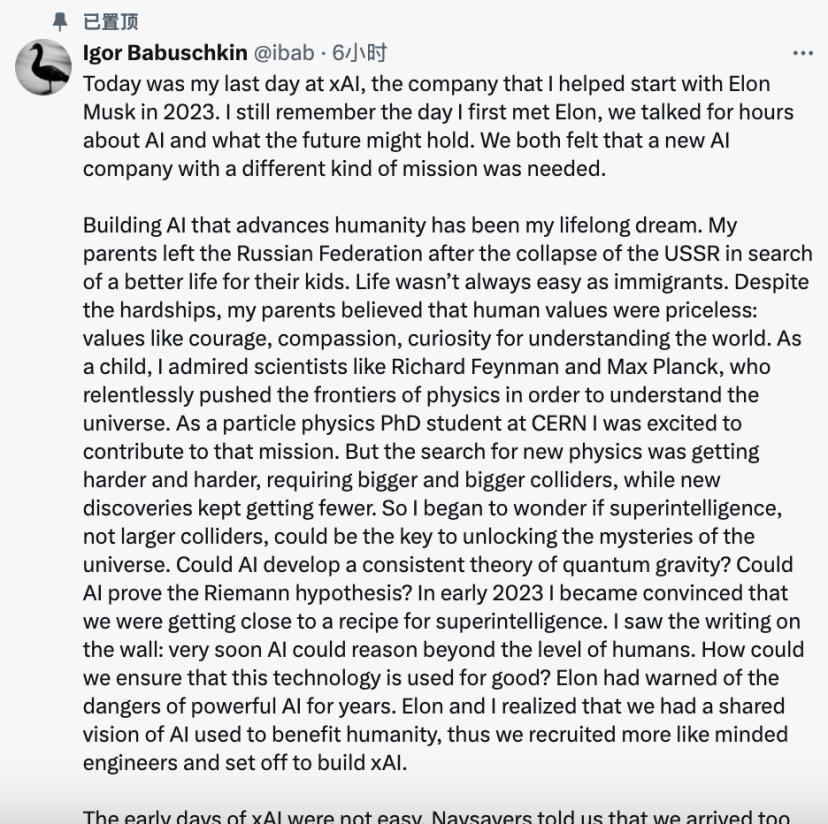
Core Insights - Igor Babuschkin, a key figure at xAI, has left the company to start his own venture capital firm, Babuschkin Ventures, focusing on AI safety research and investing in startups that aim to advance humanity and unlock the mysteries of the universe [1][3][30] - Babuschkin's departure highlights a trend of top AI talent moving from research roles to venture capital, a shift that is relatively rare in the industry, especially at such a young age [3][30][36] Group 1: Igor Babuschkin's Role and Contributions - Igor played a crucial role in the development of xAI, leading the team through multiple iterations of the Grok AI model and overseeing the construction of the Colossus supercomputing cluster in Memphis [1][16] - His background includes significant achievements at DeepMind, where he led projects like AlphaStar and contributed to the development of Codex and GPT-4 during his time at OpenAI [9][11][14] - Babuschkin's departure was marked by a heartfelt farewell message, emphasizing his contributions to xAI and the impact he had on the company's growth [4][6][29] Group 2: Industry Trends and Implications - The AI industry has seen a notable trend of talent moving to venture capital, with many former researchers opting to start their own companies or join existing ones rather than transitioning to investment roles [30][31] - The venture capital landscape in AI is booming, with significant funding opportunities, as evidenced by the over $35 billion raised in Silicon Valley alone last year [36] - Babuschkin's move reflects a broader urgency among AI professionals regarding the development of AGI (Artificial General Intelligence) and the need for responsible investment in AI technologies [30][38]

软件行业“快时尚化”背后的经济学 | AGIX PM Notes
海外独角兽· 2025-08-18 12:06
Core Viewpoint - The article discusses the transformative impact of Artificial General Intelligence (AGI) on the software industry, suggesting that AGI will redefine the technological landscape over the next two decades, similar to the internet's influence in the past [2]. Group 1: Software Industry Outlook - The software industry is experiencing a shift towards a "fast fashion" model, where AI enables cheaper and faster production processes, leading to a pessimistic sentiment among market participants [2][3]. - The fate of technology is determined not solely by the technology itself but by a combination of factors including market demand, efficiency, and policy, which together define "feasible technology" [3]. - The software industry is expected to undergo a process of elevation, moving from "dead" systems to "living" software that can learn and adapt to user contexts [4][5]. Group 2: Evolution of Software - Traditional software operates as either a system of record or engagement, but the future lies in "living software" that builds competitive advantages based on learning rather than just code [5][6]. - The ability of software companies to self-learn will depend on advanced models like Recursive agents and In Context Learning Agents, which are currently being explored in both academia and industry [6]. - The democratization of front-end UI/UX is causing anxiety in the industry, as many startups are creating environments for AI models to replicate existing software functionalities [7]. Group 3: Pricing Dynamics - AI is leading to a more granular economic landscape, allowing for extreme pricing strategies where software companies can potentially monopolize pricing based on outcomes rather than usage [8][9]. - This new pricing model could fundamentally change the revenue structure for software companies, moving away from traditional seat-based or usage-based pricing [9]. - The infrastructure investments in data centers and model training are likened to banks absorbing savings before lending, indicating a shift towards a new economic model for intelligent systems [9]. Group 4: Market Performance - Recent market performance shows a mixed sentiment, with companies like Atlassian, Monday, and MongoDB experiencing declines, reflecting broader market pessimism [12]. - AGIX has shown resilience with a year-to-date return of 15.62% and a return of 55.02% since 2024, indicating potential strength in the AGI-related investment space [11].

包凡不在这两年,华兴资本用AI布局迎他回归
Ge Long Hui· 2025-08-18 12:03
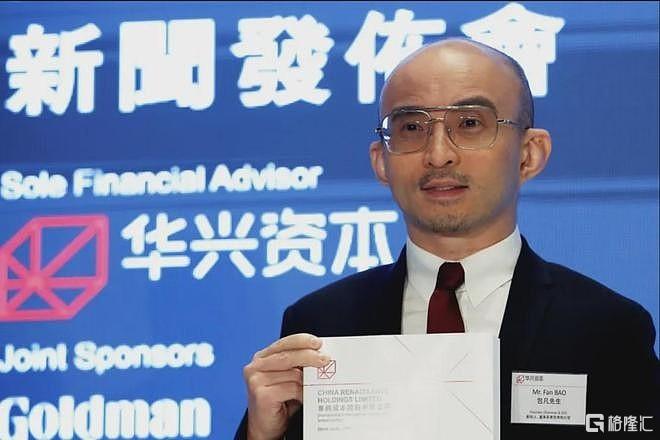
Core Insights - The return of Baofan, the founder of Huaxing Capital, symbolizes a significant shift from a relationship-driven model to a technology-driven approach within the company [2][10] - Huaxing Capital has undergone a transformation during Baofan's absence, focusing on AI and embodied intelligence as core strategic directions [3][5] Group 1: Leadership and Management Changes - Baofan has re-emerged but will not participate in daily management, with the company now led by a professional management team [2] - The new management team has introduced the "Huaxing 2.0" strategy, emphasizing AI, embodied intelligence, and mergers and acquisitions [2][3] Group 2: AI Strategy and Developments - Huaxing Capital's AI strategy evolved from initial exploration to deep engagement, with significant investments in the embodied intelligence sector [3][4] - In July 2025, Huaxing participated as the sole financial advisor in three major financing rounds in the embodied intelligence field, totaling over 15 billion yuan [3] Group 3: Business Model Transformation - The shift to AI represents a paradigm change in Huaxing's business model, moving from traditional financial advisory (FA) to becoming an industry enabler [5] - Huaxing has built a cross-disciplinary team to enhance its technical capabilities, allowing for better assessment of embodied intelligence companies [5][6] Group 4: Ecosystem and Resource Integration - Huaxing positions itself as a connector within the AI ecosystem, linking technology providers, industry players, and capital sources [6] - The company has facilitated strategic partnerships and investments, creating a comprehensive value chain from technology development to market application [6] Group 5: Organizational Adaptation - Huaxing has adopted a flexible organizational culture to respond quickly to the fast-paced AI sector, allowing for rapid resource allocation during market changes [7] - The company encourages internal entrepreneurship, enabling teams to develop AI tools to improve project efficiency [7] Group 6: Challenges Ahead - Despite progress, Huaxing faces challenges in keeping up with rapid technological advancements in AI and ensuring effective commercialization of projects [8] - Internal collaboration among Huaxing's various divisions remains a critical area for improvement to maximize synergies [8]
Dario Amodei:账面亏损?大模型照样生钱!
机器之心· 2025-08-18 09:22
Group 1 - The core argument presented by Dario Amodei is that accounting losses do not equate to business failure, and each generation of AI models should be viewed as an independent profit unit to understand the true health of the business [1][5][8] - Amodei suggests that the future AI market will likely consist of three to six major players with cutting-edge technology and substantial capital, emphasizing that both technology and capital are essential [5][6] - The traditional view of increasing R&D expenses leading to worsening business conditions is challenged; instead, Amodei argues that each model can be seen as a startup with significant upfront investment but profitability over its lifecycle [8][9][10] Group 2 - Amodei illustrates a financial model where a company spends $100 million to train a model in 2023, generates $200 million in revenue in 2024, and then invests $1 billion in the next generation model, which brings in $20 billion in 2025 [6][7] - He emphasizes that the key to determining when to train a model is not based on a calendar but rather on the specific data from the previous model, highlighting the importance of data-driven decision-making [10][11] - The concept of "capitalistic impulse" is introduced, where the leap in model capabilities naturally drives investments in capital, computing power, and data, thus amplifying economic value [13] Group 3 - Amodei asserts that as long as Scaling Law remains effective, the embedded venture capital cycle will continue to drive growth and profitability, positioning the company among the top players in the market [12][11] - The discussion also touches on the challenges of existing AI interfaces, which have yet to fully unlock the potential of models, indicating a gap in interface design that needs to be addressed [4]

OpenAI总裁透露GPT-5改了推理范式,AGI实现要靠现实反馈
量子位· 2025-08-18 06:55
Core Insights - OpenAI's President Greg Brockman discussed the company's approach to achieving AGI (Artificial General Intelligence) in a recent interview, highlighting a significant paradigm shift with the release of GPT-5, which aims to bridge the gap between the GPT series and AGI [5][6][9]. Group 1: Model Development and Learning Paradigms - The transition from text generation to reinforcement learning as a reasoning paradigm is crucial for AGI development, allowing models to learn through trial and error in real-world scenarios [6][15]. - GPT-5 employs a new reasoning paradigm that combines supervised learning with reinforcement learning, enabling the model to generate data during inference and iteratively improve based on real-world feedback [13][14]. - Brockman emphasized that the model's increasing ability to interact with the real world is a key component of the next generation of AGI [15]. Group 2: Computational Resources and Bottlenecks - Brockman identified computation as the primary bottleneck in AGI development, asserting that increased computational power directly influences the speed and depth of AI research and development [16][18]. - The current reinforcement learning paradigm in GPT-5, while more sample-efficient, still requires extensive computational resources to learn tasks effectively [18][20]. - He described computation as a fundamental fuel that transforms energy into potential stored in model weights, driving effective operations [19]. Group 3: Practical Implementation and Agent Development - The ultimate goal of AGI is to integrate large models into the workflows of businesses and individuals, moving beyond theoretical applications [26][27]. - OpenAI aims to package model capabilities into agents that can be audited and controlled, ensuring high levels of reliability and safety [29][30]. - A dual-layer "defense in depth" structure is designed to ensure the controllability of high-permission agents, akin to database security measures [31][32]. Group 4: Future Opportunities and Industry Integration - Brockman believes that significant opportunities lie in embedding existing intelligence into real industry processes rather than creating new flashy models [38][39]. - He advises developers and entrepreneurs to immerse themselves in industry specifics to identify genuine gaps that AI can fill, rather than focusing solely on superficial integrations [40]. - The future of AGI is envisioned as a model manager that combines local models with large cloud-based inference systems for adaptive computation [21][23]. Group 5: Long-term Vision and Challenges - Brockman expressed a vision for a future characterized by multi-planetary living and a truly abundant society, emphasizing the potential of current technologies [42][46]. - He noted that as technology accelerates, the demand for computational resources will grow, highlighting the importance of acquiring and allocating these resources effectively [43][45]. - The real challenge lies in maintaining curiosity and the willingness to explore new fields as AI continues to permeate all industries [48].

中国成功发射试验二十八号B星02星;AG600批产第二架机完成首次生产试飞丨智能制造日报
创业邦· 2025-08-18 03:32
Group 1 - The world's largest underwater shield tunnel, with a diameter of 17.5 meters, successfully completed its construction in Jinan, marking a significant milestone in engineering [2] - Xiaomi's automotive factory in Beijing has achieved 100% automation in key processes, producing over 300,000 electric vehicles in just over a year, reflecting a transformative shift in traditional manufacturing [2] - China's successful launch of the experimental satellite No. 28 B star 02, which is intended for space environment detection and related technology testing, demonstrates advancements in aerospace capabilities [2] - The second production aircraft of the AG600 amphibious plane has successfully completed its first production test flight, indicating readiness for delivery and compliance with design specifications [2] Group 2 - The production of new energy vehicles in Beijing reached 262,000 units in the first half of the year, representing a year-on-year increase of 150% [2] - The North Vehicle New Energy Xiangjie Super Factory, set to commence production in 2024, is positioned as a pioneer in the ongoing industrial transformation [2]


ChatGPT负责人坦言:GPT-5 仍有“幻觉”问题,建议用户核对答案;智元发布OmniHand 2025灵巧手丨AIGC日报
创业邦· 2025-08-18 00:10
Group 1 - OpenAI's ChatGPT still faces reliability issues despite the release of the GPT-5 model, with a senior executive advising users to verify answers due to potential errors [2] - ZhiYuan Robotics launched the OmniHand 2025 series, with the interactive model priced at 14,800 yuan, discounted to 9,800 yuan for a limited time [2] - The "Galbot" team from Galaxy General won the championship in the hospital medicine sorting competition at the 2025 World Humanoid Robot Games, achieving a time of 10 minutes and 22 seconds [2] Group 2 - OpenRouter's Qwen 3 Coder has rapidly gained market share, reaching 20.5%, while the market shares of Anthropic and Google's programming models have declined [2]

Meta AI大动作!超级智能实验室拆分,团队重组抢滩AI技术高地
Sou Hu Cai Jing· 2025-08-17 18:17
Core Insights - Meta is undergoing a significant restructuring of its AI department, marking the fourth major adjustment in six months, reflecting its commitment to adapt to the global AI technology competition [1][4] Group 1: Restructuring Details - The restructuring involves splitting the newly established AI department, the Super Intelligence Lab, into four distinct teams: TBD Lab, Product Team, Infrastructure Team, and FAIR Lab [1][3] - TBD Lab will focus on exploring cutting-edge AI technologies, particularly in generative AI and large model optimization, aimed at achieving short-term breakthroughs [1][3] - The Product Team will integrate AI technologies into Meta's core products, enhancing features like Facebook's content recommendation algorithms, Instagram's image generation, and WhatsApp's smart interaction services [3] - The Infrastructure Team will serve as the technical foundation for AI operations, responsible for building and maintaining the underlying technology architecture, including computing clusters and data storage systems [3] - FAIR Lab will continue to focus on long-term foundational AI research, including breakthroughs in general artificial intelligence (AGI) and the development of AI ethics and safety mechanisms [3] Group 2: Reasons for Restructuring - The restructuring is driven by the need to respond to rapid changes in the global AI industry, with competitors like OpenAI, Google, and Microsoft making significant advancements in generative AI and large model applications [4] - Previous attempts at reform revealed issues of overlapping responsibilities and high communication costs within the Super Intelligence Lab, prompting the need for a more focused organizational structure [4] - The goal of the restructuring is to enhance the efficiency of AI technology development and implementation, while fostering creativity and productivity within the teams [4]

腾讯研究院AI速递 20250818
腾讯研究院· 2025-08-17 16:01
Group 1 - Google has released the lightweight model Gemma 3 270M, which has 270 million parameters and a download size of only 241MB, designed specifically for terminal use [1] - The model is energy-efficient, consuming only 0.75% of battery power after 25 conversations on the Pixel 9 Pro, and can run efficiently on resource-constrained devices after INT4 quantization [1] - Gemma 3 270M outperforms the Qwen 2.5 model in the IFEval benchmark test and has surpassed 200 million downloads, tailored for specific task fine-tuning [1] Group 2 - Meta has open-sourced the DINOv3 visual foundation model, which surpasses weakly supervised models in multiple dense prediction tasks using self-supervised learning [2] - The model features innovative Gram Anchoring strategy and RoPE, with a parameter scale of 7 billion and training data expanded to 1.7 billion images [2] - DINOv3 is commercially licensed and offers various model sizes, including ViT-B and ViT-L, with specialized training for satellite image backbone networks, already applied in environmental monitoring [2] Group 3 - Tencent has launched the Lite version of its 3D world model, reducing memory requirements to below 17GB, allowing efficient operation on consumer-grade graphics cards with a 35% reduction in memory usage [3] - Technical breakthroughs include dynamic FP8 quantization, SageAttention quantization technology, and cache algorithms that enhance inference speed by over 3 times with less than 1% accuracy loss [3] - Users can generate a complete navigable 3D world by inputting a sentence or uploading an image, supporting 360-degree panoramic generation and Mesh file export for seamless integration with games and physics engines [3] Group 4 - Kunlun Wanwei has released six models from August 11 to 15, covering popular fields such as video generation, world models, unified multimodal, agents, and AI music creation [4] - The latest music model Mureka V7.5 significantly enhances the tonal quality and articulation of Chinese songs, improving voice authenticity and emotional depth through optimized ASR technology, surpassing top foreign music models [4] - A MoE-based character description voice synthesis framework, MoE-TTS, was also released, allowing users to precisely control voice features and styles through natural language, outperforming closed-source commercial products under open data conditions [4] Group 5 - OpenAI has released a programming prompt guide for GPT-5, emphasizing the importance of clear and non-conflicting instructions to avoid confusion [5][6] - It suggests using appropriate reasoning intensity and structured rules similar to XML for complex tasks, while planning self-reflection before execution for zero-to-one tasks [6] Group 6 - The first humanoid robot sports event showcased various competitions, including running, soccer, boxing, dance, and martial arts, with the Yushu robot winning the 1500m race [7] - The soccer 5V5 group matches demonstrated real-time computation and collaboration capabilities of robot players, with standout performances from specific players [7] - The event featured commentary focusing on AI knowledge, with humorous moments such as robots colliding and falling over during gameplay [7] Group 7 - DeepMind's Genie 3 model can generate 24 frames of 720p HD visuals per second and create interactive worlds with a single sentence, showcasing advanced memory capabilities [8] - The model's physical law representation improves as training data scale and depth increase, marking a significant step towards AGI [8] - Future developments will focus on realism and interactivity, potentially providing unlimited training scenarios for robots to overcome data limitations [8] Group 8 - OpenAI's CEO hinted at plans to invest trillions in building data centers and suggested that an AI might become the CEO in three years [9] - He confirmed the development of AI devices in collaboration with Jony Ive and acknowledged the increasing value of human-created content [9] - The CEO believes the current "AI bubble" is similar to the internet bubble but emphasizes that AI is a crucial long-term technological revolution [9] Group 9 - OpenAI's chief scientist discussed the evolution of AGI definitions from abstract concepts to multidimensional capabilities, highlighting the need for practical application value assessments [10] - The researchers noted that AI developments have exceeded expectations, with models excelling in competitions, demonstrating strong reasoning and creative thinking [10] - Experts recommend not abandoning programming education but rather viewing AI as a supportive tool, emphasizing the importance of structured and critical thinking [11] Group 10 - Sierra AI's founder predicts the AI market will split into three main tracks: frontier foundational models, AI toolchains, and application-type agents, with the latter presenting the greatest opportunities [12] - Agents can significantly enhance productivity, shifting from "software enhancing human efficiency" to "software completing tasks independently," akin to early computer impacts [12] - The future will see many long-tail agent companies emerging, similar to the evolution of the software market, with pricing based on business outcomes rather than technical details [12]

GPT-5“让人失望”,AI“撞墙”了吗?
Hua Er Jie Jian Wen· 2025-08-17 03:00
Core Insights - OpenAI's GPT-5 release did not meet expectations, leading to disappointment among users and raising questions about the future of AI development [1][3] - The focus of the AI race is shifting from achieving AGI to practical applications and cost-effective productization [2][7] Group 1: Performance and Expectations - GPT-5's performance was criticized for being subpar, with users reporting basic errors and a lack of significant improvements over previous models [1][3] - The release has sparked discussions about whether the advancements in generative AI have reached their limits, challenging OpenAI's high valuation of $500 billion [1][5] Group 2: Market Sentiment and Investment - Despite concerns about technological stagnation, investor enthusiasm for AI applications remains strong, with AI accounting for 33% of global venture capital this year [6][8] - Companies are increasingly focusing on integrating AI models into products, with OpenAI deploying engineers to assist clients, indicating a shift towards practical applications [7][8] Group 3: Challenges and Limitations - The "scaling laws" that have driven the development of large language models are approaching their limits due to data exhaustion and the physical and economic constraints of computational power [5][6] - Historical parallels are drawn to past "AI winters," with warnings that inflated expectations could lead to a rapid loss of investor confidence [6] Group 4: Future Directions - The industry is moving towards multi-modal data and "world models" that understand the physical world, suggesting potential for future innovation despite current limitations [7] - Investors believe there is still significant untapped value in current AI models, with strong growth in products like ChatGPT contributing to OpenAI's recurring revenue of $12 billion annually [8]