
储备管理购买

Search documents
【财经分析】2026美债迷局:美联储的“隐形宽松”与利率的悬崖之舞
Xin Hua Cai Jing· 2025-12-17 06:49
Core Viewpoint - The Federal Reserve is expected to initiate a significant transition from "Quantitative Tightening" (QT) to "Reserve Management Purchases" (RMP) by the end of 2025, which may signal the start of a form of "invisible easing" in 2026 [1][2] Group 1: Mechanism Change - The cessation of QT in Q4 2025 marks the end of a period where approximately $2.4 trillion in liquidity was withdrawn from the market, leading to the introduction of RMP in January 2026 [2] - RMP is officially defined as a technical operation to ensure sufficient liquidity in the financial system, but is interpreted by the market as a form of "covert easing" or "quasi-quantitative easing" [2] - The shift to RMP is driven by structural liquidity constraints in the financial system, as banks prefer to pay higher premiums in the market rather than utilize reserves held at the Fed [2] Group 2: Economic Outlook and Interest Rate Predictions - There is a notable divergence in predictions for the federal funds rate in 2026, with ICBC International forecasting a reduction of 50-75 basis points, while J.P. Morgan anticipates only a single rate cut [4] - ICBC International's bearish outlook is based on the need to shift monetary policy focus from anti-inflation to stabilizing growth amid slowing domestic demand [4] - J.P. Morgan's optimistic view is supported by strong non-residential fixed investment, suggesting limited rate cuts and stabilization around 3%-3.25% [4] Group 3: Fiscal Concerns - The implementation of RMP coincides with historically high federal budget deficits, raising concerns about the potential for monetizing fiscal deficits through the issuance of short-term Treasury bonds [3] Group 4: Yield Curve Dynamics - Analysts predict a steepening of the U.S. Treasury yield curve, with expectations that the federal funds rate will settle around 3% by the end of 2026, driven by a tug-of-war between short-term rate easing and long-term concerns over fiscal sustainability [6] - The yield curve's shape in 2026 may serve as a litmus test for the impact of the AI revolution on the economy, with a healthy inflation cycle potentially leading to a steepening curve [5] Group 5: Scenario Analysis for 2026 - ING outlines two extreme scenarios for 2026: one where the Fed cuts rates in response to a significant economic downturn, leading to a drop in 10-year Treasury yields to around 3%, and another where premature rate cuts occur without economic justification, potentially pushing yields above 5% [7] - The baseline forecast from ING suggests that 10-year Treasury yields will fluctuate around 4.5% before gradually declining to 4.25% by year-end [7] Group 6: Investment Strategies - First Source Bank emphasizes the importance of structural opportunities in a volatile environment, recommending a diversified bond portfolio that includes investment-grade corporate bonds, municipal bonds, mortgage-backed securities, and selected high-yield options [8]

大空头Burry警告:美联储RMP意在掩盖银行体系脆弱性,本质上是重启QE
Hua Er Jie Jian Wen· 2025-12-11 12:21
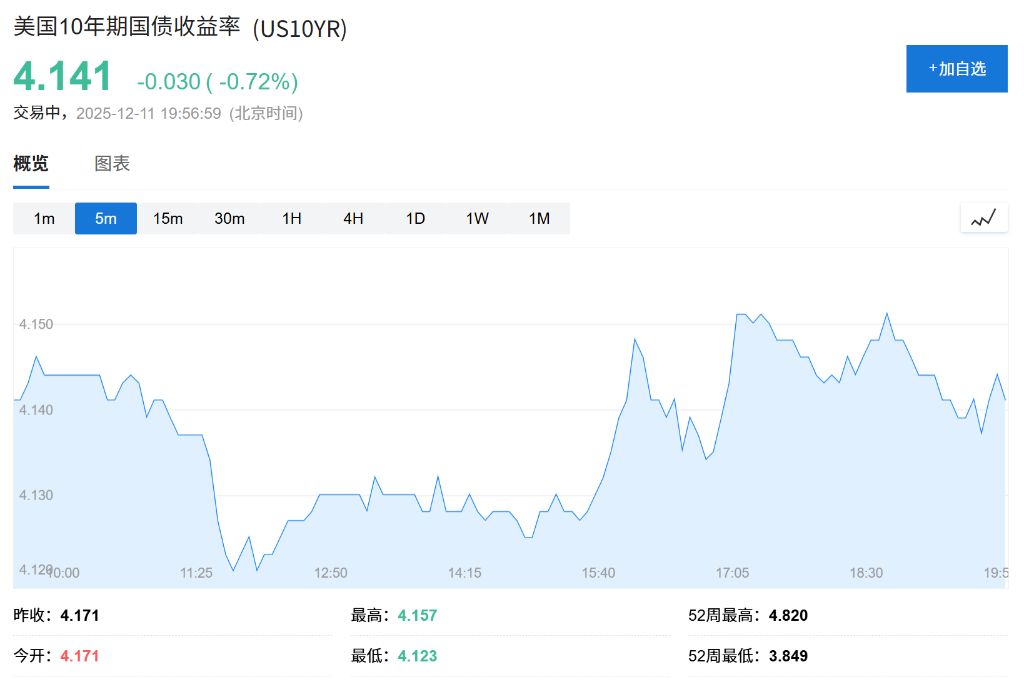
Core Viewpoint - Michael Burry warns that the Federal Reserve's latest bond-buying plan, termed "Reserve Management Purchases" (RMP), reveals deep vulnerabilities in the U.S. banking system, essentially restarting quantitative easing (QE) to mask liquidity issues rather than being a routine operation [1][3]. Group 1: Federal Reserve Actions - The Federal Reserve announced it would begin purchasing short-term government bonds to maintain adequate reserve supply, planning to buy $40 billion in short-term bonds over the next 30 days following the cessation of balance sheet reduction [1]. - Burry interprets the RMP as a covert measure aimed at stabilizing a struggling banking sector, highlighting that bank reserves have increased from $2.2 trillion before the 2023 crisis to over $3 trillion now [3]. Group 2: Market Reactions - Following the announcement, the U.S. 2-month Treasury yield surged while the 10-year Treasury yield fell, indicating market tension and prompting investors to reassess the stability of the financial system [2]. - The volatility in the repurchase market has led analysts to predict that the Federal Reserve may need to take more aggressive actions to prevent year-end funding tightness, further evidencing the underlying weakness in the financial system [7]. Group 3: Investment Strategies - Burry cautions investors against misleading advice from Wall Street regarding buying bank stocks, suggesting a preference for holding Treasury money market funds to mitigate risks associated with funds exceeding the FDIC insurance limit of $250,000 [7]. - The strategy shift between the U.S. Treasury and the Federal Reserve, where the Treasury sells more short-term securities while the Fed buys them, aims to prevent an increase in 10-year Treasury yields [4]. Group 4: Quantitative Easing Dynamics - The primary goal of QE is to lower long-term interest rates through the purchase of long-term government bonds and mortgage-backed securities, while RMP focuses on short-term bonds to ensure sufficient liquidity in the financial system [8]. - Historical data suggests that liquidity injections will quickly lower secured overnight financing rates (SOFR), with a lag in the response of the federal funds rate (FF), creating significant arbitrage opportunities for investors [8].

刚刚,暴跌!跳水!大空头,突发警告!
券商中国· 2025-12-11 11:00
Core Viewpoint - Michael Burry, the figure behind "The Big Short," warns that the Federal Reserve's resumption of short-term Treasury purchases highlights the fragility of the U.S. banking system and expresses concerns about the alignment of actions between the Fed and the U.S. Treasury [1][3]. Group 1: Federal Reserve Actions - Burry indicates that the Fed's decision to restart purchasing short-term Treasury bonds, estimated at $35 billion to $45 billion monthly, signals increasing dependency of the banking system on Fed support [3]. - He emphasizes that without the Fed's support of over $3 trillion in reserves, the U.S. banking system would struggle to operate, marking a rapid decline in the system's strength compared to previous years [3]. - The Fed's recent end to quantitative tightening, which saw a reduction of approximately $2.4 trillion in its balance sheet since 2022, coincides with rising volatility in the $12 trillion repo market [4]. Group 2: Concerns Over AI Sector - Burry warns that the most popular trades in the U.S. stock market, particularly in the AI sector, are brewing a crisis, specifically targeting OpenAI, which he believes is destined to fail [6]. - He compares OpenAI to Netscape, suggesting that the company is burning cash rapidly and will not meet its financial needs despite raising $60 billion [6]. - Burry has also criticized Nvidia, indicating concerns over its GPU inventory and the sustainability of its AI infrastructure spending [7]. Group 3: Market Reactions - Recent market movements show a significant drop in tech stocks, with Oracle falling over 11% and Nvidia nearly 2%, amid fears of an AI valuation bubble [2]. - British pension funds are reducing their exposure to U.S. stocks due to concerns over the AI sector's inflated valuations, managing over £200 billion in assets [8]. - The European Central Bank and the International Monetary Fund have echoed warnings about the high valuations of U.S. tech stocks, suggesting that a shift in market sentiment could pose significant risks [9].

为财政部接盘?伯里讽刺美联储重启购债:继续狂欢吧!
Jin Shi Shu Ju· 2025-12-11 09:52
Core Viewpoint - Investor Michael Burry warns that the Federal Reserve's resumption of Treasury purchases indicates an increasing dependency of the financial system on Fed support rather than stability [1] Group 1: Federal Reserve Actions - The Federal Reserve has decided to halt the reduction of its balance sheet and plans to purchase approximately $35 billion to $45 billion in Treasury securities monthly, expected to start in January [1] - This decision comes after the Fed has reduced its assets by about $2.4 trillion since 2022, marking the end of quantitative tightening (QT) [1] Group 2: Financial System Vulnerability - Burry highlights the increasing fragility of the U.S. banking system, which required about $2.2 trillion in support before the banking turmoil of 2023, compared to only $450 billion in 2007 [1] - He suggests that the current reliance on over $3 trillion in Fed support is a sign of weakness rather than strength [1] Group 3: Market Dynamics - Burry questions the timing of the Fed's actions, noting that the Treasury has been issuing more short-term securities to avoid raising 10-year Treasury yields, implying a strategic coincidence in the Fed's focus on short-term purchases [1] - He argues that the Fed's pattern of expanding its balance sheet after each crisis helps explain the strong performance of the stock market [1] - Burry warns that this approach could lead to the complete nationalization of the U.S. bond market, with the Fed owning all $40 trillion of U.S. debt [1]
美联储系列三十:12月“降息+准备金购买”,未来在分歧加大下保持观望
Hua Tai Qi Huo· 2025-12-11 00:55
Report Summary 1. Report Industry Investment Rating No relevant content provided. 2. Core View of the Report - The Fed's December interest - rate decision marked a key policy shift from tightening to maintaining liquidity, but there were also significant internal disagreements on the subsequent rate - cut path, making the future more uncertain. The Fed's released liquidity is expected to support risk assets, but due to factors like the US economic situation and fiscal deficits, the decline in US bond yields is likely limited, and asset prices will be driven more by growth and inflation data [2][3]. 3. Summary by Related Content Fed's Interest - rate Decision - On December 11, 2025, at 3 am Beijing time, the Fed announced a 25 - basis - point rate cut, lowering the interest rate to 3.5% - 3.75% and the excess reserve rate from 3.9% to 3.65%, in line with expectations. It also ended the balance - sheet reduction and initiated reserve - management purchases [2]. - The Fed's policy has shifted from balance - sheet reduction to maintaining sufficient liquidity by starting monthly reserve - management purchases of $40 billion in short - term Treasury bills. The dot - plot indicates a significant slowdown in the pace of easing, with a projection of only one rate cut next year [3]. - There was a "three - vote opposition" within the FOMC for the first time since 2019, showing a large divergence in views on the rate - cut rhythm and risk preference among policymakers [3]. Market Reaction - After the rate cut, US bond yields dropped rapidly, the stock market strengthened, the US dollar index fell to a monthly low, gold fluctuated upwards, and risk assets like Bitcoin first rose and then fell, presenting a typical multi - asset divergence pattern on a rate - cut day [4]. Future Outlook - The marginal improvement in liquidity released by the Fed will support risk assets. However, as the US economy is in a moderate expansion and inflation decline has stickiness, rapid easing is not supported. - Fiscal deficits and high bond supply set a structural lower limit on long - term interest rates. Given that the market has fully priced in the soft - landing and rate - cut expectations, further decline in US bond yields requires stronger evidence of recession or rapid inflation decline, and US bonds are more likely to trade within a range. The core driver of asset prices will shift from policy expectations to growth and inflation data [4]. Economic Forecast | Variable | 2025 | 2026 | 2027 | 2028 | Long - term | | --- | --- | --- | --- | --- | --- | | Real GDP | 1.7 | 2.3 | 2.0 | 1.9 | 1.8 | | Unemployment Rate | 4.5 | 4.4 | 4.2 | 4.2 | 4.2 | | PCE | 2.9 | 2.4 | 2.1 | 2 | 2 | | Core PCE | 3.0 | 2.5 | 2.1 | 2 | | | Interest Rate | 3.6 | 3.4 | 3.1 | 3.1 | 3 | [28]