全球债务风险

Search documents
杨德龙:不同板块轮番表现 马年行情值得期待
Xin Lang Cai Jing· 2026-02-09 02:38
Market Overview - The market is experiencing a phase of adjustment as it approaches the Spring Festival, following a "17 consecutive days of gains" [1][8] - This short-term pullback does not signify the end of the current slow bull market trend [1][8] - The primary reason for this adjustment is the significant prior increase in multiple sectors, which attracted a concentrated influx of investors [1][8] Trading Volume and Investor Behavior - The daily trading volume of the two markets once approached 4 trillion yuan, with margin financing balances exceeding 2.6 trillion yuan, reaching a historical high [1][8] - The recent market overheating has increased profit-taking pressure, serving as a risk reminder for investors [1][8] - The current adjustment is viewed as an opportunity to position quality stocks or funds rather than a panic-driven sell-off [11] Sector Rotation and Investment Opportunities - The adjustment has led to noticeable corrections in previously high-performing technology stocks, while the overall index has not declined significantly [9] - There is an emerging rotation among sectors, with the brand liquor sector benefiting from the upcoming consumption peak during the Spring Festival [9] - The anticipated rotation sequence may follow "small-cap stocks first, then mid-cap stocks, and finally large-cap stocks," with small-cap stocks primarily referring to technology stocks [9] Future Market Predictions - Investors who did not allocate to technology stocks last year may have experienced weaker returns, but there are expectations for better performance from mid-cap and large-cap stocks in the new year [2][9] - The potential for a more robust rotation among sectors is seen as beneficial for a more stable and lasting market [2][9] - Concerns regarding the U.S. stock market's peak and the potential for a bubble in AI stocks have been raised, with expectations that the U.S. market may enter a phase of adjustment rather than a significant downturn [10] Economic Context - Global debt risks are rising, with total global debt exceeding 300 trillion USD, approximately 2-3 times the global GDP [10] - The market is currently characterized by structural differentiation, with technology innovation sectors showing significant gains while traditional sectors remain relatively subdued [11] - A substantial amount of fixed deposits, approximately 50 trillion yuan, is set to mature in 2026, which may lead to a shift of funds from savings to higher-yielding assets [11]
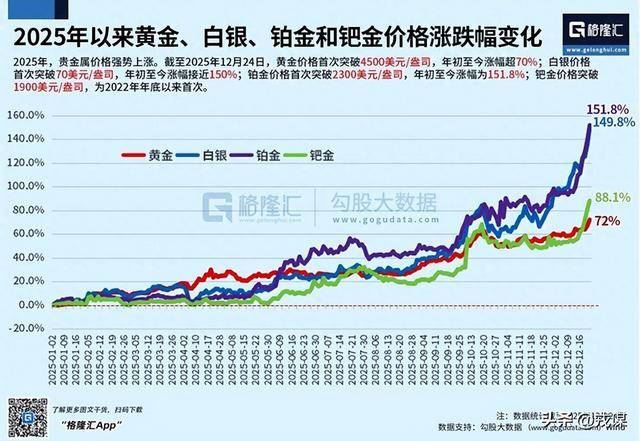
全球都在抢贵金属?黄金4500,铂金2300,白银72,普通人要跟风吗
Sou Hu Cai Jing· 2025-12-25 05:37
Group 1 - The core viewpoint of the article highlights the unprecedented surge in precious metal prices, including gold, silver, and platinum, driven by multiple factors such as geopolitical tensions and increased demand from central banks [3][5][16] - Gold prices have reached a new high of $4,500 per ounce, marking a more than 66% increase this year, potentially leading to the best annual performance since 1979 [3][5] - Platinum has seen a remarkable rise to $2,300 per ounce, with a cumulative increase of over 150% this year, attributed to supply shortages from South Africa and high borrowing costs [7][9] Group 2 - Silver has also experienced significant gains, surpassing the $70 mark, driven by strong investment demand and industrial usage, with global demand exceeding supply for five consecutive years [11][12] - The surge in precious metals has extended to domestic markets, with platinum futures hitting the limit up, and both silver and palladium prices increasing by over 6% [14] - The current market dynamics reflect a global search for reliable assets amid economic uncertainty, with precious metals serving as a safe haven for investors [16]

——2025年贵金属市场回顾与2026年展望:贵金属:金银岂是池中物一遇风云便化龙
Fang Zheng Zhong Qi Qi Huo· 2025-12-15 05:18
1. Report Industry Investment Rating The report does not mention the industry investment rating. 2. Core Viewpoints of the Report - In 2025, the precious metals market shone brightly. Gold and silver were the best - performing assets among global major asset classes, with silver doubling in value and gold rising over 60%, the best annual performance since 1979. The underlying logic driving this bull market was the global shake of faith in the US dollar system, the decline of the real interest rate's explanatory power for precious metal prices, and the weakening independence of the Federal Reserve. Precious metals were re - defined from traditional safe - haven assets to inflation - resistant and risk assets [2][167]. - In 2026, the bull market in the precious metals market is expected to continue. The factors driving the 2025 rise may be strengthened. The Fed chair change, potential interest rate cuts, and increased US debt issuance may further undermine the US dollar's credit. Global central banks are likely to maintain strong gold - buying intentions, and investment demand for precious metals is expected to be further released. Silver may have a larger price increase than gold, and the gold - silver ratio may further decline [3][4][168]. 3. Summary by Relevant Sections I. Review of Long - term and 2025 Trends of Precious Metals - **Long - term historical trends**: Since the Bretton Woods system in 1944, the gold price has experienced multiple bull - bear cycles. After the system collapsed in the 1970s, the gold price became market - oriented. From 1972 - 2023, it can be divided into five stages: the 1973 - 1980 bull market, the 1980 - 2000 bear market, the 2000 - 2011 bull market, the 2011 - 2018 bear market, and the 2019 - present bull market [12][13][14]. - **2025 trends**: Gold had two main upward waves in 2025, reaching a high of nearly $4400 per ounce. Silver's performance was even more remarkable, with a cumulative increase of over 80%. The gold - silver ratio declined from a high level [19][20][21]. II. Decline of the Explanatory Power of US Treasury Real Interest Rates for Precious Metal Prices Since 2023, US Treasury real interest rates have shown a positive correlation with gold prices. In 2025, their explanatory power for gold prices further weakened. The US debt, deficit, and damaged US dollar credit are becoming the new pricing anchors for gold, and the pricing logic has shifted from the financial to the monetary attribute [27][28]. III. The Underlying Logic of the Current Precious Metals Bull Market is Global De - dollarization - **The US dollar returning to its intrinsic value**: In 2025, the US dollar index declined by over 10%. The "Sea Lake Manor Agreement" aims to address the US trade deficit and manufacturing hollowing - out, which may lead to a long - term decline in the US dollar index [32][33]. - **Shaken faith in the US dollar**: In 2025, the US dollar and US Treasuries lost their safe - haven properties and began to show risk - asset characteristics. Gold and silver's safe - haven properties were highlighted [38][39]. - **Loosening of global capital's focus on US dollar assets**: In 2025, global capital reduced its allocation of US dollar assets and increased non - US assets. Precious metals benefited from this capital flow. In 2026, the attractiveness of US dollar assets may increase, but precious metals still have investment value [42][43][46]. - **Inability of stablecoins and the "Pennsylvania Plan" to fundamentally strengthen US dollar and US Treasury credit**: Stablecoins can temporarily increase US Treasury demand, but in the long run, they may accelerate the collapse of the US dollar credit system. The "Pennsylvania Plan" has not achieved the expected results in stabilizing the long - term US Treasury demand [49][53][57]. - **The US dollar index entering a new medium - to - long - term downward channel**: Historically, the US dollar index has a cycle of about 17 years, with 6 - 7 years of rising and 10 years of falling. Currently, it is at the beginning of a new downward cycle, which is favorable for the rise of precious metal prices [60][61][62]. IV. The Monetary Attributes of Precious Metals Shine Global high debt and shaken faith in the US dollar have made gold and silver the ultimate choice to hedge against the risk of the credit - currency system. In 2025, global major economies' long - term bond yields rose, and the US and French sovereign ratings were downgraded. The US Treasury debt scale expanded rapidly, and global central banks increased their gold holdings. The Fed's independence was severely challenged, which was conducive to the rise of precious metal prices [70][71][75]. V. Redefinition of Precious Metals - **Transition from safe - haven to inflation - resistant and risk assets**: Gold and silver are being re - defined from traditional safe - haven assets to inflation - resistant and risk assets. In 2026, with the Fed's potential interest rate cuts and balance - sheet expansion, global inflation may rise again, increasing the attractiveness of precious metals [90][91]. - **Highlighted value as a major asset allocation**: Gold and silver have both risk - asset attributes. Their volatility is similar to that of the S&P 500, and their positive correlation with the US stock market is increasing. They are becoming an important part of global major asset allocation [94]. VI. Changes in the Supply - Demand Structure of Precious Metals - **Global central banks' gold - buying**: In 2025, the global central banks' gold - buying pace slowed down in the first half of the year but accelerated in the third quarter. It is expected that in 2026, central banks' gold - buying intentions will remain strong due to the potential weakening of the US dollar credit [96][99][101]. - **Global physical gold supply and demand**: In 2025, gold investment demand soared, compensating for the decline in central banks' gold - buying. Although the supply was slightly in surplus in the first three quarters, the supply - demand pattern tightened compared to 2024. In 2026, the physical gold market may face a supply shortage [106][110][111]. - **Global physical silver supply and demand**: In recent years, silver supply has been constrained. In 2025, supply is expected to increase by about 2%. In 2026, the supply growth rate may be about 1.5%. Demand in 2025 is expected to decline by 1%, but in 2026, it may increase by 2%. The silver market has had a supply shortage for five consecutive years, and the shortage may widen in 2026 [112][121][127]. VII. Technical and Seasonal Analysis - **Technical analysis**: Gold's upward space has been fully opened. Based on historical bull - market performance, it still has room for growth. Silver usually lags behind gold in entering the bull market but has a larger cumulative increase. Technically, it supports a significant increase in silver prices [144][146]. - **Seasonal analysis**: For gold, December has the highest winning rate, and November - January is the strong - season period. For silver, January and June have a higher probability of decline, while March and October have a higher probability of increase [149]. VIII. Position Changes In 2025, the inventories of COMEX gold and silver increased. The non - commercial net long positions in the futures market decreased, but the spot - market sentiment was stronger, as shown by the increase in ETF holdings [157]. IX. Arbitrage Strategy The gold - silver ratio reflects the premium of gold over silver in terms of safe - haven demand. In 2025, the gold - silver ratio declined. In 2026, with the rise of inflation expectations and copper prices, the gold - silver ratio is expected to further decline to around 60 [162][163]. X. Full - text Summary and Operational Suggestions The bull market in the precious metals market in 2026 is expected to continue. The upper pressure range for London gold is $5000 - $5200 per ounce, and the lower support range is $4100 - $4300 per ounce. For Shanghai gold futures, the pressure range is 1200 - 1250 yuan per gram, and the support range is 920 - 940 yuan per gram. The upper pressure range for London silver is $90 - $95 per ounce, and the lower support range is $55 - $60 per ounce. For Shanghai silver futures, the pressure range is 19000 - 20000 yuan per kilogram, and the support range is 13000 - 13500 yuan per kilogram [168]. XI. Related Stocks The report lists the cumulative price increases of some precious - metal - related stocks in 2025, such as Shandong Gold (600547.SH) with a 59.05% increase and Western Gold (601069.SH) with a 129.82% increase [170].
关注!全球债务风险
Hu Xiu· 2025-09-11 00:04
Core Viewpoint - The U.S. non-farm employment data is becoming a trigger for a global debt crisis, with risks accumulating in the financial system [1] Group 1: Economic Impact - Treasury Secretary Becerra criticizes the Federal Reserve for its monetary policy, which he claims has led to inflation, wealth disparity, and uncontrolled debt [1] - There is a call for a reassessment of the Federal Reserve's independence and mission in light of these economic challenges [1]
贺利氏预测:金价高位震荡 全球经济政治不确定性依旧支撑黄金需求
Xin Lang Cai Jing· 2025-05-29 07:18
Group 1: Gold Market Insights - The global economic and geopolitical uncertainties continue to support gold demand, with short-term price expectations in the range of $3200-$3500 per ounce [2][1] - Recent fluctuations in the gold market have seen London gold prices oscillating between $3200 and $3400 per ounce, influenced by U.S. trade policies and ongoing trade negotiations between the U.S. and EU [1] - Investment demand for gold remains strong despite high prices suppressing jewelry consumption, with April's outflow from the Shanghai Gold Exchange increasing by 27 tons to 153 tons [1] Group 2: Platinum Market Insights - Short-term platinum price expectations are projected to fluctuate between $1000 and $1100 per ounce, with recent prices having risen above $1100 before a slight retreat [3][2] - The platinum market is experiencing a three-year supply-demand imbalance, with visible inventories being continuously depleted, and potential for sustained strength if the fundamentals remain supportive [2] - China's platinum market demand is expected to remain robust, with projections indicating a recovery in platinum jewelry processing by Q4 2024 and a potential 50% expansion in processing volume by Q1 2025 [2]