
全球贸易保护主义

Search documents
在变局中追问奇瑞:一家中国车企如何理解“技术之治”
财富FORTUNE· 2026-03-16 13:05
Core Insights - Chery achieved significant milestones in 2025, including its IPO and a leap in the Fortune Global 500 rankings from 385th to 233rd, marking it as the fastest-rising automotive company globally [1] - The automotive industry in China is facing two major uncertainties: the technological overhaul driven by AI and smart technologies, and the reshaping of market rules due to global trade protectionism and geopolitical tensions [1] Capital Market Perspective - Becoming a public company has led to a structural shift in Chery's operational logic, with increased scrutiny from shareholders and investors regarding stock price fluctuations and profitability metrics [3] - This external pressure compels the management to reassess resource allocation and emphasizes the need to create greater social value with fewer resources [5] Technological Challenges - AI and smart technology are central themes, with Chery's chairman actively testing autonomous driving systems to ensure competitive performance against industry leaders like Tesla and Waymo [5][6] - The introduction of end-to-end models in AI presents challenges due to their unpredictable nature, prompting Chery to isolate safety-related components while allowing more aggressive iterations for non-critical features [6] Organizational Evolution - Chery is undergoing a "fission" process to enhance organizational capabilities, breaking down its innovation system into multiple specialized directions to remain agile and responsive [7] - The company has established a framework with 17 L1, 79 L2, and approximately 500 L3 directions to ensure flexibility and continuous improvement [7] Globalization Strategy - As a leader in automotive exports, Chery recognizes the unsustainability of traditional vehicle exports and aims to contribute locally in global markets, reflecting a shift in its role from an exporter to a collaborator [11] - The company emphasizes a dual trade approach, aiming to not only sell globally but also to source globally, enhancing its position in international markets [11] Response to Geopolitical Uncertainty - Chery views current geopolitical tensions as temporary waves in the globalization process and advocates for a pragmatic approach focused on self-improvement and establishing rules to mitigate irregularities in the global landscape [11][13] - The company is committed to using technology to address global challenges, aiming to leverage Chinese cultural strengths to influence the world positively [13]


加拿大工业部长会见比亚迪、奇瑞高管?这波“神操作”藏着什么算盘
Xin Lang Cai Jing· 2026-01-21 10:25
Core Viewpoint - Canada has significantly reduced tariffs on Chinese electric vehicles (EVs) from 100% to 6.1%, allowing the import of up to 49,000 units annually, creating a strategic opportunity for Chinese automakers like BYD and Chery to enter the North American market through Canada [1][3][10] Group 1: Tariff Changes and Market Access - Canada has lowered tariffs on Chinese EVs from 100% to 6.1%, which previously made market entry nearly impossible [1][3] - The new policy allows for the import of up to 49,000 Chinese EVs each year, marking a significant shift in trade relations [1][10] Group 2: Strategic Implications for Chinese Automakers - The Canadian market, while not large, serves as a critical entry point for Chinese EV brands into developed markets, potentially validating their competitiveness against global standards [12] - Success in Canada could demonstrate that Chinese EVs can thrive not only in emerging markets but also in Europe and North America [12] Group 3: Canada’s Strategic Interests - Canada aims to benefit from lower EV prices and accelerate its energy transition by importing Chinese EVs while also attracting investment and technology by encouraging local assembly [10][12] - The Canadian Minister emphasized the importance of local assembly and collaboration with local suppliers, indicating a desire for Chinese companies to establish a manufacturing presence in Canada [10] Group 4: Global Automotive Landscape - The meeting signifies a shift in the global automotive industry, with traditional barriers being challenged by technological and cost advantages from Chinese manufacturers [12] - This development may serve as a model for other mid-sized economies seeking to balance economic growth without fully aligning with either the U.S. or China [12][14]


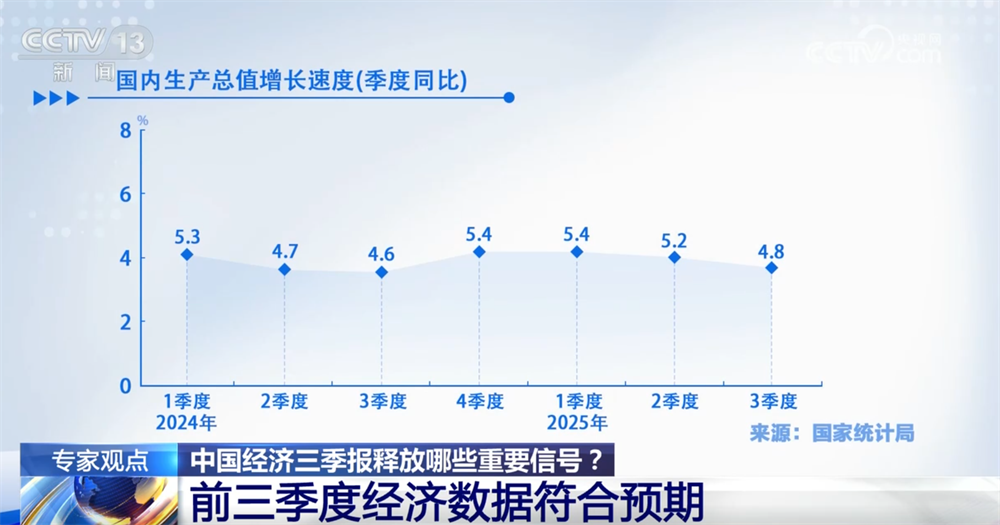
中国经济“三季报”释放哪些积极信号?四季度政策如何精准发力?一文解读→
Yang Shi Wang· 2025-10-21 07:04
Economic Growth Overview - China's GDP growth for the first three quarters of 2023 is 5.2% year-on-year, with quarterly growth rates of 5.4% in Q1, 5.2% in Q2, and a slowdown to 4.8% in Q3 [1][4] - The economic performance aligns with expectations, influenced by external environmental challenges and the timing of policy implementations [4] Foreign Trade Performance - Despite concerns over foreign trade pressures due to the trade war starting in April, actual data shows a continuation of quarterly growth, with a notable 8.0% increase in September [4][5] - The total import and export volume for goods increased by 1.3% year-on-year, with Q1 growth at 4.5% and Q2 at 6% [5] Export Competitiveness - China's export competitiveness has shown remarkable resilience, particularly in non-U.S. markets, driven by innovation and large-scale production capabilities [7] - The country has effectively countered rising global trade protectionism by promoting trade liberalization, leading to significant expansion in new trade markets [7] Policy Directions for Q4 - The focus for Q4 policy will include maximizing the effectiveness of existing policy tools, targeting key areas of economic weakness, and enhancing market liquidity through monetary policy [7]
跨境企业破产警示与深度分析:如何避免成为下一个“倒下的巨人”
Sou Hu Cai Jing· 2025-09-19 05:49
Core Viewpoint - The article discusses the increasing challenges and risks faced by cross-border trade, highlighted by the bankruptcy of three companies in Shenzhen, emphasizing the need for adaptation and strategic shifts in the industry [3][5][6]. Group 1: Company Bankruptcy Cases - Three companies, Shenzhen Yongsheng Electric, Foshan Shunde Aochuang Electric, and Shenzhen Senhe Innovation Technology, have faced bankruptcy due to various operational challenges [4]. - Shenzhen Yongsheng Electric, established in 2012, specialized in electronic switches and lighting equipment, but suffered from cash flow issues leading to its closure in September 2025 [4]. - Foshan Aochuang Electric, founded around 2015, was unable to sustain operations due to insolvency and ceased operations by the end of August 2025 [4]. - Shenzhen Senhe Innovation Technology, established in August 2022, faced difficulties in team restructuring and manufacturing issues, leading to its closure in May 2025 [4]. Group 2: External Macro Environment Challenges - The rise of global trade protectionism, including significant tariffs imposed by the US on Chinese goods, has severely impacted Chinese exporters, forcing some to shift markets and resulting in reduced profit margins [8]. - The lingering effects of the COVID-19 pandemic and geopolitical conflicts, such as the Russia-Ukraine war, have led to increased logistics costs, which can account for over 30% of a company's revenue [8]. - Changes in market demand and consumer preferences, including a trend towards consumption downgrading, have negatively affected traditional products lacking technological differentiation [8]. - The competitive landscape in manufacturing has intensified, with new brands emerging and rapid technological advancements, putting pressure on established companies [8]. Group 3: Internal Operational and Strategic Shortcomings - Many companies lack core technology and brand premium, relying heavily on OEM models, which leads to vulnerability in price competition [10]. - Poor cash flow management and weak financing capabilities have been identified, with logistics costs consuming a significant portion of revenue [10]. - Companies often face cash flow crises due to unexpected expenses and inability to secure bank loans, leading to financial collapse [10]. - Risk management mechanisms are often inadequate, with over-reliance on single markets or routes exacerbating vulnerabilities [10][12]. Group 4: Supply Chain and Partner Risks - The reliance on freight forwarding logistics creates significant risks, as the failure of major freight companies can disrupt supply chains and lead to additional costs for manufacturers [12]. - The cycle of bad debts and overdue accounts receivable can create a critical financial burden during industry downturns [12]. Group 5: Insights and Recommendations - Traditional manufacturing firms must shift from an OEM mindset to a focus on branding and product innovation to enhance resilience against market fluctuations [13]. - Technology startups should balance technological advancement with production feasibility and cost control, while also managing cash flow effectively [13]. - Companies are encouraged to explore diversified financing channels and maintain healthy debt levels to mitigate risks [13]. Group 6: China's Foreign Trade Resilience - Despite challenges, China's foreign trade demonstrates strong resilience, with significant growth in trade with ASEAN and Belt and Road countries, even as trade with the US declines [16][17]. - The export of mechanical and electrical products has increased, indicating a shift towards higher quality products in China's export structure [17]. - The potential for "transshipment trade" through third-party countries highlights the adaptability of Chinese manufacturers in response to changing international market dynamics [18].

特朗普吹的牛实现了?全球关税正式落地,中方一语道破大结局,关键时刻,20多国领导人确定访华
Sou Hu Cai Jing· 2025-08-04 05:28
Group 1 - The core viewpoint of the article highlights the significant geopolitical events, particularly the implementation of Trump's global tariff policy and China's hosting of the Shanghai Cooperation Organization summit, which are interlinked and impact global political and economic dynamics [1] - Trump's global tariff policy includes varying rates, with Syria facing a high rate of 41% and Brazil and the UK at 10%, while China is notably absent from the list, indicating a strategic delay rather than a soft approach towards China [2][4] - The U.S. aims to weaken China's influence by targeting its allies, such as Brazil, and is using the tariff policy as a means to buy time for domestic industries, particularly in the rare earth sector, where China holds a dominant position [4][6] Group 2 - China's response to the U.S. tariff policy is firm, emphasizing that there are no winners in a trade war and that protectionism harms all parties involved, showcasing China's comprehensive industrial system and diverse countermeasures [6][8] - The upcoming summit in Tianjin, with over 20 national leaders and 10 international organizations participating, signifies China's growing influence and commitment to multilateral cooperation amidst rising global trade protectionism [8] - The next 90 days are critical for U.S.-China relations, with potential acceleration in U.S. efforts for rare earth self-sufficiency and China's reinforcement of its counter-leverage, indicating a shift towards cooperation and mutual benefit in the global landscape [8]

柳工:预计下半年国内土方机械的市场需求将继续保持增长势头
news flash· 2025-07-13 05:24
Core Viewpoint - The company expects continued growth in domestic earthmoving machinery market demand in the second half of the year, with overall sales of excavators and loaders projected to achieve double-digit year-on-year growth [1] Industry Summary - Economic fiscal policy environment and various structural demands will create opportunities for the industry [1] - The international market faces challenges from a resurgence of global trade protectionism, with overall demand still in a bottoming phase [1] - A gradual recovery is anticipated by 2026, with ongoing regional differentiation [1] - Growth in emerging markets is expected to remain resilient, driven by trends in new energy and technological upgrades, while development opportunities in mature markets are also worth noting [1]

柳 工(000528) - 2025年7月11日柳工投资者关系活动记录表
2025-07-12 15:02
Financial Performance - The company expects a net profit of approximately CNY 1.18 to 1.28 billion for the first half of 2025, representing a year-on-year growth of 20% to 30% [3] - The domestic earthmoving machinery industry has shown significant recovery, with excavator domestic sales increasing by 22.9% and loader domestic sales increasing by 23.2% in the first half of 2025 [3] Market Outlook - The domestic market for earthmoving machinery is anticipated to continue its growth momentum, with overall industry sales expected to achieve double-digit year-on-year growth [3] - The international market is facing challenges due to global trade protectionism, but is expected to gradually recover in 2026, with emerging markets showing resilience [3] Corporate Governance - The company's board restructuring has not altered its strategic execution, market-oriented operations, or incentive mechanisms, maintaining a focus on enhancing market competitiveness and shareholder returns [4] Incentive Plans - The company has exceeded its performance assessment indicators for 2024, with the first phase of the stock option incentive plan set to unlock on July 14, 2025 [5] - A market-oriented executive compensation system is in place to strengthen management execution and promote long-term growth in operational performance and market value [5] International Strategy - The company has seen growth in revenue and profit in the European market, focusing on enhancing sales and channel networks while promoting ESG initiatives and electric, intelligent products [6] - Future plans include upgrading from an international strategy to a global strategy, ensuring stable and high-quality growth in overseas markets through localized supply chains and R&D centers [7] Competitive Landscape - The domestic electric loader market is experiencing increased price competition, with the company maintaining a higher price level for electric loaders due to its technological advantages [8] - The company advocates for healthy competition in the industry, emphasizing the importance of technological innovation and product quality for sustainable development [8]
土耳其央行:地缘政治局势的发展以及全球贸易保护主义上升对通胀回落进程的潜在影响正受到密切关注。
news flash· 2025-06-19 11:06
Core Viewpoint - The Turkish central bank is closely monitoring the potential impact of geopolitical developments and the rise of global trade protectionism on the inflation decline process [1] Group 1 - The central bank is paying attention to geopolitical developments [1] - The rise of global trade protectionism is a concern for the central bank [1] - The potential effects on the inflation decline process are being closely observed [1]
KVBprime外汇平台:澳洲联储有望下周降息 澳元维持上涨趋势
Sou Hu Cai Jing· 2025-05-15 03:57
Group 1 - The Australian dollar (AUD) continues its recent upward trend, reaching 0.6444 against the US dollar, with a daily increase of 0.36% supported by strong employment data and optimistic market sentiment regarding the US-China trade agreement [1] - Australia's April employment report shows resilience in the labor market, with 89,000 new jobs added, significantly exceeding the market expectation of 22,500, while the unemployment rate remains low at 4.1% [3] - The market is pricing in a 54% probability of a 50 basis point rate cut by the Reserve Bank of Australia (RBA) in the upcoming meeting, reflecting strong expectations for monetary easing [3] Group 2 - The price level around 0.6440 is currently a focal point for market contention, with a potential breakout above last year's high of 0.6515 opening a path towards 0.6687, a seven-month high reached in November 2024 [4] - The nine-day Exponential Moving Average (EMA) at 0.6429 serves as the first support level, with a breach potentially leading to a decline towards the 50-day EMA at 0.6355, and further technical selling could target the 0.5914 area, not seen since March 2020 [4] - The technical analysis indicates mixed signals, with the AUD/USD remaining above the nine-day EMA and the 14-day Relative Strength Index (RSI) stabilizing above the neutral level of 50, suggesting short-term upward momentum may persist [3]

【国信电子胡剑团队|0407周观点】全球贸易保护主义兴起,科技自强与自主可控仍是破局关键
剑道电子· 2025-04-08 10:06
点击 关注我们 报告发布日期:2025年4月7日 报告名称: 《 电子行业周报--全球贸易保护主义兴起,科技自强与自主可控仍是破局关键 》 分析师:胡剑 S098052 1080001/胡慧 S0980521080002/ 叶子 S0980522100003 / 詹 浏洋 S0980524060001 / 张大为 S0980524100002/李书颖S0980522100003 联系人:连欣然 完整报告请扫描下方二维码 长按识别小程序阅读全文 国信电子团队 胡剑: 电子行业首席分析师,复旦大学电子系学士,复旦大学世界经济系硕士,法国EDHEC商学院交换生。2021年8月加入国信研究 所,之前任华泰研究所消费电子行业首席,2018年第一财经最佳分析师电子行业第3名,2019年证券时报金翼奖分析师电子行业第2名, 2019年II China科技行业入围,2019年新浪财经金麒麟新锐分析师电子行业第1名,2020年II China科技行业第2名,2023年Wind金牌分析师 电子行业第3名,2023年新浪财经金麒麟菁英分析师半导体行业第2名、消费电子行业第3名,2024年Wind金牌分析师电子行业第1名, 2024 ...