分散交易

Search documents
道指破5万黄金冲5千美元后,市场超级震荡周延续!
Sou Hu Cai Jing· 2026-02-10 07:43
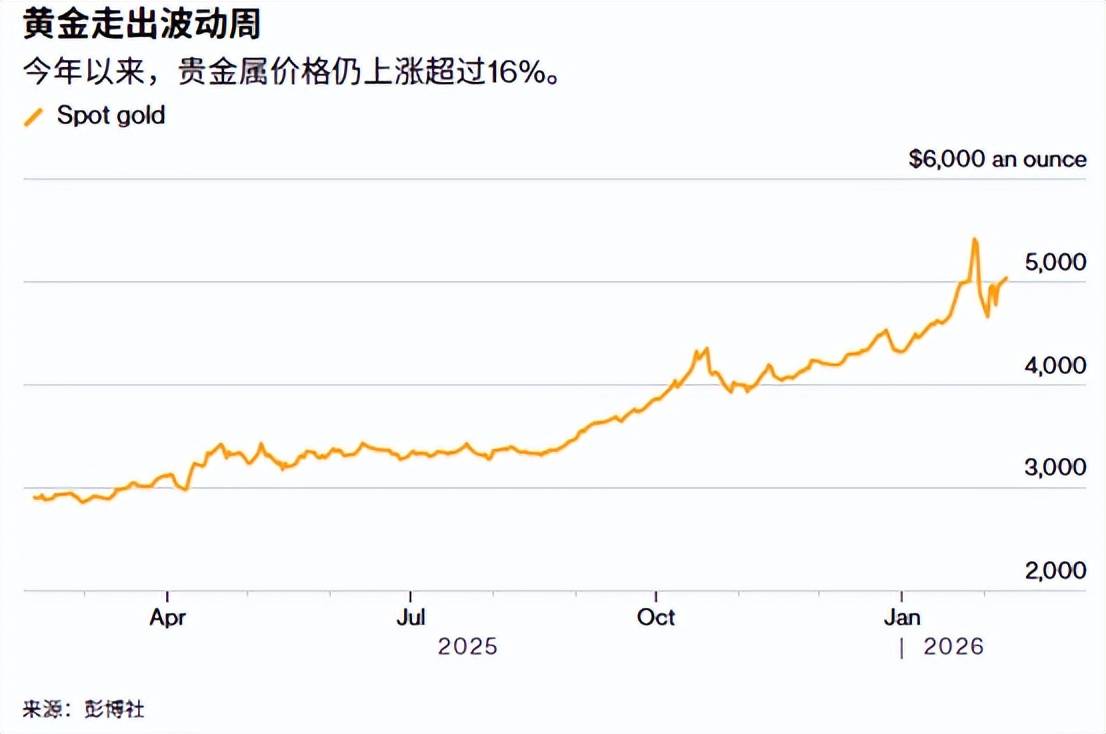
Core Viewpoint - The financial markets experienced significant volatility last week, particularly in gold and silver, with the Dow Jones Industrial Average closing above 50,000 for the first time and gold surpassing $5,000, driven by a resurgence in buying on dips ahead of upcoming U.S. non-farm payroll and CPI reports [1] Group 1: Market Volatility - The stock market's volatility has been lower than that of precious metals and currencies this year, but concerns over AI threats have led to sharp fluctuations in software stocks, with a notable ETF dropping 12% from Monday to Thursday before rebounding 3.5% on Friday [3] - European stock markets experienced one of the highest volatility levels in years, with the weighted average volatility of the Euro Stoxx 50 index components soaring to over 30 points, marking the second-largest gap since 2009 [5] - The current market dynamics are driven by a resonance of "macro uncertainty and micro structural fragility," with upcoming U.S. CPI and non-farm data acting as a "judgment day" for market expectations regarding the Federal Reserve's interest rate path [7] Group 2: Asset Reactions to Economic Data - If the CPI and non-farm data reflect a "Goldilocks economy" (steady inflation decline and moderate employment slowdown), both U.S. stocks and gold could rise simultaneously, supported by soft landing expectations and solid corporate earnings [9] - In contrast, if the economy appears "overheated" (rising inflation and strong employment), both asset classes may face downward pressure due to heightened interest rate expectations [10] - The market is expected to be in a "high sensitivity waiting mode" before key macro data is released, transitioning into a "dramatic repricing mode" immediately after the data is published [7] Group 3: Investment Strategy - In light of high volatility and market divergence, a strategy of "core defense + flexible maneuvering" is recommended, with a proactive reduction of positions, especially in high-valuation and high-volatility assets before the CPI/non-farm data release [10] - The long-term bullish foundation for gold remains intact, driven by de-dollarization and central bank purchases, suggesting a strategy of "gradual accumulation on deep pullbacks" rather than chasing highs before data releases [10]

美股“表面平静”暗藏个股巨震:AI狂热催生极端波动与“彩票心态”
智通财经网· 2026-01-15 12:15
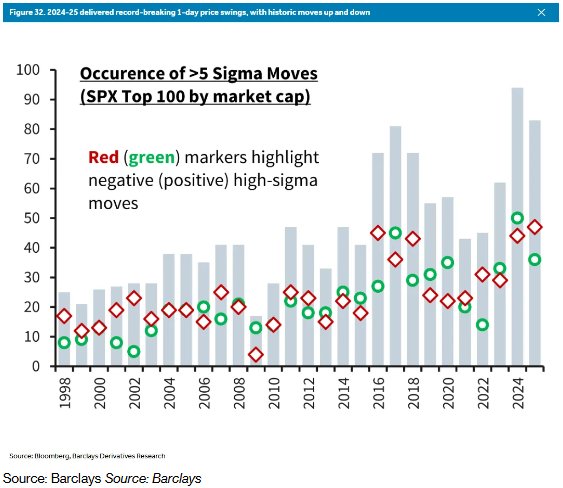
Group 1 - The core observation is that beneath the calm surface of the US stock market, there is unprecedented volatility among individual stocks, with Barclays reporting a record 47 instances of extreme sell-offs among the top 100 S&P 500 constituents in 2023 [1] - Barclays suggests that the dependency of the benchmark index on AI-related stocks has increased significantly, indicating that AI technology is accelerating traders' responses to market events [1][3] - The current environment has fostered a "lottery mentality" among retail traders, who tend to buy stocks during price declines, which helps to suppress overall market volatility [3] Group 2 - A series of upcoming events may pose risks to the S&P 500 index, which recently reached a historical high, prompting recommendations for investors to buy put options on the SPDR S&P 500 ETF Trust to hedge against potential volatility [6] - Despite low expectations for significant market fluctuations, Barclays predicts that individual stock volatility may disrupt the overall calm, suggesting a "diversified trading" strategy using derivatives to capitalize on increased individual stock volatility [6][8] - The timing for employing this strategy may be ripe as the earnings season unfolds, with notable single-day volatility observed in major S&P 500 constituents last year, such as Oracle's 36% surge and UnitedHealth's 22% drop following earnings surprises [8]

“FOMO论 vs 泡沫论”,华尔街认为明年美股波动率低不了
Hua Er Jie Jian Wen· 2025-12-22 02:09
Group 1: Market Overview - Wall Street is preparing for continued volatility in the U.S. stock market in 2026, with investors oscillating between fear of missing out (FOMO) on AI rebounds and anxiety over potential asset bubbles bursting [1] - The past 18 months have shown a pattern of large sell-offs and rapid reversals, which is expected to continue into 2026, particularly influenced by tech giants at the center of the AI revolution [1] - Despite strong performance in tech stocks in 2025, the divergence between sectors has suppressed actual market volatility, but risks from falling chip stocks could trigger broader market impacts [1] Group 2: Volatility Strategies - UBS strategists highlight that the AI boom's sustainability is crucial for volatility strategies, with high volatility contracts on the Nasdaq 100 index being a key focus [2] - The strategy of buying Nasdaq 100 volatility while selling S&P 500 volatility is viewed as a high-confidence trade for the upcoming year [2] - JPMorgan strategists anticipate that volatility will fluctuate between technical, fundamental, and macroeconomic factors, with the VIX expected to average between 16 and 17 in 2026 [2] Group 3: Options Market Dynamics - Structural imbalances in the options market are reshaping pricing, with a steepening volatility curve expected in 2026 due to an imbalance in investment flows [3] - Quantitative investment strategies and volatility selling strategies are increasing supply on the short end of the curve, while hedging funds are expected to keep long-end volatility elevated [3] - The fear of missing out and conflicting narratives around AI are creating favorable conditions for trading volatility [3] Group 4: Divergence in Trading Strategies - The "diversified trading" strategy, betting on individual stock volatility while keeping index volatility low, may become popular but raises concerns about overcrowding [4] - Some hedge funds are taking contrary positions, suggesting that the strategy may be overly crowded [4] - Despite concerns, capital is expected to continue flowing into diversified strategies, maintaining single-stock volatility premiums over indices [5] Group 5: Re-leveraging Cycle and Tail Risks - A volatility mechanism model based on the yield curve indicates that a flattening curve signals buying volatility, while a steepening curve triggers selling [6] - The model has historically avoided significant drawdowns during market downturns, suggesting that volatility is likely to rise in 2026 [6] - The U.S. is on the brink of a new re-leveraging cycle driven by AI, which could lead to increased credit spreads and equity volatility [6]
再现散户暴打空头?Krispy Kreme(DNUT.US)、GoPro(GPRO.US)等Meme股盘前飙涨
Zhi Tong Cai Jing· 2025-07-23 13:22
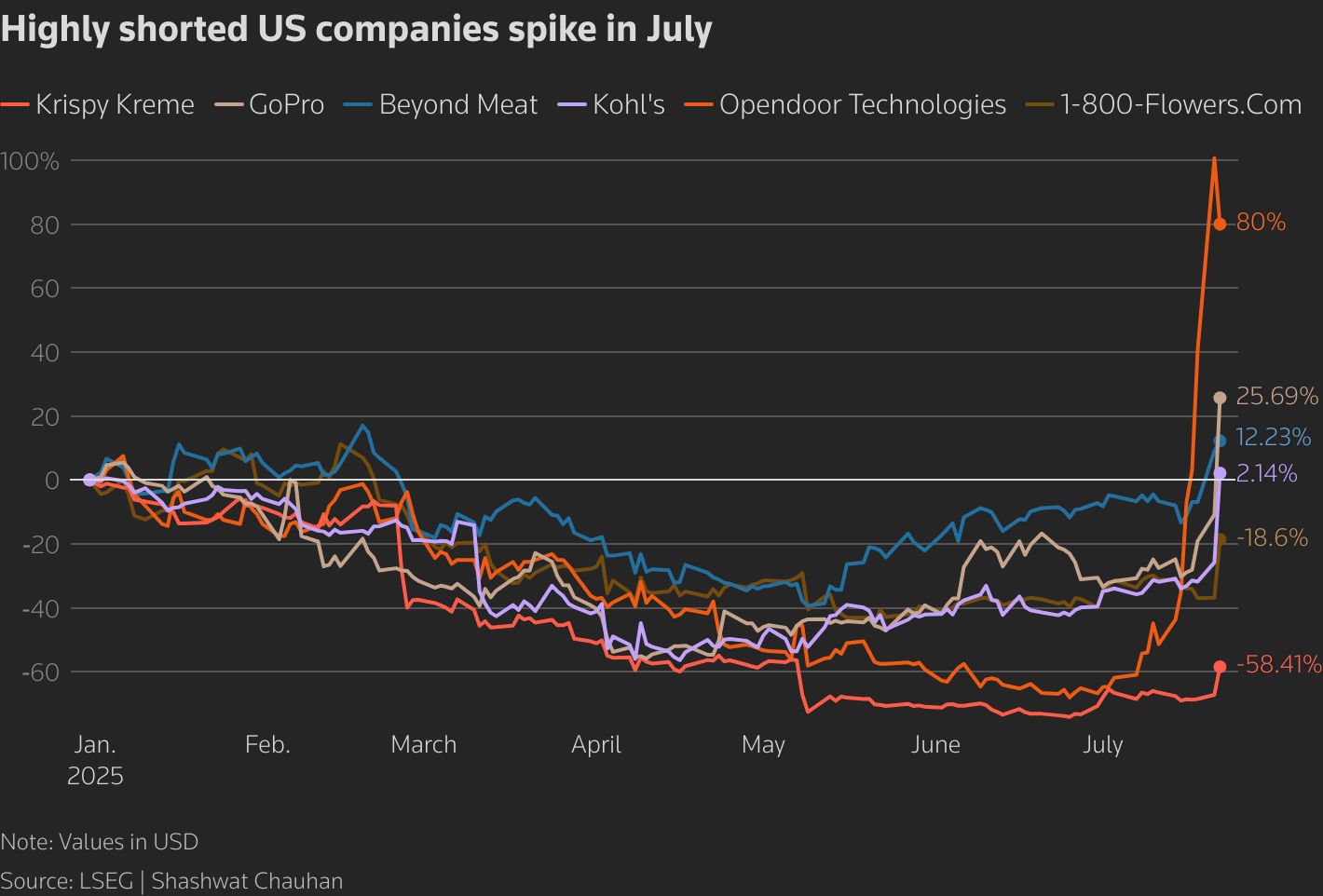
Group 1 - The article highlights a surge in stock prices for companies like Krispy Kreme and GoPro, driven by retail investor interest and high short-selling ratios [1][3] - Krispy Kreme's stock rose approximately 34% in pre-market trading, following a nearly 27% increase the previous day, while GoPro's stock soared over 83% after a 41% rise [1] - Companies such as Beyond Meat and 1-800-Flowers.com also experienced pre-market increases of around 15%, with high short-selling ratios of 38% and 71.66% respectively [1] Group 2 - The article discusses the phenomenon of "meme stocks," which are characterized by retail investor enthusiasm and lack of fundamental support for price increases [3] - S3 Partners' Ihor Dusaniwsky describes meme stocks as "battlefield stocks," where retail investors and short-sellers engage in intense market competition [3] - The article draws parallels to the speculative frenzy surrounding GameStop during the pandemic, warning that rapid price increases could be followed by equally swift declines [3] Group 3 - Analysts, including Barclays' Stefano Pascale, express concerns about excessive market enthusiasm, citing signs of a bubble, such as the rise of SPAC mergers and the performance of ARK Innovation ETF [4] - Pascale emphasizes that certain market segments exhibit significant bubble characteristics, indicating potential risks for investors [4]






Meme股热潮再现?巴克莱拉响“泡沫警报”:市场情绪过度高涨
Zhi Tong Cai Jing· 2025-07-23 10:49
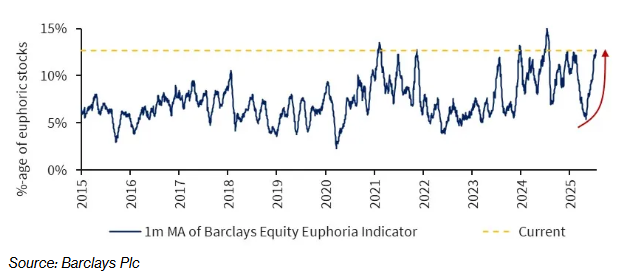
Group 1 - Barclays suggests it is time to apply brakes on the meme stock frenzy that has driven up the prices of companies like Kohl's (KSS.US) and Opendoor Technologies (OPEN.US) [1] - Retail traders have been flocking to these previously undervalued stocks, resulting in a cumulative increase of over 69% for Kohl's and more than 440% for Opendoor since July [1] - The rapid rise in stock prices raises concerns about a potential sudden decline, reminiscent of the speculative frenzy surrounding GameStop (GME.US) during the pandemic [1] Group 2 - Barclays' equity frenzy indicator, which quantifies investor sentiment through options data, has surged to its highest level since December of last year [3] - Analysts Stefano Pascale and Anshul Gupta have been warning since early July about excessive market enthusiasm, citing signs of a bubble market [3] - Pascale emphasizes that while many investors recognize the bubble, they struggle to identify which stocks will be the "losers" when the market corrects [3] Group 3 - Piper Sandler identifies Celsius Holdings (CELH.US) and NRG Energy (NRG.US) as suitable candidates for a dispersion trading strategy, given their significant price increases of 68% and 71% respectively this year [4] - Chief strategist Steve Sosnick notes that current market activity resembles the peak of the meme stock frenzy in 2021, but questions the effectiveness of dispersion trading in this context [4] - Sosnick highlights the challenge of predicting when a bubble will burst, stating that bubbles can persist for a long time, especially with liquidity injections in the market [4]