
中国产品

Search documents
罗兰贝格戴璞:企业要了解中国消费者消费心态的转变
Xin Lang Cai Jing· 2026-01-09 13:36
Group 1 - Roland Berger's report "Forecast 2026: China Industry Trends" emphasizes the need for China to address real economic issues and move away from blind investments aimed solely at GDP growth [1] - The report highlights that by 2025, China's total household savings will exceed 160 trillion RMB, suggesting that even releasing 1% to 2% of these savings could significantly boost consumption [1] - To unlock consumption potential, three core issues must be addressed: establishing consumer confidence linked to income stability and employment prospects, providing sufficient security in social welfare and pensions, and enhancing genuine consumer demand [1] Group 2 - Chinese consumers are becoming more mature and rational, seeking not just price and quality but also service, experience, and emotional value [2] - The unique competitive advantage of Chinese products lies in their combination of rich functionality, dense technology, cost advantages, and rapid adaptability, which appeals to both domestic and overseas markets [2] - Understanding the shift in consumer mindset is essential for all businesses, particularly multinational consumer goods companies operating in China, as it represents a critical transformation for survival [2]


突发特讯!海南封关,这群外籍主播为何扎堆涌入,引全球高度关注
Sou Hu Cai Jing· 2025-12-19 00:44
Group 1 - The core viewpoint of the article emphasizes that Hainan's policy changes are not merely superficial but serve as a significant attraction for foreign talent, particularly in the live streaming industry [1][3] - Hainan's new policies facilitate the entry and residence of foreign professionals, with work and residence permits processed in just three days, reducing approval times by over 70% [3] - The introduction of a "double 15%" tax incentive for cross-border e-commerce companies lowers operational costs by 15%-20% compared to mainland China, making Hainan an attractive location for businesses [3] Group 2 - Foreign live streamers in Hainan are not just simple sales tools; many possess advanced degrees and have lived in China for over four years, allowing them to effectively communicate and promote Chinese products [5] - These streamers help break down cognitive barriers, fostering trust in Chinese products among overseas consumers by emphasizing quality and craftsmanship [5] Group 3 - Hainan aims to establish itself as a "global logistics hub" rather than a traditional manufacturing base, allowing companies to focus on research and production while utilizing comprehensive services for market entry and operations [7] - The model of "goods not produced in Hainan but value-added in Hainan" is being implemented, with cross-border e-commerce exports reaching approximately 2 billion yuan in recent years [7] Group 4 - The role of foreign streamers extends beyond commerce; they act as cultural "decoders," sharing insights into Chinese culture, such as tea appreciation, which creates emotional connections with overseas audiences [9] - The composition of the streamer teams is based on cultural affinity, enhancing relatability and reducing the sense of unfamiliarity for international consumers [9] Group 5 - Hainan's opening up is viewed as a test of its commitment to high-level openness, with the influx of foreign streamers indicating a positive market response to its policies [11] - The presence of these foreign professionals in Hainan symbolizes China's broader strategy of embracing global engagement and enhancing its international presence [11]

外资来华挤破头!人民币升值,中国狂揽万亿顺差,打破关税魔咒?
Sou Hu Cai Jing· 2025-12-18 15:36
Core Viewpoint - In 2025, despite high tariffs, China achieved a record trade surplus of $1.07 trillion, indicating a significant shift in global capital flow towards China, surpassing traditional trade dynamics [5][14][31] Group 1: Capital Flow Changes - In 2025, capital inflow into China from foreign investments exceeded trade account inflows for the first time, highlighting a shift from trade-based interactions to investment opportunities [7][10] - The perception of China as merely a manufacturing hub has changed, with global capital recognizing the country's investment potential [5][10] Group 2: Manufacturing Competitiveness - China's manufacturing competitiveness is no longer solely based on low labor costs; it is attributed to a complete industrial system and modernized production processes [19][21] - The ability to rapidly develop and mass-produce new products gives China a significant edge over Western counterparts, which often take longer for similar processes [19][21] Group 3: Global Perception Shift - The global view of China has evolved from seeing it as a "population dividend industrial country" to recognizing its advanced manufacturing capabilities and technological innovations [24][26] - International visitors are increasingly interested in China's high-tech parks and advanced factories, reflecting a shift in perception towards China's industrial strength [26][28] Group 4: New Global Dynamics - The traditional Western-dominated narrative is being challenged as China promotes a model of mutual benefit and cooperation, aligning with the interests of various nations seeking their own development paths [28][30] - The 2025 trade surplus and capital inflow signify a new global order where China's approach to trade and investment is reshaping international relations [31]
美贸易代表又出狂言:加拿大、墨西哥不能成为中国等国的出口中心
Sou Hu Cai Jing· 2025-12-06 05:10
Core Viewpoint - The U.S. Trade Representative, Jamison Greer, has made controversial statements urging Canada and Mexico not to become export centers for countries like China, Vietnam, and Indonesia, indicating a desire for U.S. control over their trade policies [1][5]. Group 1: U.S.-Canada-Mexico Trade Relations - Greer criticized Canada and Mexico for their tariffs on foreign cars, suggesting that the USMCA (United States-Mexico-Canada Agreement) has issues, yet acknowledged that both countries are significant export markets for the U.S. [3][5]. - There are indications that Trump may consider withdrawing from the USMCA, despite its stipulations requiring member countries to maintain the agreement until 2036 [5][9]. - Greer proposed the idea of negotiating separately with Canada and Mexico, arguing that their economic relationships with the U.S. are distinct, which contradicts the original intent of the trilateral agreement [7]. Group 2: Global Trade Dynamics - Greer’s comments reflect a unilateral approach to trade, attempting to dictate terms to Canada and Mexico while downplaying their economic independence and needs [12]. - The interconnectedness of global supply chains makes it impractical for the U.S. to enforce a complete decoupling from China, as this could adversely affect American businesses as well [3][12]. - Canada and Mexico are actively seeking to diversify their trade relationships, as evidenced by Mexico's efforts to upgrade its free trade agreement with the EU to reduce reliance on the U.S. market [10][12].
我在巴西一天卖3000单
投资界· 2025-11-12 07:30
Core Viewpoint - The article highlights the significant growth potential of the Brazilian e-commerce market, emphasizing its attractiveness for Chinese businesses seeking new opportunities amid increasing competition and logistical challenges [4][5][6]. Market Overview - Brazil's e-commerce penetration rate is approximately 13%, with a market size projected to exceed $70 billion by 2025, maintaining an annual growth rate of over 20%, significantly higher than the global average [5][6]. - The influx of Chinese tourists to Brazil increased by 23.5% in the first half of the year, indicating a growing interest in the market [5]. Competitive Landscape - Chinese e-commerce platforms are rapidly entering the Brazilian market, with companies like Temu and TikTok Shop showing remarkable growth in user engagement and sales [8][10]. - Temu achieved 409.7 million visits in just 14 months, surpassing local competitors like Mercado Livre and Shopee [8][10]. Consumer Sentiment - A survey by EBANX revealed that 42% of Brazilian online shoppers view Chinese products as cost-effective, a significant increase from 13% five years ago [6][12]. Challenges and Risks - Despite the market's potential, challenges such as complex taxation, developing logistics, and high operational risks remain prevalent [6][12]. - Brazilian market experts note that while some businesses see growth, others have exited the market after unsuccessful attempts [6][12]. Logistics and Infrastructure - The logistics landscape in Brazil is uneven, with the southeastern region being well-developed while the northern and northeastern areas face significant challenges due to poor infrastructure [15][18]. - Companies like Mercado Livre are investing heavily in logistics, with plans to expand their distribution centers to improve delivery efficiency [20][21]. Strategic Moves by Competitors - Mercado Livre is increasing its investment in logistics, with plans to expand its distribution centers from 10 to 21 by the end of the year [20]. - Shopee has also been expanding its logistics network, with a 54% increase in warehouse space over the past year [21][22]. Regulatory Environment - New tax regulations effective August 1, 2024, will impose import duties on low-value cross-border packages, ending the previous exemption, which may impact the cost structure for e-commerce businesses [29][30]. Conclusion - The Brazilian e-commerce market presents both opportunities and challenges for Chinese businesses, necessitating a careful approach that respects local market dynamics and logistics realities [30].

到巴西淘金去,一天卖出3000单
3 6 Ke· 2025-11-03 09:49
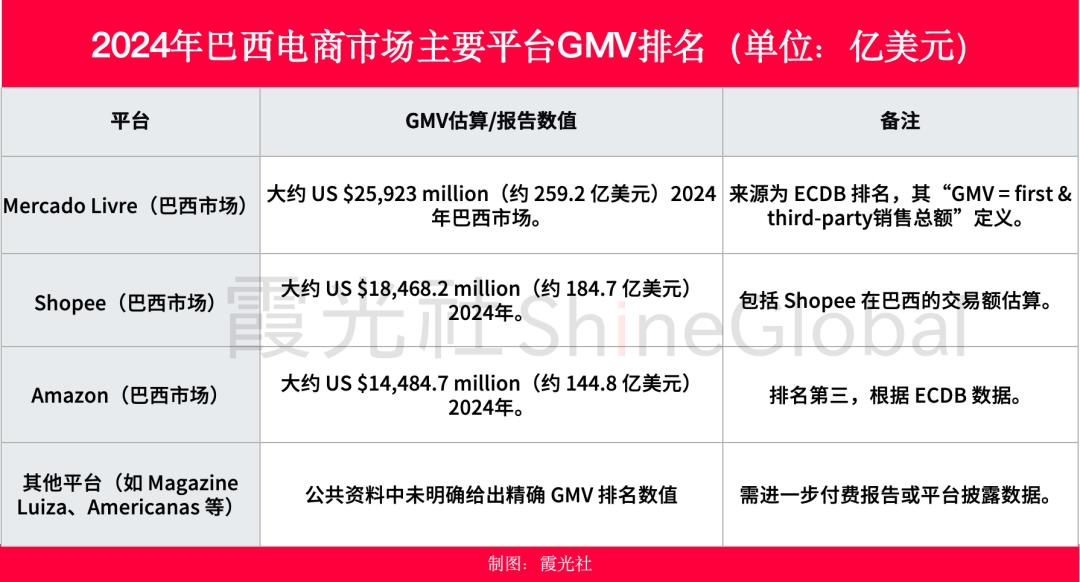
Core Insights - Brazil's e-commerce market is experiencing rapid growth, with a projected market size exceeding $70 billion by 2025 and an annual growth rate of over 20%, significantly outpacing global averages [1][2] - Chinese e-commerce platforms are increasingly targeting Brazil as a new market, with rising consumer interest in Chinese products, as evidenced by a jump in positive perceptions from 13% to 42% among Brazilian online shoppers over five years [2][3] - The competitive landscape in Brazil is intensifying, with platforms like Temu and TikTok Shop rapidly gaining market share, indicating a shift in consumer shopping habits towards online channels post-pandemic [3][4] Market Dynamics - Brazil's e-commerce market is still in its early development stage, presenting both opportunities and challenges for Chinese e-commerce businesses [3][4] - Major players like Mercado Livre dominate the market with an estimated GMV of approximately $25.9 billion for 2024, followed by Shopee and Amazon with GMVs of $18.5 billion and $14.5 billion, respectively [5][6] - The logistics landscape in Brazil is uneven, with significant disparities between urban and rural areas affecting delivery times and costs, complicating the e-commerce fulfillment process [8][10][12] Competitive Strategies - E-commerce platforms are investing heavily in logistics to enhance delivery efficiency, with Mercado Livre planning to expand its distribution centers from 10 to 21 by year-end 2023 [14][19] - Shopee has also increased its logistics footprint, with a 54% growth in warehouse space, positioning itself as a strong competitor against Mercado Livre and Amazon [18][19] - Amazon is adapting its strategy by enhancing its logistics network and establishing partnerships with local businesses to improve delivery times and customer satisfaction [20][21] Consumer Behavior - Brazilian consumers are increasingly accustomed to online shopping, particularly in urban areas, where logistics and delivery services are more developed [9][10] - The average order volume in Brazil has increased by 10% to 15% compared to the previous year, reflecting growing consumer engagement in e-commerce [22] - High product margins of 30% to 40% in Brazil attract new entrants, but the distance and logistical challenges present significant risks for businesses [22][23] Regulatory Environment - Recent changes in tax regulations, including the end of the "low-value exemption" for cross-border packages, may impact the cost structure for e-commerce businesses operating in Brazil [26] - The Brazilian government is implementing compliance programs that offer tax incentives to participating companies, which could further influence market dynamics [18][26]


突尼斯记者克里菲:亲历中国改变了我的思维方式
人民网-国际频道 原创稿· 2025-10-22 09:00
Core Viewpoint - The article highlights the transformative experience of a Tunisian journalist during his visit to China, emphasizing the country's advancements in technology, culture, and economy, and the need for better media representation of China in Tunisia [1] Group 1: Observations on China - The journalist noted that China is a highly developed and efficient country, contrasting sharply with the perceptions formed through social media [1] - Impressions included the strong familial bonds and the importance of family in society, as well as the disciplined and hardworking nature of the Chinese people, which he identified as key to the country's success [1] - The quality of Chinese products was found to be high, countering stereotypes, and the journalist was surprised to learn that many globally recognized car brands are produced in China [1] Group 2: Technological Advancements - The mobile payment system in China was praised for its efficiency, with transactions primarily conducted through apps and regulated by the government to prevent tax evasion [1] Group 3: Media's Role in Bilateral Relations - The journalist pointed out that Tunisian media coverage of China is limited, leading to a lack of public understanding of daily life in China [1] - He advocated for more comprehensive media coverage to correct misconceptions and showcase real opportunities for cooperation between Tunisia and China [1] Group 4: Future Cooperation - The journalist expressed the belief that the time is ripe for Tunisia to deepen its cooperation with China, stating that every household globally relies on Chinese products [1] - He emphasized that countries not engaging with China risk falling behind economically and technologically, urging proactive steps to establish partnerships with China [1] Group 5: Personal Transformation - The visit significantly changed the journalist's perspective, particularly in understanding hope and the potential for creating miracles through love for one's country [1]
X @外汇交易员
外汇交易员· 2025-10-11 01:16
Trade Policy & Tariffs - The US will impose an additional 100% tariff on Chinese products starting November 1st [1] - Export controls will be implemented on all critical software from November 1st [1] Geopolitical Implications - China is accused of adopting an extremely aggressive stance on trade issues [1] - China allegedly sent a hostile letter announcing large-scale export controls on almost all products starting November 1st, 2025 [1] - The US views China's actions as unprecedented and a moral disgrace in international trade [1]
美国联邦机构停摆,转移矛盾?白宫:对中国产品额外加征100%关税
Sou Hu Cai Jing· 2025-10-11 01:05
Group 1 - The U.S. Congress has failed to reach a consensus on the fiscal budget for the 2026 fiscal year, leading to a government shutdown that has lasted for 10 days, affecting federal agencies and military pay [1] - The budget impasse has created significant turmoil within the U.S. government, with the Republican Party struggling to find solutions to internal conflicts [1] - The White House announced on October 10 that it would impose an additional 100% tariff on products from China, drawing immediate attention and criticism [3][10] Group 2 - The U.S. has been engaged in a comprehensive trade war since April 2, 2025, imposing tariffs on all trade partners, with tariffs being used as a "cure-all" for various issues [5] - The U.S. has pressured India to reduce its purchase of Russian oil by imposing a 50% tariff, while also adopting aggressive stances towards Japan, South Korea, the EU, Canada, and Mexico [5] - The recent tariff increase on China is perceived as a reaction to China's restrictions on rare earth exports, which the U.S. views as a threat to its high-tech industries, particularly in the semiconductor sector [10]
世贸组织服务贸易理事会召开2025年第三次会议
Shang Wu Bu Wang Zhan· 2025-10-10 04:08
Core Points - The WTO Services Council held its third meeting of 2025 to discuss the outcomes of the 13th Ministerial Conference and the e-commerce work plan [1] - The Chinese representative criticized the US's unilateralism and protectionism regarding "reciprocal tariffs," highlighting the misleading nature of focusing solely on goods trade while ignoring benefits from services trade [1] - China introduced its latest policies and best practices on cross-border data flow and raised concerns about the US and India's misuse of national security measures to restrict Chinese enterprises and products [1]